Text Processing and Pipelines
 Call Kai
 Learn
Learn Practice Test
 Spaced Repetition
 Match
Match Flashcards
 Knowt Play
1/12

There's no tags or description
Looks like no tags are added yet.
Name | Mastery | Learn | Test | Matching | Spaced | Call with Kai | Chat |
|---|
No analytics yet
Send a link to your students to track their progress
13 Terms
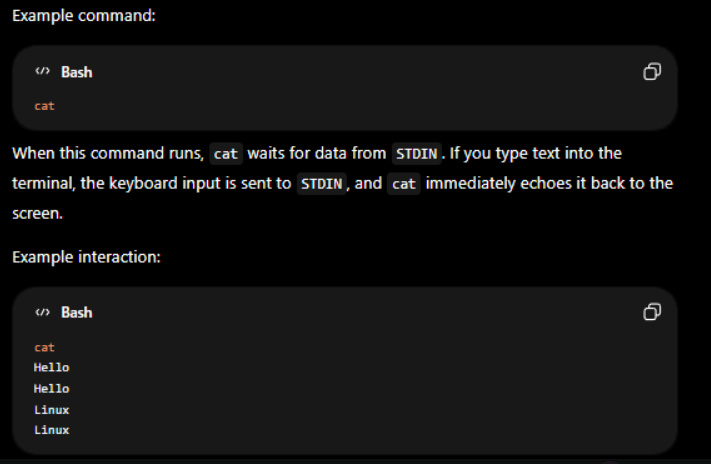
Stands for Standard Input. It is the default input stream that programs use to receive data in Linux systems. Is associated with file descriptor 0. By default, input usually comes from the keyboard, but it can also come from files, pipes, or redirected input.
STDIN
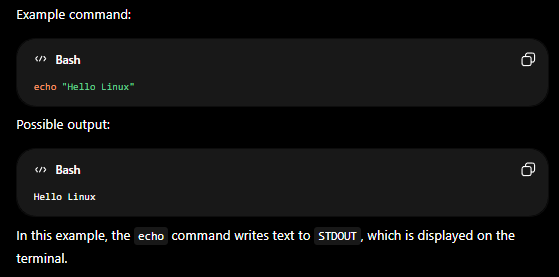
STDOUT
Stands for Standard Output. It is the default output stream used by programs to display normal output in Linux systems. Is associated with file descriptor 1. By default, ___ sends data to the terminal screen.
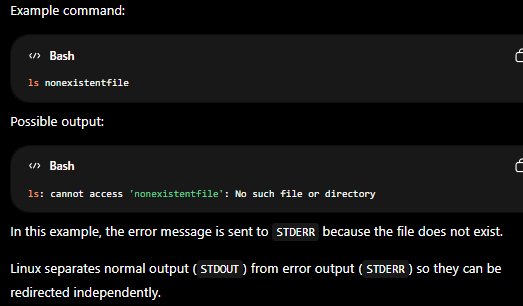
STDERR
Stands for Standard Error. It is the default stream used by programs to display error messages and diagnostic information in Linux systems. Is associated with file descriptor 2. By default, error output is displayed on the terminal screen, separate from normal command output.
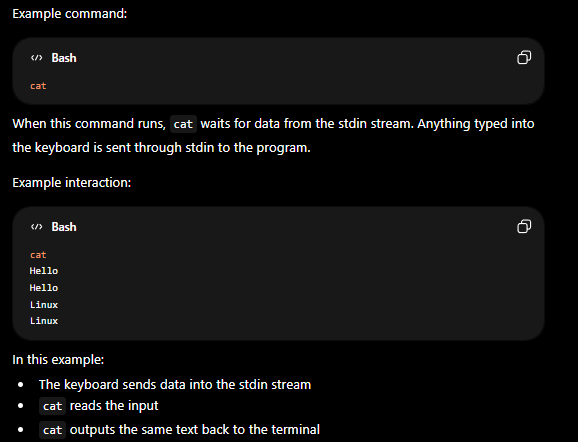
stdin stream
A ___ is the input stream that a program uses to receive data. In Linux, the stdin stream is associated with STDIN, which uses file descriptor 0. By default, the ___ usually receives input from the keyboard, but it can also receive input from files, pipes, or redirected data.
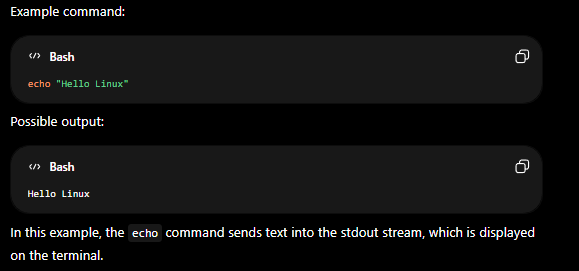
stdout stream
A ___ is the stream used for normal program output in Linux systems. It is associated with STDOUT, which uses file descriptor 1. By default, the ___ sends data to the terminal screen so the user can see the normal output of a command.
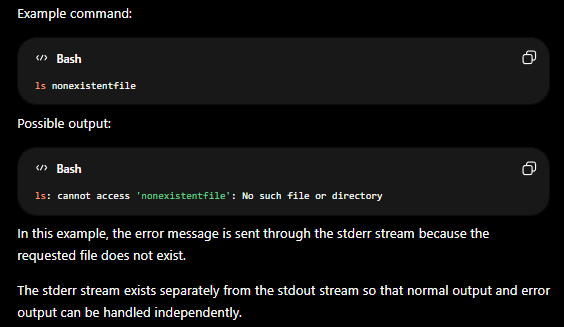
stderr stream
A ___ is the stream specifically used for error messages and diagnostic output in Linux systems. It is associated with STDERR, which uses file descriptor 2. By default, the ___ sends error messages to the terminal screen separately from normal program output.
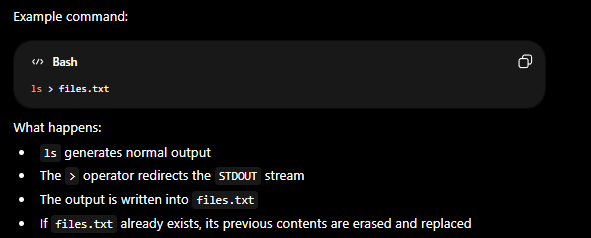
>
The ___operator redirects the STDOUT stream into a file and overwrites the file’s existing contents if the file already exists. Since STDOUT is file descriptor 1, the ___ operator redirects normal command output away from the terminal and into a file instead.
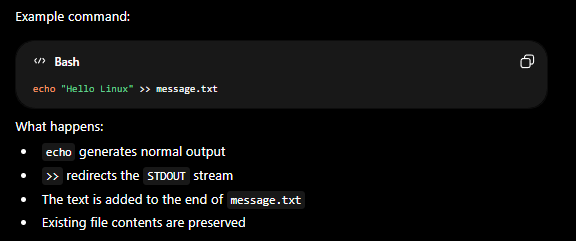
>>
The ___operator redirects the STDOUT stream into a file and appends the new output to the end of the file instead of overwriting its existing contents.
Since STDOUT is file descriptor 1, the ___ operator redirects normal command output away from the terminal and adds it to a file.
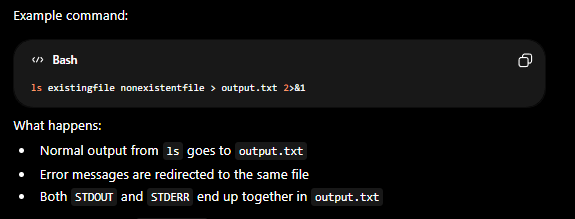
2>&1
Redirects STDERR to the same destination as STDOUT.
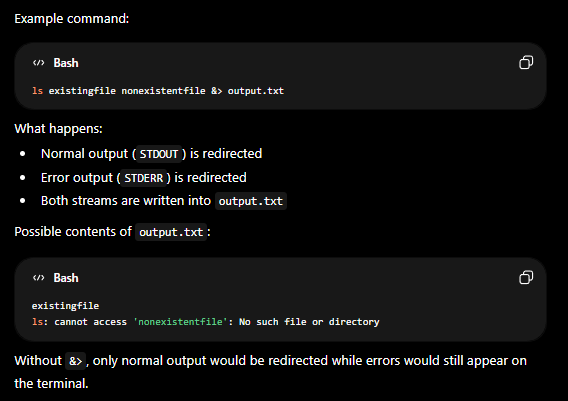
&>
Redirects both STDOUT and STDERR together to the same destination.
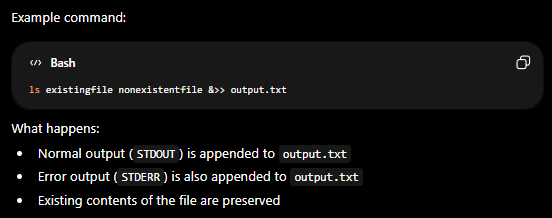
&>>
Appends both STDOUT and STDERR to the same file without overwriting existing contents.
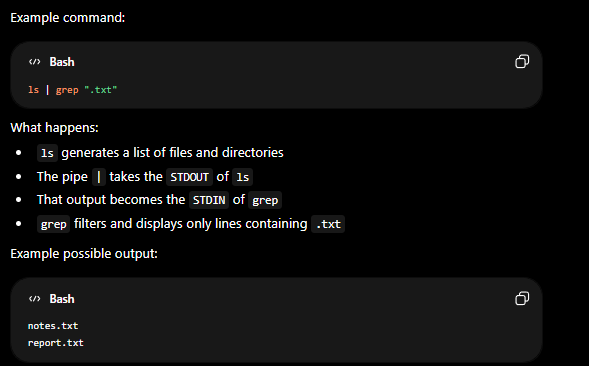
pipe operator: “ | ”
Sends the STDOUT output of one command directly into the STDIN input of another command. Instead of displaying output on the terminal, the pipe passes data between commands so they can work together.
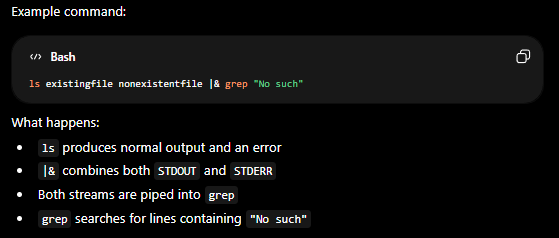
|&
Pipes both STDOUT and STDERR into another command. Normally, the regular pipe operator | only sends STDOUT. The ___ operator automatically combines both normal output and error output before piping them.