MCB 2000 CH 5: Protein Binding
 Call Kai
 Learn
Learn Practice Test
 Spaced Repetition
 Match
Match Flashcards
 Knowt Play
1/17

There's no tags or description
Looks like no tags are added yet.
Name | Mastery | Learn | Test | Matching | Spaced | Call with Kai | Chat |
|---|
No analytics yet
Send a link to your students to track their progress
18 Terms
What are 4 main categories of proteins?
What do they bind?
Enzymes = bind substrates
Receptors = bind hormones
Antibodies = binds invaders
Myoglobin + Hemoglobin = binds oxygen
What is the dissociation constant? What does it indicate?
Dissociation Constant (Kd) → determines tightness of binding
What is molecular recognition?
What is an example of this?
Molecular recognition = ability to pick partner molecule out of lookalike
Estrogen receptor binds to estradiol but NOT testosterone
Despite similar chemistry
What does a steep hyperbolic curve indicate about relationship b/w receptors and ligand concentration?
What does a less steep hyperbolic curve indicate about relationship b/w receptors and ligand concentration?
Steep hyperbolic curve → receptors = bound very quickly @ low [ligand]
Less steep hyperbolic curve → receptors = bound gradually @ low [ligand]
![<p>Steep hyperbolic curve → receptors = bound very quickly @ low [ligand]</p><p>Less steep hyperbolic curve → receptors = bound gradually @ low [ligand] </p>](https://assets.knowt.com/user-attachments/f19f1554-46fa-4376-a58e-f97f0a52ad43.png)
What is L1/2?
What does a lower L1/2 indicate?
Curve touches 100% receptors bound: (True/False)
What is the difference in status of receptors between L1/2 of individual molecules compared to total molecules?
L1/2 = [ligand] @ which ½ receptors = bound, ½ receptors = free
Lower L1/2 → lower [L] needed to reach ½ occupancy → tighter binding
Lower L1/2 → higher affinity
False → approaches, BUT never touches
always some free receptor
L1/2 of Individual molecules → constantly changing
L1/2 of Total molecules → stay the same
What is Kd equal to? In concentrations of receptor, ligand, and receptor-ligand complex?
What does Kd equal @ [L] = L1/2?
Kd = [R][L]/[RL]
@ [L] = L1/2 → [R] = [RL] → Kd = L1/2
How many orders of magnitude do the Kd values in biology span?
Describe the 3 types of binding interactions and the associated Kd values
12 orders of magnitude
Metabolite-protein interactions = 10-3 mM
Antibody-antigen = 10-9 nM to 10-12 pM
Avidin-biotin = 10-15 fM → holds biotin VERY TIGHTLY
Avidin = protein that binds to biotin
Laboratorial superglue → stick molecules together

What are the 3 main differences between myoglobin (Mb) and hemoglobin (Hb)?
Myoglobin (Mb)
1 polypeptide
Inside muscle cells
Storage
Hemoglobin (Hb)
Tetramer = 2 α + 2 β subunits
RBCs
Transport (Lungs → Tissues)
What is a heme group?
How does it relate to protein?
Why are heme groups described as prosthetic groups?
How many coordination sites does Fe have? How many of them are occupied by Nitrogens?
What are the roles of the free sites?
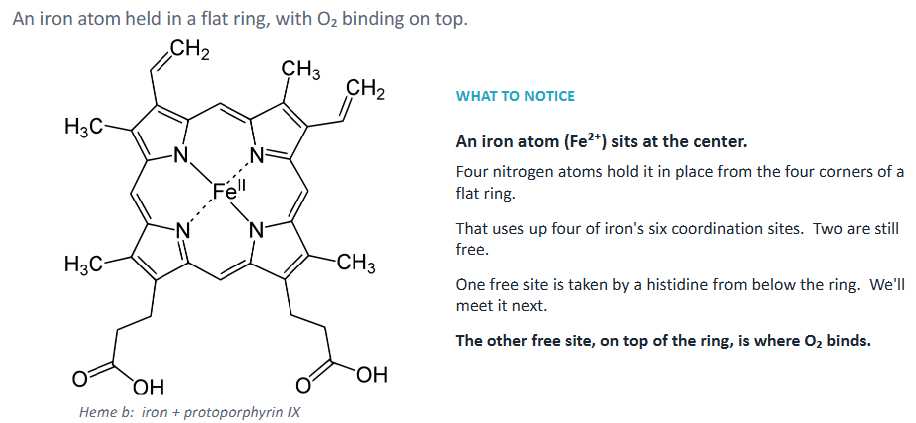
Heme group = ring-shaped iron-containing molecule that binds O2
Protein = folded around heme group
Prosthetic group = non-protein molecule permanently attached to protein → essential for protein’s function
Fe = 6 coordination sites → 4 occupied by N → 2 free sites
Top site = O2 binding site
Bottom site = Histidine from protein chain
What is the proximal histidine?
What is the role of proximal histidine in relation to heme?
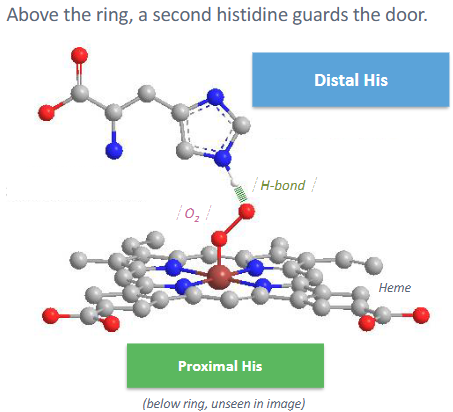
Proximal Histidine = Histidine of protein → Heme Bottom Site
Physically links protein chain to heme as mechanical unit → important for cooperativity

What is the distal histidine?
What are the 2 primary roles of distal histidine?
Distal Histidine = donates H-bond to LPs of O2 when bound to Fe
Stabilizes O2 complex
Discriminates against CO
CO = binds more strongly to iron than O2
Helps Heme favor O2 through stabilizing H bonds of LPs
Why does CO bond more strongly to Fe than O2?
How would this change if distal histidine was absent?
What is the effect of CO binding to one Hb subunit?
CO = binds Fe 200x more tightly than O2
CO = binds Fe 20,000x more tightly than O2
Hb shifts toward high-affinity state → O2 held on tightly
What is neuroglobin?
Neuroglobin = engineered to bind CO 500x more tightly than O2
Has lower Kd
Strips CO off rat Hb administered w/ lethal dose CO
Neuroglobin-CO complex → excreted
What is the treatment for when CO binds to 1 subunit of Hb?
Flood patient w/ 100% O2 → displace CO
What are the differences in types of curves between myoglobin (Mb) and hemoglobin (Hb)?
What do they indicate about each type of protein?
What is the x and y-axis of the graph?
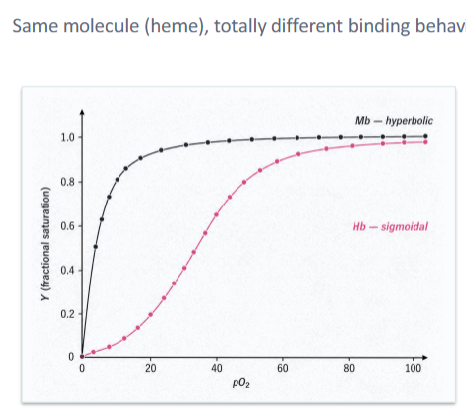
Myoglobin → hyperbolic
Saturates quickly
Holds tight → releases @ low pO2
Storage protein
Hemoglobin → sigmoidal
Saturates slowly
High saturation (lungs) → low saturation (tissues)
Transport protein
X-axis = pO2
Y-axis = fractional saturation
What is P50?
What does it indicate?
P50 = pO2 @ which protein is ½ saturated → protein affinity
Lower P50 → Tighter binding
Higher P50 → Looser binding
What is the relationship between P50 and Kd in myoglobin?
P50 = Kd
What is the difference between T and R state?
What are the differences in Fe and Salt Bridge status in both states?
T (Tense) state = none of 4 binding
Fe = below plane of porphyrin ring → bad binding geometry
Salt Bridge = hold tetramer in place = protein locked
R (Relaxed) state = enough O2 is bound
Fe = up in plane of porphyrin ring → good binding geometry
Salt Bridge = broken b/w subunits = protein unlocked