Non-Invasive patient care skills Test
 Call Kai
 Learn
Learn Practice Test
 Spaced Repetition
 Match
Match Flashcards
 Knowt Play
1/53

There's no tags or description
Looks like no tags are added yet.
Name | Mastery | Learn | Test | Matching | Spaced | Call with Kai | Chat |
|---|
No analytics yet
Send a link to your students to track their progress
54 Terms
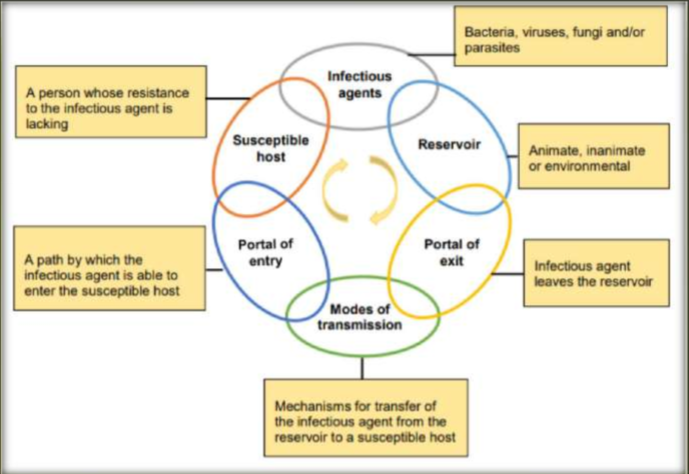
What are the 6 elements of chain of infection?
Infectious agents
Reservoir
Portal of exit
Modes of transmission
Portal of entry
Susceptible host
What are examples infectious agents?
Bacteria
Viruses
Fungi
Parasites
Define infectious agent
The potential for microorganisms/parasites to cause disease depends on virulence, Invasiveness and pathogenicity.
What are the factors for infectious agents?
Virulence - Ability to multiply and grow
Invasiveness - ability to enter tissue
Pathogenicity - ability to cause disease
What does reservoir mean in chain of infection?
Place where the infectious agent resides, survives and reproduces
Presence of microorganisms does not always cause illness in a person
What is the most common reservoir?
Human body
What are some examples of reservoirs other than the human body?
Animals
Food
Water
Insects
inanimate objects
Why is the purpose of reservoirs for pathogens?
Pathogens require proper environment to thrive
What do pathogens need to survive?
Appropriate food
oxygen
Water
temperature
pH
Light
What is portal of exit in chain of infection?
A way for the infectious agent to leave reservoir
What are some examples of Portal of Exit?
Blood
Skin and mucous membranes
Respiratory tract
Urinary tract
GI Tract
Transplacental (Mother to foetus)
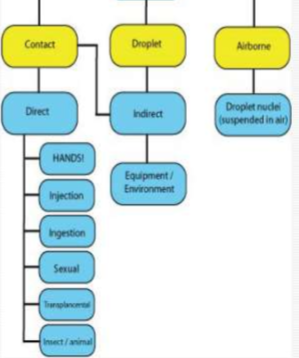
What is mode of transmission in chain of infection?
Mechanism of transfer of infection from reservoir to a susceptible host
Through direct or indirect contact, droplet, airborne vehicles and vector borne
What is portal of entry in chain of infection?
Path that infection is able to enter the susceptible host (same as portal of exit)
What does susceptible host mean in chain of infection?
Person who is at risk for developing an infection from the infectious agent.
What are the factors that make a person more susceptible?
Age
Underlying chronic diseases
Conditions that weaken the immune systems
Invasive devices
Why is hand hygiene done?
Decision to perform hand hygiene depends on 4 factors
the intensity of degree of contact with patients or contaminated objects
the amount of contamination that may occur with the contact
the patient or healthcare workers ability to infection and
the procedure or activity to be performed
How is hand hygiene done?
Stand in front of the sink keeping hands and body away from sink surface
turn on water turn on faucet to regulate flow and temperature
avoid splashing water against uniform regulate flow of water so temperature is warm
wet hands and wrists thoroughly underwater Keep hands and forearms lower than elbows during washing
apply 3 to 5 ML of antiseptic soap and rub hands together
Perform hand hygiene using plenty of lather and friction for at least 15 seconds Interlace fingers and rub palms and the back of hands with circular motion at least five times each keep fingers down to facilitate removal of microorganisms
areas underlying fingernails are often soiled cleaned up with fingernail of other hand an additional so or with nail cleaner
rinse hands and wrists thoroughly keeping hands down and elbows up
dry hands thoroughly from fingers to wrists with paper towel single use cloth or warm air dryer
if used discard paper towel in proper receptacles
to the turn off hand faucet used clean dry may paper avoid touching handles with hands
If hands are dry or chapped use a small amount of lotion or barrier cream dispense from individual container
What are the six types of vital signs?
Temperature
Pulse
Blood pressure
respiratory rate
oxygen saturation
pain
What are factors that affect vital signs?
Temperature of environment
patient's physical exertion
effects of illness
When is vital signs taken?
On admission to a health care facility
in a hospital or care facility on routine schedule according to a healthcare providers order or standards of practice of agency
before during and after a surgical or invasive diagnostic procedure
when patient reports specific symptoms of physical distress
before during and after the administration of medications or application of therapies that affect cardiovascular respiratory or temperature control functions
when patient's general physical condition changes
What are some important considerations on patient centered care?
Be sensitive to each patient's need for privacy and observe cultural norms
Always inform patients about the vital measurements
Procedures that are normally non invasive sometimes produce anxiety because of cultural variabilities of touch privacy and gender
What are the core sites for temperature measurement?
Rectum
earlobe
temporal membrane
esophagus
pulmonary
urinary bladder
What are the surface sites for temperature measurement?
Skin oral
cavity
axilla*
How are specimen’s collected?
In appropriate containers, at the correct time and in the appropriate amount
Properly label all specimens with the patient identification (Name & IC) complete laboratory requisition if necessary
Deliver specimens to the laboratory within the recommended time or ensure that they are stored properly for later transport
What are the 4 Different collection types and they're uses?
Random
For routine analysis
collect during normal voiding from an indwelling catheter or urine collection bag
use a clean specimen cup
Clean-voided or midstream urine
For culture and sensitivity
requires proper cleansing to perineum before collecting urine
use a sterile specimen cup
Sterile specimen
for culture and sensitivity
usually from an indwelling urine catheter
Use sterile syringe and transfer to a sterile specimen cup
Time urine specimen
for measuring levels of adrenal cortisol steroids or hormones creatine clearance or protein quantity test use
special collection container which contains special preservatives
What is the normal pH for urine and how does it protect against bacterial growth?
4.6 - 8.0
An acidic pH protects against bacterial growth
What's the normal level of protein in urine what does protein presence indicate?
None or up to 8 /100mL
common in renal disease
What is the normal level of glucose in urine and what the presence of glucose indicate?
None
Common in diabetic patients
Ingestion of high concentration of glucose
What's the normal level of ketone in the urine and what does ketonuria indicate?
None
ketonuria is poorly controlled in diabetic patients
Patients with dehydration starvation or excessive aspirin → risk of ketoacidosis
When is blood positive in urine test?
Positive when intact erythrocytes hemoglobin or myoglobin is present
In woman it may be a result of contamination with menstrual fluid
What's the specific gravity of urine and What does a high and low value represent?
High SG reflects concentrated urine low SG reflects diluted urine
Conditions elevate SG
dehydration reduce
renal blood flow
increase ADH secretion
conditions reduce SG
over hydration
early renal disease
inadequate ADH secretion
What's the normal red blood cell count in urine?
Up to 2
Damage to Glomeruli or tubules trauma disease or surgery of lower urinary tract can also cause blood to be present
What's a normal white blood cell count in urine?
0-4
greater number indicate urinary infection
What are other microscopic things that should not be present in urine?
Bacteria that indicates UTI
Casts that indicates renal alterations
crystals that result in Renal Stone formation
What are the advantages of oral temperature taking?
easily accessible - requires no position change
Patience comfortable for a patient
Provides accurate surface temperature reading
reflects rapid change in core temperature
reliable route to measure temperature for Intubated patients
What are the limitations of oral temperature taking?
Causes delay in measurement if patient recently ingested hot cold fluids or foods chewed gum or smoked
Not used with patients who had had oral surgery or facial trauma are unable to position mouth or have shrinking chills or history of seizures
not used with infant small children or confused unconscious or uncooperative patients
Risk for body fluid exposure
What are the advantages of tympanic membrane (Earlobe) temperature taking
Easy accessible site
obtained without disturbing waking or repositioning patient
used for patients with Tachypnea without affecting breathing
Sensitive to call temperature changes
very rapid measurement (2 to 5) seconds
unaffected by oral intake of food or fluids or smoking
use in newborns to reduce infant handling and heat loss
What are the limitations of tympanic membrane (earlobe) temperature taking?
More variability of measurement than with other core temperature devices
Requires removal of hearing aids before measurement
requires disposable sensor cover with only one size available
readings possibly to start it with Otitis Media and ceremonial impaction
not used with patients who have had surgery of the ear or tympanic membrane
does not accurately measure core temperature changes during and after exercise
affected by ambient temperature devices such as incubators radiant warmers or facial fans
anatomy of ear canal makes it difficult to correctly position in neonates infants and children younger than three years of age
inaccuracies reported because of incorrect positioning of handheld unit
What are the advantages of axillary (under arm) temperature taking?
Safe and inexpensive
reliable and stable and preterm infants
What are the limitations of axillary (under arm) temperature taking?
Long term measurement time
requires continuous positioning
poorly reflects call temperature
not recommended for detecting fever in infants and young children
requires exposure of thorax which can result in temperature loss especially in newborns
affected by exposure to the environment including time that takes to place with thermometer
underestimates core temperature
What is pulse rate?
Pulse rate is the measurement of the heart rate or the number of times the heart beats per minute
What does measuring pulse help to indicate?
Heart function
tissue perfusion
Heart rhythm
strength of pulse
What is the site for pulse assessment
Radial pulse
When and how is respiration rate?
When patient is at rest
Count number of breaths for one minute ( how many times chest rises)
What does increased respiration rate indicate?
Fever
Illness
medical conditions
Difficulty breathing
What is blood pressure?
Is the force exerted by the blood against the arterial walls.
What is systolic pressure?
pressure of contraction of the heart
What is diastolic pressure?
Pressure of the ventricles contract
When should a diagnosis of hypertension be given?
Only after multiple blood pressure measurements over several days or weeks
What are the advantages Of assessing blood pressure electronically?
Ease of use efficient
when frequent repeated measurements are indicated
stethoscope not required
allows blood pressure to be recorded more frequently as often as every 15 seconds with accuracy
what are the limitations of assessing blood pressure electronically?
Expensive
required source of electricity
requires space to position machine
sensitive to outside motion interference and cannot be used in patients with seizures tremors or shivers or patients unable to cooperate
Not accurate for patients with irregular heart rate or hypotension or in conditions with reduced blood flow
accuracy standards for electronic blood pressure machine manufacturers are voluntary
vulnerable to error among older adults and obese patients
How are blood tests collected?
Specimen are collected through
Capillary skin puncture
arterial or venous sampling
bone marrow aspiration
When is capillary puncture/skin puncture preferred?
Preferred for a peripheral blood smear
Adult: skin puncture through fingertips
children: fingertips
infants: the great toe For a side of you