[AMECON] CH.6 | Hybrid Market Structure and the Aviation Industry
 Call Kai
 Learn
Learn Practice Test
 Spaced Repetition
 Match
Match Flashcards
 Knowt Play
1/49

There's no tags or description
Looks like no tags are added yet.
Name | Mastery | Learn | Test | Matching | Spaced | Call with Kai | Chat |
|---|
No analytics yet
Send a link to your students to track their progress
50 Terms
Hybrid Market Structure
A market structure that lies between perfect competition and monopoly, consisting of monopolistic competition and oligopoly. These two structures are prevalent in modern industry, while the airline industry is heavily influenced by the characteristics of oligopolies.
Market Structure
The number of firms involved in a market and the degree of competition among them.
Extent of economies of scale
Barriers to entering and exiting the market
Number of buyers and sellers
Degree of product differentiation
Factors Determining Market Structure (4)
Monopolistic Competition
A market situation in which many independent sellers produce differentiated products. Each seller provides goods or services with some degree of product differentiation and some monopoly power.
Example: Different airlines offering flights on the same route but competing through schedules, service, cabin classes, and frequent-flyer programs.
Large number of sellers
Full dissemination of information
Low barriers to entry
Product differentiation
Characteristics of Monopolistic Competition (4)
Large Number of Sellers
[MONOPOLISTIC COMPETITION]
Each seller produces only a small fraction of industry output, resulting in limited market consolidation.
Product Differentiation
[MONOPOLISTIC COMPETITION]
Firms produce similar, but not identical products. Each seller has some degree of product differentiation and some monopoly power.
Entry Costs
[MONOPOLISTIC COMPETITION]
It is relatively easy to enter the market, although there are associated entry costs. The ease of obtaining capital is considerably less in a monopolistically competitive market compared with an oligopoly market.
Barriers to Entry
[MONOPOLISTIC COMPETITION]
Other barriers may include customer loyalty or regulatory restrictions.
Heterogeneous Products
[MONOPOLISTIC COMPETITION]
Products that are similar but not identical, with numerous proximate substitutes.
Proximate Substitutes
[MONOPOLISTIC COMPETITION]
Products that are close alternatives to one another, allowing consumers to switch between competing products.
Monopoly Power
[MONOPOLISTIC COMPETITION]
The degree of control over price that comes from having a differentiated product and facing substitutes that are not identical.
Monopolistic Competition
Examples:
Accounting firms
Books
Convenience stores
Hairdressers
Grocery stores
Garment producers
Hotels
Jewelry shops
Law firms
Private music lessons
Radio stations
Restaurants
Oligopoly
A market structure characterized by a small number of large firms dominating the market. The pricing decision by one firm can have a significant impact on the behavior of the other firms in the market, creating mutual independence.
Example: Boeing and Airbus in commercial aircraft manufacturing.
Oligopoly
Is a market structure in which two or more firms dominate the market. In this market environment, the users of this can effectively influence the price. The markets for aircraft, airlines, jet engine manufacturers, etc. are examples of this market structure.
Mutual Independence
[OLIGOPOLY]
The condition in which the decisions of one firm significantly affect the behavior and decisions of the other firms in the market.
A few firms dominating the market
Substantial barriers to entry and exit
Homogenous or differentiated products
Restricted or asymmetric information
Characteristics of Oligopoly (4)
Duopoly
Is a market structure in which two producers are competing for the same product.
Ex: Boeing and Airbus are the only two producers of commercial jet with about 99% of global large plane demand. Commercial Aircraft Corporation of China (COMAC) is planning to make waves in the Aviation Manufacturing Industry, but not in the near future.
Contestability Theory
states that even a monopoly or oligopoly will act like a competitive business if new firms can enter and leave the market easily. The constant threat of outside competition forces existing companies to keep prices low and operate efficiently
CFM International
International Aero Engines (IAE)
General Electric
Rolls-Royce
[OLIGOPOLY]
Aircraft Engine Manufacturing
Leading manufacturers include: (4)
Together, these firms hold more than 90% of the market share.
Barriers to Entry
[BARRIERS AND MARKET POWER]
Factors that make it difficult for new firms to enter a market, including high startup fixed costs, sizeable economies of scale, control over scarce resources, and exclusive patent/legal rights.
Startup Fixed Costs
[BARRIERS AND MARKET POWER]
Large initial costs that firms must incur before entering an industry.
Economies of Scale
[BARRIERS AND MARKET POWER]
The situation in which a few large firms can produce at far lower costs and sell at far lower pricesthan an industry composed of smaller, more numerous firms.
Economies of Density
[BARRIERS AND MARKET POWER]
Cost or efficiency advantages associated with having a greater concentration of operations or traffic within a particular market or network.
Economies of Density
[BARRIERS AND MARKET POWER]
Cost or efficiency advantages associated with having a greater concentration of operations or traffic within a particular market or network.
Above-Normal Long-Run Profits
[BARRIERS AND MARKET POWER]
Profits greater than the normal return that can theoretically occur when barriers to entry are sufficiently high.
Normal Long-Run Profits
[BARRIERS AND MARKET POWER]
The level of profit associated with a competitive long-run equilibrium. Monopolistic competition inherently leads to ______________.
Below-Normal Long-Run Profits
[BARRIERS AND MARKET POWER]
Returns below the normal long-run level. Many well-established airlines have consistently reported ______________.
Anti-Merger View
[DIFFERING VIEWS OF OLIGOPOLY]
The perspective that any substantial increase in market concentration is generally undesirable, and oligopolistic competitors should generally not be allowed to merge.
Market Process View
[DIFFERING VIEWS OF OLIGOPOLY]
The perspective that very few, if any, barriers to entry other than legal barriers established by government are significant.
Industry Consolidation
[DIFFERING VIEWS OF OLIGOPOLY]
A reduction in the number of firms through mergers, acquisitions, or other forms of combination.
Industry Consolidation
[DIFFERING VIEWS OF OLIGOPOLY]
The level of concentration in the industry helps determine the market’s structure. Industries that are highly concentrated may be more prone to exhibit characteristics of monopolies and oligopolies, while industries with multiple players may tend to exhibit characteristics of monopolistic competition
Industry Consolidation
[DIFFERING VIEWS OF OLIGOPOLY]
This can:
Increase efficiency
Allow firms to benefit from economies of scale
Reduce competition
Increase market concentration
Potentially increase pricing power
Contestability Theory
A theory examining how the possibility of new firms entering a market can influence the behavior of existing firms.
Contestable Market
A market in which potential competitors can influence pricing even if they have not actually entered the market.
Core Rules:
No entry barriers: New rivals can start selling goods with no extra trouble.
No exit barriers: Firms can leave the market without losing money.
Zero sunk costs: Money spent on setup can be fully recovered or moved elsewhere.
Equal technology: New firms and old firms use the same tools and methods
Price Increase in a Contestable Market
An increase in price results in an even larger decrease in quantity demanded because new competitors may enter and match the price increase. Demand therefore becomes relatively elastic.
Price Decrease in a Contestable Market
New competitors may also see the benefit from a price decrease and strategically enter by matching the decrease. The increase in quantity demanded is unlikely to be as large as expected, making demand relatively inelastic.
Kinked Demand Curve Theory
A theory that predicts price stability in oligopolistic markets. It states that there exists a band of price stability, which is the kinked portion of the demand curve.
Kinked Demand Curve Theory
Core Assumptions
Raising prices: If one firm raises its price, others will not follow. The price-raising firm loses many customers, making demand elastic.
Lowering prices: If one firm cuts its price, others will match it to keep their customers. The firm gains very little extra business, making demand inelastic.
Price Stability
The condition in which prices remain relatively stable because firms are concerned about competitors' reactions to price changes.
Market Price in a Duopoly
The firm with the lowest price sets the market price, which the other firm must then match in order to remain competitive.
Cournot Theory/Competition
A theory that explains competition and market equilibrium based on firms competing through output decisions.
Cournot Theory/Competition
is an economic model created by French mathematician Antoine Augustin Cournot in 1838. It explains how rival firms in an oligopoly (a market with few sellers) decide how much of a product to make when they act at the same time.
Cournot Theory/Competition
Core Assumptions
Same products: Every company makes the exact same item, so buyers do not care who they buy from.
Choose output at the same time: Companies pick their production amounts independently and simultaneously.
No talking or cheating: Firms do not cooperate or form cartels.
Price depends on total supply: The total amount made by all firms sets the market price. More supply means a lower price.
Fixed guess about rivals: Each firm assumes its competitors will keep their production steady.
Cournot Theory/Competition
Assumptions
Products are homogeneous.
Market entry is difficult.
Firms have market power.
Cost structures are similar.
Each firm assumes its counterpart will remain unresponsive to changes.
Antitrust policy
has a basic and fundamental objective. The objective is to protect the process of competition for the benefit of consumers, ensuring strong motivations exist for businesses to operate efficiently, keep prices down, and maintain high quality. This policy restricts cartels and monopolies, thus eliminating price fixing and discrimination, and pricing
Predatory Pricing
is a strategy of selling a product below cost to force the competitions out of business, it is illegal under antitrust laws.
Cartel
is another form of market structure created from a formal (or tacit) agreement between a group of producers to reduce the production and increase prices.
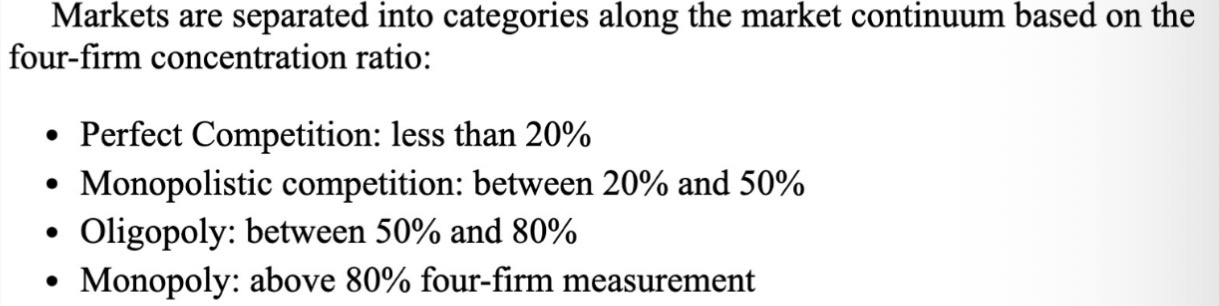
Four-Firm Concentration Ratio
The most commonly used concentration ratio, which measures the output of the four largest firms in the industry. Consequently, the market can then be classified according to a continuum of the percentage share of the top four.
Herfindahl-Hirschman Index (HHI)
measures market concentration and competitiveness. It is calculated by squaring each firm’s market share and summing the results.
•Lower values indicate more competition; higher values indicate greater concentration.
•Regulators use this to evaluate mergers and potential antitrust concerns.