Genetic Diversity
 Call Kai
 Learn
Learn Practice Test
 Spaced Repetition
 Match
Match Flashcards
 Knowt Play
1/18

There's no tags or description
Looks like no tags are added yet.
Name | Mastery | Learn | Test | Matching | Spaced | Call with Kai | Chat |
|---|
No analytics yet
Send a link to your students to track their progress
19 Terms
What is genetic diversity?
Genetic diversity: the total number of genetically controlled characteristics that appear in the phenotype of a species.

What is the gene pool?
Gene pool: the complete set of alleles carried by all the individuals in a population.
Basically the sum of all genetic variation in a population, including all possible alleles present (not just the genes).
What is a genome, and how does it differ from a gene pool?
Genome: all the genetic information (base pairs) found in one complete set of an organism's genetic material (all the genes).
The genome belongs to an individual, while the gene pool is within a population.
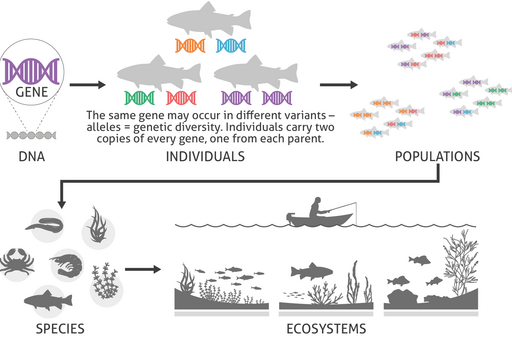
What are the levels of ecological organisation in genetic diversity?
Individual.
Species.
Population.
Community.
Ecosystem.
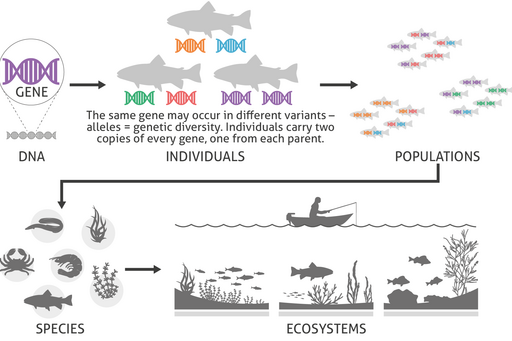
What is an individual, in ecological organisation?
Individual: a single living organism of a particular species.


What is a species, in ecological organisation?
Species: a group of organisms that share similar characteristics and are capable of interbreeding to produce fertile offspring.
What is a population, in ecological organisation?
Population: members of one species living in one region at a particular time.

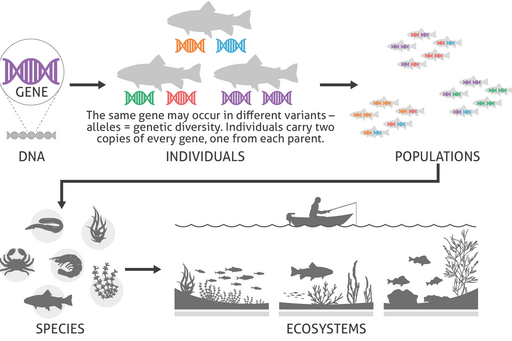
What is a community, in ecological organisation?
Community: all the different populations of different species interacting and living together in the same area at the same time.
What is an ecosystem, in ecological organisation?
Ecosystem: a community of interacting organisms (biotic factors) together with the non-living (abiotic) components of their environment, and the interactions between them.
What is the level of biodiversity, species diversity?
The variety of different kinds of organisms living in a particular habitat or region. Example: all the different plant species in the Australian Desert.
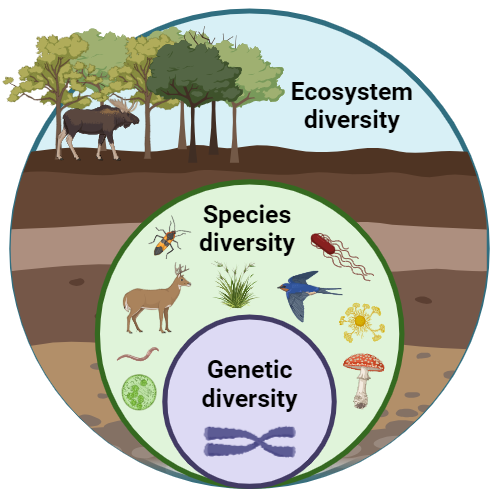
What is genetic diversity, as a level of biodiversity, and why is it important?
Genetic diversity: The variety of genes or the number of different genes inherited.
A species with high genetic diversity has a large gene pool.
High genetic diversity is important as it increases the chances of the species surviving through environmental changes.
Example: Siberian tiger

How does genetic diversity in a population relate to tolerance and optimum range?
All organisms need to stay in their tolerance range in order to survive
Genetic diversity in a population ensures that individual organisms have diversity in their tolerance range
Means individuals of the species may be able to survive in changing environmental conditions

How does the tolerance range differ to the optimum range? How does genetic diversity in a population relate to this?
Tolerance range: the range of conditions in which an organism can survive.
Optimum range: the range of conditions within the tolerance range in which an organism carries out life processes (e.g. living, hunting, mating, raising offspring) at an optimal level.
Genetic diversity in a population ensures that individual organisms have diversity in their tolerance range

How does gene pool size relate to genetic diversity?
A large gene pool = high genetic diversity; a small gene pool = low genetic diversity.
High genetic diversity means individuals within a species have more variation in their tolerance ranges, increasing the chances of surviving changing environmental conditions.
Low genetic diversity makes a population more susceptible to environmental changes, since there's less variation for natural selection to act on.

Does population size determine genetic diversity?
Population size doesn't automatically determine genetic diversity.
A large population can still have low genetic diversity, especially if it started from a small number of genetically similar organisms (the founder effect).

Why are small populations particularly at risk of low genetic diversity?
Fewer individuals to contribute different alleles to the gene pool.
Inbreeding becomes more likely, which reduces genetic diversity over generations.
Low genetic diversity in a population increases vulnerability to disease, environmental change, and reduces long-term survival prospects of the species (e.g. Siberian tiger, cheetah).
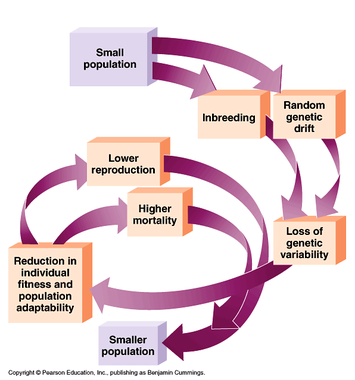
What is inbreeding and how does it decrease genetic diversity?
Inbreeding: members of the same family or close relatives breeding only amongst themselves.
Reduces the variety of alleles passed into the gene pool over generations
Results in a population more vulnerable to disease and environmental change
What are the advantages of genetic diversity?
Ensures that individual organisms have diversity in their tolerance range.
Means individuals of the species may be able to survive in changing environmental conditions.
Large gene pool = high genetic diversity.
What are the implications of low genetic diversity?
A large population can have low genetic diversity, especially if the population was started with a small number of genetically similar organisms (founder effect).
Can also occur due to inbreeding, which reduces genetic diversity over time.
Low genetic diversity can result in a population being susceptible to environmental changes. Small gene pool = low genetic diversity.