Ch.2 Sound
 Call Kai
 Learn
Learn Practice Test
 Spaced Repetition
 Match
Match Flashcards
 Knowt Play
1/35

There's no tags or description
Looks like no tags are added yet.
Name | Mastery | Learn | Test | Matching | Spaced | Call with Kai | Chat |
|---|
No analytics yet
Send a link to your students to track their progress
36 Terms
What do all waves carry from one location to another?
Energy
Sound is a _____ wave
Mechanical. It MUST travel through a medium where the molecules are alternately compressed and rarefied
Mechanical wave
A wave that needs a medium (material) to travel through
Vacuum
Empty space, has no particles so sound can’t travel through.
Sound waves are a series of
Compressions and Rarefaction (compress together and spread apart)
Compressions
Are areas of INCREASED pressure and density. Meaning it is squeezed together/tightly packed together.
Rarified
Are areas of DECREASED pressure and density. Meaning it is stretched apart.
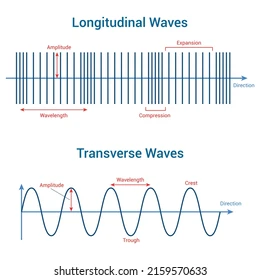
Sound travels in a
straight line and are longitudinal waves
Sound waves summed up
A mechanical, longitudinal wave that travels in a straight-line carrying energy from one location to another through a series of compressions & rarefactions
Acoustic propagation properties
The effects of the medium upon the sound wave (what does the tissue do to the sound).
Biologic effects
The effects of the sound wave upon the biologic tissue through which it passes. (what does sound do to the tissue?)
Sound waves
also known as acoustic waves, are identified by oscillations in acoustic variables. Meaning, acoustic variables identify which waves are sound waves.
Three acoustic variables that are used to distinguish between sound waves and other types of waves.
Pressure, Density, Distance
If something OTHER than pressure, density, or distance rhythmically oscillates in a wave then
the wave is NOT a sound wave.
Pressure
Concentration of force in an area, force/area* Units: Pascals (Pa)*
Density
Concentration of mass in a volume. How much mass/how tightly its packed into a certain amount of space (volume) Units: kg/cm^3
Distance
Measure of particle in motion. How far a particle moves. Units: cm, feet, mile
How many acoustic parameters are used to describe the characteristics of a sound wave?
7: Period, Frequency, Amplitude, Power, Intensity, Wavelength, Speed
Acoustic parameters
describe the features of a particular sound wave.
Acoustic variables
Identify which waves are sound waves

In a transverse wave
Particles move in a direction that is perpendicular (right angle or 90 degrees) to the direction that the wave propagates. Wave moves left to right but the particles in the wave are moving up and down.
Propagates
travels or moves from one place to another.

In a longitudinal wave
The wave travels forward, AND the particles move back and forth in the same direction. Particles move in the same direction that the wave propagates.

In-phase
A pair of waves, peaks (maximum values) occur at the same time and at the same location. Similarly, the troughs of the waves (minimum values) occur at the same time and place.

Out-of-phase
their peaks occur at different times as do their troughs.
More than one sound beam may travel in a medium
True
A string being shaken up and down is an example of a longitudinal wave.
False
When two waves overlap at the same location and at the same time they
combine into a single new wave
Interference depends upon
the phase relationship of the pair of waves.
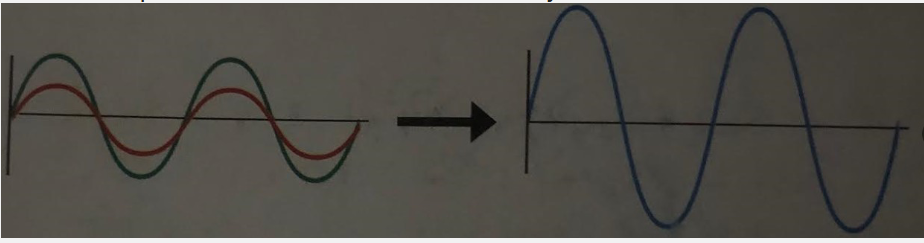
Constructive Interference
Occurs when a pair of in-phase waves results in the formation of a single wave of greater amplitude than either of its components. The resulting wave is greater than the original two waves.
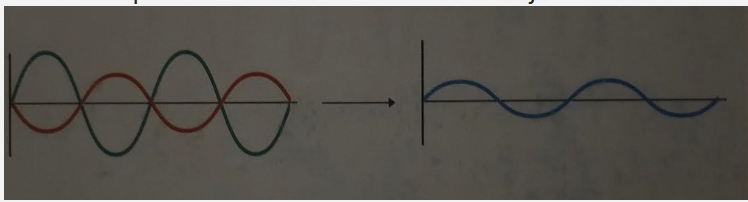
Destructive Interference
Occurs when a pair of out-of-phase waves interfere and results in the formation of a single wave of lesser amplitude than at least one of its components.

Which types of waves will exhibit both constructive and destructive interference
Waves of different frequencies
What happens when two out-of-phase waves of equal amplitude interfere?
Complete destructive interference may occur.
In-phase waves are described as being 'in step'.
True
How many complete wave cycles happen in a certain amount of time
Frequency
Something about the medium that changes when sound passes through it
Acoustic variables