Lab 8: Fischer Esterification
 Call Kai
 Learn
Learn Practice Test
 Spaced Repetition
 Match
Match Flashcards
 Knowt Play
1/22

There's no tags or description
Looks like no tags are added yet.
Name | Mastery | Learn | Test | Matching | Spaced | Call with Kai | Chat |
|---|
No analytics yet
Send a link to your students to track their progress
23 Terms
is Fischer is acidic or basic conditions
acidic
what is the nucleophile and electrophile
nucleophile: alchol
electrophile: carboxylic acid
what are the two ways of increasing product in this reaction?
removing water/product as it forms
use an excess of one of the reactants
for this experiment, which method are we choosing to drive this reaction forward
using excess of the aldehyde/carboxylic acid
what is the carboxylic acid portion of this experiment
acetic acid
techniques
microwave reflux, liquid liquid extraction, decanting, IR, and HNMR
reagents
Glacial acetic acid (structure, MW, BP, density)
Sulfuric acid (structure, MW, BP, density)
Each unknown alcohol(s) provided by TA (structure, MW, BP, density)
5% Sodium bicarbonate (structure, MW, MP)
Sodium sulfate (structure, MW, MP)
Brine (structure, MW, BP, density)
Water (structure, MW, BP, density)
Each product ester(s) based on unknown alcohol (structure, MW, BP, density
explain procedure on broad terms
add glacial acetic acid and alcohol to your MW vessel then add concentrated sulfuric acid
let the 10 minutes reaction occur
take contents out and add water. remove the aqueous layer (ester is in organic)
wash ester with water and then 5% sodium bicarbonate until you get a basic solution (aqueous should be basic)
wash ester with brine
add sodium sulfate to dry
what kind of alcohols are we using
primary or secondary in the presence of acid catalyst
what is the purpose of the acid catalyst
enhance the electrophilic nature of the carboxylic acid’s carbonyl moiety
true or false: the catalyst changes the equilibrium of the reaction
false: it only increases the rate it achieves equilibrium but not the actual equilibrium itself
what are the three alcohol options here? what about the carboxylic acid?
alcohol: 1-propanol, 1-butanol, isopentanol
carboxylic acid: glacial acetic acid

Draw the skeletal structure of the product resulting from the Fischer esterification of sec-butanol and propionic acid.
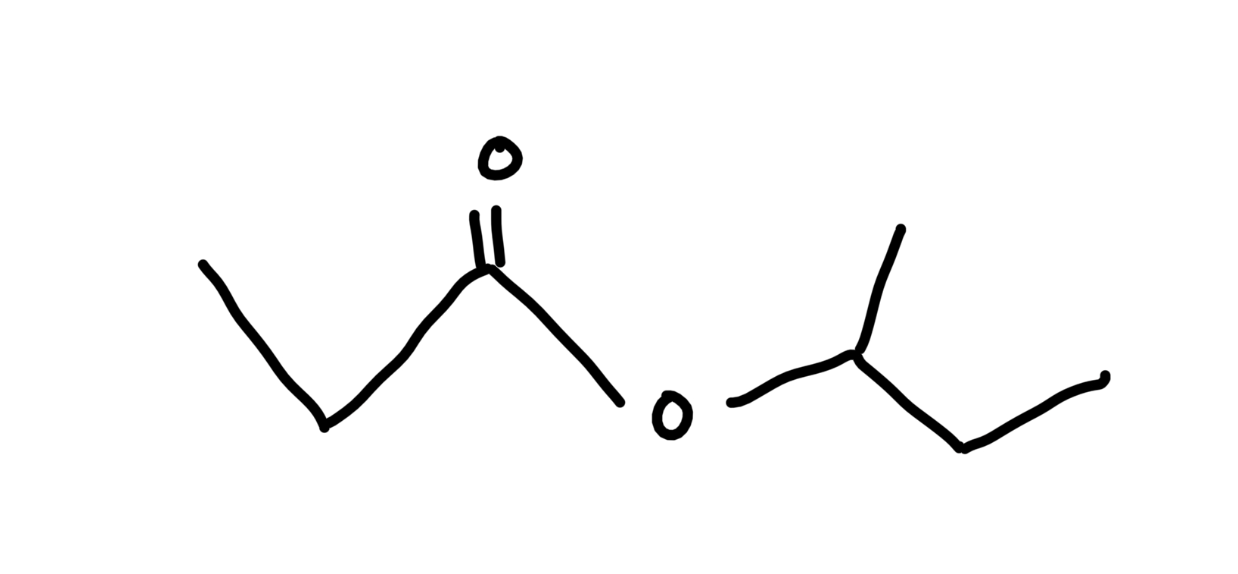
balanced equation
reminder 2:1 ratio of carboxylic acid and alcohol

mechanism
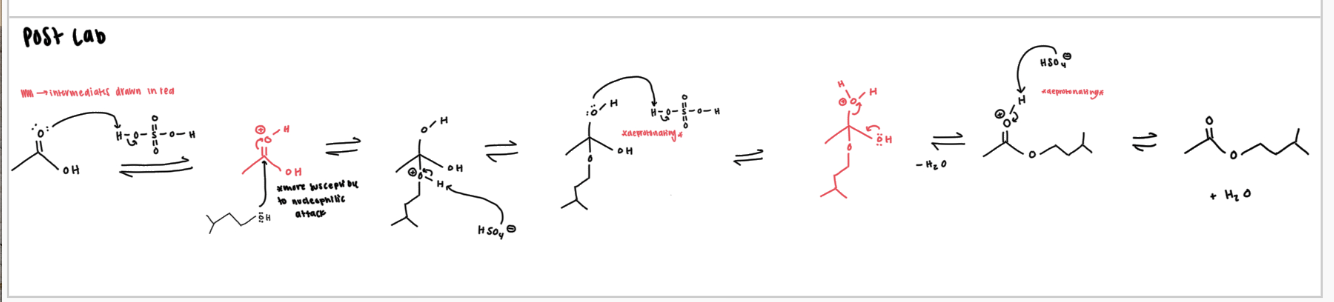
remember we are in acidic conditions so the carbonyl will get protonated, nucleophilic attack by oxygen, the H on the nucleophile gets deprotonated, one of the OH groups gets protonated, water leaves as a LG, electrons from the other OH form the double bond, and the H on the new carbonyl gets deprotonated

limiting reagent
unknown alcohol
how can you tell your reaction went to completion
disappearance of OH group (broad peak around 3200-3400)
newly formed carbonyl group (C=O around 1720)
C-O bond around 1200 but in fingerprint region
Provide a brief description of how the microwave works in the context of this reaction. How does it supply heat/energy to the reaction solution? What does it mean for a reaction to be “microwave-promoted?”
the microwave accelerates the reaction and increases the yield because
rapid uniform radiation
interaction of polar molecules with the electromagnetic field
oscillating electromagnetic field allows for polar molecules to rote and be properly oriented for the reaction + higher collision rate
Explain how concentrated sulfuric acid catalyzes the Fischer esterification reaction. You must draw reactive intermediate structures to help explain your reasoning:
the protonation of the carbonyl is needed because it makes it more susceptible to a nucleophilic attack by the weak nucleophile (alcohol). also, the sulfuric acid is needed to protonate the OH to make water leave and to ultimately form the carbonyl
Once the initial extraction was performed (removal of the reaction mixture’s aqueous layer) how was your ester product further separated from any remaining unreacted carboxylic acid?
with 5% sodium bicarbonate because it reacts with glacial acetic acid to form a carboxylate salt, which is discarded with aqueous waste
balanced equation of how glacial acetic acid reacts with sodium bicarbonate

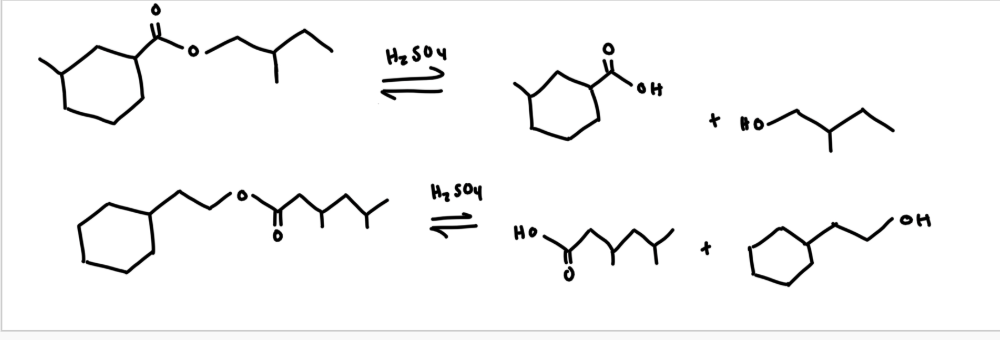
Provide the appropriate starting materials and reagents needed to form the following compounds via a Fischer esterification:
A. 2-methylbutyl 3-methylcyclohexane-1-carboxylate
B. 2-cyclohexylethyl 3,5-dimethylhexanoate
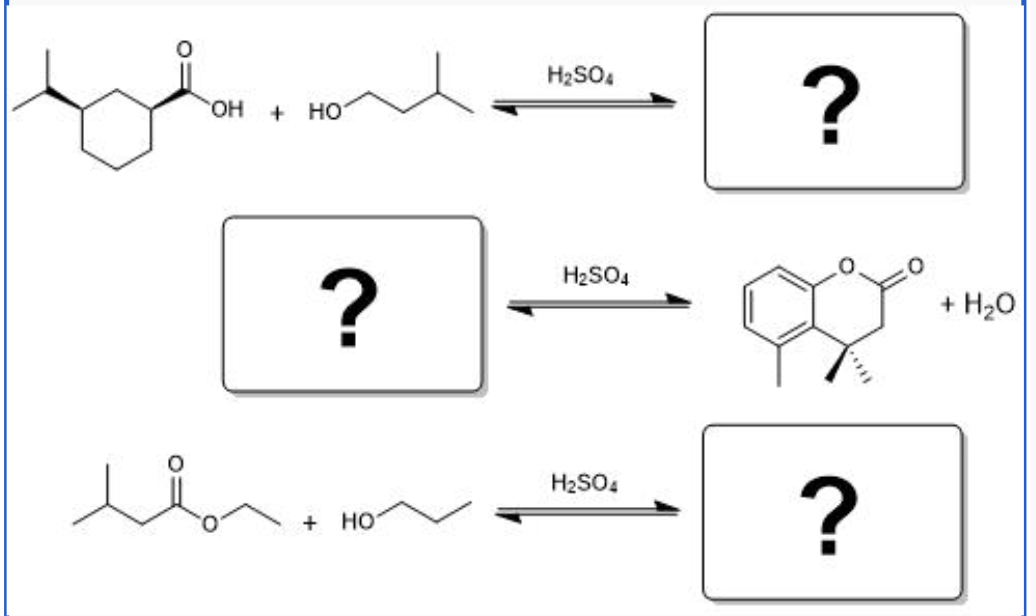
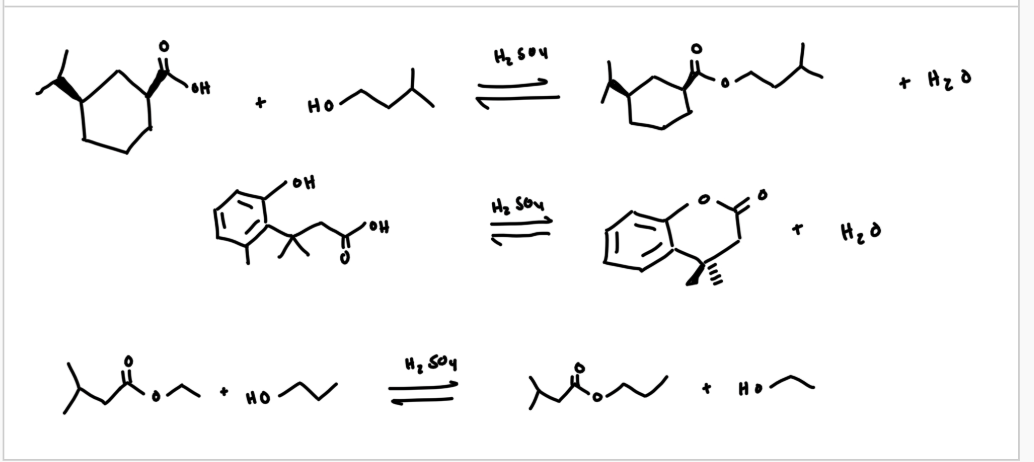
Provide the appropriate starting materials and/or product(s) needed to complete the following Fischer esterification reaction schemes: