PPAP I: Intro to EBM
 Call Kai
 Learn
Learn Practice Test
 Spaced Repetition
 Match
Match Flashcards
 Knowt Play
1/19

There's no tags or description
Looks like no tags are added yet.
Name | Mastery | Learn | Test | Matching | Spaced | Call with Kai | Chat |
|---|
No analytics yet
Send a link to your students to track their progress
20 Terms
Evidence-Based Medicine (EBM)
How do?
Formulate clinical question
Assessing the literature
“the important thing to learn is how to learn on your own”
5 Steps of Evidence-Based Medicine
Clinical Question
Evidence Acquisition
Evaluate the Evidence
Apply the Evidence
Assess the Outcome (REPEAT)
helps you get the answer you are looking for quick! from reliable source
Formulating a Clinical Question
PICO!!: assessment of need and problems INTO structure clinical Q (adequate, focused information w/o too m detail)
Patient/Population: disease/condition you are investigating, and the particular demographic you are wanted to learn about
Intervention: primary treatment option
Comparison/Control: secondary treatment option or control groups (if appicable)
Outcome: desired outcome
additional timeframe component (PICOT)
PICO: Patient/Population/Problem
Patient/Patient Group
gender/race/sex/age
How described to a medical colleague?
disease/condition?
Stage of illness?
setting of __?
PICO: Intervention
What you plan to do
consider…
type of treatment
intervention level (dosage/freq not necessarily known)
stage of intervention (preventative, early, advanced)
Delivery method (hospital admin, at home, self)
PICO: Comparison
Alternative to intervention
standard of care, placebo, other approved therapies
Only assess one alternative at a time
optimal when in reviewing studies on prognosis or diagnosis
PICO: Outcome
result you want to review for the patient
when possible: measurable terms (BP mmHg, A1C..)
others: SE, Quality of Life, Cost Effectiveness, Improvement of Symptoms
Types of PICO
Diagnosis: How to select and evaluate diagnostic tests?
types: cross-sectional study/ prospective blind comparison to a gold standard
Therapy: Is a treatment effective?
Types: systematic review, randomized controlled trial (RCT) or cohort study
Prognosis: What is the patient’s clinal course over time?
Types: Cohort studies, case studies, or case series
Harm/Etiology: What cause this disease/condition?
Types: Cohort studies, case studies, or case series can answer question of harm
Acquiring the Evidence
Skills:
ask a focused clinical question
searching medical literature
retrieving the medical literature
Appraising the Evidence
Directness → will i read?
Validity → will i believe?
Results → does it work?
Applying the Evidence
Applicability → can i use?
Individualizing results → how will it affect my patient?
Sharing decision → what does my pt think?
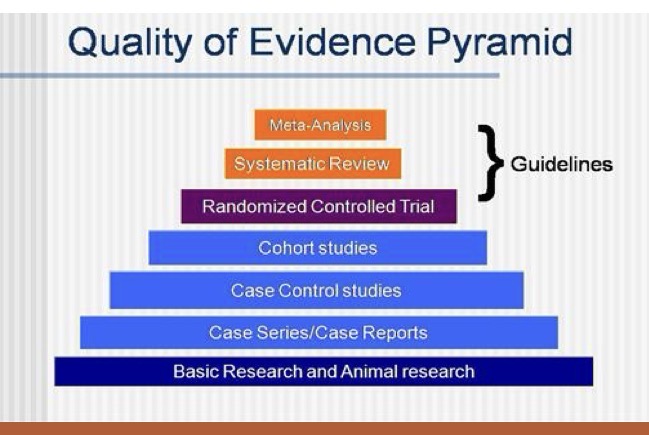
Randomized Controlled Trials (RCT)
High Validity
top choice for all types of questions
Low Feasibility
big sample size
ethical outcomes
requires long term followup
Case-Control
Observational Retrospective study
assignment
popu w/ disease VS popu AT RISK w/o disease
measure predictor variables
exposure to certain drug/ condition
LOW validity and HIGH feasibility
start at outcome and assess exposure status
Strength
overcomes temporal delay (waiting time to find out)
may only need small sample size
can assess mult exposures
Weakness
only assess one condition/disease
susceptible to bias → esp selection bias and recall bias (self-reporting)
limited validity (certain popu)
Cohort Studies
Observations Prospective study
can be retrospectives (via claims databases)
select sample → measure predictor variables (risk factors) → follow-up the cohort → measure outcome (incidence/chance of dev disease/condition)
Start! exposure status to assess outcome event (measuring variable)
moderate validity and feasibility
Strengths:
feasible whenrandomizaiaont of exposure is not possible or unethical
assess multiple outcomes
Weaknesses
susceptible to bias
limited validity (potential to lose subjects to follow up)
longer to conduct
more expensive than case control
Case Reports
manuscript reporting sev cases on particular incident or therapy in specific situation
new ideas/discussion can emerge
Strengths
fast to report outcomes to med community
observationsal to potentially lead to larger study
good for unique, rare clinical scenarios
Weaknesses:
not generalizable (external validity)
difficult to compare cases and replicate
uncontrolled
can include bias
Bias
Recall Bias: retrospective studies
pt recalls exposure
want obj!! if subj → collab w/ medical record
Selection Bias: consider random sequence generation and allocation concealment methods of RCT
Performance Bias: difference b/tw study groups as result of systematic differences in performance outside study treatment (MUST blind subjects/caregivers)
Detection Bias: possibility for differences b/tw comparison groups w/ regard to how outcomes measured/assessed (BLIND assessors)
Attrition Bias: result of systematic cause of pt withdrawals in a study that disproportionately affect a certain subset of pt
could imbalance/impact results/conclusions
asses study analysis and look further into results
Reporting Bias: concerns w/ regard to outcomes reported w/in results of study
report only some measured outcomes (deemed not important)
Internal Validity
how well a study’s results reflect the true cause-effect relationship w/in the study
confidence that study’s results are conclusive and NOT influences by other factors/bias
Threats:
Selection Bias
Performance biase
Detection Bias
Attrition Bias
External Validity
Extent the study’s results can be generalized to other settings or populations
real world application? what degree?
Threats:
studies excluding certain popu
restrictions on medial comorbidities
restrictions on concurrent medications
short study length
Assessing Applicability
Sex: physiological, hormonal, biochemical differences
Comorbidities: coexisting conditions effecting outcome risk for given exposure?
Race: racial/ethnic differences that might alter risk for outcome?
Age
Pathology: more extensive infection, more catastrophic course (malignant histology causes earlier metastasis)
Socioeconomic factors: Location, lifestyle
Sharing Decision
come up w/ estimate of prognosis specific to individual patient based on characteristics
helps pt make treatment decisions, diagnosis, and harm
help pt make general plans for future