MEATS - EXAM 1
 Call Kai
 Learn
Learn Practice Test
 Spaced Repetition
 Match
Match Flashcards
 Knowt Play
1/103

Earn XP
Description and Tags
ANSC 307 - LAB
Name | Mastery | Learn | Test | Matching | Spaced | Call with Kai | Chat |
|---|
No analytics yet
Send a link to your students to track their progress
104 Terms
What are the basic procedures involved in sharpening a knife?
grinding, honing, and steeling
Why is grinding necessary?
Grinding of the knife is necessary because new knives are not usually sold with blades that are sharp enough for immediate use.
Why are honing and steeling necessary?
Honing (water + stones) & Steeling (steels) realigns the microscopic metal edge of a knife that bends and folds over during regular cutting, it extends blade life, and improves safety by preventing slips.
How do two objects at different temperatures communicate heat to each other?
The one which cools down is termed the “hot” object and the one that receives the heat is the “cold” object.
Why is ice used for the cooling of foods?
ice does NOT dessicate (dry out) foods
What is the downfall of using Mechanical Refrigeration?
It cools a food but also condenses moisture from the food. It is therefore necessary to protect foods during cold storage to minimize moisture losses, either by controlling the atmospheric humidity in the refrigerated room or by proper packaging of the food.
How does a mechanical refrigeration system based on ammonia work?
Ammonia liquid goes through the Expansion Valve (to go from liquid to gas), it takes energy (heat) from carcasses near the Evaporator Coils. The expanded ammonia gas is then compressed in the Compressor. The heat from the compressed gas is removed by a Condenser in which running water, brine, or circulating air runs over the condenser coils/tubes. The hot gas liquifies and the liquid collects in the Receiver.
Why must heat be removed from a freshly slaughtered animal?
Heat must be removed to avoid decomposition and to delay excessive losses in body weight
At what temp are carcasses entering a cooler vs what temp is required after cooling?
Carcasses enter at about 100ºF and some 24 hours is required for the thickest parts of the carcass to reach 32 to 34ºF
How much weight do carcasses lose during chilling and what is done to prevent that?
They lose about 2% of their weight as moisture vapor EXCEPT that packing plants spray water on carcasses intermittently and as a result carcasses do not lose any weight
How can the humidity of a storage cooler affect the carcass?
If the humidity is above 90%, the meat will mold. If the humidity is less than 85%, the carcass will lose excessive weight.
What was the Meat Inspection Act of 1906 and why was it passed?
This act required federal inspection for cleanliness and wholesomeness of meat moving in interstate and foreign commerce. It was stimulated by public concern over the refusal by foreign countries to accept American meat and Upton Sinclair’s book, The Jungle, which described the unsanitary conditions of meat handling.
What is the function of meat inspection?
It eliminates meat considered to be unsound, unhealthful, unwholesome, or unfit for human consumption.
What are the six basic functions in federal meat inspection?
Detection & destruction of diseased/contaminated meat
Assurance of clean/sanitary handling & preparation
Minimization of microbiological contamination of meat
Prevention of adulteration & the presence of chemical or drug residues
Prevention of false labeling
Application of the inspection stamp
What are the 11 responsibilities for federal meat inspection?
Facilities construction and provisions for operational sanitation
Assurance that all plants adopt and use HACCP
Assurance that SSOPs are practiced by personnel of the facility
Antemortem Inspection
Postmortem Inspection
Verification of HACCP system effectiveness
Oversight of plant protocols for conducting Generic E.coli testing
Product Inspection
Laboratory determinations and assays
Control and restriction of condemned products
Marking, labeling, and inspection insignia
What does HACCP stand for?
Hazard Analysis and Critical Control Point Systems
Why was the Final Rule on Pathogen Reduction introduced?
To improve food safety and begin the long awaited modernization of USDA’s meat and poultry inspection system
What are the four essential elements identified by The Final Rule?
All slaughter and processing plants are required to adopt the system of process controls to prevent food safety hazards known as HACCP
To verify that HACCP systems are effective in reducing contamination with human pathogens, FSIS set performance standards for Salmonella that certain products must meet
Slaughter plants are required to conduct microbiological testing for Generic E.coli to verify that their process control systems are working as intended to prevent fecal contamination, which is the primary avenue of contamination with human pathogens
Plants must adopt and follow written Sanitation Standard Operating Procedures (SSOPs) to reduce the likelihood that human pathogens will contaminate finished products
What key issues must establishments follow to meet FSIS regulations?
Maintained grounds and pest control
Sound construction
Quality lighting
Sufficient ventilation
Proper plumbing
Sewage disposal
Water supply
Dressing rooms, lavatories, and toilets
Equipment and utensils easy to clean
Employee hygiene
Proper clothing
Disease control
Tagging insanitary equipment, utensils, room or compartments
What are the 7 principles of HACCP?
Conduct a hazard analysis
Determine the critical control points
Establish critical limits
Establish monitoring procedures
Establish corrective actions
Establish verification procedures
Establish record-keeping and documentation procedures
What is required for an SSOP (Sanitation Standard Operating Procedure)?
Describe all procedures that an establishment will conduct to maintain proper sanitation
Specify the frequency of the procedures
Identify the individual responsible for implementing and monitoring the SOP
Be signed and dated by the individual with on-site implementation authority
What is antemortem inspection?
Animals must be inspected both while in motion and at rest
What causes an animal to be marked U.S. Condemned?
If they have abnormal temperature, display other symptoms of disease that would render their meat as unfit for food, or are dead/dying
What causes an animal to be marked U.S. Suspect?
If they are:
seriously crippled
Downers (unable to stand/walk)
Reactors to tuberculin test
Minor epithelioma (cancer eye)
Minor anasarca (brisket edema (swelling))
Minor swine erysipelas (bact. skin infection)
Vesicular exanthema (blisters on lips, tongue, feet)
Immature (bobby veal)
What is postmortem inspection?
Inspection of head, lymph nodes, viscera, and carcass after slaughter
What does the Humane Methods of Slaughter Act of 1978 state?
All animals must be stunned before sticking-bleeding. Also spells out handling of livestock in holding pens, chutes, etc., and the proper use of “hot shots” by plant employees.
What needs to be done after postmortem inspection?
All eligible carcasses are stamped, “Inspected and Passed”. Stamps must include the designation of the meat inspection system and the establishment number of the packer
What are Specified Risk Materials (SRM)?
The items from bovine animals that may contain the BSE agent if an animal had BSE. Establishments must determine whether the animal is less than 30 months of age or older.
What is required for labels on prepared meat products?
the common or usual name of the product
the inspection legend
the establishment #, name, and address of the processor or distributor
correct statement of quantity as net weight
for sausage and canned meats, a statement of the ingredients used, listed in descending order of their predominance
Requirements for cooked sausage labeling (franks, bologna,etc)?
Product may contain meat and meat by-products with no more than 30% fat, 2% corn syrup, no more than 15% poultry, no more than 3.5% cereals and nonfat dry milk, with a product name showing what was added.
How can the skeleton be divided?
Can be divided into 3 primary parts: axial, appendicular, and splanchnic
What is the Vertebral Column?
It is an integral part of the axial skeleton (skull to tail) and is composed of individual sections called vertebra. A typical vertebra consists of:
the body
arch
processes
What are the basic divisions of the vertebral column?
Cervical
Thoracic
Lumbar
Sacral
Coccygeal
Describe the Cervical division
Cervical (neck) are the first 7 vertebrae. The first cervical vertebra is the ATLAS and the second is the AXIS. The ATLAS vertebra articulates with the occipital condyles at the back of the skull.
Describe the Thoracic (thorax) vertebrae
vertebrae to which the ribs are attached
Describe the Lumbar (loin) vertebrae
vertebrae characterized by long transverse, but short dorsal processes
Describe the Sacral (rump) vertebrae
vertebrae that form the roof of the pelvic canal
Describe the Coccygeal (caudal) vertebrae
vertebrae that are basic skeletal units of the tail
What is the number of each kind of vertebra in an ox (bovine)?
7 cervical, 13 thoracic, 6 lumbar, 5 sacral, 18-20 coccygeal
What is the number of each kind of vertebra in a sheep?
7 cervical, 13 thoracic, 6-7 lumbar, 4 sacral, 16-18 coccygeal

What is the number of each kind of vertebra in swine?
7 cervical, 14-16 thoracic, 1-7 lumbar, 4 sacral, 20-23 coccygeal
What are the ribs?
elongated, curved bones that form the skeleton of the lateral walls of the thorax. Those which articulate with the sternum by means of their cartilages are termed sternal ribs, the remainder are asternal ribs
What is the sternum?
A median segmental bone that completes the skeleton of the thorax ventrally
What is the head?
The head has the mandible or jaw bone, skull, and is attached to the atlas by the occipital condyles. The HYIOD bone serves as the attachment for the tongue
What does the Appendicular Skeleton consist of?
The thoracic limb and pelvic limb
What does the thoracic limb consist of?
Consists of the shoulder, the arm, the forearm, and the manus.
The shoulder consists of the scapula, coracoid, and clavicle
The arm is comprised only of the humerus (connects to scapula)
The forearm consists of the radius and ulna (supports weight)
The manus is composed of the carpus (knee in animals=wrist in humans), metacarpus, and the digits
What does the pelvic limb consist of?
Consists of the pelvic girdle, the thigh, the leg, and the pes
The pelvic girdle consists of the os coxae (hip bone) which joins the aitch bone and then the sacrum. The hip bone consists of the ilium, ischium, and pubis
The thigh (femus) contains a long bone, the femur
The leg is composed of the tibia (supports weight), fibula, and patella
The pes (=human foot) consists of the tarsus, metatarsus, and digits
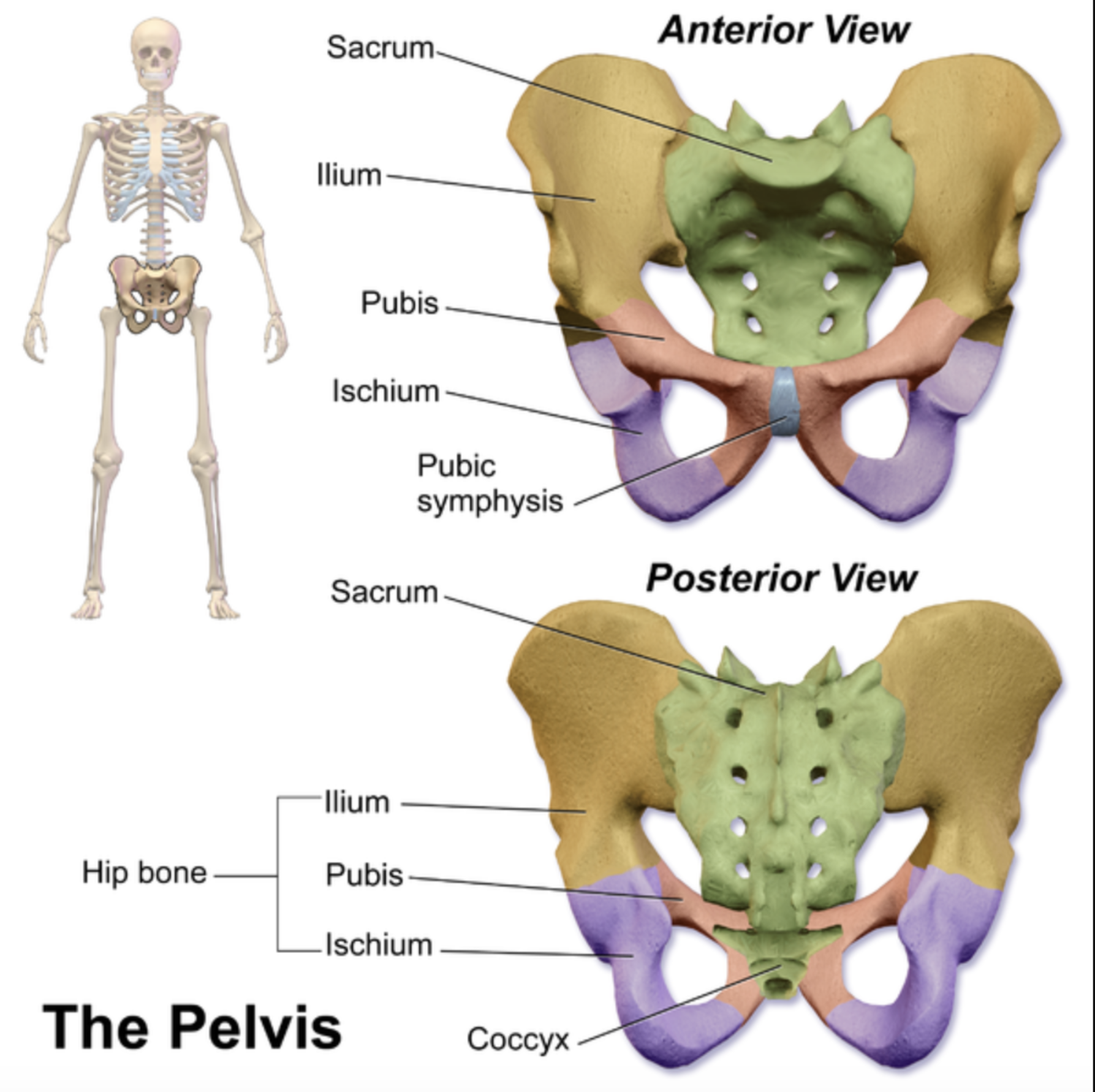
What is the splanchnic/visceral skeleton?
It consists of certain bones developed in the substance of some of the viscera or soft organs. ex - the os penis of the dog
What is ossification or osteogenesis?
The conversion of cartilage to bone and is effected by bone-producing cells called OSTEOBLASTS
What is endochondral ossification?
Cartilage → gets calcified → cartilage is broken down → bone replaces it
What is Long Bone Ossification?
Think about a long bone like the femur.
The middle portion is the diaphysis.
The ends are the epiphyses.
Between them is the:
Epiphyseal cartilage
This is basically the growth region.
As long as this cartilage keeps growing, the bone can keep getting longer.
Eventually, the cartilage stops growing and becomes bone.
At that point:
The bone can no longer increase in length.
What is myology?
Myology = study of muscles and their accessory structures.
Muscles are specialized organs that can:
contract → relax → produce movement
What are the 3 kinds of muscles?
Striated-Voluntary, Striated-Involuntary, Smooth-Involuntary
What is Striated-Voluntary muscle?
This is skeletal muscle.
You can consciously control it.
It is attached to the skeleton and is responsible for much of the animal's movement.
This is also the muscle that eventually becomes meat.
What is Striated-Involuntary muscle?
This is cardiac muscle.
It's found in the heart.
It has striations like skeletal muscle, but you cannot consciously control it.
What is Smooth-Involuntary muscle?
This is smooth/visceral muscle.
It's found in places like the digestive tract.
You don't consciously tell your intestines to move food.
The muscle does it automatically.
How does muscle movement work?
Muscles attach to structures using connective tissue, such as tendons.
When a muscle contracts, it shortens and pulls.
Prime mover = does the main movement
Synergist = helps prime mover
Antagonist = opposes/controls prime mover
Fixation = prevents unwanted movement/stabilizes
What are muscle fibers?
A muscle fiber is basically a muscle cell.
But skeletal muscle fibers are unusual because they are:
very large
long
multinucleated
The muscle fibers are arranged together in bundles called fasciculi.
What are the 3 connective tissue layers and what do they do?
Epimysium
Surrounds the entire muscle.
Perimysium
Surrounds the bundles of muscle fibers.
Endomysium
Surrounds individual muscle fibers.

What makes up a muscle fiber?
The muscle fiber is surrounded by the: Sarcolemma
That's basically the muscle cell's membrane.
Inside it is: Sarcoplasm
That's basically the muscle cell's cytoplasm.
Inside the sarcoplasm are: Myofibrils
And the myofibrils are responsible for muscle contraction.

What are myofibrils?
Myofibrils are long structures running through the muscle fiber.
They give skeletal muscle its striped/striated appearance.
The myofibrils contain two major types of protein filaments:
Thick filaments
Mostly:
Myosin
Thin filaments
Mostly:
Actin + tropomyosin + troponin
What is fat/marbling?
Fat stored when there are more nutrients available than the animal immediately needs.
There are four major fat deposits.
Perinephric = internal fat - Around the kidneys.
Intermuscular = seam fat - Between muscles.
Subcutaneous = external fat - Under the skin.
Intramuscular = marbling - Inside the muscle.
What are the 4 major tissues and 4 minor tissues in a carcass?
Bone, connective tissue, muscle, and fat are the 4 MAIN TISSUES. Skin, arteries, veins, and nerves are the 4 MINOR TISSUES.
What is the function of bone?
Gives rigidity/support/form, serves as levers for locomotion, protects vital organs, stores minerals, forms components of blood
What is the function of connective tissues?
connect bones
attach muscles
surround muscle bundles
surround individual fibers
help hold muscle structures together
Composed of 3 proteins: collagen, elastin, reticulin
What is the function of the muscles?
Produces energy & converts energy into motion
What is the function of fat?
Provides storage for excess nutrients, insulates the body against extreme weather, and protects vital organs
What are Type I/Red Fibers?
smaller in diameter
slower contracting
capable of continuous contraction
able to use fatty acids as an energy source
These are useful for muscles that have to work for a long time.
Think:
RED = slow + endurance
What are Type II/White Fibers?
larger
faster
more vigorous
primarily use glucose for energy
Think:
WHITE = fast + powerful
What is the difference between Parallel and Penniform muscle fibers?
Parallel - Fibers run more parallel to the tendon.
This allows a greater distance of shortening, but the muscle produces less force.
Parallel = more movement
Penniform - Fibers are angled relative to the tendon.
This allows more fibers to fit into the muscle, so the muscle can produce more force. But it sacrifices some distance of shortening.
Penniform = more power
Beef Chuck 7-Bone Steak → Muscles 1-5
M. triceps brachii
M. infraspinatus (2nd most tender muscle)
M. supraspinatus (above scapula)
M. subscapularis (below scapula)
M. serratus ventralis thoracis (looks like a knife)

Beef Chuck Arm Steak → Muscles 2-4
M. triceps brachii
M. pectoralis profundus
Mm. pectorales superficiales
3 & 4 - BRISKET

Beef Rib Steak, Small End → Muscles 2-4
M. spinalis thoracis
M. longissimus thoracis
M. iliocostalis thoracis

Beef Chuck Blade Steak → Muscles 2-4 & 6-9
M. spinalis thoracis
M. semispinalis thoracis
M. longissimus thoracis
M. serratus ventralis thoracis
M. latissimus dorsi
M. trapezius
M. rhomboideus thoracis

Beef Loin Porterhouse Steak → Muscles 1-3
M. psoas major (most tender)
M. longissimus lumborum
M. gluteus medius

Beef Loin Top Loin Steak → Muscle 2
M. longissimus lumborum

Beef Round Steak → Muscle 1-3, 8, and 10
M. semimembranosus
M. semitendinosus
M. gluteobiceps
M. adductor
Intermuscular (seam) fat
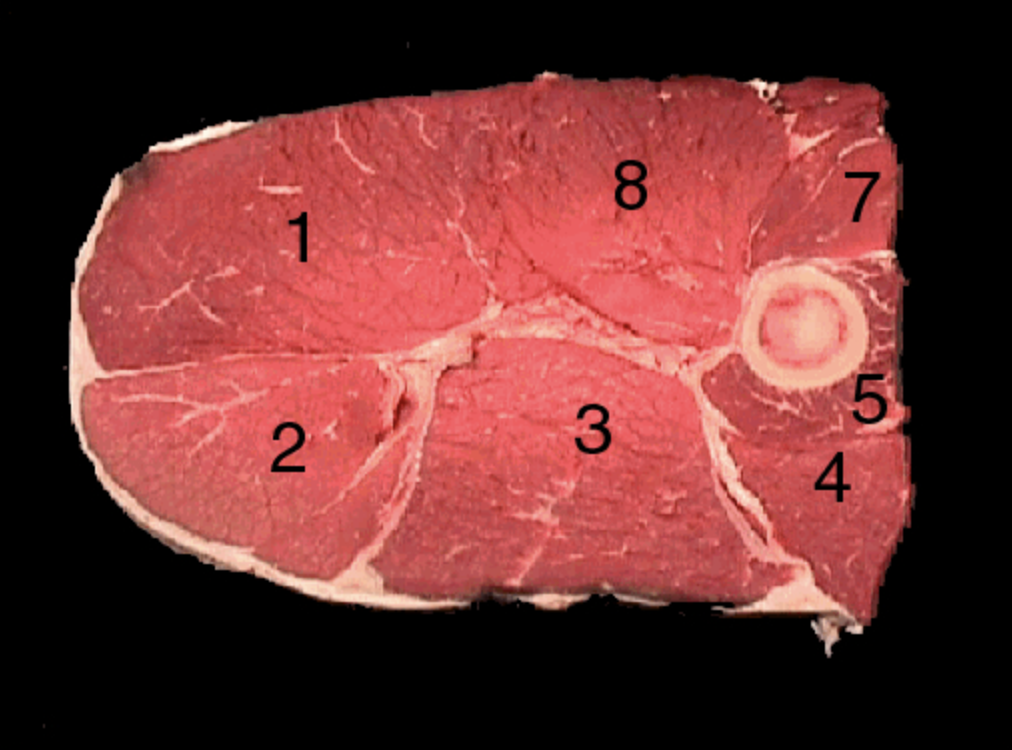
Beef Loin Sirloin Steak → Muscles 1, 3-5, and 7
M. tensor fasciae latae
M. gluteobiceps
M. gluteus medius
M. psoas major
M. rectus femoris

What are the standard operating procedures for slaughter?
Immobilization or stunning
Bleeding
Head removal
Skin or hair removal
Feet or toenail removal
Evisceration
Splitting
Inspection
Washing
Chilling
Swine are dressed with the skin and feet not removed
How must swine be handled before slaughter?
Sprinkler systems to help swine dissipate heat (prevent death)
Must not mix with unfamiliar hogs to prevent fighting, scratches, and bruising.
Hogs transported long distances before slaughter must have available feed to prevent muscle glycogen depletion (results in DFD).
Stress free conditions to prevent PSS and PSE.
How does fasting for swine look like during the holding period?
Swine must be held 12-24 hours before slaughter, without feed, but with access to water.
Withholding feed facilitates evisceration and minimizes migration of bacteria from GI tract into bloodstream
Free access to water enhances complete bleeding, results in brighter color lean, and facilitates more effective electrical stunning
Hogs must be handled quietly and calmly to enhance blood removal
What is the stunning method for swine?
Swine are electrically stunned before bleeding (all animals must be stunned before bleeding).
Electrically stunning with voltages that are too high may result in broken bones and ecchymosis (blood splash)
How is bleeding accomplished?
A six inch knife must be inserted midway from the sternum to the throatlatch and squarely in the middle of the ventral aspect
How does the Scalding/Dehairing process work for a pig?
Skin is left on but hair must be removed. Hogs are immersed in 140ºF water until the hair begins to slip from the flank area. Hot water converts the collagen that surrounds the hair follicle into gelatin so that the hair can be removed by scraping or with a dehairing machine.
What months are hard hair season?
September, October, November
143ºF and immersion times of 4 ½ minutes are appropriate
What months are soft hair season?
February, March, April
136ºF and immersion times of 4 minutes are sufficient
What is scurf?
A layer of accumulated oil, dirt, and epidermal cells on the skin surface.
Commercial alkaline products are added to the scalding vat to help eliminate scurf
What is done to the carcass after the scalding vat?
The carcass is shaved with knives and singed with a gas-fire hand-held torch
What is evisceration?
The process of removing the viscera (from the abdominal cavity) and the pluck (from the thoracic cavity).
What has to be done before evisceration?
The anus or “bung” must be cut from the attachment under the tail (bunging) and the head must be removed at the occipito-atlantal space
How do we control fecal material, milk, or ingesta contamination?
There must be no visible fecal material, milk, or ingesta contamination on livestock carcasses at or immediately after the final rail (where postmortem inspection takes place). If contamination occurs. careful trimming must take place to remove it
How are pigs split and prepped for chilling?
The carcass is split down the vertebral column and has the kidneys and leaf fat removed. The carcass is washed, weighed, and identified. It is placed in a 28 to 32ºF blast chill cooler for 18-24 hours before fabrication.
What is dressing percentage and how is it calculated?
The ratio of dressed carcass weight divided by the live animal weight multiplied by 100
(180 lbs dressed / 250 lbs live) x 100 = 72%
Why do hogs have the highest dressing percentages of the farm animal species?
Because they are fatter, have one stomach instead of four, and are dressed with the skin, feet, and tail left on. (approx. 70%)
What is Carcass Cost Basis and how is it calculated?
It is the price per cwt of carcass necessary to realize the same amount of money that was paid for the live animal.
(live price per cwt / dressing percentage) x 100
How is sex determined in pork carcasses?
By viewing the anatomical differences in the region of the aitch bone. Barrows have a smaller, square shaped M. semimembranosus and a bald spot in which a ring of erectile tissue called the pizzle eye is located. Gilts have a larger, bean-shaped M. semimembranosus and no pizzle eye
What are the USDA Grades for Pork Carcasses?
U.S. No. 1, U.S. No. 2, U.S. No. 3, U.S. No. 4, and U.S. Utility
How is the quality of lean best evaluated?
Color and Marbling
1 (pale pink/grey/white) 2 (gray pink), 3 (reddish pink), 4 (purplish red), 5 (dark purplish red)
1,2,3,4,5,6,10 (marbling increases as the number increases)
How is carcass muscling score evaluated?
Observation of how thin/thick the carcass is.
Thin (1.0), Intermediate (1.5-2.5), Thick (3.0)
How is carcass length measured?
Measured from the cranial tip of the aitch bone to the cranial edge of the first rib and next to the thoracic vertebra