Balance WK2 LG 3 Regulation of Arterial Pressure- Hormones, Pressure Natriuresis and Diuretics
 Call Kai
 Learn
Learn Practice Test
 Spaced Repetition
 Match
Match Flashcards
 Knowt Play
1/202

There's no tags or description
Looks like no tags are added yet.
Name | Mastery | Learn | Test | Matching | Spaced | Call with Kai | Chat |
|---|
No analytics yet
Send a link to your students to track their progress
203 Terms
What is the overall goal of blood-pressure regulation in this lecture?
Answer: Maintain effective circulating volume and blood pressure.
Extra Information:
Multiple systems act over different time scales to accomplish this.
What equation relates blood pressure to cardiac output and total peripheral resistance?
Answer: BP = CO × TPR.
Extra Information:
Cardiac output and vascular resistance are the major determinants of arterial pressure.
What determines cardiac output?
Answer: Heart rate × stroke volume.
Extra Information:
- CO = HR × SV.
What two major factors determine stroke volume in the BP review?
Answer: Preload and afterload.
Extra Information:
- Changes in circulating volume can therefore affect stroke volume and cardiac output.
What organ acts as the master controller of cardiovascular regulation?
Answer: Brain.
Extra Information:
- The autonomic nervous system regulates the heart, blood vessels, and kidneys.
- It influences heart rate, stroke volume, and total peripheral resistance.
What blood vessels are major determinants of total peripheral resistance?
Answer: Resistance arteries.
Extra Information:
- Their constriction increases resistance.
- Their dilation decreases resistance.
What factors regulate resistance arteries according to the lecture?
Answer: ANS, angiotensin II, and endothelial nitric oxide.
Extra Information:
- Remodeling or hypertrophy can also narrow the vascular lumen.
Which organs provide long-term control of blood volume and pressure?
Answer: Kidneys.
Extra Information:
- They regulate sodium and water balance.
- They respond to ANS, RAAS, ANP, and other signals.
How does vascular remodeling or hypertrophy affect blood pressure?
Answer: It can narrow the vascular lumen and increase resistance.
Extra Information:
- Resistance arteries are major determinants of total peripheral resistance.
What is the basic division of labor in blood-pressure regulation?
Answer: Neural mechanisms act rapidly, while renal-fluid mechanisms provide long-term control.
Extra Information:
- Hormonal and vascular mechanisms operate between these time scales.
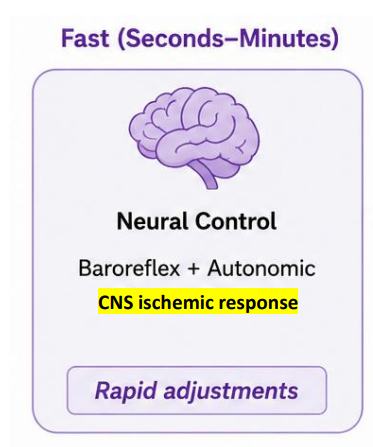
What controls blood pressure within seconds to minutes?
Answer: Neural control.
Extra Information:
- Examples include the baroreflex, autonomic nervous system, and CNS ischemic response.
What mechanisms dominate BP control over minutes to hours?
Answer: Hormonal and vascular mechanisms.
Extra Information:
- RAAS, ADH, catecholamines, and vasoconstriction provide sustained support.
What mechanisms dominate BP regulation over hours to days and long term?
Answer: Renal sodium and water balance.
Extra Information:
- Pressure natriuresis and diuresis control blood volume.
What is the main purpose of rapid neural BP regulation?
Answer: Rapidly defend arterial pressure.
Extra Information:
- It does not necessarily replace lost circulating volume.
What ultimately replaces volume lost during hemorrhage?
Answer: Long-term renal and hormonal mechanisms.
Extra Information:
- Neural reflexes initially defend pressure.
- Sodium and water retention restore volume.
What is the CNS ischemic response?
Answer: An extreme sympathetic response to severe cerebral ischemia.
Extra Information:
It is described as a “last-ditch” pressure-control mechanism.

At approximately what blood pressure does the CNS ischemic response become important in this lecture?
Answer: Below about 60 mm Hg.
Extra Information:
- Severe cerebral ischemia triggers an emergency survival response.
What happens to sympathetic activity during the CNS ischemic response?
Answer: It greatly increases.
Extra Information:
- The goal is to rapidly raise mean arterial pressure.
How does the CNS ischemic response affect heart rate?
Answer: Heart rate increases.
Extra Information:
- Sympathetic stimulation also increases contractility and stroke volume.
How does the CNS ischemic response affect cardiac contractility?
Answer: Contractility increases.
Extra Information:
- This helps increase stroke volume and cardiac output.
How does the CNS ischemic response affect systemic vascular resistance?
Answer: Systemic vascular resistance increases.
Extra Information:
- Strong sympathetic vasoconstriction produces this effect.
Trace the CNS ischemic response to increased MAP.
Answer: Severe cerebral ischemia → increased sympathetic activity → increased HR, contractility, CO, and SVR → increased MAP.
Extra Information:
- MAP rises because MAP = CO × SVR.
How does hypercapnia stimulate cardiovascular compensation?
Answer: It activates the central chemoreceptor pathway and increases sympathetic activity.
Extra Information:
Respiratory abnormalities can therefore alter cardiovascular function.

How does hypoxia contribute to sympathetic activation?
Answer: It stimulates peripheral chemoreceptors.
Extra Information:
This can further increase sympathetic activity.

Why can blood pressure changes in a hypoxic or hypercapnic patient not be viewed as purely cardiovascular?
Answer: Respiratory abnormalities can drive sympathetic cardiovascular compensation.
Extra Information:
- The lecture emphasizes respiratory failure/hypercapnia and severe hypotension/shock as examples.
What change most directly causes the transient BP increase in the severe-hypotension clinical case?
Answer: Increased stimulation of the medullary vasomotor center.
Extra Information:
The patient has a BP of 52/30 mm Hg.
This severe hypotension can activate the CNS ischemic response.
The medullary vasomotor center is a group of neurons in the medulla oblongata of the brain that regulates blood vessel diameter and blood pressure
What happens to blood volume after acute blood loss?
Answer: Blood volume decreases.
Extra Information:
- Arterial pressure also tends to decrease.
Which major hormonal system is activated by acute blood loss?
Answer: RAAS.
Extra Information:
- ANP activity decreases because atrial stretch is reduced.
What happens to renin during acute blood loss?
Answer: Renin increases.
Extra Information:
- Reduced renal perfusion activates the renin-angiotensin-aldosterone system.
What happens to angiotensin II during acute blood loss?
Answer: Angiotensin II increases.
Extra Information:
- Increased renin ultimately increases angiotensin II formation.
What happens to aldosterone during acute blood loss?
Answer: Aldosterone increases.
Extra Information:
- Angiotensin II promotes aldosterone secretion.
What happens to ADH during acute blood loss?
Answer: ADH increases.
Extra Information:
- This promotes water retention.
What happens to norepinephrine during acute blood loss?
Answer: Norepinephrine increases.
Extra Information:
- Sympathetic activation helps support arterial pressure.
What happens to renal Na⁺ reabsorption during acute blood loss?
Answer: It increases.
Extra Information:
- Sodium retention helps restore extracellular fluid and blood volume.
What happens to renal water reabsorption during acute blood loss?
Answer: It increases.
Extra Information:
- Water retention helps restore circulating volume.
What is the overall goal of the response to acute blood loss?
Answer: Restore perfusion.
Extra Information:
- RAAS and other volume-retaining systems increase blood volume and pressure toward normal.
What is the overall effect of RAAS on volume and pressure?
Answer: Volume up, pressure up.
Extra Information:
- RAAS promotes vasoconstriction and sodium and water retention.
What stimulates renin release in the RAAS diagram?
Answer: Decreased renal perfusion pressure.
Extra Information:
- Renin initiates the hormonal cascade.
What does renin act on?
Answer: Angiotensinogen.
Extra Information:
- This produces angiotensin I.
What enzyme converts angiotensin I to angiotensin II?
Answer: Angiotensin-converting enzyme.
Extra Information:
- ACE is one pharmacologic target for RAAS blockade.
How does angiotensin II affect total peripheral resistance?
Answer: It increases TPR through vasoconstriction.
Extra Information:
This contributes directly to increased arterial pressure.
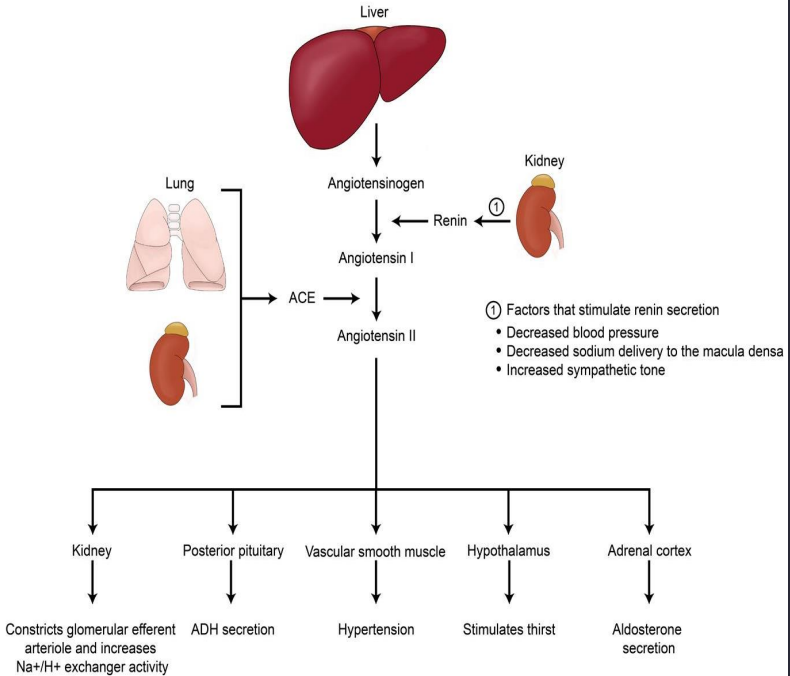
How does angiotensin II affect thirst?
Answer: It increases thirst.
Extra Information:
- Increased water intake helps restore extracellular fluid volume.
How does angiotensin II affect Na⁺ reabsorption?
Answer: It increases Na⁺ reabsorption.
Extra Information:
- Water follows retained sodium.
How does aldosterone contribute to the RAAS response?
Answer: It increases Na⁺ reabsorption.
Extra Information:
- This increases extracellular fluid volume.
What are the net effects of RAAS activation?
Answer: Increased extracellular fluid volume and increased blood pressure.
Extra Information:
- Both vascular and renal mechanisms contribute.
What are major targets for RAAS-blocking drugs shown in the lecture?
Answer: Renin, ACE, angiotensin II receptors, and aldosterone signaling.
Extra Information:
- Blocking RAAS reduces its volume- and pressure-raising effects.
What happens to blood pressure with RAAS blockade?
Answer: Blood pressure decreases.
Extra Information:
- Reduced vasoconstriction and sodium retention contribute.
What cardiovascular structural benefit is shown for RAAS blockade?
Answer: Reduced cardiac remodeling.
Extra Information:
- This is one of the net effects shown on the RAAS slide.
What renal benefit of RAAS blockade is shown in the lecture?
Answer: Reduced renal injury and slower progression of kidney disease.
Extra Information:
- This accompanies its blood-pressure-lowering effects.
What happens to atrial stretch after blood or fluid transfusion?
Answer: Atrial stretch increases.
Extra Information:
- Increased circulating volume stretches the atria.
Which hormone is released in response to increased atrial stretch?
Answer: ANP.
Extra Information:
- ANP is released from atrial myocytes.
What is the overall effect of ANP on volume and pressure?
Answer: Volume down, pressure down.
Extra Information:
- ANP opposes the major actions of RAAS.
Where are the low-pressure baroreceptors highlighted in the ANP slide?
Answer: Veins, atria, and pulmonary arteries.
Extra Information:
- Atrial stretch is especially important for ANP release.
Where is ANP produced?
Answer: Atrial myocytes.
Extra Information:
- Increased atrial stretch stimulates ANP release.
How does ANP affect vascular smooth muscle?
Answer: It causes vasodilation.
Extra Information:
- ANP binds NPR1 on vascular smooth muscle.
How does ANP affect total peripheral resistance?
Answer: It decreases TPR.
Extra Information:
- Vasodilation produces this effect.
How does ANP affect the afferent arteriole?
Answer: It dilates the afferent arteriole.
Extra Information:
- This contributes to increased GFR.
How does ANP affect the efferent arteriole?
Answer: It constricts the efferent arteriole.
Extra Information:
- Together with afferent dilation, this increases GFR.
How does ANP affect GFR?
Answer: It increases GFR.
Extra Information:
- This promotes greater sodium and water excretion.
How does ANP affect renal Na⁺ reabsorption?
Answer: It decreases Na⁺ reabsorption.
Extra Information:
- This occurs in the late distal tubule and collecting duct in the lecture diagram.
What is natriuresis?
Answer: Increased urinary Na⁺ excretion.
Extra Information:
- ANP promotes natriuresis.
What is diuresis?
Answer: Increased urinary water excretion.
Extra Information:
- ANP promotes both natriuresis and diuresis.
What is the net effect of ANP on extracellular fluid volume?
Answer: ECF volume decreases.
Extra Information:
- Increased Na⁺ and water excretion lowers blood volume.
What happens to RAAS after blood/fluid transfusion?
Answer: RAAS activity decreases.
Extra Information:
- Renin and aldosterone decrease as circulating volume increases.
What happens to ADH after volume expansion in the ANP-vs-RAAS comparison?
Answer: ADH decreases.
Extra Information:
- This favors water excretion.
What is the overall relationship between ANP and RAAS?
Answer: They are complementary opposing systems that return blood volume and pressure toward normal.
Extra Information:
- Low volume favors RAAS.
- High volume favors ANP.
What happens to ANP during acute blood loss?
Answer: ANP decreases.
Extra Information:
- Reduced volume produces less atrial stretch.
What happens to ANP during volume expansion?
Answer: ANP increases.
Extra Information:
- Increased atrial stretch is the major stimulus.
What is BNP primarily used to help evaluate clinically?
Answer: Acute heart failure in patients with dyspnea.
Extra Information:
- BNP is interpreted along with the rest of the clinical picture.
What does a low BNP suggest in a dyspneic patient?
Answer: Acute heart failure is less likely.
Extra Information:
- Increasing BNP levels support the diagnosis and tend to reflect greater severity.
What does pressure natriuresis mean?
Answer: Increased arterial pressure causes increased renal Na⁺ excretion.
Extra Information:
- This is a major mechanism of long-term BP control.
How do kidneys provide long-term stability of arterial pressure?
Answer: By controlling body-fluid and Na⁺ balance.
Extra Information:
- The lecture emphasizes that pressure natriuresis can function independently of hormonal influence.
How does a normal kidney respond to high salt intake?
Answer: Na⁺ excretion increases with almost no change in blood pressure.
Extra Information:
Normal kidneys have excellent salt-excreting ability.

What characterizes a hypertensive but salt-resistant patient?
Answer: A higher baseline pressure is required, but salt causes relatively little additional BP increase.
Extra Information:
This corresponds to Patient 1 on the pressure-natriuresis graph.

What characterizes salt-sensitive hypertension?
Answer: An impaired pressure-natriuresis response.
Extra Information:
Salt loading causes a substantial increase in blood pressure.

What happens to blood pressure after salt loading in salt-sensitive hypertension?
Answer: Blood pressure rises substantially.
Extra Information:
- The kidneys require greater pressure to excrete the sodium load.
What does an impaired pressure-natriuresis relationship mean physiologically?
Answer: The kidney requires higher arterial pressure to excrete a given sodium load.
Extra Information:
- This can contribute to chronic hypertension.
What happens to effective circulating volume when sodium is retained?
Answer: It increases because water follows sodium.
Extra Information:
- Sodium balance is therefore closely related to ECF volume.
What do disorders of extracellular fluid volume usually reflect?
Answer: Problems with Na⁺ balance.
Extra Information:
- Edema is an example.
What do hypernatremia and hyponatremia primarily reflect according to the clinical pearl?
Answer: Problems with water balance.
Extra Information:
- Sodium concentration disorders are conceptually different from total-body sodium/ECF-volume disorders.
In bilateral renal artery stenosis, what happens to plasma renin activity?
Answer: It increases.
Extra Information:
- Reduced renal perfusion stimulates renin release.
In renal artery stenosis, what happens to angiotensin II and TPR?
Answer: Both increase.
Extra Information:
- Angiotensin II causes vasoconstriction.
Why does renal artery stenosis cause Na⁺ retention?
Answer: RAAS activation increases renal Na⁺ reabsorption.
Extra Information:
- This contributes to volume expansion and edema.
Why can ANP increase secondarily in renal artery stenosis?
Answer: RAAS-mediated volume expansion increases atrial stretch.
Extra Information:
- ANP acts as a compensatory opposing system.
What is the correct overall pattern in the renal-artery-stenosis case?
Answer: Increased renin, angiotensin II, TPR, Na⁺ retention, and compensatory ANP.
Extra Information:
- This corresponds to option C on the lecture slide.
How do most diuretics reach the renal tubular lumen?
Answer: Active secretion from blood into the proximal tubule.
Extra Information:
- Many diuretics are organic acids.
Which transporter is shown secreting many diuretics into the proximal tubule?
Answer: Organic anion transporter.
Extra Information:
Active secretion concentrates the drug in tubular fluid.

Why is tubular secretion important for many diuretics?
Answer: It allows them to reach their luminal site of action.
Extra Information:
- Many diuretic targets are located on the luminal membrane.
How are diuretics commonly administered?
Answer: Orally, with IV administration also used.
Extra Information:
- The appropriate route depends on the clinical situation.
What are major clinical uses of diuretics?
Answer: Edema/volume overload, heart failure, hypertension, glaucoma/ICP, and selected other disorders.
Extra Information:
- Additional lecture examples include respiratory alkalosis, nephrolithiasis, and electrolyte disorders.
What is the immediate renal action by which diuretics lower BP?
Answer: Increased Na⁺ and water excretion.
Extra Information:
- Natriuresis and diuresis reduce body-fluid volume.
How does diuresis affect plasma volume?
Answer: Plasma volume decreases.
Extra Information:
- Loss of Na⁺ and water reduces extracellular fluid volume.
How does decreased plasma volume affect preload?
Answer: Preload decreases.
Extra Information:
- Venous return and end-diastolic volume decrease.
How does reduced preload affect stroke volume?
Answer: Stroke volume decreases.
Extra Information:
- This contributes to reduced cardiac output.
How does reduced stroke volume affect cardiac output?
Answer: Cardiac output decreases.
Extra Information:
- CO = HR × SV.
What is the short-term BP-lowering sequence produced by diuretics?
Answer: Na⁺/water loss → decreased plasma volume → decreased preload and SV → decreased CO → decreased MAP.
Extra Information:
- This is the immediate/short-term mechanism emphasized in the lecture.
What additional long-term effect helps diuretics lower BP?
Answer: Decreased peripheral vascular resistance.
Extra Information:
- Reduced arterial stiffness and improved endothelial function further support lower BP.
What is the example carbonic anhydrase inhibitor in the lecture?
Answer: Acetazolamide.
Extra Information:
- It acts in the proximal tubule.
Where do carbonic anhydrase inhibitors act?
Answer: Proximal tubule.
Extra Information:
- Carbonic anhydrase participates in bicarbonate reabsorption there.
What enzyme does acetazolamide inhibit?
Answer: Carbonic anhydrase.
Extra Information:
- This decreases bicarbonate reabsorption and H⁺ secretion.