Intro to CNS
 Call Kai
 Learn
Learn Practice Test
 Spaced Repetition
 Match
Match Flashcards
 Knowt Play
1/99

There's no tags or description
Looks like no tags are added yet.
Name | Mastery | Learn | Test | Matching | Spaced | Call with Kai | Chat |
|---|
No analytics yet
Send a link to your students to track their progress
100 Terms
What are the divisions of the Nervous System?
Central Nervous System
Peripheral Nervous System
CNS
Brain and spinal cord
PNS
cranial nerves, spinal nerves, and ganglia
What are the 3 functions of the Nervous System?
Sensation, Integration, and Motor function
Sensation
Sensory perception; continuously receives info from the surrounding environment, concerning physical and chemical stimuli
Integration
Process the information (encoded as electric signal) and transmits it to effectors
Motor Response
Effectors can now produce a response or an effect
Afferent
sensory
ARRIVING at CNS
Efferent
motor
EXITING CNS
Brain
-Receives sensory input from the spinal cord and from its own nerves.
-Processes sensory inputs and initiates appropriate motor outputs
Spinal Cord
-Conducts sensory info from the PNS to the brain
-Conducts motor info from our brain to our various effectors
Sensory Division
sensory info from PNS receptors to CNS
one neuron system
Motor Division
2 divisions
Somatic and Autonomic
Somatic Division
-Voluntary control over Skeletal Muscle
-One neuron system
Autonomic Division
-INVOLUNTARY regulation of SMOOTH MUSCLE, CARDIAC MUSCLE, and GLANDS
-Two neuron system
What type of system is GSE?
General Somatic Efferent
One neuron
What type of System is GVE?
- General Visceral Efferent (autonomic)
- Two neurons
- Preganglionic neuron axon synapses a second neuron in the chain called postganglionic neuron
What muscles does GSE control?
voluntary skeletal muscle
What muscles does GVE control?
cardiac muscle, smooth muscle, and glands
GSA
Somatic Sensory
body senses
GVA
visceral sensory
organ senses
CARDIAC, SMOOTH, GLANDS
GSE
somatic motor
body movement
GVE
visceral motor
organ movement
Involuntary movement
CARDIAC, SMOOTH, GLANDS
It's the first day class and a D1 student decides to show off and flex his biceps. What axon is directly innervating this muscle?
GSE
My favorite food just arrived and my mouth is salivating! What is the axon that is directly innervating my salivary glands?
GVE
A patient arrives to the ER feeling pain from her lower right abdomen. It is possible her appendix is about to burst! What axon is providing the patient with this discomfort?
GVA
Neurons
- Basic functional element of the nervous system
- Generate electrical signals, the action potential, and pass them on to other nerve or muscle cells
- Can be classified on their form or function
Glial Cells
- Support cells
- Do not carry nerve impulses
- Protection, myelin formation, metabolic exchange with the vascular system, capable of mitosis (unlike neurons).
What part of the neurons recieves?
dendrites and cell body
What part of the neuron inetgrates?
axon hillock
What part of the neuron transmits?
Axon
Synapse
- Unidirectional transmission of signals
- Specialized region between two cells
- No contact, but are separated by a narrow 20-micron wide gap
What happens when an impulse reaches the end of an axon?
Small vesicles containing a NT are released into the synaptic gap
What happens to NTs once released into synaptic gap?
- NTs bind to specific receptors on postsynaptic cell to initiate excitatory or inhibitory response.
- The NT is rapidly destroyed by local enzymes.
What are the three structural classifications of neurons?
Multipolar neuron, Bipolar neuron, Unipolar (pseudounipolar) neuron
Most common type of neuron
multipolar neuron, specifically interneurons (20 billion)
Multipolar Neuron
-one axon and multiple dendrites
-Found throughout NS and autonomic ganglia
Bipolar Neuron
-one axon and one dendrite attached to its soma
-retina, olfactory, auditory
Pseudounipolar Neuron
- Axon that splits into 2 branches. 1 branch that runs to the peripheral tissues, and a 2nd branch that leads to the spinal cord.
- Spinal ganglia (dorsal root ganglia) and in some cranial nerve ganglia
Sensory Neurons are what kind of neurons?
commonly pseudounipolar
Motor Neurons are what kind of neurons?
multipolar
Interneurons are what type of neuron?
- Multipolar
- Most common type of neuron (20 billion)
- Transmits information between neurons within the CNS
Myelin
- Spiral layer of closely apposed cell membranes
- Increase action potential conduction speed
- Produced by glial cells
Thicker myelin
faster conduction
Thicker diameter of axon
faster conduction
Purpose of nodes of ranvier
- Saltatory conduction
- Allows for energy efficiency
- Greater speed of conductance
White matter
- Myelinated axons
- Information transmission
- Makes up the outside of the spinal cord
- Makes up the inside of the brain
Grey Matter
- Unmyelinated axon
- Information processing
- Makes up the inside of the spinal cord
- Makes up the outside of the brain
Coronal Plane
divides brain into anterior and posterior parts
Sagittal Plane
divides brain into left and right
Horizontal/transverse plane
divides the brain into superior and inferior parts
ipsilateral
same side
contralateral
opposite side
Orientation at the brain
Superior/ dorsal= towards the top
Inferior/ ventral= towards the bottom
Anterior/ rostral= towards the front
Posterior/ caudal= towards the back
Orientation at the brainstem
Ventral (belly)/ Anterior
Dorsal (back)/ Posterior

What are the five major divisions of the brain
Forebrain - Telencephalon and Diencephalon
Midbrain - Mesencephalon
Hindbrain - Metencephalon and Myelencephalon
Forebrain yields
Structure on TOP
telencephelon
diencephelon
Midbrain Yields
Alphabetical order
Mesencephalon
Hindbrain yields
Alphabetical order
Metencephalon
Myelencephalon
Telencephalon
TELEPATHY/TOP
cerebrum/cerebral hemisphere
largest part of CNS-memory, speech, senses, emotion
Diencephalon
DIET
thalamus, hypothalamus, pineal gland
Thalamus
Forebrain-->diencephalon
relay station of incoming motor and sensory info
Hypothalamus
forebrain-->diencephalon
FOOD center
Pineal gland
Secretes melatonin for sleep cycle
Mesencephalon
midbrain of the brainstem
visual and auditory coordination
motor pathways
Metencephalon
MEeT me at the PONd BELLa
pons and cerebellum
Pons
hindbrain-->metencephalon
handles unconscious processes
Cerebellum
hind brain-->Metencephalon
fine movement and coordination
Myelencephalon
last one alphabetically
Medulla oblongota
Medulla Oblongata
Transmits signals between the spinal cord and higher parts of the brain and autonomic functions - heart beat and respiration
Where does the spinal cord lie
Within the vertebral (spinal) canal of the vertebral column. Continuous rostrally with the medulla oblongata of the brainstem.
Function of spinal cord
Recieves information from, and controls, the trunk and limbs.
How many pairs of spinal nerves are there?
31 pairs of spinal nerves
Dorsal rootlets
Carry sensory information TO spinal cord
SAME DAVE - Sensory, Afferent. Motor Efferent. Dorsal, Afferent. Ventral Efferent.
Ventral rootlets
Ventral is motor VROOOM
Carry motor info AWAY from spinal cord
SAME DAVE - Sensory, Afferent. Motor Efferent. Dorsal, Afferent. Ventral Efferent.
Spinal nerve
-Dorsal root + ventral root
-Mixed, containing both motor and sensory modalities
-Spinal nerve primarily divides into a posterior ramus (B) and an anterior ramus (D).
-Ramus/Rami are also mixed nerves.
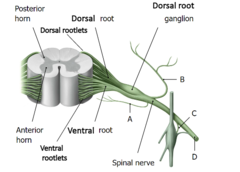
Ganglion
group of neuronal bodies outside of the CNS
either sensory(dorsal) or autonomic
Sensory Ganglia
- Dorsal root ganglion
- Pseudounipolar
- All afferent neurons
- Nerve fibers pass through the ganglion without synapsing
Autonomic Ganglion
- Motor
- Multipolar
- GVE
- Preganglionic axon-->autonomic ganglion-->postganglionic axon
Where are the preganglionic cell bodies of the autonomic ganglion located?
Lateral horn of the spinal grey matter.
How does the preganglionic axon leave the lateral horn?
Through the ventral nerve root
Where are the cell bodies of general motor axons located?
The ventral horn of the spinal cord.
Outer surface of nerve
epineurium
connective tissue
What is the epineurium a continuation of in cranial and spinal nerves?
The dura mater.
Nerve is comprised of :
fascicles covered by the perineurium
Individual axons are covered by:
endoneurium
Autonomic Nervous System function
PNS
maintenance, or homeostasis, of internal environment
Where are the cell bodies of postganglionic neurons located?
Autonomic ganglion.
Where are preganglionic cell bodies located of the Autonomic Nervous System?
lateral horn of spinal cord or in a nucleus in the brain
What are the divisions of the Autonomic NS
Sympathetic and Parasympathetic
Preganglionic Neurons of sympathetic division are located exclusively where?
- Thoracolumbar region T1-->L2.
- Lateral horn of spinal grey matter.
Postganglionic Neurons of sympathetic division are located where?
- Sympathetic chain of ganglia that lies near the vertebral column
OR
- Plexus (network of ganglion:Celiac ganglion, superior mesenteric ganglion, inferior mesenteric ganglion)
Neurotransmitter released by preganglionic sympathetic neurons
acetylcholine
Neurotransmitter released by postganglionic sympathetic neurons
norepinephrine
preganglionic parasympathetic neurons are located where
- Brain stem and Spinal cord (craniosacral region)
- In cranial nerve nuclei associated with cranial nerves 3, 7, 9, 10

postganglionic parasympathetic neurons are located where
close to where they innervate
Which neurotransmitter is released by both pre and postganglionic parasympathetic neurons
acetylcholine
Organization of the sympathetic division of the pre and postganglionic neurons
preganglionic-short
postganglionic-long
Ganglia (sympathetic chain) lies near the vertebral column.
Organization of the parasympathetic division of the pre and postganglionic neurons
preganglionic-long
postganglionic-short
Ganglia are closest to the target organ.
The _______________ __________________ is a special exception that is directly innervated by preganglionic sympathetic neurons
adrenal medulla