Chapter #8 - Tansport Layer
 Call Kai
 Learn
Learn Practice Test
 Spaced Repetition
 Match
Match Flashcards
 Knowt Play
1/39

There's no tags or description
Looks like no tags are added yet.
Name | Mastery | Learn | Test | Matching | Spaced | Call with Kai | Chat |
|---|
No analytics yet
Send a link to your students to track their progress
40 Terms
What is the primary goal of the transport layer?
Reliable, efficient, low-cost process-to-process (end-system-to-end-system) data transport, independent of the underlying network.
What are the two service types a transport layer can offer?
Connection-oriented (3 phases: setup, data transfer, disconnect) and connectionless (transfer of isolated units).
Why do we need both a network layer and a transport layer if both offer similar services?
The network service is fixed (not user-influenced); the transport layer improves its quality — e.g., adding reliability on top of an unreliable network.
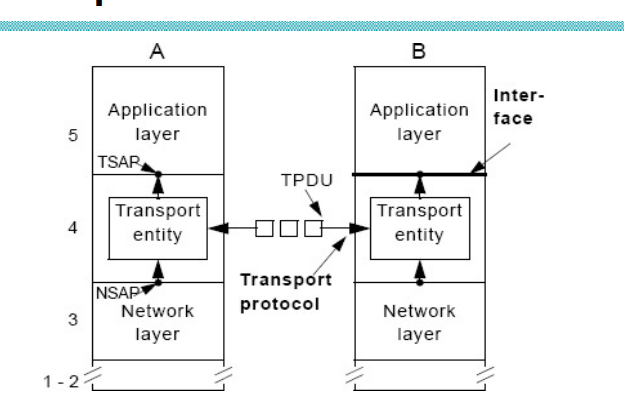
Where is the transport entity typically implemented?
In the OS kernel (as a process or library).
What is a TPDU?
Transport Protocol Data Unit — the data unit exchanged at the transport layer.
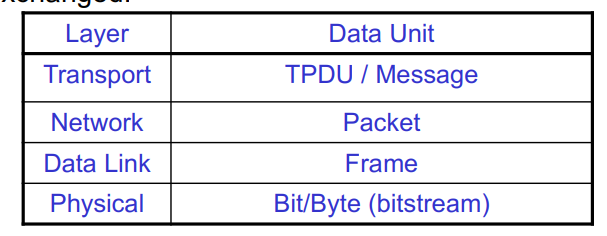
Data unit names per layer (Transport / Network / Data Link / Physical)?
TPDU / Packet / Frame / Bit-Byte (bitstream)
What is a TSAP?
Transport Service Access Point — the generic term for a transport layer address; called a port in the Internet.
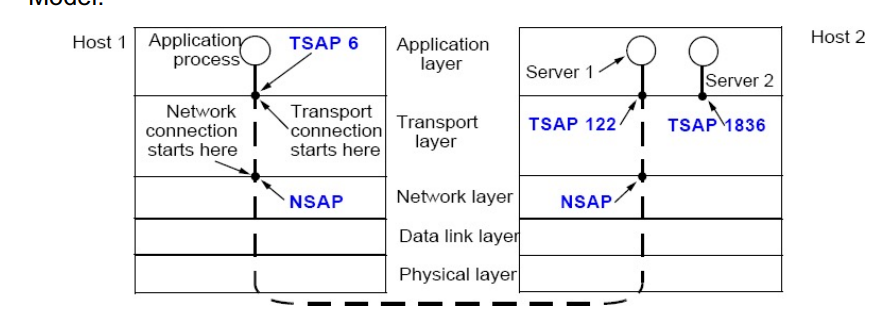
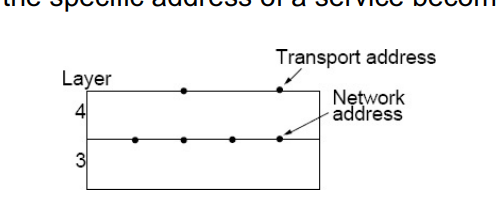
What is the analogous address concept at the network layer?
NSAP (Network Service Access Point) — e.g., an IP address.
What are the 3 approaches to finding a service provider's TSAP?
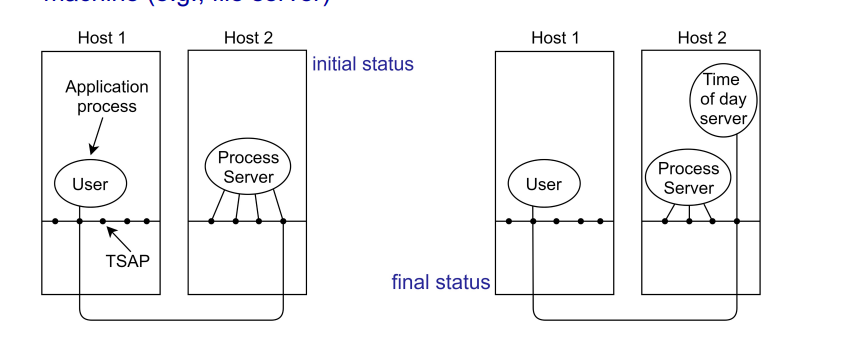
Well-known ports — pre-defined TSAPs for common services (e.g., port 13 = time of day). Simple but wastes resources.
Initial connection protocol — a process server listens on many ports, spawns the right service on demand. Good for on-demand servers.
Name server (directory server) — client asks a name server for the TSAP of a service by name, then connects directly.
What is a key disadvantage of well-known ports?
Waste of resources (rarely used servers must stay active and listening); not suitable for user-specific processes.
What is a key disadvantage of the initial connection protocol?
Not suitable if the service exists independently on a different machine (e.g., a file server).
How does addressing differ between DL and TL?
DL: outgoing router line identifies the next hop. TL: explicit addressing of the destination process is required.
How does connection establishment differ?
DL: the peer is always present (direct link). TL: reachability of the peer may be uncertain.
How does storage capacity in the subnet affect TL vs. DL?
DL: negligible storage in the medium. TL: packets can be stored anywhere and delivered much later — a serious problem (duplicates).
How does flow control complexity differ?[DL & TL]
DL: few outgoing lines → simple buffer allocation. TL: potentially many dynamic connections → flexible schemes needed.
List the 8 Berkeley socket primitives and their meanings.
Primitive | Meaning |
|---|---|
SOCKET | Create communication endpoint |
BIND | Attach local address |
LISTEN | Announce readiness to accept |
ACCEPT | Block until connection arrives |
CONNECT | Actively establish a connection |
SEND | Send data |
RECEIVE | Receive data |
CLOSE | Release connection |
What is a "duplicate" in transport layer context?
A packet that arrives at the receiver at an unintended later time — caused by varying transit times, retransmissions after timeout, network storage, or packet replication.
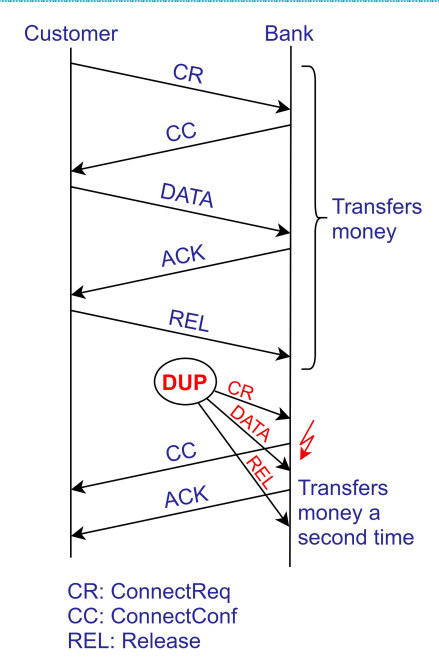
What is the core danger of duplicates?
The receiver cannot distinguish real data from duplicates → may re-execute a transaction (e.g., double bank transfer).
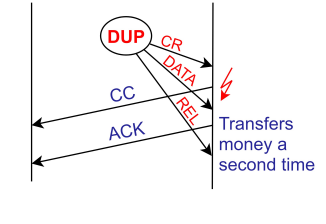
How are duplicates within a connection handled?
Use consecutive sequence numbers from a sufficiently large range (TCP uses 32-bit sequence numbers).
Why is a 32-bit sequence number range potentially insufficient today?
At 10 Gbit/s, the sequence number space wraps around in ~3.4 seconds; old packets can still be in the network.
How are duplicates handled across consecutive connections or after a crash?
Choose the initial sequence number wisely, considering the maximum message lifetime (MSL).
How do you prevent a duplicate connection request from being accepted as a new connection?
Use the three-way handshake — both sides must confirm each other's sequence numbers.
Why is a 2-message connection setup (CR + CC) insufficient?
delayed duplicate CR from an old session can cause the receiver to accept a new (unwanted) connection.
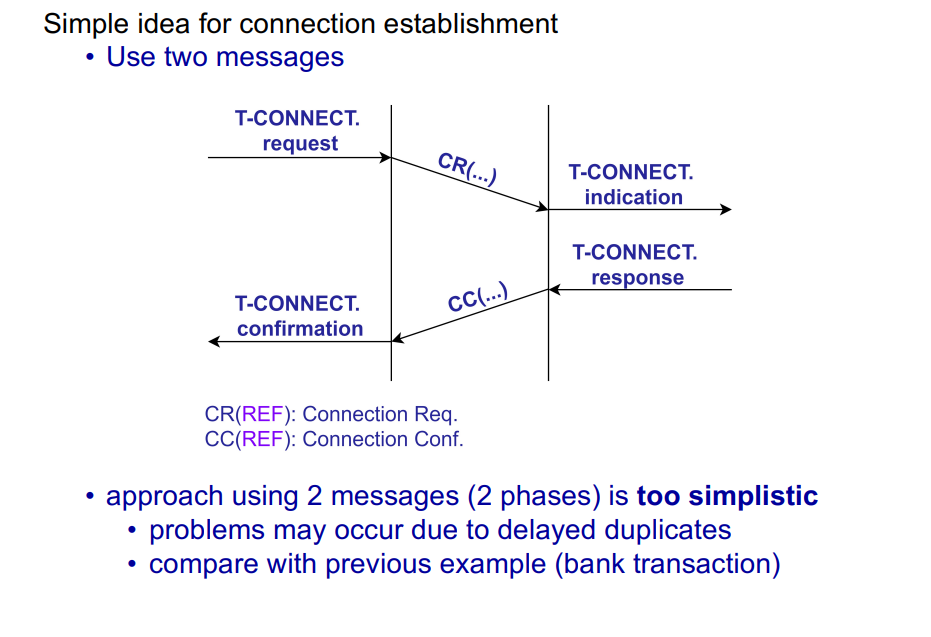
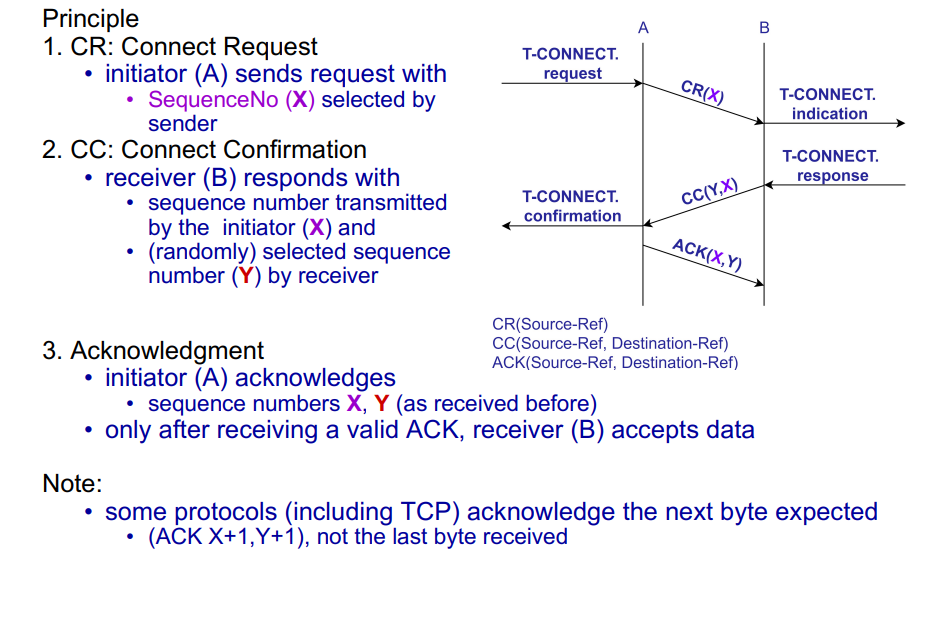
Describe the three-way handshake steps. {Transport Layer Connection Establishment}
CR(X): Initiator A sends Connect Request with sequence number X.
CC(Y,X): Receiver B responds with its own random sequence number Y and echoes X.
ACK(X,Y): A acknowledges both X and Y; B accepts data only after receiving a valid ACK.
In TCP, what does the ACK number actually acknowledge?
The next byte expected, not the last byte received — so ACK = X+1, Y+1.
How does the three-way handshake handle a duplicate CR(X) with old data?
B sends CC(Y,X); A replies with ACK(X,Z) where Z≠Y (old sequence number) → B discards it (DISCARD Z≠Y).
What are the two disconnect variants?
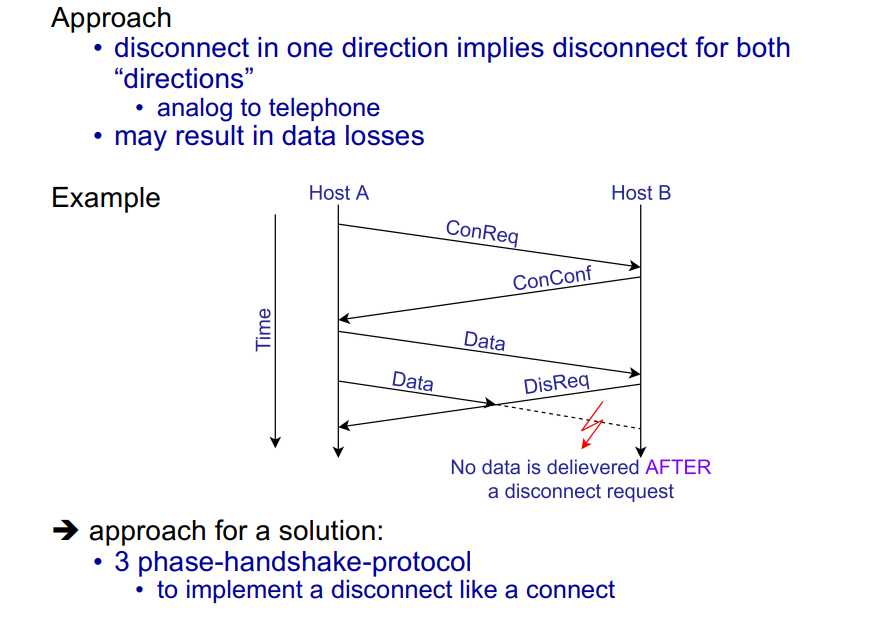
Asymmetric: disconnect in one direction closes both. Symmetric: each direction is closed independently.
What is the risk of asymmetric disconnect?
Data loss — data in transit when the disconnect request is sent is not delivered.
How does symmetric disconnect avoid data loss?
A host that has sent a DISCONNECT can still receive data; both sides must independently send a disconnect.
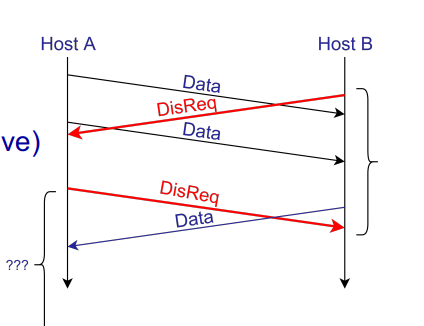
When does symmetric disconnect fail?
When a host doesn't know how much data it will still receive after sending its disconnect.
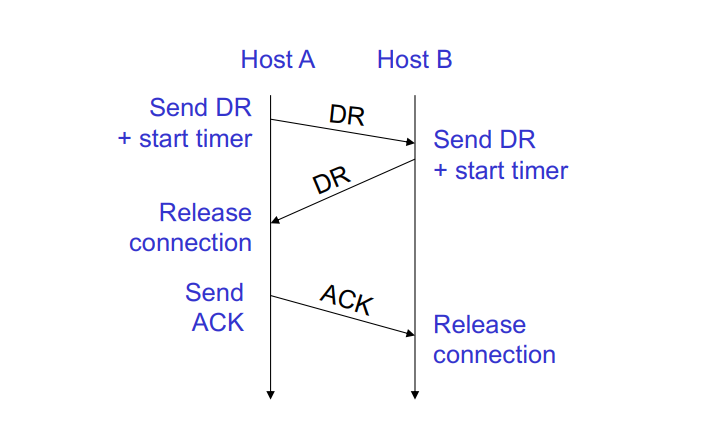
How is disconnect made reliable using a three-way handshake?
A sends DR + starts timer.
B sends DR + starts timer.
A sends ACK → both release.
If last ACK is lost → B's timer disconnects it (no problem).
If B's DR is lost → A retransmits DR on timeout; B retransmits.
If all DRs lost → both sides disconnect by timeout (N timeouts).
What is a "half-open connection"?
When one side has disconnected but the other still has the connection state — caused when all disconnect requests are lost.
How is a half-open connection prevented?
Activity strategy: if no TPDU arrives within a timeout, auto-disconnect. Keep-alive "Dummy-TPDUs" are sent to keep the connection active when no data is flowing.
What do TL and DL flow control have in common?
Both prevent a fast sender from flooding a slow receiver; both require the sender to buffer unacknowledged packets.
Name the 3 flow control strategies at the transport layer.
Sliding window / static buffer allocation
Sliding window / no buffer allocation
Credit mechanism / dynamic buffer allocation
Sliding window + static buffer allocation — characteristics?
+Receiver reserves 2·w buffers per duplex connection.
-High buffer usage, poor utilization for low-throughput connections. → Best for high-throughput traffic.
Sliding window + no buffer allocation — characteristics?
+Receiver allocates buffers on TPDU arrival; discards if no buffer available.
+Optimized memory use.
-High discard rate under heavy load. → Best for intermittent/bursty low-throughput traffic.
Credit mechanism — how does it work?
Sender requests buffers; receiver grants credits dynamically. ACK = confirmation only; CREDIT = buffer grant. Sender blocks when credits exhausted. Receiver adjusts credits based on buffer situation, #connections, connection type.
In the credit mechanism, what is the difference between ACK and CREDIT?
ACK confirms receipt only (does not free sender to send more). CREDIT explicitly grants buffer slots the sender may use.
What type of traffic is the credit mechanism best suited for?
All types — it dynamically adjusts: many buffers for high-throughput, few for low-throughput connections.