muscle physiology
 Call Kai
 Learn
Learn Practice Test
 Spaced Repetition
 Match
Match Flashcards
 Knowt Play
1/33

There's no tags or description
Looks like no tags are added yet.
Name | Mastery | Learn | Test | Matching | Spaced | Call with Kai | Chat |
|---|
No analytics yet
Send a link to your students to track their progress
34 Terms
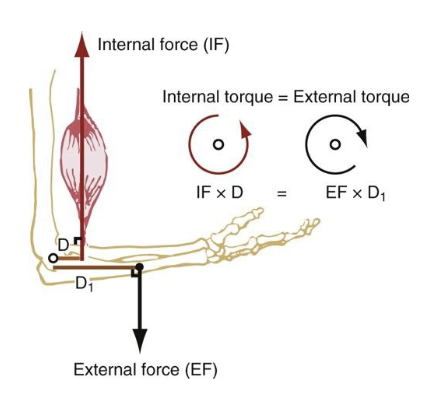
joint torque is product of _____________ & _____________
muscle force & moment arm
4 steps of force production
neuromuscular transmission
excitation-contraction coupling
cross-bridge cycling
Ca2+re-uptake & relaxation
neuromuscular transmission
nerve & muscle tissue are excitable (can conduct APs)
AP in alpha motor neuron causes release of Ach from presynaptic nerve terminal
Ach binds to receptors in end plate, causing depolarization of the end plate
if depolarization reaches threshold, an AP is generated, which travels along sarcolemma into T-tubules

excitation contraction coupling
PASSIVE PROCESS
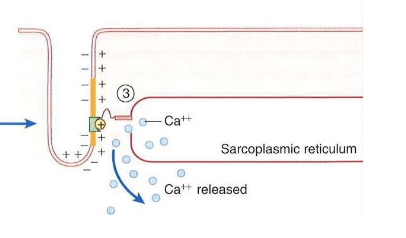
AP sensed by dihydropyridine (DHP) receptor on T-tubule
DHP causes conformational change in ryanodine receptor (RYR) on SR, causing release of Ca2+ into sarcoplasm
cross-bridge cycling
Ca2+ binds to troponin, causing a shift in the position of tropomyosin on actin
tropomyosin shift exposes myosin binding site on actin
myosin cross-bridge binds & interacts with actin
at rest, myosin head is cocked, but in the presence of Ca2+, myosin binds to actin & Pi is released
myosin power stroke causes filaments to slide; ADP is released
ATP binds to myosin head, allowing it to release actin
ATP is hydrolyzed as myosin head returns to cocked position
cross-bridge cycling clinical connection - rigor mortis
depletion of ATP → crossbridge can not release from actin binding site → stiffening of the muscle
Ca2+ re-uptake & relaxation
Ca2+ pumped back into SR by SERCA pump
ATP consumed by pump/active transport
Ca2+ in sarcoplasm falls, tropomyosin shifts & covers active site on thin filament
time to peak tension
30-100 msec
twitch time is affected by the _____________________
series elastic component
what causes the series elastic component relax?
when Ca2+ is re-sequestered
one sarcomere produces ______ of force
1 pN
one sarcomere spans ______
1 uM
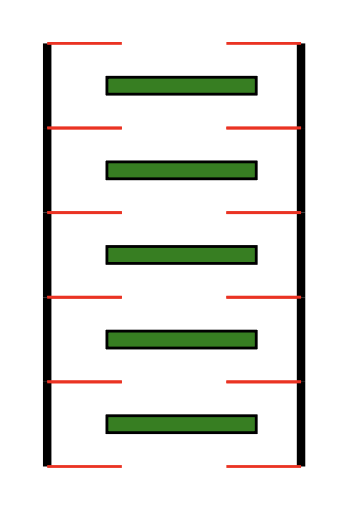
sarcomeres in parallel
sarcomeres in series

how does pennation angle affect the abilities of a muscle?
affects orientation of sarcomeres with respect to tendon
decreases the force transmitted from fiber to tendon
why are our strongest muscles pennate?
there are more fibers per amount of surface area
when fibers are longitudinal (fusiform) …
cross-sectional area indicates number of sarcomeres in parallel (proportional to force capacity
muscle length indicates number of sarcomeres in series (proportional to excursion & shortening velocity)
when fibers are pennate …
physiological CSA accounts for pennation angle & is proportional to force capacity
fiber length indicates number of sarcomeres in series (proportional to excursion & shortening velocity)
soleus fiber length is ________ (short/long), but physiological cross-sectional area is ________ (small/large)
fiber length is short, but physiological cross-sectional area is large; propels entire body forward, but experiences little excursion
sartorious fiber length is ________ (short/long), but physiological cross-sectional area is ________ (small/large)
fiber length is long, but physiological cross-sectional area is small; large excursion during gait, but produces little force
resting muscle is elastic, as it is stretched, ___________ increases
tension
tension results from elasticity of _____________
parallel elastic component
passive insufficiency
when a multi-joint muscle cannot lengthen enough to allow full movement at all the joints it crosses at the same time
example of passive insufficiency
when the hip is flexed, hamstring length can restrict knee extension ROM
passive tension in lengthened muscle can ______________ & ______________
stabilize joints & compensate for muscle weakness
how does muscle length affect force generating capacity?
length determines degree of myofilament overlap, which affects the number of cross-bridges formed, & therefore the amount of force produced

total force = _______________ + _______________
active force + passive force
the joint-angle torque relationship reflects combined effects of changes in _______________ & _______________
changes in moment arm & muscle length

active insufficiency
the inability of a multi-joint muscle to generate maximum force when it is shortened across all the joints it crosses at the same time
lengthening = ___________ (positive/negative) work
shortening = ___________ (positive/negative) work
lengthening = negative work
shortening = positive work
a muscle’s capacity to produce force is a function of what 3 variables?
physiological cross-sectional area
muscle length
velocity of contraction
PCSA is proportional to _________________
the number of sarcomeres in parallel
what does muscle length determine?
degree of myofilament overlap
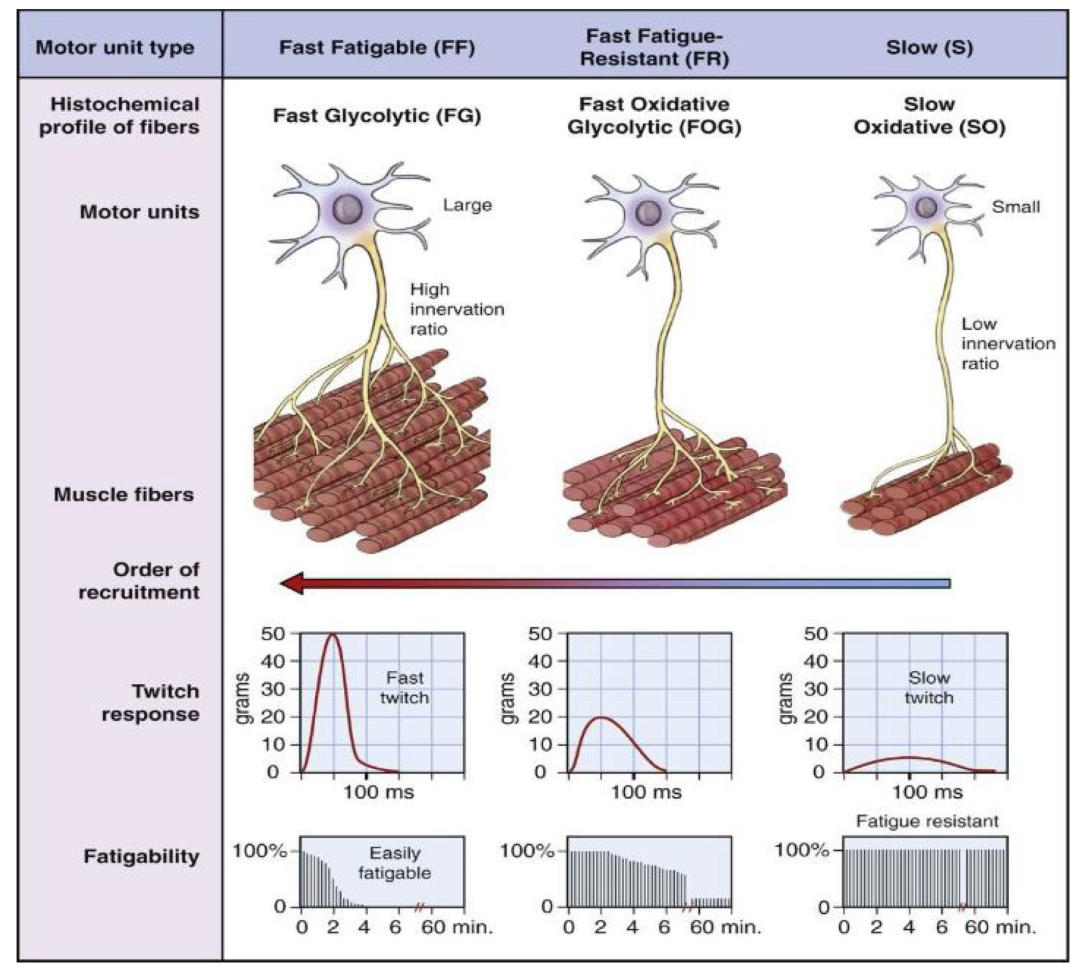
chart of motor unit types