BIOL112: Ecology
 Studied by 0 people
 Call Kai
 Learn
Learn Practice Test
 Spaced Repetition
 Match
Match Flashcards
 Knowt Play
1/94

There's no tags or description
Looks like no tags are added yet.
Name | Mastery | Learn | Test | Matching | Spaced |
|---|
No study sessions yet.
95 Terms
what is ecology
the study of all processes influencing the abundance and distributions of organisms
the interactions between living things and their environment (either living or non living)
is a hierarchy of studies looking at these aspects at different scales
what are the general abiotic factors affecting species distribution for
terrestrial organisms
aquatic organisms
(terrestrial) temperature, precipitation (water availability)
also elevation, soil tupes
(aquatic) nutrient availability, light
also depth, salinity, oxygen, soil types, pH
for species environmental limits, define…
optimum range
range of tolerance
limits of tolerance
zones of stress
(optimum range) a certain level for each condition where organisms grow / survive best, vary between species, can be broad or narrow
(range of tolerance) the range for each condition allowing for any growth
(limits of tolerance) the upper and lower ends of the range of tolerance - past this, death / no growth occurs
(zones of stress) areas within the range of tolerance, but between the optimum range and the limits, where survival is possible but not optimal (physiological stress / less growth occurs)
what do species environmental tolerance levels dictate?
what field studies this
the population density (no of individuals at a given space), which is greatest in areas with conditions in the optimal range for the species
the geographic range, based on the series of various optimums for conditions, and the geographic areas these correlate to (combined with condiserations of biotic factors)
biogeography (the study of geog distr. of species and the abiotic factors affecting distr.)
name some abiotic factors
solar radiation, angle of incidence, water oxygen, air oxygen, temperature, humidity, precipitation, topography, altitude, salinity
name the geographic patterns in abiotic factors for terrestrial systems
what do these collectively dictate
latitude
altitude
lognitude
seasonality
wind patterns
surface currents
geography / topography
rain shadows
these collectively dictate the patterns of biodiversity seen around the world, and the geographic distributions of each species
define abiotic factors…
latitude
longitude
altitude
how may these affect species dispersal
(latitude) N/S distance from equator, major pattern of decreasing temperature with distance
(longitude) E/W distance from prime meridian
(altitude) height above sea level, major pattern of decreasing tempreature and increasing precipitation (but is maintained as snow)
define abiotic factors…
solar angle of incidence
wind patterns
surface currents
how may these affect species dispersal
(solar angle of incidence) creates seasons, when stronger at an area we have more light (days longer, more temperature and variation in it) - varies with latitude (less variation at equator due to low tilt here)
(wind patterns) where these blow from either bring cold / warm, strong / weak, dry / wet - winds, affecting temperature, moisture, species dispersal
e.g. NZ winds mainly from Aus, so most natural colonisation of species was via winds and currents from Aus
(surface currents) driven by wind patterns, forming the ocean’s gyres (circulating currents) - dictating water temperature and nutrient avialability in different areas
define abiotic factors…
geography / topography
how may this affect species dispersal
what phenomenon does this cause
things like mountains, as lots of things change with elevation (lower pressure so gas move around more and lose energy feels cooler, lower temperature, moisture locked as snow, wind)
creates distribution gradients up mountains (Extreme change in abiotic conditions, creating grouped areas of conditions)
creates rain shadows as air (cool, ocean, wet) moderates shore temperature, then gets pushed up the mountain, releasing water from air as rain, then as this air (dry, warm) moves down the leeward mountainside there is no rain left
e.g. Tibetan Plateau, has Himalayan Mountains with wet rainforests one side, and deserts the other side
e.g. NZ Southern Alps, prevailing western wind hits these, water dumps on West Coast, dry over to Canterbury (dry)
define abiotic factors…
salinity
water movement
name the different types of each
(salinity) salt content of water, marine (oceans / seas) vs freshwater (lakes / rivers / wetlands)
(Water movement) open systems (marine) vs freshwater flowing (lotic = rivers / streams) vs freshwater still (lentic = lakes)
define the abiotic factor…
light
how does this change with geographic patterns
in aquatic systems, decreases down the water column, but also loses wavelengths (e.g. Red doesnt make it down to the depths as visible light, less and less colours)
pressure also increases with depth
e.g. Red deep sea species as these pigments camoflague (red dont make it down as visible light)
also decreases with latitude, as light also affects temperature (decreases with latitude), with the equator having more light, thus being hotter
define the abiotic factors…
oxygen availability
pH
(oxygen availability) in aquatic systems, higher at the surface (oxygen from air dissolves in), also affected by organism abundance (some take in oxygen, some add oxygen), and due to surface currents (Transport oxygen around)
(pH) affects both aquatic and terretestrial (water pH vs soil pH), certain pH needed for cells to function so this alters tolerance
what is a biome
how do abiotic factors affect these
what else may affect these
a way of categorising a combination of abiotic factors into a landscape
defined / classified based on the morphological / physical traits of the dominant types of organisms found here, combined with the abiotic factors (e.g. rain forest, temperate grassland)
so key abiotic factors can be used to predict the type of biome of a landscape (And thus use to predict the organisms found here based on tolerance ranges)
this can be done by plotting the data of abiotic factors and biomes they create, to show how the variation of these factors due to global gradients, create diverse biomes across the world
however, similar abiotic conditions can house vastly different communities / ecosystems, based on geographic / abiotic history, human influence, etc
what is a global gradient in biomes / landscapes
correlates with latitude, species richness decreases with latitude (decreases equator → poles)
due to the tempearture also decreasing across this gradient
seen with most groups of organisms (e.g. birds, insects, mammals)
what factors have caused NZ’s unique biota
isolation
temperate & oceanic climate
mountains
history of major disturbances (tectonic, glacial)
moderately infertile soils
last major land mass to be inhabited by humans
why is NZ considered isolated
far from other islands - therefore seperate from other terrestrial / freshwater / shallow marine habitats / rocky intertidal areas, organisms here prevented from dispersal (deep ocean barrier)
lots less landmass on our side of the world compared to the opposite
what are the two types of allopatric processes
how would these apply to the origin of species on NZ
(vicariance) a group of a population is seperated from being split by something over time forming a natural barrier - resulting in a new species forming
e.g. when NZ seperated from other landmasses, the species already present were isolated from their previous species, and evolved seperately - resulting in the biota of today
(dispersal) a group of a population is seperated as they move away from the original population, over a barrier - resulting in a new species forming
e.g. when NZ had seperated from other landmasses, species travelled here from Australia etc, became isolated, and evolved seperately from original population - resulting in the biota of today
name the 5 phases in developing NZ’s land mass
describe these changes over time
(supercontinent) ~237MYA all land was in a Supercontinent
(seperation into Gondwana) ~152MYA tectonic plates and continental drift broke this into 2 continents (Gondwana & Laurasia)
species present here where isolated
(seperation of Gondwana) ~94MYA NZ broke apart from Gondwana (Australia) as Zealandia, as the Tasman Sea begun to open and widen
species present here were isolated
(Oligocene) ~25MYA, Zealandia was relatively low lying with few mountains, but techtonic action and sea level rising caused it to drown, so little land above sea was available
killed many species
(Miocene) ~10MYA, tectonic activity (plate boundary collisions & lateral displacement) acted to form mountains (Southern Alps), saving NZ from its drowning
killed species but promoted new evolutionary conditions - new abiotic factors opened
(Glaciation) ~2.5MYA, an ice age so glaciers expanded and shrunk on the South Island, and the sea levels rose and fell (split with ~20 short interglacial periods, warmer with higher seas) - many shifts in land availability / abiotic conditions
killed species but also promoted new evolutionary conditions
what major disturbance happened to NZ in the Miocene period
what consequences did this have for our biota
provide some examples
the tectonic plates colliding & laterally moving to form the Southern Alps
opened up many new habitats / environments / subjected organisms to new abiotic factors, resulting in evolution to fit into these new niches, rapid speciation / radiation for some
e.g. Hebe rapid speciation / radiation
formed a geographic barrier between species on each side of the island, preventing movement and promoting speciation
e.g. Cicada genetic patterns on East / West splits along the Southern Alps
created unique conditions to form unique biota
e.g. Alpine Parrot (Kea), due to having Parrots that evolved to inhabit alpine environments, after being subject to this with the mountain formation
e.g. Giant Vegetable Sheep, extreme temperature surviving terrestrial plants, with adaptations of low-growing shoots to create a shared microclimate in the population, reducing SA exposed to dry air / wind / water loss (adaptations to alpine conditions)
why did NZ lose some species that are still present in Australia today
NZ had glaciation (promoted a cooler climate) so it was out of the temperature tolerance zone for these species
meanwhile, Australia drifted towards the equator (Temperature increased), so these species were able to survive
how are our native species made up
what evidence would support a species being a classic Gondwanan survivor vs dispersing here after the split
give an example of each scenario
a mix of Gondwanan survivors, and more recently evolved groups - however, could have either been here since Gondwanan split, or moved here from Australia after the split
distinguished with DNA evidence, looking at speciation events and divergences
e.g. Native Beech Trees, very similar to other Beeches in places that were once Gondwana (shown by fossil records seemingly as far back as Gondwana) suggesting vicariance, however DNA evidence found the current species arose in 2 events many years after Gondwana split - therefore the ancestral species died out when NZ split, but then dispersed back here (forming a new genus related to the ancestral lineage)
e.g. Kauri trees are an actual Gondwanan survivor (as far as we know)
e.g. Abrotanella (cushion plant) an actual Gondwanan
however knowledge is constantly changing as new evidence is found
name the 5 unique features of NZ plants
describe each
large proportion of species are trees
compared to globally / other temperate areas, so thought to be due to the in between of temperate / tropical conditions due to our geographic history
few species are deciduous
thought to be due to our oceanic climate, doesnt get as cold here as it could, so leaves can still photosynthesise on cold and less sunny days, and our soil is low fertility so it is energy costly to lose and regain our leaves
common plant x bird / plant x lizard mutulisms
compared to elsewhere, unusual to rely on brds for pollenation (e.g. bell-shaped flowers to fit bird beaks) and seed dispersal (via fruits), may be due to less diversity in pollenator insects / seed dispersing mammals found elsewhere
simple white flowers are common
compared to elsewhere, likely due to fly or native bee pollenators being common (attracts them)
traits to avoid herbivory are common
to avoid herbivory from our bird domination vs typical mammals (e.g. divaricating shrub species, hard to browse on when small, then when large grow a new set of leaves - dimorphism - as at this point they have avoided herbivore pressure)
why are NZ Falcon (and similar birds) threatened?
what is a real conservation method NZ Falcon were used for
despite being top native predators (fast, agile, very successful at hunting prey), they have traits that make them vulnerable to introduced mammalian predators
so are now confined to the high country (once found all around NZ)
this is due to ground nesting traits, laying eggs on the ground so they can be easily eaten by mammals
this was advantageous for warmth / no eggs falling / hidden from other avain predators (Haast Eagle, Owls Etc) - no risk for predation on the ground, uniquely involved to this unique system
e.g. Marlborough efforts to introduce NZ Falcon to put a predator into the vineyard plains ecosystem, as these Falcons have been driven out, and the birds remaining are damaging the crops
why was ground nesting / flightlessness once a beneficial adaptation for NZ birds?
flying has an energetic cost, so if not needing to fly, there was selective pressure to be ground-living / flightless
in this system, predators were avaian from the skies, so being hidden on the ground was advantageous
what is island endeism
what are two other traits that arise from this
the idea that endemic species are common in islands, due to isolated environments preventing gene flow
results in K-Selected life histories favored, and unique behavioural traits - and weird physical traits
(gigantism) results in really big species
(dwarfism) results in really small species
why does NZ have no mammals
the rise of mammals occurred AFTER NZ had split and become isolated, and this isolation meant mammals were unable to disperse here
how did exotic species arrive in NZ
give the main examples and stages
what are the consequences
(Maori settlement) brought rat and dogs (the first mammals)
this caused rapid extinctions of many native species (e.g. Moa, Flightless Wrens) especially on major islands (offshore islands were isolated)
(European settlement) introduced various animals and plants for various reasons (food, hunting, make it like home, pest control for previously introduced species) e.g. rabbits, weasels, stoats, hedgehogs
describe NZ’s Marine Biota
very unique, vast, and important
may go all around the world, but being endemic they come back to breed in NZ
e.g. many endemic marine fish in our shallow seas / coasts
e.g. many unique inveretbrates (e.g. paua, coral, sea snails)
e.g. many marine mammals (e.g. hectors dolphins, maui dolphins)
e.g. many semi-terrestrial marine mammals (e.g. seals, sea lions)
e.g. many seabirds (considered seabird capital)
name the 8 patterns of unique features in NZ animal (vertebrate & invertebrate) Biota
describe each briefly
ancient lineages / prehistoric traits
remained unchanged throughout evolutionary time (e.g. Tuatara, Velvet worm)
extremely long / absent migration
our isolation makes it hard to migrate physically (time costly, impossible if freshwater as we are surrounded by saltwater) (e.g. Eels spend most of life in freshwater systems → migrate to marine near Tonga → breed and die → offspring return to freshwater) (e.g. Godwits, spend their winter in NZ → Alaska to breed in their summer → back to NZ via wind patterns)
giant / tiny
common in Island Endemism (e.g. Moa & Kiwi, smallest in largest in Ratti bird group of ostriches and stuff, largest snail species)
convergent evolution
many signs of convergent evolution in birds to fill the role of mammals or other species not seen in NZ due to filling a similar niche, involving evolving unique traits compared to related species elsewhere
k-selected traits
more common here than elsewhere, highlighting struggle of rapid predator introductions (e.g. 50YO NZ Geckos, Kakapo), long-lived adults, long reproductive period, low reperoduction
flightlessness
evolved many seperate times (convergent) compared to other landmasses, selective advantages of flight being costly / hard to herbivore (heavy as must eat lots of plants to get the same nutrients) - so lack of ground predators opened this niche (e.g. Bats spend more time on ground, Kiwi, Moa)
nocturnal
numerous species where their overseas relations are not nocturnal, evolved due to selective pressures of many diurnal avaian predators (e.g. Kiwis, all 3 NZ frogs are nocturnal)
lack of fear of mammals
mainly documented in birds, compared to continental introduced species (do show fear) - do show good anti-predator avoidance and fear of birds (evolved as a threat)
smelly birds
appear to smell more strongly compared to related species elsewhere, due to lack of selection against having a smell (bird predators hunt with sight)
unique selection of species groups
lots of radiation in the species that managed to reach NZ after split, but also missing lots of species - some overrepresented, some missing (e.g. Geckos, Skinks, Songbirds)
define behaviour for an organism
what is this influenced by
what does this go on to influence
(definition) the way an organism acts in a particular sitution
crucial to an individual’s survival / fitness / interactions between species
(influenced by) genetics (natural selection from the species environment - abiotic factors & biotic interactions)
(influenced by) learning (experience in their lifetime)
(go on to affect…) species distribution / abundance
what are the 4 questions for Animal Behaviour
what are the 2 groups these fit into
who’s questions are these known as
Tinbergen’s Four Questions about Animal Behaviour - guiding concepts / outline / framework for studying Animal Behaviour
HOW behaviour works (development, physiology)
WHY behaviour evolved (function, evolution)
(Proximate Causes)
occur in relation to events happening during an individual’s lifetime - ‘how’ questions, how a behaviour works
(Mechanism) what environmental stimuli / physiological factors are responsible for short-term behavioural changes
e.g. found a new behaviour to be helpful, so repeats it more - staying still to avoid predators
(Development) how does behaviour change over the lifetime of an individual
e.g. change this behaviour in different circumstances - adapt it for new predators
(Ultimate Explanations)
‘why’ questions, why the behaviour evolved in the first place, and how it affects populations (like fitness relative to other populations with/without the behaviour)
(Function) what is the adaptive significance of this behaviour? how does it affect survival and reproduction?
e.g. stay still to avoid predators → increases survival → increases reproduction → pass on genes for this behavioural trigger
(Evolution) how has current behaviour been shaped by natural selection over time for the whole population? how has behaviour in the poplation changed therefore?
how does Natural Selection affect Animal Behaviour?
provide an example
apply the 4 questions to this example
Natural Selection acts to favor behaviours that increase fitness of individuals, survival and reproduction, causing evolution within a population to favor different genetics
(E.g. Mamushi Snakes)
have been hunted for humans for more than 100 years, anecdotal evidence showing populations are declining, but fast adaptation in behaviour has been observed over 100 years
this hunting causing selection for individuals with certain genetic characteristics (mutation allele / genetc switch) - phenotypic selection for snakes to flee earlier in areas of hunting VS areas in no hunting, where snakes are likelier to stay and bite
this must be genetic, as if a snake gets caught it is killed, so has no possibility of teaching against this behaviour to future generations
(Mechanism) sight or sound of human approaching
(Developemntal) - doesnt really apply
(Function) fleeing from snake hnters increases survival, reproduction, and passes on this gene
(Evolution) staying and biting was previously successful to non-human predators, but now fleeing is beneficial to survive human predators
how are Senses influential to Animal Behaviour?
how does this affect evolution
provide an example
different stimuli are differently important to different species depending on evnrionments and lifestyles
therefore different sense organs are evolved, as having them all would be costly to build and maintain, if not all in use - driven by natural selection as to what increases survival in their environment
(E.g. Bats)
complex behaviours, but differ between species, due to sense organs evolving in different ways to different environments due to different selective pressures
this has resulted in different face morphologies between species, which have the function of guiding ultrasonic sounds into their ears, which differs in source, function, echo of the environment etc, depending on the environment
name 10 different stimuli
give an example of how each affect animal behaviour
(Light)
colour seen differently in all organisms, driving interaction with the environment
altered with eye morphology, rods (low light, respond faster, no colours) vs cones (detect colour) - some have both or only one type
different eyes pick up different frequencies of light (e.g. birds & insects = ultraviolet, bees = ultraviolet but no red)
altered with eye position, differ depending on where the visual world needs to be seen (e.g. forward for humans vs wrap-around for birds)
(Magnetic Fields)
important for animal migration, often more so than visual cues
e.g. Homng Pigeons return home regardless of landscape change
(Heat)
e.g. Snake Pit Organs contain membrane to detect IR (heat) - mice prey
(Sound)
e.g. Bat developed faces to funnel in high pitch bat communication
e.g. Owls developed funnelling face structure to funnel in prey sound (hunt at night so no sight) AND asymmetrical ears (hear the distance of prey in vertical plane)
(Scent)
uses in navigation
e.g. Mammals, commucate with scent signals (territories for intraspecific, track prey scents for interspecific)
(Chemical)
release chemicals that signal something to receptors of other individuals, causing behaviour to occur
e.g. Catfish & Minnows release of alarm substance in skin when injured → fright response among other fish
(Touch)
e.g. Sea Otters, sensitive paws to enable rapid decision making when grabbing on to food, whether to take it or not
(Electric Fields)
using disturbances in these to detect nearby objects / prey / etc
e.g. fish, sharks, rays, dolphins, Electric Eel (Generates voltage currents to detect / immobalise prey / deter predators)
(Taste)
identifying food sources
e.g. human tongue, Catfish whole skin (sense the environment from surrounds), insect feets (land on food from on top)
define Signals & Communcation in Animal Behaviour
what is their purpose
give examples of different uses
(signals) stimuli from one animal that cause a change in behaviour for another animal
(communcation) the reception and response to signals
(purpose) to transmit information, based on lifestyle & environment, which in turn influence other parts of the environment
(Specific Examples)
(Mating)
(Resource Location) e.g. Honeybee Waggle Dance
(Cooperative)
(Appearance) brightly coloured to signal poisionous, may be used to mislead if mimicking another poisonous one - signals other animals not to eat
what is learning
name 4 types of learnt behaviour
(learning) the modification of behaviour based on specific experiences with environmental events, ranging from simple to complex (something around you, affects something you do)
imprinting < spatial learning < associative learning < cognition and problem solving
what type of experiments can distinguish learnt behaviour?
why do we need 3 treatment groups for these?
experiments are carried out, giving some parts of the population specific experiences, and observe their behaviour compared to the control group behaviour (no experience / intervention)
control group gives something to compare to as a baseline
we also need a third treatment group (control experience), who recieve the experience but without the FULL environmental impact / stimuli
this allows us to distinguish - is it the environment itself causing this effect, or is it the factor (e.g. blindfold and spend time in nature vs spend time in nature vs not spend time in nature)
this considers the genetic factors behind the behaviour, if any genetic changes are being undergone
what are innate behaviours
how are they developed
what are they opposite to
opposite to learnt behaviour
instinctual behaviour relatively unaffected by the environment / experiences, largely genetic (evolved from years of NatSec)
does not need to be practiced, however it can improve with experience
are selected for as those without these behaviours would die, they are that critical to survival, so only those with the genetics to do the behaviour will survive - thus becoming innate
what is a fixed action pattern (FAP)
a more environmentally informed behaviour than innate behaviour, but still largely genetic
these are a sequence of unlearned / innate behaviours, that are relatively unchangeable, being carried out to completion once initiated
HOWEVER, are triggered by an external stimuli (sign stimulus)
give an example of innate behaviour
(turtles) babies hatch and know what direction to move towards sea, if unable to do this behaviour they’d die
(deer mouse & beach mouse) burrow short and long with an escape tunnel respectively, found to be innate with lab-raised mice, never exposed to sand / soil / others burrowing (no teaching / learning), still able to burrow their respective style
(three-spined stickleback) males get red bellies in mating season, which innately stimulates other males to act aggressive towards it based on this visual stimuli of red triggering brain signal to attack- even acting aggressive towards half red clay circles (thought to have adaptive significance as those who attacked, scared off others, so were likelier to reproduce & pass on aggression)
(human yawning) visual stimuli of yawning invokes innate behaviour to yawn
(herring gulls) chicks have innate behaviour to peck at the parent’s bill, provoking it to release food - babies without this behaviour would get no food, so would not survive
where does migration fit on the innate (Genetic) → learned (Environmental) behaviour spectrum?
innate in some species, learned in others, a combination of both in others
can involve some components of environmental cues, with genetic variation - is an evolved response to variation in resource availability between seasons, therefore is critical for survival (selected for)
but sometimes is more learnt, some species learning to stop in places with better food (environmental stimuli of good food makes them come back / bad food find somewhere else) - if just innate they would only go to specific places
therefore depends on species (happens in every animal group so lots of variation)
give an example of a FAP
(greylag goose) innate behaviour to roll eggs back into their nest when rolled away, which once started must be completed in a specific way
thus innate and FAP - selection cemented this behaviour as those who could roll back their eggs, ensured their protection, so ensuring passing on of genes to survivng offspring
describe Taxis & Kinesis
what type of behaviour is this
provide an example for each
these describe the innate ability to follow a stimulus to find conditions required for survival - those unable to do this die, so these behaviours are innate (Due to NatSec)
(Kinesis) study of undirected movement in response to a stimulus
e.g. Woodlouse requires wet conditions for survival, so in response to dry stimuli, will move undirectedly rapidly, and will move less and less with more moist conditions
(Taxis) study of directed movement towards or away from a stimulus
e.g. Euglena (photosynthetic microorganisms), require light for survival (photosynthesis), so when exposed to light they move towards it
what is supernormal stimuli
what behaviours does this relate to
provide an example
when evolved preferences do not always match the exact stimulus, so unrealistic / exaggerated stimuli can enact innate behaviours to
so picking and choosing stimuli, only certain ones enact the innate behaviours, like colour but not size etc
e.g. innate behaviour for bird to look after egg, doesnt necessarily mean innate behaviour to look after an egg of their exact size / characteristics (experimenters found them to care for large eggs unlike their own)
e.g. chicks innate behaviour to peck at parent’s bill, instead peck at a red pencil
what is imprinting
where does this fit on the innate → learned behaviour spectrum
how does this relate to the 4 questions
involves both learning and innate components, but is a generally irreversible form of learning where behaviours can only be learnt in the sensitive period (limited phase in animal development) - informed by both environment and genetics
(proximate causes) during the sensitive period, the animal recieves a stimuli from the environment (environmental component, some action the parent has done)
e.g. baby geese see mother walking away
(ultimate causes) when this stimuli is enacted upon in a certain way, they have a greater chance of survival (some genetic component)
e.g. baby geese follow and imprint on their mother, causing a greater chance of survival - recieve care and learn survival skills
give an example of imprinting
what are its implications for conservation
(songbirds) some birds raised in isolation hearing no song, will produce a different song than birds in the wild - showing innate behaviour (singing) shaped by learnt behaviour (hearing style of song from neighboruing birds)
(zebra finch) females imprinted on (artifically) ornamented males preferred ornamented males as mates, but offspring showed no preference (informed by learning, from genetic behaviour of mate selection)
(conservation) shows importance of taking care so captive birds dont imprint on humans and learn the wrong skills (e.g. Kakapo hand raised then wanted to mate with humans), sometimes humans have to artificially imprint however (e.g. swans - fly a swan-like vehicle away to teach migration, Takahe chicks - fed by glove puppets
describe spatial learning
where does this fit on the innate → learnt behaviour spectrum
learning from environmental stimuli, to optimise where they go in space, to maximise their ability to survive - therefore further towards the learnt end of the spectrum, but still has genetic components
important as environments are patchy, so may reduce their ability to provide stimuli required for innate / partially learnt behaviors - this instead relies on gaining behaviours based on recognising spatial relationships between objects, in an environment
e.g. visual stimuli involves learning landmarks of the environment, associated with something that benefits / harms survival - so is selected for
extent varies with species, some can move around lots until finding good stimuli (e.g. hummingbirds, bees), while some can only move a little or will get lost (e.g. tunnel spiders) - for some species was less evolutionarily important
(digger wasps) use visual cues of landmarks for their nest location, experimented on by surrounding nest with pincones then moving to a new location with no nest - they still followed the pinecones
(nutcracker birds) collect and bury pine seeds to dig up and eat in winter, can remeber locatin of ~70%, even when covered in snow
define associative learning
where is this on the spectrum of innate → learnt behaviours
provide an example
learning to associate one stimuli with another - learning a cause & effect / correlation relationship
e.g. toxins in brightly coloured organisms, makes species feel sick if ingested, so they learn not to eat these species with bright colour visual stimuli (Taste / Chemical vs Visual stimuli)
e.g. Blue Jay x Monarch Butterflies - causes sickness so learns not to eat more, distinguished by their bright colours
what is social learning
provide an example, and describe the experiment that distinguished this
learning to behave in certain ways in response to certain stimuli, based on teachings of others in their species / social group (cultural transmission)
adaptively beneficial, as if one individual learns a survival beneficial behaviour, other individuals learning this will increase their survival too => survival success of the overall population / species will increase
(Blackbird Predatory Call)
Blackbird predators are Little Owls, who prey by sneaking, so when seen, Blackbirds will call to attract other birds - mobbing the Owl and exposing its sneak (benefitting survival)
Experimenters put 2 birds in the same area, but one exposed to a Little Owl (Taxidermy) visual stimuli, and one exposed to a Friar Bird (Taxidermy) visual stimuli - a species unknown to them
Birds seeing the owl made predator calls, resulting in the other bird showing danger responses to the Non-Predator - associating the visual stimuli with danger, from social learning
this could occur down a learning slope (through upto 6 different birds), to teach more birds that the Non-Predator was dangerous, even with new Non-Predators, and even objects (a bottle of detergent)
what is animal cognition
where does this fit on the innate → learned behaviours spectrum
provide an example
the ability of an animals NS to percieve / store / process / use information - gathered by sensory receptors from external stimuli
higher order problem solving skills, the ability to learn then apply it to various novel (new situations) - requiring awareness / reasoning / recollection / judgement
(Honeybees) were trained to go to a matching colour for food, but could thereafter generalise and go to a matching pattern, so they were able to distinguish same-same = food, shwoing the concept of same vs different, and learning then applying to a new situation (visual cue of colour → pattern)
(Ravens) learned to hold a string and pull up food
(New Caledonia Crows) can use tools and pass tests that 5-6yrold children can begin to pass - showing a similar level of problem solving
(Kea) well known curiosity, can use tools (using sticks to set off stoat traps to get the food within), can do these problem-solving tests at a 5-6yrold human level, can do probability / playing the odds tests which guage their ability to percieve and use probability
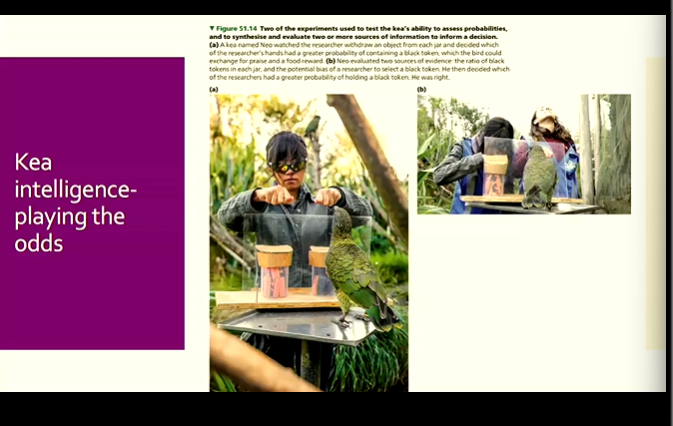
what is foraging behaviour
how is this developed and refined
behaviour around recognising / searching for / capturing / handling / eating food items - associated with lots of cognitive behaviour
is greatly important for survival, so refined by natural selection to enhance efficiency
acts to favor different adaptations to increase feeding efficiency (form for function)
e.g. Galapogos Finch beak depth & size, differs between species, as they inhabit different islands with different size / hardness of seeds available as food - also are altered in response to competition when in environments with multiple species
can be cooperative, working together with others to obtain food - beneficial to take down larger prey to get more food - costly as more individuals need to be fed - so tradeoff is considered and depends on species & lifestyle
what is the Ideal Free Distribution
what model does this relate to
part of the Optimal Foraging Model
expects that the number of foragers in an area, will match the amount of resources in that area
makes the assumptions that the foragers have complete knowledge of the resources in all areas, and that there are no other barriers preventing dispersal
what is the Optimal Foraging Model
provide an example
the theory that NatSec will act to favour foraging / feeding behaviour that minises the costs, and maixmises the benefits
this is backed by the idea that everything an organism does has cost - foraging / feeding behaviour should balance the cost of obtaining / searching for food (e.g. predator risk, energy cost), with the reward of the food
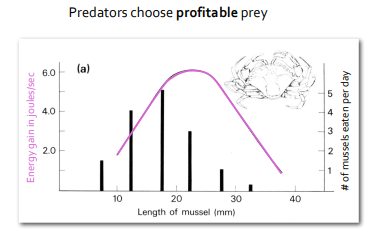
e.g. predators choose profitable prey, with a balance between ease of obtaining, and survival benefit / nutritional reward of the food item
e.g. Crabs, eat more medium sized mussels VS smaller & larger, as they provide more overall energy considering the energy input to open them - larger mussels more food but harder to obtain and open - smaller mussels easier to obtain and open but less food reward from this cost
give some examples of social behaviour in animals
(work together for resources) may hunt together to get more food
(work together for protection) beyond just gaining resources, they groom / surround young, to protect them - protecting resources for the future (in this case future generations)
(cooperative breeding) individuals living in groups with several adults, which all help raise offspring, even when not the parent (often k-selected) - defense / preparing and maintaining living area / helping feed young - all beneficial to ensure survival of the species
what are life history traits in animals?
how do these relate to resource allocation?
what are the 3 main tradeoffs in this?
evolutionary outcomes of a series of events over their lifetime, that influence various aspects of their biology - with the overall consideration of how resources are allocated for growth / maintenance / reproduction
resources are limited in an environment & within an organism (energy budget), so it must balance the allocation and make tradeoffs (allocating to one aspect, reduces energy available to other functions) - these differ between species
reproduction vs growth, reproduction vs survival, size vs number of offspring - species optimise traits leading to a few successful strategies, to balance energy budgets, consider tradeoffs, and be successful in evolution (passing on genes)
threfore, no species can both live long AND produce lots of offspring - which is where the r & k selection divisons come in
furthermore, longevity doesnt nescesarily equal fitness - evolution’s currency of success is reproduction of your genes to the next generation
name and define the 4 vital rates for a species
(maturity) age at 1st reproduction
(parity) number of episodes of reproduction (semelparity = once, iteroparity = multiple times)
(fecundity) number of offspring per reproductive episode
(senescence & mortality) lifespan and age related declines in vital rates
distinguish between r-selected & k-selected species
what do these ideas represent
give some examples
these ideas represent a collection of life history traits, optimised for species, that balance energy budgets / consider tradeoffs / are successful in evolution
this is a continuum, most species existing somewhere in between
neither strategy is better - they ensure parental genes are passed on to future generations (Reproductive success) - just in different ways
(r-selected)
maximise population growth rates
produce many small offspriing early in life - usually in a single reproductive event per lifetime
smalll body size with rapid development, and short lifespans
low competitive ability
e.g. rats, frogs
e.g. dandelions grow quickly and release many fruits with a single seed - easy to disperse as they float away, but have low survival chance (prone to conditions)
e.g. birds with higher adult mortality have higher annual fecundity (offspring per reproductive episode) and breed earlier in life - as they must maximise reproduction early
(k-selected)
maximise resource utilisation
produce few large offspring later in life - usually in multiple reproductive events per lifetime
larger body size with slow development, and long lifespans
high competitive ability
come under threat more often, as it is harder to restore populations who get rapidly impacted
e.g. humans, cats, whales, kea
e.g. black beans produce a moderate number of large seeds, in pods with nutrients - but are harder to disperse
how are life history traits affected by evolution
give an example
they are subject to evolution, and under constant evolutionary pressure - depending on changes in the environment favoring different traits to ensure reproductive success (e.g. high rate of disturbances => reproduce early and give many offspring, human hunting / predator introduced that targets adults => reproduce earlier)
(E.g. Guppies in Trinidad)
in freshwater streams, are colourful and reproduce quickly (easy to study, so put a subset of the population in a predator-free stream)
in populations with predators (normal situation), Guppy males are duller coloured to hide from predators - as brighter colours give higher susseptibility to being seen by predators
in these predator-free streams, males became more colourful after generations, and tended to reproduce later in life / take longer to mature / live longer - due to less mortality chance so more energy could be spent on growth rather than just to reproduction (as before to ensure reproductive success before predation)
(E.g. Mamushi Snakes)
evidence showed population declines, hypothesised due to human hunting
also hypothesised this resulted in phenotypic selection (within-generation change in trait distribution independent of genetic bases => causing cumulative genetic changes (evolution))
these were seen by comparing hunted vs non-hunted populations
these changes included smaller sized individuals being favored, as human hunting selective pressure favored individuals that reproduced earlier (to ensure reproductive success before being hunted), which would be smaller (less developed)
also included changes (some being heritable) like more offspring per female / greater investment in reproduction (% body mass) => showing a shift to more r-selected traits to adapt against hunting
what is Grime’s Triangle
what organisms does this describe
what traits does this relate to
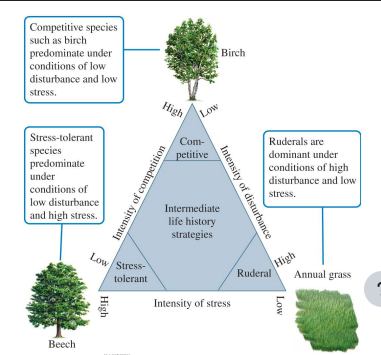
relates to life history traits for plants, and classifies this on a triangle, with different axis showing different extremes of life history traits
(low disturbance & low stress) favor competitive traits (as easy conditions result in more competition)
(low disturbance & high stress) favor stress-tolerant traits
(high disturbance & low stress) favor ruderal traits (growing on waste ground / among rubbish)
can life history traits differ within species?
provide an example
yes - easy to compare BETWEEN species, but these can also differ WITHIN species, if beneficial to their lifestyle
(E.g. Coho Salmon males)
substantial phenotypic plasticities in male reproductive traits, which is the consequence of female reproductive traits - who go out to sea in a cohort to mature (~19 months) => come back to breeding grounds => breed ONCE then die
‘jacks’ come back a year early, maturing at ~6 months, as this gives them the ability to sneak among larger males and fertilise female eggs, being less likely to be noticed
‘hooknose’ come back with the females, maturing at ~19 months, as this gives them the size and strength to fight other males for females
both types of males have ensured reproductive success through these traits, a result of evolution and selection acting to favor these opposite extremes => so both are sustained in the population
an intermediate sized male, would have worse performance (cannot fight & cannot sneak), so this is selected AGAINSt, resulting in these clear-cut divisons
why are life history traits important to conservation?
explain the diversity of life
provide knowledge on how species will survive in the future, by modelling population dynamics of the past and present
this is important to understand how species will survive under environmental changes / climate change, to identify risks to survival, and strategies for conservation therefore
e.g. k-selected traits identified, may need more conservation protection, as they must survive much longer before reproducing to ensure population growth, and these offspring may need extra help being dependent
e.g. important to consider natural replenishing of species in farming, will they recover themselves or require additional planting / help
name and define the 4 aspects influence population growth & regulation
what traits govern this
BIDE
(Birth) = any process producing new individuals in a population (sexual & asexual)
(Immigration) = movement between populations, migration INTO a population
(Death) = may be due to old age / predation / random event
(Emmigration) = movement between populations, migration OUT OF a population
what is demography
what type of graphs does this use
what do these show
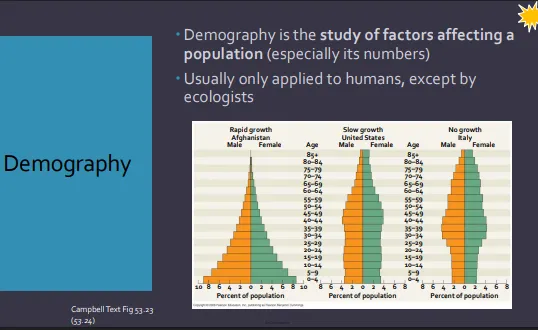
(Demography) the study of factors affecting a population (especially its numbers, overall and split into different groups / demographics), usually for humans but can model plants & animals too
(Graphs) splits the population into different demographics, to show the distribution of the population (number) in each demographic
(e.g. Age Class distributions) therefore show population growth (rapid vs slow vs none) based on the % of population in each age group (more young = rapid growth, more middle aged = no growth)
this can tell us the distribution of the population able to reproduce, which is important to population growth / recovery
this can inform predictions about extinction, if populations suffer events that only affect certain ages (e.g. drought only kills young trees => important ramifications to species survival as it affects entire population growth)
where should you start when wanting to predict what will happen to population numbers over time?
what are the 2 ways this can be done?
what methods are used for each?
first count CURRENT population numbers - using size or density
(Population size) can count total number of individuals, expressed as a whole number (N)
(Population density) can count number of individuals within a specific area / volume, expressed as a number per unit area
Methods
method to count depends on context of species / environment, some easier than others, but we want it to be standardised as possible, so use specific methods)
(Quadrats) use a certain measurement area (e.g. 1m x 1m) to divide the environment into squares to count the number of species present in each
can see many individuals, but not those moving in and out / above the quadrat / dormant / present as seeds only - so ensure doing replicants (number countable will differ WHERE placed, and WHEN sampled)
therefore better for animals that move less / are smaller
ensure knowledge on the species to inform WHERE to quadrat, based on how they disperse: clumped = group together in areas in their overall area, uniform = spaced uniformally, random = distribute randomly over their range
(Mark & Recapture) capture + tag + count individuals, then return again and repeat - noting the proportion tagged the second time
then calculate N = no marked 1st catch X no total of second catch / no marked second catch
this enables it to be standardised, and considering of factors like not all individuals being captured the first time - the second catch giving insight into how many were missed
has the assumptions: population is closed / individuals have equal capture probability across efforts
what are survivorship curves?
name and describe the 3 types
give an example for each
graphs showing the number of survivors, per percentage of maximum lifespan
(Type I) death rates increase with age, low death rates at early / middle life
e.g. Humans
(Type II) constant death rates with age (nothing about age affects death rate)
(Type III) death rates decrease with age, high death rates at early life
e.g. turtles, oysters, Starfish, Fish in general
what is exponential growth
what is the realistic outcome
(exponential growth)
rapid population growth over time with no slowing down
displayed using a graph showing population size (Y) with time (X)
(realistic outcome)
environments have limiting factors (e.g. space, resources), so exponential growth only occurs up to a point (carrying capactiy = K), where resouces cannot provide for it anymore
at this point, population growth plateaus and becomes steady (reaches logistic growth), as individuals die (competition, not enough resources) or leave populations (birth + immigration = death + emmigration)
how do k-selected and r-selected life history traits link to type of population growth rates?
(r-selected)
favor traits that are good at exponential growth (e.g. many offspring produced per reproduction)
therefore r denotes population growth rate
(k-selected)
favor traits good at logistic growth, getting to carrying capacity slower (e.g. ability to migrate)
therefore K denotes carrying capacity
describe human population growth rates
what model can be used for this
is an example of exponential growth, as we havent reached our carrying capacity - we keep using more and more resources that are still avialbale in different ways
from a fertility persepctive, we can tell growth rate over time (relative) is decreasing - but with so many people exponential growth still continues
define biotic interactions / biotic factors
name and define the 2 types
how species interact with other species in their ecosystem - influencing their distribution, abundance, behaviour, etc
(intraspecific) interactions between members of the same species
(interspecific) interactions between members of different species
define mutualism
how is each party affected
give an example
name and define the 2 different types
interactions where both parties benefit
(facultative mutalism) individuals in the relationship benefit from mutalism, but do not require it for survival
(obligate mutualism) one or more species in the relationship entirely rely on the mutualism benefits for survival
e.g. Ox birds, birds get food and Ox gets parasitic removal
e.g. Plant Pollenators, pollenator gets food, plant has increased reproductive success (efficient pollen (gamete) dispersal)
e.g. Plant Seed Dispersers, disperser gets food, plant has increased reproductive success / survival of generations / population growth / minimises competition (disperses offspring to different locations)
e.g. Tui pollenate Kowhai, Tui gets nectar food, Kowhai gets pollen dispersed
e.g. Lichens (fungi + algae) algae gets a home, the host gets fed the photosynthetic product
define commensalism
how is each party affected
give an example
a relationship between two species where one benefits, and the other is unaffected
can however lead to a negative effect on the unaffected species (=> parasitism), usually when something goes wrong in the system - as they have evolved to benefit up to a point where the other species isnt harmed
e.g. Barnacles on Whales (barnacles benefit, whales are unaffected) - if a whale was negatively affected, it would likely be something wrong with the whale, as this is an evolved trait
e.g. Fantails and Mammals, Fantails benefit as mammals walk through the forest to disrupt insects, while mammals are unaffected - an unusual example which would likely not occur naturally (if evolved predator-prey fantails would likely avoid due to fear)
define ammensialism
how is each party affected
give an example
a relationship between two species where one is harmed, while the other is unaffected
usually due to indirect effects from the neutral species making an effect on the environment, which then goes on to impact how another species can survive
e.g. Fly and Human, fly buzzes in the environment, human swats it (dies is harmed), while the human is unaffected
e.g. Cows and Burrowing Invertebrates, cows walk around and compact the soil and affect the environment (unaffected), while burrowing invertebrates cannot go into the ground hide / get food => survive (harmed)
define exploitation
how is each party affected
name and describe the 4 types
give an example
a relationship between two species where one benefits, and the other is negatively affected
(true predation)
one species kills another species immediately (lots of subgroups, varies in duration and lethality)
e.g. Venus Flytraps and Flies, Stoats and NZ Native birds,
(parasitism)
where the negative effect isnt lethal (or only gradually so), removing only PART of the individual causing harm (very numerous)
ectoparasites on the external surface of a host, endoparasites within
plant parasites can be hemi-parasitic (partial parasites, steal host water but make their own food via green leaves) or holo-parasitic (total parasites, steal both water and sugars from host roots)
e.g. Fungi and Ants, fungi induces host behaviour change, and gradually feeds on body before killing it and using as a vessel for spore dispersal
e.g. Fleas, Flies, Mosquitoes (Ectoparasites), Fish and Trematodes, Humans and Tapeworms (Endoparasites)
e.g. Misletoe (hemi-parasitic), Broomrape (holo-parasitic)
(herbivory)
where an animal eats a plant, predates on a plant - usually not a lethal / only gradualyl lethal effect, removing part of the individual (importantin determining plant community composition over time)
can be ectoherbivores (eat plants from the outside), or endoherbivores (eat plants from the inside)
e.g. Cows and Grass, Mule Deer and Plant communities, Dugong and Seagrass, Invertebrates and Plant Leaf Insides
(parasitoids)
where the predator attacks the prey (without killing it), and not immediately but gradually, the offspring of the predator kill the prey (releasing a certain chemical into the prey so it will carry their eggs)
e.g. Golden Hunter Wasp and Paralysed Spider, Wasp and Caterpillars, Wasp and Midge (adult lays eggs in the host => larvae parasitoid eats out the host => kills it eventually but slowly => provides starting nutrients to grow)
name and define the 2 types of biotic trophic interactions
give an example of each
(top-down interactions)
something controls other species populations from the top down (affects them, and those below in the food chain)
e.g. Orca eats Penguin - affects abundance of organisms at lower trophic levels
(bottom-up interactions)
something controls other species populations from the bottom up (affects them, and those above, in the food chain)
e.g. limiting plant nutrient supply, limiting insects required for survival - affects the abundance of organisms at higher trophic levels
name and define the 2 types of factors that influence population size
give an example of each
what do they both lead to
(density-dependent factors)
factors that increase in severity, with increased population density
usually biotic factors that happen more with more individuals
e.g. competition, predation, diseases, food shortages, parasites, territorality
(density-independent factors)
factors that dont increase in severity with increased population density - independent of the density of the population
usually abiotic factors that just occur anyway
e.g. temperature, precipitation, fire, spring freeze
(result)
redirect exponential growth to logistic growth of population size
describe what happened to population growth, in the Reindeer Island example
29 Reindeer introduced into an island (no immigration or emmigration - IE), with no natural predators
population growth was exponential, as only had natural B&D of means to control population growth
this occurred up to a point, when carrying capacity was reached, as resources could no longer support the population size, so individuals started to die off
there was no means to reach logistic growth, as there was no community structure to control population growth
what is competion
what effects does it have
give an example of competition & its effects
a type of density-dependent population regulation factor
individuals competing for resources (e.g. water, space, food, nutrients, sunlight, territory, nest space, access to mates), usually because of a limitation in these
is usually assymmetric, with one species competing being fitter than the other, able to be slightly better and outcompete the other, as every species is unique and occupies a slightly different niche
is an important regulator of population growth, as competition usually results in decreasing growth for one / both individuals, so they cannot survive and reproduce as well, so fitness decreases and population growth is hindered
(examples)
e.g. Roundworms, found decreased Fecundity (eggs per female), size, and body weight - with increased population density of worms
e.g. Monarch Butterfly Cateripillars, increased density found lowered survival probabilities (emergence as Monarch Butterflies) as body condition lowered from competing for resources
name and describe 4 types of competition
give an example for each
(intraspecific)
competition between members of the same species
usually more severe as they occupy the exact same niche
regulations population size / growth
e.g. same type of plant competing for the same amount of space / water / nutrients in soil, e.g. access to mates, e.g. access to nest space / territory
(interspecific)
competition between members of different species
determines community structure
e.g. different plants in the same environment competing for space / water / nutrients in soil
(exploitative)
competition to secure resources first, that both individuals require for survival
is usually assymmetric so one species is able to get these resources more / better / more efficiently, so survives more
e.g. trees competing for water
(interference)
competition where one individual prevents the other from accessing a resource that they are competing for, via active aggressive interactions (even if they arent actively using the resource themselves)
an adaptation to combat competition and ensure resource needs are met
e.g. pollenators hanging around a flower, territory aggressive behaviour in monkeys / wolves
list and give real examples, for adaptive strategies to reduce density dependent competition
density dependent competition is competition for food / territory / water / space / access to mates
(dispersal)
individuals respond by moving away from others / away from their birth area, to breed
e.g. Geese, move in a flock to maximise dispersal (seen increased dispersal with increased number of pairs)
(dormancy)
respond by waiting for a good opportunity where competition is reduced (density is decreased), to emerge
e.g. Seed Dormancy, many will lie dormant until a certain level of population density, which gives them a better chance of survival by reducing compeition severity
(aggression)
respond by showing aggression / display fights (usually not with intent to kill, instead to show display of strength for territories / mates etc)
usually only done when density and competition severity gets so bad, as it wastes energy
e.g. Hierarchies, most species have hierarchies within groups that determine who gets resources first, which is maintained with aggressive interactions (e.g. chimpanzees, wolves)
e.g. Territories, many species (e.g. monkeys, wolves, birds) have territories (part of a home range - the whole spanning area for the individual to live in) that they defend as it contains core resources for survival - maintained with aggressive interactions, and causing dispersal (of others to find new home ranges)
name and describe the 6 types of interspecific competition
(consumption) - one species inhibits another by consuming a shared resource they both require for survival
(preemption) - one species prevents another occupying an area, to exclude from a resource / space they both need to survive
(overgrowth) - one species growing over another, inhibiting access to a shared resource both required for survival
(chemical interaction) - one species inhibitting / killing another, by releasing growth inhibitors / toxins
(territorial) - one species behaviour excluding another species from a specific location they defend as a territory
(encounter) - one species affects another species via nonterritorial encounters
what is a niche
name and define the 2 types
(niches)
the set of environmental (abiotic & biotic) conditions where an organism can survive and reproduce
e.g. tolerated light / temperature / water level / salinity, the food it eats, who predates on it, the space it occupies,
niches always overlap in some aspects, but as a whole are unique to each species, due to the (competitive exclusion principle), which states no 2 species can occupy the same realized niche, eventually one will outcompetete the other
(fundamental niche)
the set of abiotic conditions a species can inhabit (the abiotic factors of their niche), in absense of interactionsother species (biotic factors)
so their theoretical niche
(realized niche)
the realistic niche they can occupy, which is narrowed from their fundamental niche by considering biotic factors
interactions with other species cause the niche to contract as the species cannot inhabit everywhere it possibly can survive abiotically, due to competition / predation / paratism
e.g. Cattail species, growing seperately they have lots of niche overlap (abundance at a range of depths), but when together, their niches shift (realised niche) to occupy different depths (resource partitioning
what are the 3 outcomes of species occupying the same niche as another
give an example
(outcompeting)
as the Competitive Exclusion Principle suggests, where one species will eventually completely exclude the other, due to being slightly better / fitter at surviving the conditions
(niche partitioning / resource partitioning)
species occupying the same niche, but have partitioned it so they can both survive there simultaneously, relying on the same resources but in slightly different areas of their environment
developed over hundreds of years of natural selection
e.g. Squirrel & Chipmunk, feed on the same things in the same place, but Squirrels live in trees, Chipmunks live on the ground
e.g. Reptiles (Anoles Inguanian Lizards) species all need sunlight, the same environment, and the same food - but are partioned to feed on sunny surfaces / shady branches
e.g. a set of NZ birds (Fantial, Robin, Bellbird, Grey Warbler), live in the same environment and feed on the same food, but inhabit slightly different parts of the environment (tree trunk vs canopy vs ground vs flying vs mid level vs upper level)
(character displacement)
an outcome of niche / resource paritoning, where certain characters have been adapted to in situations with partitioning (in spaces with a species their niche overlaps with), compared to when without this species
adaptation to minimise competition
e.g. Galapogos Finch species, beak depth depends on whether they occur with another species, more divergent together, more similar when apart (sympatric vs allopatric)
give an example on how predator-prey relationships regulate population growth
(Snowshoe Hares & Lynxes)
population growth for each species, follows the other species
Hares increase to carrying capacity → Lynxes have more food so they increase
Hares decline as Lynxes eat them → Lynxes decline as carrying capacity is reached due to Hares decreasing
the cycle repeats continusously, they are adapted to this so it wont cause a collapse
name some of the adaptations prey have to protect against predators
give an example for each
(mechanical defence)
e.g. porcupines
(chemical defence)
e.g. skunks
(warning colouration / aposematic colouration)
e.g. poision dart frog
(camofalgue / cryptic colouraton)
e.g. Canyon tree frog
(Batesian / trickery mimicry)
a harmless species mimics a harmful one
e.g. snakes
(Millerian / honest mimicry)
harmful / unpalatable species mimic eachother
e.g. wasps (Cuckoo bee & Yellow Jacket)
what is a community in ecology
how is this formed and regulated
(community)
a group of species occurring together in the same space and time
individuals interac to form a population, populations interact to form a community - with multiple interacting to form an ecosystem (then onto the biome, then the biosphere)
so realtionships at multiple scales, changing over time under changing conditions
structure regulated by behaviours, relationships etc (which regulate population growth and abundance)
formed based on abiotic factors of the area, as this informs a species geographic range - so communities are populations of species that share a similar variety of optimal conditions (That align with the geography’s conditions)
what is a keystone species
give an example
species that play key roles in maintaining the structure of their ecosystem
may prevent other species from taking over an area, to ensure less competitive species can survive
removing them can cause a cascade of effects on the ecosystem that impact many others - the whole overall structure
(Sea Otter Example)
In US West Coast ecosystem, Sea Otters eat Sea Urchins, which maintains Kelp forests as with abundant Sea Urchins, they eat all the Kelp, therefore also helping maintain the Kelp forest associated species
overhunting occurred with Sea Otters, so their numbers declined, so Urchins thrived, which removed the Kelp forests, affecting all the other associated species negatively => reducing diversity
with conservation, Sea Otters returned and Urchins reduced, and Kelp Forests came back
this highlighted the importance of Sea Otters in the ecosystem, not a top predator but a keystone to the system
what is ecological succession
define the two types
(ecological succession)
the sequence of community and ecosystem changes after a disturbance
a disturbance refers to an event that damages and removes biomass (e.g. Windstorms, Fire, Snowbreak, Landslides, Droughts, Floods)
(primary succession)
succession to restore an ecosystem, when there was no ecosystem to begin with (no soil at the start, the ecosystem suddenly appears on a new landmass)
e.g. after Glaciation, after Volcanic Eruption => creating a new landmass
(secondary succession)
succession to restore an ecosystem, after a disturbance on an existing ecosystem (soil remains)
e.g. plant species colonising an area after a fire
what determines how ecosystems respond to disturbances
give an example
the history of the area depends on how well the ecosystem will respond to that disturbance, and whether a similar ecosystem will be restored OR a new type will form - and how quick this occurs
this is because if species are adapted to the disturbance (if it is usual for that area), they will have traits to restore themselves - if not they may be removed
systems with high levels of disturbance favor r-selected traits generally, as these are less predictable systems, and these traits allow quick response to availability of resources, and if disturbances happen - more temporary populations
so excluding slow growing / colonising species (k-selected)
e.g. Yellowstone National Park, fire disturbances are a common part of the system, so trees species are fire-adapted, using this disturbance to remove older trees so younger ones can grow, and remove competitive invaders (less fit as are exotic and not adapted to the fire)
systems with low levels of disturbance favor k-selected traits, as they have time to grow and thrive as the environment is more predictable and conditions are less temporary
therefore excluding less competitive species (quick inhabiting so less competitive, more temporary)
e.g. in NZ, plant species not adapted to fire recovery in their life history traits (fire disturbance not part of the system), so cannot restore in succession after a fire - instead new ecosystems arise (e.g. Cass fire 1999)
describe the NZ Robin Experiment example (loss of Antipredator behaviour)
how was the study conducted
what were their key findings
how are their findings useful to conservation
(method)
experimented on natural populations of NZ Robins vs ecosanctuary NZ Robins (exposed to predators vs not exposed to predators, wild forested habitats vs translocated ~3 years ago to predator-free areas)
put fake predators (taxidermied Rats & Stoats) and observed bird behaviour in response, and how these differed between the areas
(fndings)
ecosanctuary birds displayed less antipredator behaviour, than wild robins (even after only ~3 years)
also found that in one ecosanctuary with a recent Stoat breach, they showed SOME antipredator behaviour for Stoats (compared to Rats) - more so than for other ecosanctuaries
this shows neuroplasticity, that this antipredator behaviour CAN quickly be lost, but also CAN be recovered
(importance)
important behaviour for life in the wild, can be quickly lost under ecosanctuary conditions (e.g. important behaviour for predator defence / survival / living alongside, can be lost when predators are removed)
so ecosanctuaries should do predator training to maintain these behaviours, so if ever put back into the wild (the main goal after restoring population size) - they will still have the antipredator beahviour to allow for effective survival