1_Review of Drug Discovery and Development Process
 View linked note
 Call Kai
 Learn
Learn Practice Test
 Spaced Repetition
 Match
Match Flashcards
 Knowt Play
1/77

There's no tags or description
Looks like no tags are added yet.
Name | Mastery | Learn | Test | Matching | Spaced | Call with Kai | Chat |
|---|
No analytics yet
Send a link to your students to track their progress
78 Terms
Drug Discovery and Development Activities
Basic research, preclinical development, clinical trials, FDA filling/ approval
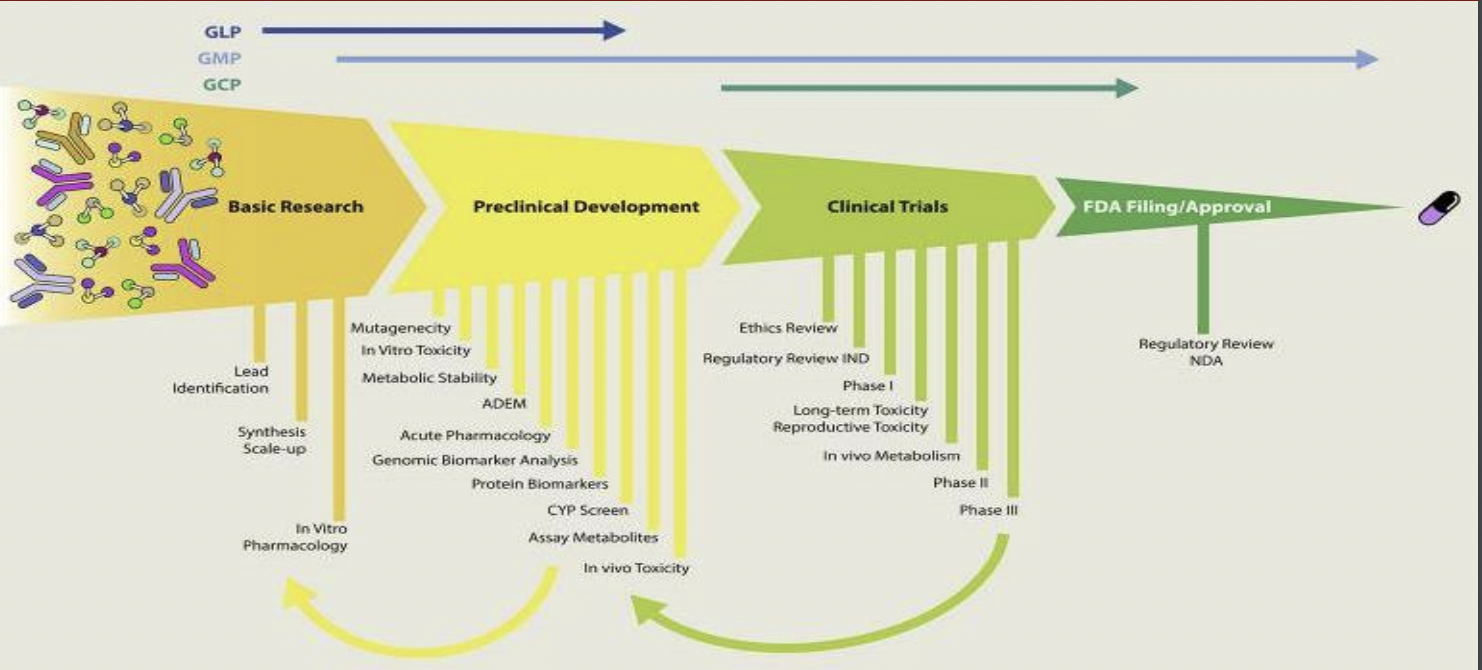
Basic Research involves the ff:
lead identifcation, synthesis scale-up, and in-vitro pharmacology
Develop into an appropriate dosage form
■ Because most drugs came from a natural product, so it’s more of an extraction.
■ Developing a way to synthesize it inside the laboratory.
■ Scale-up–manufacturing and production of the active on a large scale.
Synthesis Scale-up
Preclinical Development involves the ff:
mutagenicity, in vitro toxicity, metabolic stability, and pharmacokinetics (ADME).
dito iniintindi kung ano yung magiging effect ng compound/drug that is being developed. we also check the safety of our drug before we commence our clinical trials
Preclinical Development
Different responses from different subjects based on genetic factors.
Very important since the effects of drugs are not applicable to all patients
Genomic Biomarker Analysis
A test to evaluate the metabolism of drugs by cytochrome P450 enzymes.
What enzymes are responsible for the metabolism of drugs
CYP Screen
Clinical Trials involves the ff:
ethics review, regulatory reviews, IND, Phase I, long-term toxicity & reproductive toxicity, in vivo metabolism, phase II, phase III
Ethics board (different from regulatory authority)
Ethics review
Regulatory Review IND (Investigational New Drug application) is needed when?
Before clinical trials
Regulatory review process for New Drug Application (NDA).
FDA Filing & Approval
FDA Filing & Approval is needed when?
Before commercialization
Monitoring drug safety after it has been marketed.
Pharmacovigilance
Pharmacovigilance is needed when?
after commercialization
Timeline of GLP during the Drug Discovery and Development as a Quality Assurance Guide
From basic research to preclinical development.
Timeline of GMP during the Drug Discovery and Development as a Quality Assurance Guide
From basic research to FDA filing/approval
(As long as you are making drugs, you should be GMP compliant.)
Quality Assurance Guide involved during clinical trials (applicable to human beings) in the Drug Discovery and Development Process:
GCP
Compounds showing an effect in a biological screen (e.g. binding assay).
Active Compounds
A molecule that shows the desired type of activity in a screening assay.
Hit Compound
Selected from a collection of hits by refining the screening criteria.
Lead Compound (molecule)
Prototype moiety with desired pharmacologic activity
Undergoes further optimization untilyou reach the final compound that you will develop
Lead Compound (molecule)
Automated technology for rapid data collection in drug discovery.
High Throughput Screening (HTS)
Uses technologies of automation to collect a large amount of experimental data in a relative short time
includes the ff: > Robots, Detectors, Softwares
High Throughput Screening (HTS)
The Echo 650: Liquid Handling Device dispenses a minimum ___ nanoliters through __ waves
2.5, acoustic
Basic Research Steps
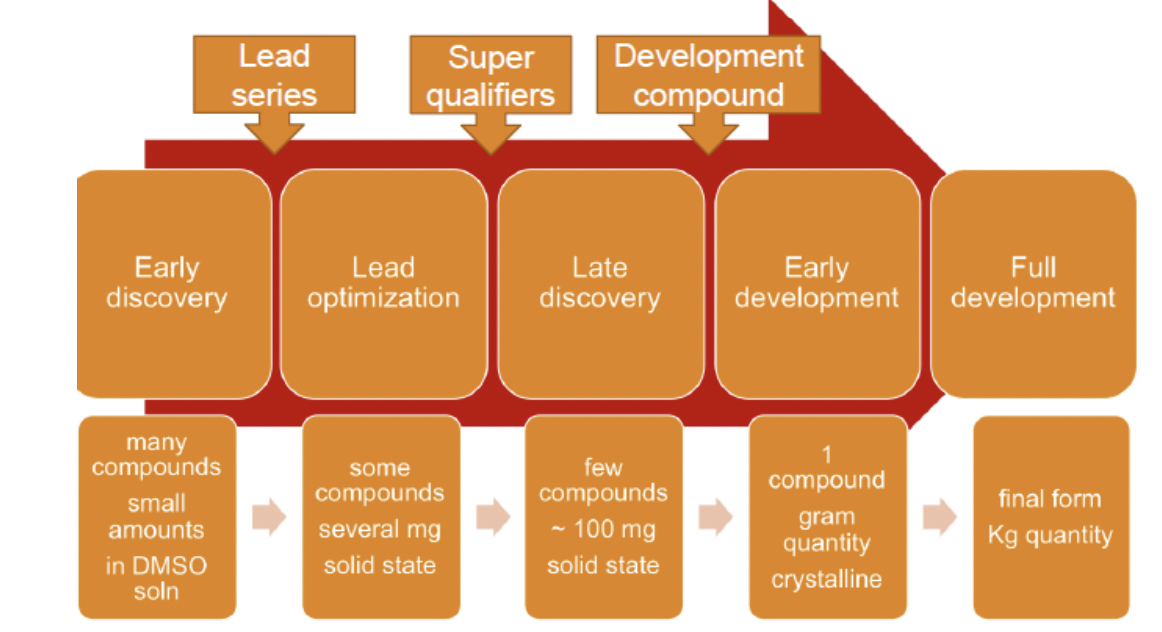
many compounds, small amounts in DMSO solution
Early Discovery
some compounds, several mg solid state
Lead Optimization
few compounds, approx 100 mg solid state
Late Discovery
1 compound gram quantity crystalline
Early Development
final form in kilogram quantity
Full Development
in between early discovery & lead optimization
Lead series
in between lead optimization & late discovery
Super qualifiers
in between late discovery & early development
development compound
To identify compounds with properties that are acceptable for a drug
Compounds are grouped into:
good
acceptable
bad
unacceptable
Large number of compounds are ranked from a physicochemical point of view
Acid/base properties
solubility
lipophilicity
Early Discovery
In Early Discovery, large number of compounds are ranked from a _____ point of view
physicochemical
Factors that affect the product during early discovery (physicochemical point)
acid/base properties, solubility, lipophilicity
Compounds in early discovery are grouped into: ?
good, acceptable, bad, or unacceptable
Improvement of target specificity, selectivity, pharmacokinetics (PK), and safety profiles
done by medicinal chemists using advanced organic synthesis methods or by biotechnological methods
if the structure of the drug target is known, computational in silico methods is used
in silico = performed in computer
Lead Optimization
Lead compound has 2 parts:
Pharmacophore & Auxophore
The part of a drug's structure responsible for its activity.
Pharmacophore
The part of a drug's structure that modifies physicochemical properties.
Auxophore
In Lead Optimization, to optimize the series as regards to physicochemical properties:
pKa
logP/logD
aqueous solubility
stability
Selection of promising compounds (super qualifiers)
• Few promising compounds are selected – super qualifiers
• To characterize them and judge whether they have suitable properties for development, highlight problems, and give input to possible solutions
• Solid state characterization
Late Discovery
Characterizing super qualifiers and judge whether they have suitable properties for development, highlight problems, and give input to possible solutions
Late Discovery
In late discovery, it refers to evaluating the physical form of a drug and its effects on dissolution.
Solid State Characterization
Types of Solid state characterization:
• Effect of crystal form on dissolution
• Characterization of polymorphs
• X-ray diffraction
• To find the best form of the compound for development into a drug
• Evaluate whether the compound may be developed into a stable bioavailable drug
• Whether prodrug formation should be considered
• Compatibility studies
• Best salt for development has to be identified.
Early Development
• polymorphism (XRPD)
• intrinsic dissolution rate
• thermal properties (TGA & DSC)
• solid state stability (light, heat, & humidity); stability is tested under stressed conditions to be able to rank the compounds in a short time
• hygroscopicity (DVS)
Best salt for development has to be identified through the following instructions:
Evaluation of physicochemical properties during scale-up and stability testing of drug compounds.
Full Development
Bioassays (measures biological activity)
Biological test system (in vitro, ex vivo, in vivo)
Pre-Clinical Development
Pre-clinical development: Measurement of biological activity of substances in various test systems.
Bioassays
Biological test systems in Pre-clinical Development
in vitro, ex vivo, in vivo
lower organisms, enzymes, cells
in vitro
animals (mice, rat)
in vivo
tissues, organs
ex vivo
Phase 0, Phase I, Phase II, Phase III
Clinical Trials
Focus on relationship of mechanism of action and treatment of disease
Clinical Trial Phase 0
pharmacokinetics (PK), including biodistribution
microdoses (1/100th of the dose calculated to yield a pharmacological effect)
no therapeutic event
7-14 days (short-term)
Clinical Trial Phase 0
Prioritizes safety and pharmacokinetics in open studies focusing on ideal dosage range
Clinical Trials Phase I
• Safety
• Pharmacokinetics
• Ideal dosage range
• Non-blind or open studies
Clinical Trials Phase I
Efficacy
IIA: Best and most effective dose
IIB: Drug response to the dose
Single-blind design, with placebo and established active drug in addition to the investigational agent
Clinical Trials Phase II
Focuses on efficacy and determining the best and effective dose.
Clinical Trials Phase IIA
Focuses on efficacy and determining the drug response to the dose
Clinical Trials Phase IIB
Single-blind design, with placebo and established active drug in addition to the investigational agent
Clinical Trials Phase II
Safety and Efficacy
IIIA: done prior to marketing
IIIB: supplemental/label expansion
Certain toxic effects may first become apparent
Double-blind and crossover techniques
Phase III
Prioritizes safety and efficacy with double-blind/ cross-over techniques.
Clinical Trials Phase III
Clinical trial in which certain toxic effects may first become apparent
Clinical Trials Phase III
Clinical Trial: done prior to marketing
Clinical Trials Phase IIIA
Clinical Trial: supplemental/label expansion
Clinical Trials Phase IIIB
Clinical Trial: Phase I participants, duration & purpose
Participants: 20-80 healthy human volunteers
Duration: 1 month
Purpose: • Safety profile • Dose-ranging • Identifying S/E
Participants: Few dozen to 300 patients with the disease
Duration: Several months
Purpose: • Evaluate effectiveness • Further evaluate safety
Clinical Trial: Phase II
Participants: >300 (2000-3000) patients with the disease
Duration: Several years
Purpose: • Confirm effectiveness • Compare treatment drug to standard/ commonly used tre atment
Clinical Trial: Phase III
Done if Phase III results meet expectations
Submission of clinical data for marketing permission.
Regulatory Application and Review
Full reports of all pre-clinical and clinical data
Registration Dossier
Version of Registration Dossier in the US
NDA/ New Drug Application
Version of Registration Dossier in the EU
Marketing Authorization Application
Ongoing monitoring of drug safety and adverse effects, involving:
Additional pharmacological & toxicological data
ADR reporting
Product defect reporting
Post Marketing Surveillance (Phase IV)
Drug Discovery and Development. The discovery and development of new drugs