Bio Chapter 3: Carbon and the Molecular Diversity of Life
 Call Kai
 Learn
Learn Practice Test
 Spaced Repetition
 Match
Match Flashcards
 Knowt Play
1/207

Earn XP
Description and Tags
Carbon and the Molecular Diversity of Life
Name | Mastery | Learn | Test | Matching | Spaced | Call with Kai | Chat |
|---|
No analytics yet
Send a link to your students to track their progress
208 Terms
Carbohydrates, Lipids, Proteins, Nucleic Acids
The 4 important classes of biological molecules
Electron configuration
The key to an atom’s chemical characteristics is its __ __
4
With four valence electrons, carbon can form __ covalent bonds with a variety of atoms
Tetrahedral
In molecules with multiple carbons, each carbon bonded to four other atoms has a ___ shape
Double
When two carbon atoms are joined by a double/single bond, the atoms joined to the carbons are in the same plane as the carbons
Valence
The number of covalent bonds an atom can form
Covalent
The electron configuration of carbon gives it ___ compatibility with many different elements
Chains
A carbon atom can also form covalent bonds to other carbon atoms, linking the atoms into ___
Carbon __ form the skeletons of most organic molecules, vary in length and shape
Some have double bonds which vary in number and location
Length, Double bond position, branching, presence of rings
What 4 ways can carbon skeletons vary
Hydrocarbons
Organic molecules consisting of only carbon and hydrogen, hydrocarbons can undergo reactions that release a large amount of energy
Fats
Many organic molecules, such as __, have hydrocarbon components
Isomers
Compounds that have the same number of atoms of the same elements but different structures and properties
Structural isomers
Isomers that differ in the covalent arrangement of
their atoms
Increases
The number of possible isomers ___ as carbon skeletons increase in size
Single
__ bonds allow the atoms of structural isomers to rotate freely about the bond axis
Cis-trans isomers
Carbons have covalent bonds to the same atoms, but the atoms differ in their spatial arrangement due to inflexibility of double bonds
Shape
The subtle differences in ___ between cis-trans isomers can greatly affect the activities of organic molecules
Enantiomers
Isomers that are mirror images of one another (left-handed and right-handed versions of the same molecule)
Differ in shape due to the presence of an asymmetric carbon, usually only one isomer is biologically active
Structural, enantiomers, cis-trans
The 3 types of isomers
Geometric isomers
Another name for cis-trans isomers
Functional groups
The chemical groups that affect molecular function by being directly involved in chemical reactions
Replace
Chemical groups can ___ one or more of the hydrogens bonded to the carbon skeleton of a hydrocarbon
Characteristic
Each functional group participates in chemical reactions in a ___ way
They have different functional groups
Why do estradiol and testosterone produce different physical traits despite having nearly identical four-ring carbon backbones
HO
What extra group does estradiol have that testosterone doesn’t
O, CH3
What extra groups does testosterone have that Estradiol doesn’t
7
There are __ functional groups that are most important in the chemistry of life
Hydroxyl, carbonyl, carboxyl, amino, sulfhydryl, phosphate, methyl
What are the functional groups (know these!)
Alcohol
Compound name for Hydroxyl group (-OH/HO-)
Ketone (within) Aldehyde (at end)
Compound name for Carbonyl group (>C=O) (depending on where in skeleton)
Carboxylic Acid (or organic acid)
Compound name for carboxyl group (-COOH)
Amine
Compound name for Amino group (-NH2)
Thiol
Compound name for Sulfhydryl group (-SH or HS-)
Organic phosphate
Compound name for phosphate group (-OPO32-)
Methylated compound
Compound name for methyl group (-CH3)
Acetone Propanal
Textbook example for Carbonyl group
Acetic acid
Textbook example for Carboxyl group
Glycine
Textbook example for Amino group
Cysteine
Textbook example for Sulfhydryl group
Glycerol phosphate
Textbook example for Phosphate group
5-Methylcytosine
Textbook example for Methyl group
Ethanol
Textbook example for Hydroxyl group
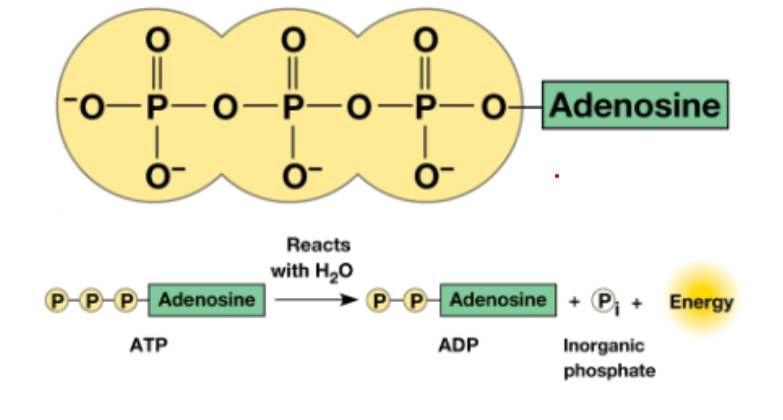
Adenosine triphosphate (ATP)
An organic phosphate molecule, consists of an organic molecule called adenosine
Attached to a string of three phosphate groups
Stores the potential to react with water, releasing energy that can be used by the cell
An important source of energy for cellular processes
ATP
What is this an image of
Polymer
A long molecule consisting of many similar or identical building blocks
Monomers
Small building-block molecules that create polymers
Functions
Some molecules that serve as monomers also have ___ of their own
Macromolecules
Polymers, built from Monomers
Similar
The process of making and breaking down polymers is __ for all classes of large biomolecules
Enzymes
Facilitate the process of making and breaking down polymers, speed up chemical reactions
Condensation
In a ___ reaction two molecules are covalently bonded to each other with the loss of a small molecule
Dehydration reaction
Reaction that occurs when two monomers bond together through the loss of a water molecule
Hydrolysis
Polymers are disassembled to monomers by ___, a reaction that is essentially the reverse of the dehydration reaction.
Adds a water molecule, breaking a bond
Thousands
Each cell has ___ of different macromolecules
Vary
Macromolecules __ among cells of an organism, _ more within a species, and __ even more between species
Small
An immense variety of polymers can be built from a __ set of monomers
Carbohydrates
Include sugars and the polymers of sugars
Serve as fuel and building material
Monosaccharides
The simplest carbohydrates are ___, or simple sugars
Have molecular formulas that are usually multiples of CH2O
Polysaccharides
Carbohydrate macromolecules are ___, polymers composed of many sugar building blocks
Glucose
The most common monosaccharide (C6H12O6)
Classified
Monosaccharides are ___ by the number of carbons in the carbon skeleton and the placement of the carbonyl group
Rings
Though often drawn as linear skeletons, in aqueous
solutions, many sugars form ___
Glucose
Monosaccharides, especially ___, are major nutrients for cells and as raw material for building molecules
Disaccharide
Formed when a dehydration reaction joins two monosaccharides
Glycosidic linkage
What is a disaccharide’s covalent bond called
Table sugar
The most prevalent disaccharide is sucrose, which is ___ ___
Dissaccharide synthesis
Ex: Glucose and fructose combining together to form sucrose through a dehydration synthesis reaction. Joining a -OH with -H from the hydroxyl groups of both sugars to make H2O
Polysaccharides
The polymers of sugars, have storage and structural roles
The structure and function are determined by its sugar monomers and the positions of its glycosidic linkages
Granules
Plants store surplus starch as __
Starch
A storage polysaccharide of plants, consists entirely of glucose monomers
Hydrolyze
Most animals have enzymes that can __ plant starch, making glucose available as a nutrient
Glycogen
A storage polysaccharide in animals
Humans and other vertebrates store ___ mainly in liver and muscle cells, this stored fuel cannot sustain an animal for long
ok
Understand this
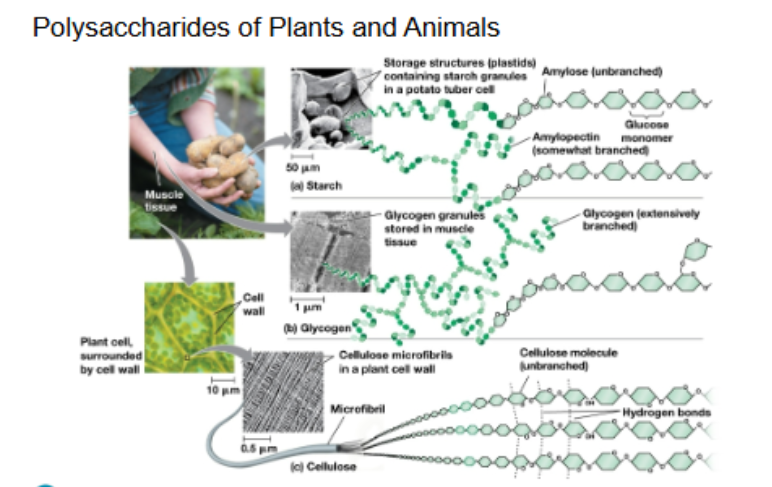
Cellulose
The polysaccharide ___ is a major component of the tough walls that enclose plant cells
Like starch, ___ is a polymer of glucose, but the glycosidic linkages in these two differ, based on the two ring structures for ___
beta
In cellulose, the monomers are arranged in the __ conformation, making each monomer “upside down” with respect to its neighbors
alpha
In starch, the glucose monomers are arranged in the __ conformation
Helical
Certain starch molecules are largely __
Unbranched
Cellulose molecules are relatively straight and are___
Parallel
In cellulose, some hydroxyl groups on its glucose monomers can hydrogen-bond with hydroxyl groups of other cellulose molecules many ___ cellulose molecules are held together this way
Microfibrils
Parallel cellulose molecules held together this way are grouped into ___, which form strong building materials for plants
Cellulose strands forming hydrogen bonds
What is this an image of

Can’t
Enzymes that digest starch by hydrolyzing alpha linkages can/can’t hydrolyze the beta linkages in cellulose
Fiber
Cellulose in human food passes through the digestive tract as insoluble ___
Enzymes
Some microbes use ___ to digest cellulose
Symbiotic
Many herbivores, such as cows and termites, have ___ relationships with these microbes
Fungi
___ can digest cellulose, helping to recycle the elements in Earth’s ecosystems
Chitin
Structural polysaccharide, is found in the exoskeleton of arthropods
Also provides structural support for the cell walls of many fungi
Lipids
Do not form true polymers and are usually too small to be considered macromolecules
The unifying feature is having little or no affinity for water
Hydrophobic because they consist mostly of hydrocarbons, which form nonpolar covalent bonds
Fats, phospholipids, steroids
The most biologically important lipids are __ __ and _
Fats
Assembled from two types of smaller molecules: glycerol and fatty acids
Glycerol
___ is a three-carbon alcohol with a hydroxyl group attached to each carbon
Fatty acid
Consists of a carboxyl group attached to a long carbon skeleton
1 glycerol backbone + 3 fatty acids
Components of a fat molecule (triacylglycerol)
Hydration synthesis, 3(H2O)
Reaction type of synthesis of fat and water molecules released
Separate
Fats ___ from water because water molecules hydrogen-bond to each other and exclude the fats
Dehydration
In a fat, three fatty acids are joined to glycerol by ___ reaction
Ester linkage
What’s the name of the bond linking glycerol to fatty acids, creating a triacylglycerol or triglyceride
Length
Fatty acids vary in ___ (number of carbons) and in the number and locations of double bonds
Saturated fatty acids
Fatty acids that have the maximum number of hydrogen atoms possible and no double bonds
Unsaturated fatty acids
Fatty acids that have one or more double bonds