28 Information Gathering, Physical Exam, Swine Barn Walkthroughs and Diagnostics
 Call Kai
 Learn
Learn Practice Test
 Spaced Repetition
 Match
Match Flashcards
 Knowt Play
1/43

There's no tags or description
Looks like no tags are added yet.
Name | Mastery | Learn | Test | Matching | Spaced | Call with Kai | Chat |
|---|
No analytics yet
Send a link to your students to track their progress
44 Terms
History and observation of individuals
Traditional physical exams are difficult to do with pigs. What do you often heavily rely on instead?
1. complete a circle walk through the OUTSIDE of the building
2. complete a circle walk through the INSIDE of the building
3. complete a circle walk through the INSIDE of a pen
4. complete a circle walk around an INDIVIDUAL ANIMAL
What is the 4 circle method to methodically approach a swine barn walkthrough
Subjective
Clinical observations, relevant history, proximity to other pigs, how long it has been going on, how the owner has treated pigs are all WHAT PART of a SOAP?
Objective
Clinical signs (what you smell, hear, and see when walking pens), evaluation of feed, water, and air in environment, and estimated % morbidity are all WHAT PART of a SOAP?
2x per day (and make sure they GO IN THE PENS)
How often should producers be walking their pig pens?
A: high treatment success - listless ears, dull/red eyes, slightly gaunt
B: moderate treatment success - definite gauntness, thinner, beginnings of flesh loss, rough hair coat and uncomfortable posture
C: low treatment success - black exudate around eyes, severe gauntness, advanced flesh loss
note: "gauntness": the quality of being extremely thin and bony, often due to hunger, sickness, or weariness
What are the stages of individual pig care, treatment success, and clinical signs?
Feed, water, air
What are the 3 MOST IMPORTANT FACTORS to evaluate with pigs?
Is it available, how many pigs to one feeder, is it the right diet, is it fresh, micron size (ideally 600-800)
What kinds of questions do you need to ask when assessing feed?
Digestibility issues
What happens if microns are finer than 600-800 for pig diets?
Clog feeders
What happens if microns are more coarse than 600-800 for pig diets?
Is water on, enough nipples per pen, drinker height, water pressure, water quality
What kinds of questions do you need to ask when assessing water?
If I bend down, what are these animals smelling, moisture, humidity, barn temperature, surface temperature, dust, ventilation?
What kinds of questions do you need to ask when assessing air?
A pigs are too cold = pig piles
B pigs are just right, laying with each other's head on the neighbors flank
What kind of information can you gather from the images of these two separate sets of pigs?
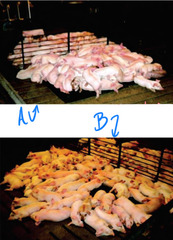
Assessment
Which part of the SOAP involves putting history, observations, and records together to develop a differential list
Plan
Which part of the SOAP involves diagnostics from the right animals, treatment options, and follow-up appointments?
Part of your PLAN, where you harvest oral fluids from pigs which can be sent for testing. It's just a rope they gnaw on for like 20 minutes
What is this?
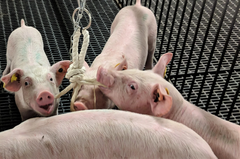
2-3 pigs per group
How many pigs do you need to submit for a VLD (veterinary diagnostic laboratory) necropsy?
Live, untreated pigs showing clinical signs
like "sacrifice" pigs
What pigs should you submit for necropsy?
1. dorsal recumbency: cut thru axilla to partially separate front limb from rib cage
2. hook knife under cranial sternum and cut thru cartilage of ribs
3. remove skin of sternum and ventral abdominal wall (belly)
4. organs now visible
What are the steps of a swine necropsy?
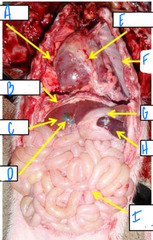
Lung
What is A?
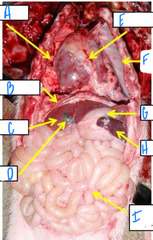
Diaphragm
What is B?
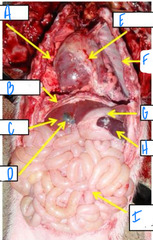
Liver
What is C?
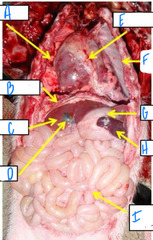
Gall bladder
What is D?
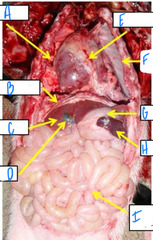
Heart
What is E?
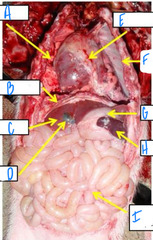
Rib cage
What is F?
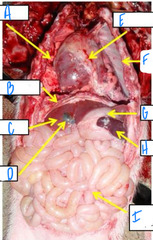
Stomach
What is G?
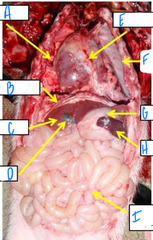
Spleen
What is H?
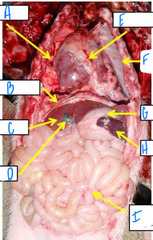
Small intestine (jejenum)
What is I?
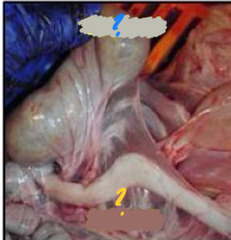
Blue = cecum
Yellow = ileum
What are these two question marks showing?
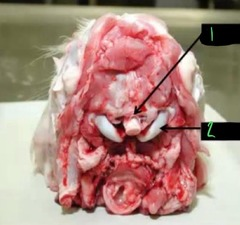
Brainstem/spinal cord from a partially skinned pig head ready for brain removal
What is 1?
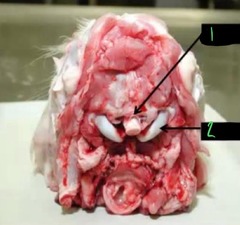
Occipital condyles visible on a partially skinned pig head ready for brain removal
What is 2?
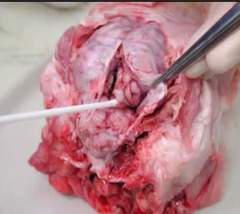
Stripping off the meninges to take a sterile swab
What is happening here?
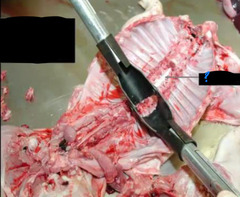
Spinal cord removal with a sharp barns dehorner to remove the vertebral column
What is happening here?
Spinal cord
What is the blue question mark?
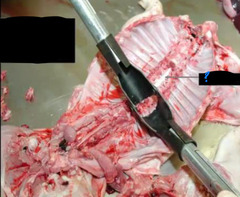
Using a forceps and scissors to clip the peripheral nerves to remove the spinal cord from the vertebral column
What is happening here?
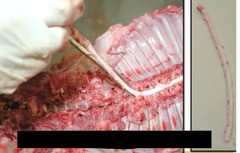
Fresh and formalin fixed tissue samples that are at LEAST 1 cm thickness (formalin in containers, fresh in labeled bags)
What should a complete swine necropsy submission consist of?
1. nasal swabs
2. blood
3. oral fluids
4. fecal
5. processing fluids (PRRS)
6. environmental swab (PEDV)
7. udder swabs (IAV-S)
Name field diagnostics you can collect from swine
Nasal swabs
Polyester or nylon swabs, samples tubes with transport medium or 1 cc sterile saline, permanent gloves, and a marker are needed for which diagnostic for swine?
Grab by chest or rear legs
You should grab pigs but the chest/rear legs OR front legs/ears in order to perform field diagnostics
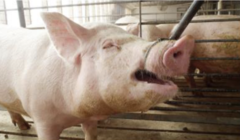
Swine snare around the maxilla, NOT mandible
What is this?
IAV
(influenza A virus swine)
For which disease do you need to make sure you scrape the epithelium and get blood on a nasal swab?
Jugular vein and anterior vena cava, maybe orbital sinus
Where do you collect blood from pigs?
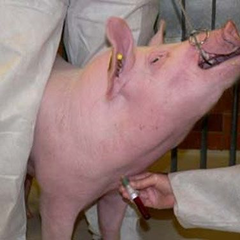
Jugular vein blood sample
What is being done here?
Without environmental contamination
Ideally, how do you collect pig fecal samples?