Flashcards Intro to Profesional Nursing: Nursing in Today's Evolving Health Care Environment + The History and Social Context of Nursing (Lecture 2)
 Call Kai
 Learn
Learn Practice Test
 Spaced Repetition
 Match
Match Flashcards
 Knowt Play
1/62

There's no tags or description
Looks like no tags are added yet.
Name | Mastery | Learn | Test | Matching | Spaced | Call with Kai | Chat |
|---|
No analytics yet
Send a link to your students to track their progress
63 Terms
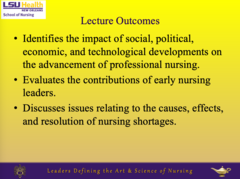
Lecture Outcomes (flip card):
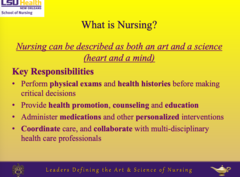
What are the key responsibilities of a nurse?
- perform physical exams/health histories before making critical decisions
- provide health promotion, counseling and education
- administer medications and other personalized interventions
- coordinate care, and collaborate with other health care professionals
What are the health care delivery systems?*
- how health care is organized and provided
- involves providers and clients (patients) within the limits of money and rules
- includes: patients, care settings (hospital, clinic, etc.), agencies that regulate care, and financial support systems (insurance, medicare, etc.)
in short: the network of people, places, money and rules that make health care work
What comprises the largest segment of healthcare workforce in the United States?
Nursing
What percentage of nurses remain in nursing (in years)?
0-5 years = 25%
6-10 years = 23%
11-20 years = 23%
>20 years = 5%
Unstated = 24%

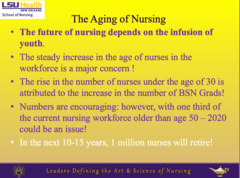
In the next 10-15 years, approximately how many nurses will retire?
1 million
What are the Gender and Racial Demographics in Nursing?*
- Mostly white nurses, but is slowly diversifying
- Women are primarily nurses, but more men are entering the field
- Gender pay gaps exist; men earn more across most specialties
- Nursing workforce is aging; effort is being made to bring in younger nurses

In Louisiana from 2016-2020, which type of pre-RN licensure program produced the largest number of graduates?
Baccalaureate (BSN) programs; most nurses nowadays get BSNs
What recent global event had the biggest impact on nursing staffing in recent history?
Covid; caused stress, getting infected, lack of child care

What percentage of BSN students are male?*
12.9%
What percentage of minorities make up the RN population?*
19%, but it is improving
What are the four mechanisms to get basic nursing education?
1.BSN = 4 years
2. Hospital-based Diploma = 3 years
3. Accelerated BSN = 2 years
4. Associates Degree (ADN) = 2 years
Then must take NGNCLEX

What does NGNCLEX stand for?
- New Generation National Council Licensure Examination for Registered Nurses
- Pass = RN
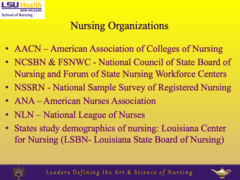
What is the AACN?
American Association of Colleges of Nursing
What is the NCSBN?
National Council of State Board of Nursing

What is the FSNWC?
Forum of State Nursing Workforce Centers
What is the NSSRN?
National Sample Survey of Registered Nursing
What is the ANA?
American Nurses Association
What is the NLN?
National League of Nurses
What is the LSBN
Louisiana State Board of Nursing

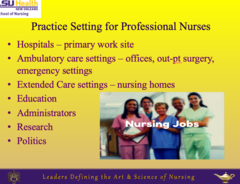
Where do most nurses practice?
Hospital
What is Evidence-based practice (EBP)?*
- using current knowledge from research and other credible sources to base clinical judgment and patient care
- better patient comes are likelier from RN with a Bachelor's or higher degree
From slide 21/84: Make sure to read the Boxes 1.1 & 1.2

What is Nursing for Quality Improvement?
- Care-related and organizational processes that involve the development and implementation of a plan to improve health care services and better meet clients' needs
- Derived from what we know for the research literature
- Usually agency specific

In the hospital setting, who is considered Direct patient care?
1. Staff nurses
2. Clinical Nurse Specialist - advanced practice nurses
3. Charge Nurses - oversee other nurses on unit
Where do Community health nurses work?
- Ambulatory clinics
- Health departments
- Hospices
- Homes
- Community-based settings
What is the Clinical Ladder?*
- a program in healthcare that allows nurses to advance their skills while still working directly with patients
added picture for context

When nursing began in Biblical times, what was the demographic?
- lots of male priests and monks were nurses

When did Monks and nuns disappear as caregivers? Who was left taking care of the sick?*
- Monks and nuns disappeared during the Reformation
- Untrained women became nurses
- "nursing" wasn't a respectable position at the time
- *Men didn't return to nursing until the 20th century
- Introduction to the Daughters of Charity
*slide will be on test

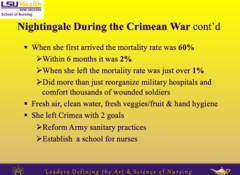
Who was Florence Nightingale?*
- A pioneer of modern nursing known for her work caring for soldiers during the Crimean War (significantly reduced mortality rate from 60% to 2%)
- Founded the first training school for nurses in 1860 in London
- Used statistics to improve healthcare policies
- Practiced hand hygiene, reformed sanitary practices
- Helped bring women into the British Army as nurses
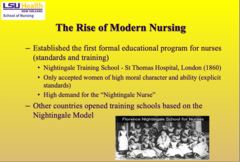
What is the Nightingale Training School?
- the first formal education program for nurses
- only accepted women of high moral character and ability
- other countries made training schools based on the Nightingale Model
Who was Mary Seacole?*
- Wealthy Jamaican born woman who established a "hotel for soldiers" during the Crimea War in London
- Learned how to take care of patients with cholera by performing an autopsy on a child who died of the illness
- Didn't consider herself a nurse
- Wanted to work with Nightingale; request was denied
- Voted as "Greatest Black Briton" in 2005
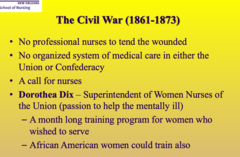
Who was Dorothea Dix?
- Superintendent of Women Nurses of the Union
- helped the mentally ill during The Civil War
- trained African Women to become nurses
Who was Clara Barton?*
- Founded the American Red Cross
- known as the Angel of the Battlefield
- took care of Union soldiers during the Civil War
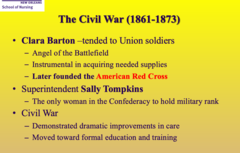
Who was Superintendent Sally Tompkins?
- the only woman in the Confederacy to hold military rank
- nurse, ran a hospital
What was the first facility that opened the first training school for nurses?
- The New England Hospital
Who was the first trained nurse in the United States? Who did she study under?*
- Linda Richards was the first trained nurse
- Trained under Florence Nightingale
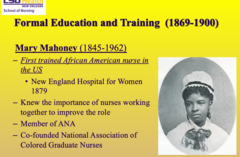
Who was Mary Mahoney? What was her impact?*
- the first professionally trained African American nurse
- studied at the New England Hospital for Women in 1879
- Co-founded the National Association of Colored Graduate Nurses
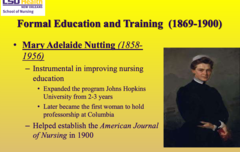
Who was Mary Adelaide Nutting?*
- established the American Journal of Nursing in 1900
- very important in improving nursing education
- expanded the program at John Hopkins University from 2 to 3 years
- the first woman to become a professor at Columbia
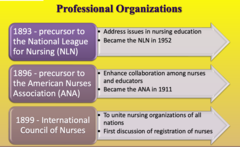
What organization began in 1893 to address nursing education issues and later became the NLN?
- The precursor to the National League for Nursing (NLN).
- Focus: Nursing education issues
- Became the NLN in 1952
Need to know*
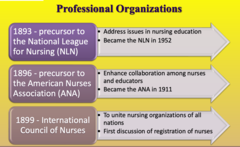
What organization was founded in 1896 to enhance collaboration among nurses and educators?
- The precursor to the American Nurses Association (ANA).
- Focus: Collaboration among nurses/educators
- Became the ANA in 1911

What was the purpose of the International Council of Nurses (1899)?
- To unite nursing organizations of all nations and begin the first discussion of nurse registration.
Who was Clara Maass?
- A young nurse who volunteered to be bitten by mosquitos to prove yellow fever was spread in Cuba
- Was studied to help prove how the disease spread; she died in 1901 from yellow fever after being bitten

What diseases plagued people during the Spanish American War?
- typhoid
- malaria
- dengue
- yellow fever
Who was Lillian Wald?
- Founded the Henry Street Settlement in NY in 1893
- Focused on healthcare education, health promotion and disease prevention for immigrant communities
- Founded the National Organization for Public Health
- Co-founder of the NAACP (National Association for the Advancement of Colored People)
- Pushed for insurance reimbursement for home nursing care (proved it saved companies money)

Who was Lavinia Dock?
- Social activist and reformer
- A colleague of Lillian Wald
Who was Jessie Sleet Scales?
- First African American nurse to bring community health nursing to NYC tenements (1900)
- Worked with Lillian Wald at the Henry Street Settlement
- Along with Elizabeth Tyler, founded the Stillman House, serving Black patients in NYC
- Fought racial barriers while providing excellent nursing care to underserved families
- Focused on disease prevention and managing illness in poor communities
*Think of her as a pioneer in public health nursing for African Americans.

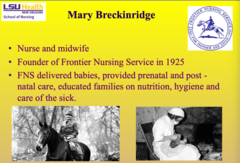
Who was Mary Breckinridge?
- Founder of the Frontier Nursing Service (FNS) in 1925
- A nurse and midwife
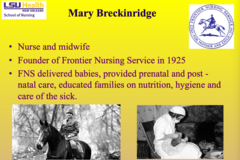
What did the Frontier Nursing Service (FNS) do, and who was it founded by?
- Founded by Mary Breckinridge
- The FNS delivered babies
- provided pre/post natal care
- educated families on nutrition
- hygiene education
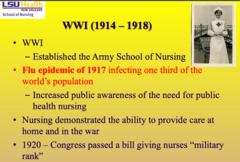
What role did nurses play during World War I?
- WWI led to the establishment of the Army School of Nursing
- Flu epidemic of 1917 infected ⅓ of the world's population
- Showed the need for public health nursing
- Nurses proved they could provide care both at home and in war
- In 1920, Congress gave nurses "military rank"
What were the key milestones in nursing licensure in the early 1900s?
- 1903 - NC, NJ, NY, VA → Permissive licensure (could practice without license but not use RN title)
- 1923 - All states had exams for permissive licensure
- 1942 - NLN created state board test pool → first profession with same national licensing exam (different pass rates by state)
- 1947 - NY made licensure mandatory (law passed in 1930s)
What were the key provisions of the 1935 Social Security Act, and how did it impact nursing and public health?
- Created a national system for old-age insurance
- Federal grants for maternal and child health services
- Vocational rehab for handicapped individuals
- Medical care for people who were "crippled" or blind
- Strengthened public health services
- Established a federal-state unemployment system
- Created public health and hospital jobs

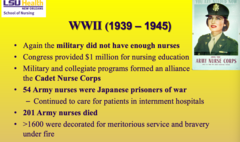
How did WWII (1939-1945) impact nursing?
- Military lacked nurses → Congress funded $1M for nursing education
- Cadet Nurse Corps formed (military + collegiate training alliance)
- 54 Army nurses became Japanese POWs (still cared for patients)
- 201 Army nurses died
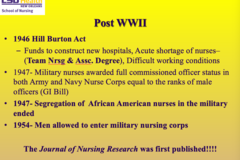
What were major nursing developments Post-WWII?
- 1946 Hill Burton Act → funded hospital construction, created acute nurse shortage → led to Team Nursing and Associate Degree programs
- 1947 → Military nurses granted full commissioned officer status (GI Bill)
- 1947 → Segregation of African American nurses in the military ended
- 1954 → Men allowed into military nursing corps
Journal of Nursing Research first published
What role did nurses play in the Vietnam War (1959-1975)?
- Improved trauma care
- Mobile hospitals set up in jungles
- Nurses often worked without direct physician supervision
- Some awarded Purple Heart (LT Ruth Mason, LT Frances Crompton, LT Barbara Wooster, LTJG Ann Darby Reynolds)
- Nurses and soldiers experienced PTSD
- 1993 Vietnam Women's Memorial dedicated → honored nurses' service (depicts 2 nurses, one White & one Black, aiding a wounded soldier)

What impact did the 1965 Amendments to the Social Security Act have on nursing?
- Established Medicare & Medicaid
- Hospitals provided most patient care → became preferred place of employment for nurses
- Medicaid = largest public assistance program (covered 9.2% of population, 15% of children)
- Health departments employed nurses to provide care
- Medicare reimbursement drew patients to hospitals → boosted hospital occupancy & nursing jobs

What new nursing roles and advancements emerged in the 1960s-1970s?
- Specialty care and clinical specialization expanded (psychiatric nursing, cardiac-thoracic surgery, coronary care).
- Nurse practitioner (NP) roles developed due to shortage of primary care physicians.
Technological advances:
- Intensive Care Units (ICUs) - 1950s
- Coronary Care Units (CCUs)
- Idaho (1971) = 1st state to legally recognize NPs for diagnosis & treatment.

How did the women's movement (1960-1980) both help and hurt nursing?
- Helped: Opened more career choices for women; increased number of students educated in colleges.
- Hurt: Nursing faced competition as women pursued other professions; economic issues in nursing became more visible.

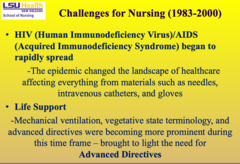
What major challenges did nursing face between 1983-2000?
- HIV/AIDS epidemic: Changed healthcare practices; required use of universal precautions (needles, catheters, gloves).
- Life support & ethics: Rise of mechanical ventilation, vegetative state issues, and the need for advanced directives.
How did the events of 9/11 and Hurricane Katrina impact nursing between 2001-2015?
- Post 9/11 attacks: Disaster management became a major focus; disaster drills were implemented in hospitals to prepare nurses and staff for wide-scale emergencies.
- Hurricane Katrina (2005): Highlighted the critical role of nurses during human catastrophes; nursing emphasized preparedness for disasters and emergency response.

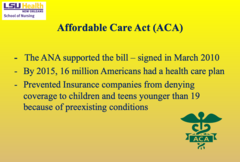
What were the key impacts of the Affordable Care Act (ACA) signed in 2010?
- Supported by the ANA, signed in March 2010
- By 2015, 16 million Americans gained health care coverage
- Prevented insurance companies from denying coverage to children/teens under 19 with preexisting conditions
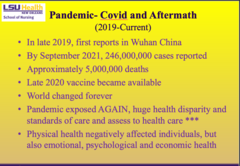
What were the major impacts of the Covid-19 pandemic on healthcare?
- First reported in Wuhan, China (late 2019)
- By Sept. 2021: 246 million cases, ~5 million deaths
- Vaccine available in late 2020
- Exposed major health disparities and gaps in care access
- Affected physical, emotional, psychological, and economic health
- World permanently changed
What factors influenced the public image of nursing from the late 1900s into the 2000s?
- Wars increased the need to recruit nurses
- TV & movies shaped stereotypes (ex: Nurse Ratched)
- Woodhull Study (1997): Showed nursing was "invisible" in media and public perception
- Nurses ranked 2nd only to firefighters in trust after 9/11
- Johnson & Johnson Campaign (2002): Promoted nursing as a profession
- Center for Nursing Advocacy (2001-2009) worked to improve the profession's image
- The Truth About Nursing nonprofit continues advocacy
What challenges did African-American nurses face in the mid-1900s?
- Educational opportunities were limited for African-American women
- By 1950, only 6% of graduate/student nurses in the US were African-American → health needs of the community were not being met
- In some states, African-American nurses were barred from state nurses associations (and the ANA)
- Roosevelt's order to end exclusion in the military opened the door for African-American nurses to serve in all areas of wartime production