Genetics Chapter 5: Non-Mendelian Inheritance
 Call Kai
 Learn
Learn Practice Test
 Spaced Repetition
 Match
Match Flashcards
 Knowt Play
1/12

There's no tags or description
Looks like no tags are added yet.
Name | Mastery | Learn | Test | Matching | Spaced | Call with Kai |
|---|
No analytics yet
Send a link to your students to track their progress
13 Terms
Extranuclear Inheritance AKA cytoplasmic inheritance
Inheritance patterns involving genetic material outside the nucleus
Mitochondria and chloroplasts are the most important due to genetic material within organelles found in cytoplasm, located in nucleoid
T/F: Chloroplasts tend to have more nucleoids per organelle than mitochondria
TRUE
Maternal effect
inheritance pattern for certain nuclear genes in which the genotype of the female parent directly determines the phenotype of the offspring
the genotypes of the male parent and offspring themselves do not affect the phenotype of the offspring
due to the accumulation of gene products that the female parent provides to developing eggs
Discovery of Maternal Effect Genes
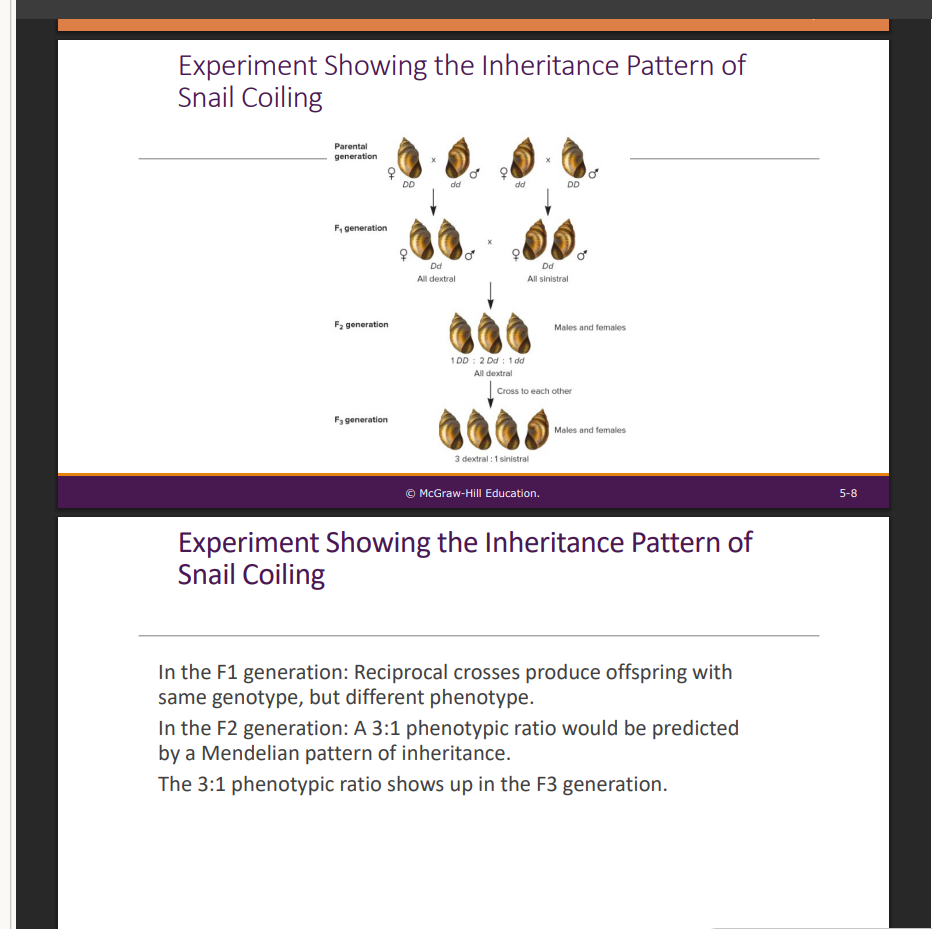
First discovered in 1920s by AE Boycott studying water snails
Right-handed: Dextral
Left-handed: Sinistral
Dextral is more common and dominant
The phenotype of the offspring depended solely on the genotype of the mother, NOT her phenotype
DD or Dd mothers produce dextral offspring
dd mothers produce sinistral offspring
The genotypes of the father and offspring do not affect the phenotype of the offspring
This non-Mendelian inheritance pattern can be explained by the process of oogenesis
Epigenetic Inheritance
pattern in which a modification occurs to a nuclear gene or chromosome that alters gene expression
The expression is not permanently changed over the course of many generations b/c the DNA sequence does not change
What are epigenetic changes caused by?
Epigenetic changes are caused by DNA and chromosomal modifications
Occurs during oogenesis, spermatogenesis or early embryonic development
Dosage compensation
The purpose of dosage compensation is to offset differences in the number of active sex chromosomes
Mechanism of X-chromosome Inactivation
During X chromosome inactivation, the DNA becomes highly compacted
Most genes on the inactivated X cannot be expressed
When this inactivated X is replicated during cell division:
Both copies remain highly compacted and inactive
X inactivation is passed along to all future somatic cells
Nucleation
Occurs during embryonic development. The number of X-inactivation centers (Xics) is counted and one of the X chromosomes remains active and the other is targeted for inactivation.
Spreading
Occurs during embryonic development. It begins at the Xic and progresses toward both ends until the entire chromosomes is inactivated and becomes a Barr body.
Maintenance
Occurs from embryonic development through adult life. The inactivated X chromosomes is maintained as such during subsequent cell divisions.
Genomic Imprinting
phenomenon in which a segment of DNA is marked and the effect is maintained throughout the life of the organism inheriting the marked DNA
Depending on how the genes are “marked”, the offspring expresses either the maternally-inherited or the paternally-inherited allele
Not both
Termed monoallelic expression
Stages of imprinting
Establishment of the imprint during gametogenesis
imprinting occurs during gametogenesis in the lgf2 gene, which exists in the lgf2 allele from the male and the Igf2- allele from the female. This imprinting occurs so that only the paternal allele is expressed.
Maintenance of the imprint during embryogenesis and in the adult somatic cells
After fertilization, the imprint pattern is maintained throughout development. In this example, the maternal Igf2- allele will not be expressed in somatic cells.
Erasure and reestablishment of the imprint in the germ cells
In the germ-line cells, the Imprint is erased. The female mouse produces eggs in which the gene is silenced. The male produces sperm in which the gene can be transcribed into mRNA.