Midterm 3 Review
 Call Kai
 Learn
Learn Practice Test
 Spaced Repetition
 Match
Match Flashcards
 Knowt Play
1/82

Earn XP
Name | Mastery | Learn | Test | Matching | Spaced | Call with Kai | Chat |
|---|
No analytics yet
Send a link to your students to track their progress
83 Terms
What is a unitary matrix?
Q* = Q^-1
What is a Hermition matrix
H* = H
The eigenvalues of A* are the…
conjugates of the eigenvalues of A
By the adjoint formula, <Av, w> =
<v, A*w>
det(A*)=
det(A)not
rank(A*) =
rank(A)
trace(A*) =
trace(A)not
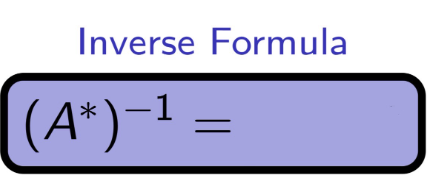
(A^-1)*
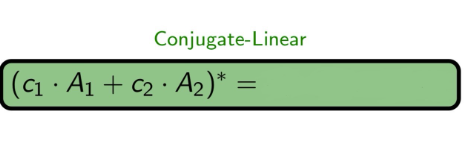
c1notA1* + c2notA2*
What does conjugate transposition being an order-reversing involution imply?
(AB)* = B*A* and (A*)*
What is the conjugate transpose of A equal to?
A* = A^Tnot
What is right conjugate-linearity?
<v, cw> = c<v, w>
What is left conjugate-linearity?
<cv, w> = cnot<v, w>
What is the conjugate-symmetric property for the inner product in the complex plane?
<v, w> = <w, v>not
<v, w> = …?
What is the inner product of vectors in complex plane
Take the conjugate for each of the values of the FIRST vector, then use element-wise comparison
When you take the conjugate of a vector in the complex plane you have to…
take the conjugate of each of the values
What is the reciprocal of z=a+bi where z is not 0?
1/z = znot/(|z|²)
What is the absolute value of z = a+bi?
sqrt(a² + b²)
What is the conjugation of z = a+bi?
a-bi
What is the complex product for z1 and z2?
(a1a2 - b1b2) + (a1b2 + a2b1)i
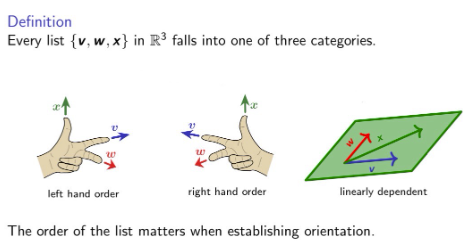
Label the categories
Negative orientation, positive orientation, and coplanar
How do you determine the orientation and area of a parallelogram formed by vectors v and w?
The orientation is the SIGN of the det[v w], and the area is the ABSOLUTE VALUE of det[v and w]
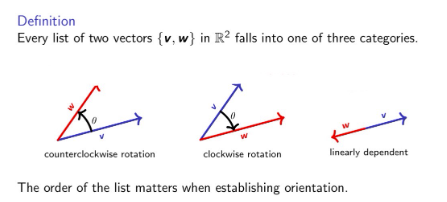
Label the categories
Positive orientation, negative orientation, and colinear
What is Cramer’s Rule?
If A is invertible, then Ax = b is solved by x = (products of n det of Ai where each column i is replaced by b)^T/det(A)
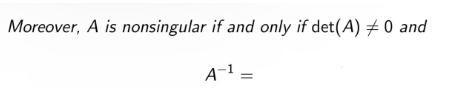
Fill in the blank
adj(A)/det(A)
What does a matrix’s determinant say about its singularity?
If det(A) is 0, then A is singular
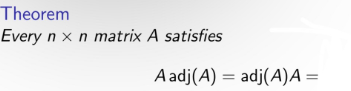
What is it = to?
det(A) x In
How are the cofactor and adjugate matrices of a matrix A related?
The adjugate matrix is the transpose of the cofactor matrix
In PA = LU, A = P^TLU. What do det(P^T), det(L), and det(U) equal?
det(P^T) = det(P) = (-1)^(# of swaps)
det(L) = diagonal product
det(U) = diagonal product
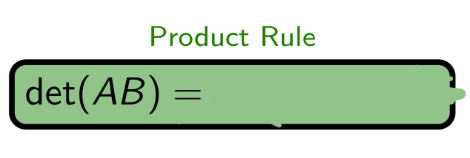
What is it equal to?
det(A)det(B)
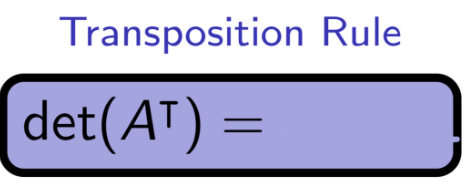
What is it equal to?
det(A)
What is the determinant of a triangular matrix?
The product of its diagonal
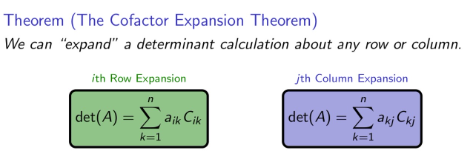
DONT FORGET THIS!!
ith Row: aikCik
jth Col: akjCkj
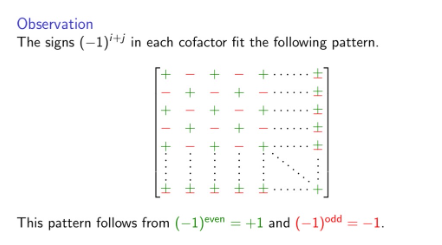
DONT FORGET THIS!!
(-1)^even = +1
(-1)^odd = -1
What is a cofactor of A?
Cij = (-1)^(i+j) det(Aij)
What is a minor (i, j) of A?
Mij = det(Aij)
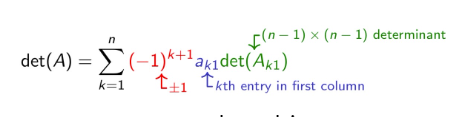
DONT FORGET THIS!!
determinant notation w/ sigma
Aij is obtained by____
deleting the ith row and jth column of A
What is R equal to in A = QR
R = Q^T A
How do you produce the columns of Q in A = QR?
Apply the Gram-Schmidt algorithm to the pivot columns of A
What is the gram-Schmidt general form for wd and qd?
wd = vd - projw1(vd)-…-projwd-1(vd)
qd = qd/||qd||
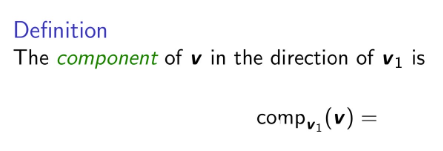
compv1(v) = ?
<v1, v>/||v1||

What does the projection onto a vector 1-D vector space reduce to?
v1<v1, v>/<v1^T, v1>
The least squares problem Axhat = Pb reduces to what in A = QR?
Rxhat = Q^tb
In A = QR, the projection onto Col(A) is equal to____
QQ^T
The columns of Q in A = QR form an orthonormal basis of ______
Col(A)
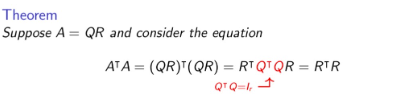
What do A and R have in common?
Common Gramian and rank
An m x r matrix Q has orthonormal columns if and only if_____
Q^TQ = Ir
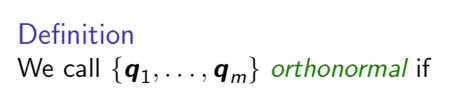
What are the condition for a list of vectors to be orthonormal?
The vectors in the list are mutually orthogonal and each vector is a unit vector
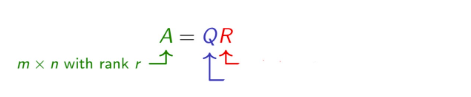
What are the dimensions of Q and R? What is special about Q and R?
Q is m x r with orthogonal columns,
R is r x n upper-triangular
For a function f(rnot) = ?
f(r)not = 0
Quadratic form is q(x) = ?
<x, Sx>
What is the outcome of completing the square?
<y, Dy> → where y = U^Tx
lambda1y1² + lambda2y2² + lambda3y3²…
What is the definiteness of a Gramian matrix?
Positive semidefinite
How do you obtain the columns of U for H = UDU*
Apply Gram-Schmidt to the eigenspaces of H
What qualities to U and D have for a spectral factorization UDU*?
U is unitary and D is real-diagonal
A matrix H is Hermitian only if it has a….
Spectral factorization where H = UDU*
By the spectral theorem, every Hermitian matrix is…
diagonalizable
By the spectral theorem, the eigenspaces of a Hermitian matrix H are…
orthogonal to each other
Real-symmetric matrices are also known as…
Hermitian matrices
By the spectral theorem, the eigenvalues of every Hermitian matrix H are…
real
What is the diagonal rule for matrix exponentials?
e^diag(d1,…,dn) = diag(e^d1,…, e^dn)
e^(a+bi) = …?
e^a
{cos(b)+isin(b)}
If A is diagonalizable, then exp(A) = …?
Xexp(D)X^-1
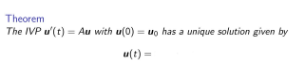
u(t) = ?
u(t) = exp(At)u0
If A is diagonalizable, then the columns of X are the…
linearly independent eigenvectors of A
What are the two tests for diagonalizability?
The sum of each of the geometric multiplicities equals the size of the matrix OR the gm=am for each eigenvalue
(-1)^n (det(A)) = ?
the product of each of the eigenvalues raised to their algebraic multiplicities
trace(A) =
the sum of the products between a matrix’s eigenvalues and algebraic multiplicity
If A is diagonalizable, then the diagonal entries of D are…
the eigenvalues of A
If A is diagonalizable that means…
A is similar to a diagonal matrix
What is the power rule in A~B?
A^k = X(B^k)(X^-1)
What is the eigenspace rule of A~B?
EA(lambda) = XEB(lambda)
If A is similar to B, then A =
XBX^-1
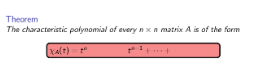
Fill in the blanks
-trace(A) (-1)^n(det(A))
What are the geometric multiplicity bounds for the roots of the characteristic polynomial?
Between 1 and the am(lambda) inclusive
What do the algebraic multiplicities sum to?
the size of a matrix
The roots of xA(t) are the…
eigenvalues of A
xA^T(t) = ?
xA(t)
What is the characteristic polynomial xA(t)?
xA(t) = det(tIn - A)
What are the vieta formulas?
cn-1 = (m1r1 +….+ mkrk)
c0 = (-1)^n r1^m1… rk^mk
What does the sum of multiplicities equal to?
The degree of the polynomial
What is the form of the fundamental theorem of algebra?
f(t) = (t-r1)^m1…(t-rk)^mk