Human Phys - Chapter 11: Sensory Physiology
 Call Kai
 Learn
Learn Practice Test
 Spaced Repetition
 Match
Match Flashcards
 Knowt Play
1/36

There's no tags or description
Looks like no tags are added yet.
Name | Mastery | Learn | Test | Matching | Spaced | Call with Kai | Chat |
|---|
No analytics yet
Send a link to your students to track their progress
37 Terms
1. What is the basic sensory pathway?
Stimulus → transduction → receptor potential → action potentials → brain → perception
Transduction = converting a stimulus into an electrical signal
Receptor potential = graded potential in the receptor
Easy: Stimulus → convert → graded → AP → perceive
Transduction
converting a stimulus into an electrical signal
Receptor potential
graded potential in the receptor
What is an adequate stimulus?
The type of stimulus a receptor responds to best.
Examples:
Chemoreceptor → chemicals
Mechanoreceptor → pressure/movement
Thermoreceptor → temperature
Photoreceptor → light
Easy: adequate stimulus = receptor’s favorite stimulus
Chemoreceptor
Chemicals
Mechanoreceptor
Pressure/movement
Thermoreceptor
temperature
Photoreceptor
Light
What is a receptive field?
The area where a stimulus can activate a sensory neuron.
Small receptive fields = more precise/sensitive
Large receptive fields = less precise
Easy: small field = sharp location
How does convergence affect two-point discrimination?
More primary neurons converging onto one secondary neuron → larger receptive field → worse ability to distinguish 2 nearby points.
Easy:
More convergence = less precision
Less convergence = more precision
What 4 properties of a stimulus does the CNS encode?
Modality = what kind
Location = where
Intensity = how strong
Duration = how long
Easy: M-L-I-D
Your professor basically organizes the whole section around these four.
What is labeled-line coding?
Each sensory pathway stays associated with a specific type of sensation.
Example: activating a cold pathway is interpreted as cold.
Easy: The pathway tells the brain WHAT it is.
Your professor specifically notes that modality and receptive-field information stay organized as signals travel toward the brain.
What is lateral inhibition?
The strongest sensory pathway inhibits neighboring pathways, making the stimulus location easier to pinpoint.
Easy: Strongest signal tells its neighbors to shut up. 😭
How is stimulus intensity coded?
Stronger stimulus causes:
a larger receptor potential
higher frequency of action potentials
often activation of more receptors
Important: APs themselves do not get bigger.
Easy: Stronger = bigger graded potential + faster AP firing
Tonic vs phasic receptors?
Tonic = slowly adapt and keep firing while stimulus is present.
Phasic = rapidly adapt and mainly respond when the stimulus changes.
Easy:
Tonic = stays ON
Phasic = detects CHANGE
Tonic
slowly adapt and keep firing while stimulus is present.
Stays ON
Phasic
rapidly adapt and mainly respond when the stimulus changes.
detects CHANGE
11.2 — Somatic Senses Flashcards
What are the 4 somatic senses?
Touch
Proprioception
Temperature
Nociception
Easy: touch, position, temp, pain/itch
Where are primary somatic sensory neuron cell bodies?
In the dorsal root ganglia.
Easy: DRG = sensory cell bodies
Where do pain, temperature, and coarse touch cross?
In the spinal cord.
Easy: pain/temp cross early
Where do fine touch, vibration, and proprioception cross?
In the medulla.
Easy: fine touch crosses later
Why does the left side of the body go to the right brain?
Because sensory pathways cross the midline.
Easy: body side → opposite brain side
What is the basic somatosensory pathway to the cortex?
Primary neuron → secondary neuron → thalamus → tertiary neuron → somatosensory cortex
Easy: 1 → 2 → thalamus → 3 → cortex
What does the somatosensory cortex do?
It tells the brain where the sensation came from.
More sensitive body parts get more cortex space.
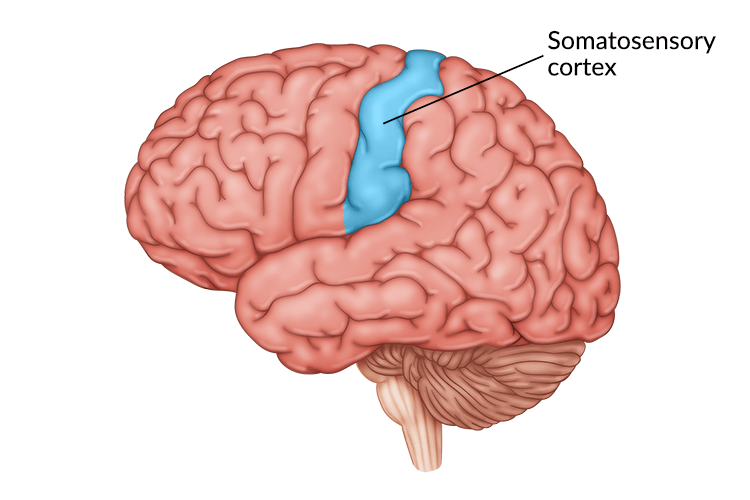
Easy: more sensitive = more brain space
What do Pacinian corpuscles detect?
Vibration
They adapt quickly.
Easy: Pacinian = vibration
What do Meissner corpuscles detect?
Light touch / stroking
Easy: Meissner = light touch
What do Ruffini corpuscles detect?
Skin stretch
Easy: Ruffini = stretch
What do Merkel receptors detect?
Steady pressure and texture
Easy: Merkel = pressure + texture
What are nociceptors?
Free nerve endings that detect harmful or damaging stimuli.
They can respond to:
chemical
mechanical
thermal stimuli
Easy: nociceptor = damage detector
What is fast pain?
sharp
well localized
carried by Aδ fibers
Aδ fibers are myelinated
Easy: Aδ = fast + sharp
What is slow pain?
dull
diffuse
carried by C fibers
C fibers are unmyelinated
Easy: C = slow + dull
Which fiber is linked to itch?
C fibers
Histamine in the skin can activate C fibers and cause itch.
Easy: C = slow pain + itch
What is referred pain?
Pain from an internal organ that feels like it comes from somewhere else on the body.
Easy: organ hurts → brain feels it somewhere else
Why does referred pain happen?
Visceral and somatic pain signals converge onto the same pathway, so the brain can confuse where the pain came from.
Easy: same pathway = wrong location
What is a classic referred pain example?
Heart pain can be felt in the left arm/chest area.
Easy: heart → left arm
How can touch reduce pain?
Touch signals can help inhibit pain signaling in the spinal cord.
Easy: rub it → pain feels less
Your professor literally notes this on the slide.
Why can pain cause sweating, nausea, or other body reactions?
Pain pathways also connect with the hypothalamus and limbic system.
Easy: pain affects emotion + body responses