PHYS EXAM 1 REVIEW
 Call Kai
 Learn
Learn Practice Test
 Spaced Repetition
 Match
Match Flashcards
 Knowt Play
1/99

There's no tags or description
Looks like no tags are added yet.
Name | Mastery | Learn | Test | Matching | Spaced | Call with Kai | Chat |
|---|
No analytics yet
Send a link to your students to track their progress
100 Terms
Which of the choices below correctly lists things in order from largest to smallest?
Milky Way, Universe, Solar System, Local Group
Universe, Local Group, Milky Way, Solar System
Universe, Milky Way, Local Group, Solar System
Solar System, Local Group, Universe, Milky Way
Local Group, Solar System, Milky Way, Universe
|
A light-year is:
about 365 Earth days.
the time it takes a beam of light to circle the Sun.
the distance between the Sun and the nearest other star.
the distance that light travels in a year.
The distance that light travels in a year.
Into how many constellations is the celestial sphere divided?
57
44
12
88
110
88
What is Polaris?
The North Star
Where on Earth would you be if Polaris were at your zenith?
Arctic Circle
Tropic of Cancer
North Pole
Equator
It lies overhead everywhere on Earth.
North Pole
Where on Earth can you observe all the stars in the sky over an entire year?
North Pole
Arctic Circle
Equator
Tropic of Cancer
Everyone on Earth can see the whole sky.
The Equator!
WHY: The Equator is the only place where you can see all the stars because it sits directly between the top and bottom of the Earth.
The stars appear to be attached to a sphere that surrounds the Earth and rotates above, causing the apparent rising and setting of the stars. This is called the:
universe.
Sun.
celestial sphere.
cosmos.
constellations.
Celestial sphere.
While watching a star, you see it moves 15 degrees across the sky. How long have you been watching it?
15 minutes
3 hours
1 minute
1 hour
15 seconds
1 Hour
360 degrees for one rotation (360 degrees / 24 hours) = 15 degrees per hour!~
How long is the precession cycle? What is precession?
365.24 days
29.5 days
18 years, 11.3 days
1 day
26,000 years
26,000 years
Earths wobble while it rotates on its axis (Like a dog on a leash lwk)


The Place the sun stops its northward motion along the ecliptic is the:
summer solstice.
node of the ecliptic.
prime meridian.
vernal equinox.
equator.
summer solstice.
The places where the Sun crosses the equator are called the:
equinoxes.
zeniths.
solstices.
prime meridians.
annalemmas.
equinoxes.
What is the definition of an equinox?
A. The point when the Sun is at its highest point in the sky.
B. The time when the Sun crosses the celestial equator.
C.The longest day of the year.
D. The shortest day of the year.
B. The time when the Sun crosses the celestial equator.

What happens during a solstice?
A. The Sun crosses the celestial equator.
B. Day and night are of equal length.
C. The Sun is directly overhead at the equator.
D. The Sun is at its greatest distance from the equator.
D. The Sun is at its greatest distance from the equator.
From a location in the United States of America, a star is observed to be rising due East. Where will this star be located 6 hours later?
directly overhead
setting due West
high in the southern sky
high in the Northern sky
The location of the star cannot be determined from the information given.
high in the southern sky (Stars rise in the northeast and set in the southwest)

What is an ecliptic?
The ecliptic is the apparent yearly path that the Sun takes across the sky against the background of stars

Which statement about the ecliptic is FALSE?
The Sun appears to move about a degree per day eastward long it.
The Moon can never leave it, but moves twelve times faster than the Sun.
The major planets stay close to it, but not always on it.
The year is marked by the Sun's return to the same place along it.
It is tilted 23.5 degrees with respect to the equator.
THE MOON CAN NEVER LEAVE IT, BUT MOVES TWELVE TIMES FASTER THAN THE SUN - The Moon does not stay perfectly on the ecliptic. The Moon's orbital plane is actually tilted by about 5.1 degrees relative to the Earth's orbital plane (the ecliptic).
Why other choices are wrong:
"The Sun appears to move about a degree per day eastward along it."
👍 True. The Sun takes roughly 365 days to complete a full 360-degree circuit of the sky, which averages out to approximately 1 degree of eastward motion per day."The major planets stay close to it, but not always on it."
👍 True. Most planets in our solar system orbit the Sun in nearly the same flat plane, meaning they stay very close to the ecliptic in our night sky, though their slight orbital tilts keep them from being perfectly on it."The year is marked by the Sun's return to the same place along it."
👍 True. A solar year is fundamentally defined by the time it takes the Earth to complete one full orbit around the Sun, which visually looks like the Sun returning to the exact same starting point on the celestial sphere."It is tilted 23.5 degrees with respect to the equator."
👍 True. Because the Earth's rotational axis is tilted by 23.5 degrees, the plane of our equator is thrown off by that same angle relative to the plane of our orbit (the ecliptic)
That Polaris will not always be the pole star is due to:
the sidereal day being shorter than the solar day.
the Solar winds blowing the Earth farther away from the Sun.
the Earth's revolution being slightly less than exactly 365.25 days.
the Moon following the ecliptic, instead of the equator.
precession shifting the celestial pole.
precession (earths wobble) shifting the celestial pole.
What celestial line is a product of the Earth's orbit around the Sun?
Analemma
Prime Meridian
Ecliptic
Equator
Galactic Plane
Ecliptic (The annual circular path the Sun appears to take across the celestial sphere as Earth revolves around it.)
Where would you be if the Sun sets for six continuous months, beginning on September 23rd?
South Pole
Equator
Antarctic Circle
North Pole
Arctic Circle
Equator gets 12hr day and nights, and the antartic/artic circle get 1 day of continous night during solstices. You are left with SOUTH OR NORTH POLE.
To rule out the final choices, determine which hemisphere goes into darkness after September 23rd.
Between September and March, the Earth's northern axis points away from the Sun (causing winter in the Northern Hemisphere)
while the southern axis points toward the Sun (causing summer in the Southern Hemisphere)
So, the answer is NORTH POLE
When does the Sun set at the North Pole?
A.June 21st
B.March 21st
C.September 23rd
D.December 21st
C. September 23rd (The autumn equinox)
What is the significance of the equinoxes in relation to the poles?
They mark the transition between polar day and night.
Where would you be if the Sun sets for six continuous months, beginning on September 23rd?
A.Antarctic Circle
B.South Pole
C.Equator
D.North Pole
E.Arctic Circle
North Pole: September 23rd (The autumn equinox) marks the beginning of 6m of polar nights.
When is the winter solistice? At which tropic must it be at the furthest point?
12/21, Tropic of Capricorn
When is the summer solistice? Which tropic does it fall on?
6/21, Tropic of Cancer
Where would you be if the Sun passes through your zenith on December 21st?
Tropic of Cancer
South Pole
Equator
Tropic of Capricorn
Antarctic Circle
Tropic of Capricorn
The constellations of the zodiac fall along:
the celestial equator.
lines of latitude.
lines of longitude.
the ecliptic.
The Ecliptic!
Why? the Earth, Moon, and all the planets in our solar system orbit the Sun in roughly the exact same flat, pancake-like plane (Ecliptic).
When the Sun rises, it is located in the constellation Gemini. When the Sun sets later that same day, it will be:
in the constellation Cancer.
in the constellation Gemini.
in the constellation Aries.
in the constellation Leo.
in the constellation Taurus.
in the constellation Gemini. (follows same line while rising and setting, cannot hop paths mid day durrr
A solar eclipse can only happen during a:
perihelion passage of the Sun.
solstice.
new moon.
first quarter moon.
full moon.
New Moon!
Why?
The Shadow: When the Moon is in this middle position, its dark, unlit side faces Earth.
The Phase: By definition, when the Moon is directly between the Earth and the Sun, it is a new moon.
A lunar eclipse can only happen during a:
new moon.
perigee.
full moon.
equinox.
aphelion.
full moon.
Why:
Alignment: A lunar eclipse occurs when the Earth sits directly between the Sun and the Moon. [1, 2]
Shadow: This exact lineup only takes place during the full moon phase when the Moon is on the opposite side of the Earth from the Sun, allowing Earth's shadow to fall on the lunar surface. [1, 2, 3, 4]
If you are in the Moon's umbral shadow, then you will witness:
a total lunar eclipse.
nighttime.
a total solar eclipse.
a partial solar eclipse.
some kind of lunar eclipse.
A Total Solar Eclipse
WHY: Umbral = Total, Penumbral = partial.
For the moon to cast a shadow, the sun has to be behind it (Sun blocked = Solar eclipse)
What is required for an eclipse?
An eclipse happens only when the Moon is positioned precisely between the Earth and the Sun and aligns with the Ecliptic plane at a point called a node
Why don;t we have an eclipse every month?
Orbital Tilt: The Moon’s orbit around Earth is tilted by about 5 degrees relative to Earth's orbital plane around the Sun. [1, 2]
Missed Shadows: During most new or full moons, the Moon passes either too high or too low above or below this plane, meaning the shadows miss their targets. [1, 2]
Identify if this is a lunar or solar eclipse:
☀ [Sun] -----> 🌍 [Earth] -----> 🌕 [Moon]
🌕 Lunar Eclipse (The Earth is in the Middle)
Identify if this is a lunar or solar eclipse:
☀ [Sun] -----> 🌑 [Moon] -----> 🌍 [Earth]
🌞 Solar Eclipse (The Moon is in the Middle)
What is a Perigree?
the point in an elliptical orbit where an orbiting object, like the Moon or a satellite, is closest to the Earth
What conditions are necessary for a total solar eclipse?
full moon on equator at perigee
new moon on equator at perigee
new moon on ecliptic near aphelion
new moon on ecliptic near perigee
full moon on ecliptic near aphelion
new moon on ecliptic near perigee
Near Perigee: Perigee is the point when the Moon is closest to Earth in its elliptical orbit. This makes the Moon look slightly larger in the sky, giving it enough apparent size to completely block the Sun's disk
Driving eastward just before sunrise, if you observe the Moon in the eastern sky, its phase must be:
waning Crescent.
new moon.
waxing Gibbous.
full moon.
first quarter.
Waning Crescent
When the Moon is close to the Sun in the sky, we only see a small sliver of its illuminated side. Since it is trailing just ahead of the Sun, it rises shortly before dawn.
The angular size of an object depends on which two quantities?
the object's actual size and its mass
the object's actual size and its distance from us
the object's distance from us and its brightness
the objects brightness and its mass
the object's actual size and its distance from us
If the angular size of a spherical object is known, along with its distance from Earth, what third quantity can be determined?
the object's brightness
the baseline
the object's diameter
the object's mass
the object's diameter
What conditions are necessary for an annular solar eclipse?
new moon on ecliptic at apogee
new moon on equator at perigee
new moon on equator at apogee
full moon on ecliptic at perihelion
new moon on ecliptic at perigee
New moon on the ecliptic at Apogee
Why "At Apogee"? (The Size Barrier)
This is the specific factor that makes an eclipse annular (creating the "ring of fire") rather than total.
What is an annular solar eclipse?
An annular solar eclipse happens when the Moon passes between the Sun and Earth while it is at or near its farthest point from Earth, leaving a bright ring of sunlight visible around the dark disk of the Moon
The new Moon happens about once a month, and is often described as happening when the Moon passes between the Sun and the Earth. Why isn't there an eclipse during every new Moon?
The Moon is not actually directly between the Earth and the Sun during the new Moon because its orbit is tilted relative to the celestial equator.
The Moon can only block the Sun when it is furthest away from Earth, and most new Moons happen when the Moon is at another place on its orbit.
The Moon is not actually directly between the Earth and the Sun during the new Moon because its orbit is tilted relative to the ecliptic plane.
The apparent size of the Moon is only occasionally large enough to block the Sun.
The Moon is not actually directly between the Earth and the Sun during the new Moon because its orbit is tilted relative to the ecliptic plane.
Parallax angle:
This is the apparent shift of a star when viewed from opposite sides of Earth's orbit.

The star Wolf 1061 has a parallax of 2.34 arcseconds, while the star Ross 652 has a parallax of 1.70 arcseconds. What can you correctly conclude?
Ross 652 must have a larger proper motion than Wolf 1061.
Both stars are outside the Milky Way galaxy.
Wolf 1061 is closer to Earth than Ross 652.
Ross 652 is closer to Earth than Wolf 1061.
Wolf 1061 must have a larger proper motion than Ross 652.
Wolf 1061 is closer to Earth than Ross 652.
A larger parallax angle means a shorter distance.
Which of the following describes parallax?
It is more accurate as the distances to objects become greater.
It is best measured over exactly one year intervals.
It is only applicable to objects within the solar system.
It is inversely proportional to the distance to the star.
It was first observed by Galileo with his new telescope.
It is inversely proportional to the distance to the star.
A star with a large parallax:
is at a short distance from Earth.
is at a great distance from Earth.
is moving at a great speed with respect to Earth.
is moving at a slow speed with respect to Earth.
is not moving with respect to Earth.
is at a short distance from Earth.
(Parallax is inverse to distance)
The Earth's circumference was first determined by:
Aristarchus with first and third quarter Moon timings.
Aristotle using lunar eclipses.
Erastothenes with solstice shadows.
Pythagoras with geometry.
Hipparchus with stellar parallaxes.
Eratosthenes with solstice shadows
The most accurate Greek attempt to explain planetary motion was the model of:
Erastothenes.
Hipparchus.
Pythagoras.
Aristotle.
Ptolemy.
Ptolemy. (Pt kinda looks like planet)
The Ptolemaic model of the universe:
always kept Mars and Mercury between the Earth and Sun.
explained and predicted the motions of the planets with deferents and epicycles.
is the basis of our modern cosmology.
describes the orbits of the planets as being ellipses, not circles.
could not account for the stellar parallax observed by Hipparchus.
explained and predicted the motions of the planets with deferents and epicycles.
According to Copernicus, retrograde motion for Venus must occur around:
quadrature, when the planet is 90 degrees away from the Sun.
greatest elongation, when the planet is farthest from the Sun.
opposition, when the planet lies opposite the Sun in the sky.
inferior conjunction, when it passes between us and the Sun.
superior conjunction, when the planet is on the far side of the Sun.
inferior conjunction, when it passes between us and the Sun.
Copernicus determined a heliocentric model (earth centered)
This overtaking happens exactly when Venus passes directly between the Earth and the Sun, which is known as inferior conjunction
Scientists today do not accept the Ptolemaic model because:
it has been shown that Ptolemy faked his data.
it had no explanation for retrograde motion.
it is ancient history.
it was too complicated, compared to Copernicus' heliocentric model.
the work of Tycho and Kepler showed the heliocentric model was more accurate.
the work of Tycho and Kepler showed the heliocentric model was more accurate. (reason we have kepners laws)
The heliocentric model was actually first proposed by:
Hipparchus.
Archimedes.
Aristarchus.
Alexander the Great.
Aristotle.
Aristarchus
According to Copernicus, the retrograde motion for Mars must occur:
at greatest elongation, when Mars can get up to 47 degrees from the Sun.
at superior conjunction, when Mars lies on the far side of the Sun.
at inferior conjunction, when Mars laps the Earth and passes between us and the Sun.
at quadrature, when Mars lies exactly 90 degrees east or west of the Sun.
at opposition, when the Earth overtakes Mars and passes between Mars and the Sun.
at opposition, when the Earth overtakes Mars and passes between Mars and the Sun.
Which of these was NOT a part of the original Copernican model?
Mercury speeds up at perihelion, and slows down at aphelion.
The Earth rotates on its axis once a day.
Venus can go all the way around the Sun.
The Sun lies at the center of the solar system.
Mercury must move faster in its orbit than any other planet.
Mercury speeds up at perihelion, and slows down at aphelion was NOT a part of the original Copernican model.
Which of the statements below is part of both the Ptolemaic and Copernican models?
The Moon orbits the Earth once a month.
The Earth orbits the Sun once a year.
The Sun lies in the center of the Cosmos.
Epicycles are needed to explain retrograde motion of the planets.
Venus' epicycle must always lie between us and the Sun.
The Moon orbits the Earth once a month.
Which of these was NOT seen telescopically by Galileo?
Four moons around Jupiter
Sunspots
Venus' phase cycle
Craters and mare on the Moon
Stellar parallax
Stellar parallax
Which of the following was NOT a contribution of Galileo to astronomy?
The four moons of Jupiter are a model for the solar system motions in general.
The changing appearance of Saturn's rings corresponds to our seasons.
Sunspots showed the Sun was rotating on its axis, like the Earth does.
The craters and mare of the Moon prove it a world in its own right.
The phases of Venus prove it orbits completely around the Sun.
The changing appearance of Saturn's rings corresponds to our seasons
Which of the following is a contribution to astronomy made by Galileo?
The Moon has craters, mountain, valleys, and dark flat areas on its surface.
Jupiter has four moons orbiting it.
The astronomical telescope can show us far more detail than the eye can.
Venus appears almost fully lit when it lies on the far side of the Sun.
All of the above.
All of the above.
Which of these was NOT a telescopic discovery of Galileo?
the phases of Venus
the moons of Saturn
the craters and mare of the Moon
sunspots and the rotation of the Sun
the four largest moons of Jupiter
the moons of Saturn
A fatal flaw with Ptolemy's model is its inability to predict the observed phases of:
Jupiter and Saturn.
the Sun during an eclipse.
Mercury and Venus.
Mars and Jupiter.
the Moon in its monthly cycle.
Mercury and Venus
Galileo found the rotation period of the Sun was approximately:
a year.
a month.
three months.
a day.
a week.
a month.
Kepler's first law worked, where Copernicus' original heliocentric model failed, because Kepler described the orbits as:
much larger than Copernicus had envisioned.
complex, with epicycles to account for retrograde motions.
around the Sun, not the Earth.
being on equants instead of epicycles.
elliptical, not circular.
Elliptical, not circular.
Tycho Brahe's contribution to Kepler's Laws of Planetary Motion was:
the correct explanation of lunar phases.
his observations of Jupiter's moons.
his detailed and accurate observations of the planet's position.
a precise lunar calendar.
a mathematical explanation of epicycles.
his detailed and accurate observations of the planet's position.
A circular orbit would have an eccentricity of:
infinity.
0.
between 0.5 and 1.
between 0 and 0.5.
exactly 1.0.
0
Upon which point do Copernicus and Kepler disagree?
The orbits of the planets are ellipses, with one focus at the Sun.
Retrograde motion occurs when one planet overtakes another.
The Earth orbits the Sun.
Venus will appear as a crescent when she retrogrades between us and the Sun.
The Moon orbits the Earth.
1. The orbits of the planets are ellipses, with one focus at the Sun.
Kepner’s Law #1
Planetary orbit is an elipse (2 focus points, center of gravity and empty focus)
Aphelion: Furthest from sun, slowest motion
Perihelion: Closest to sun, fastest motion
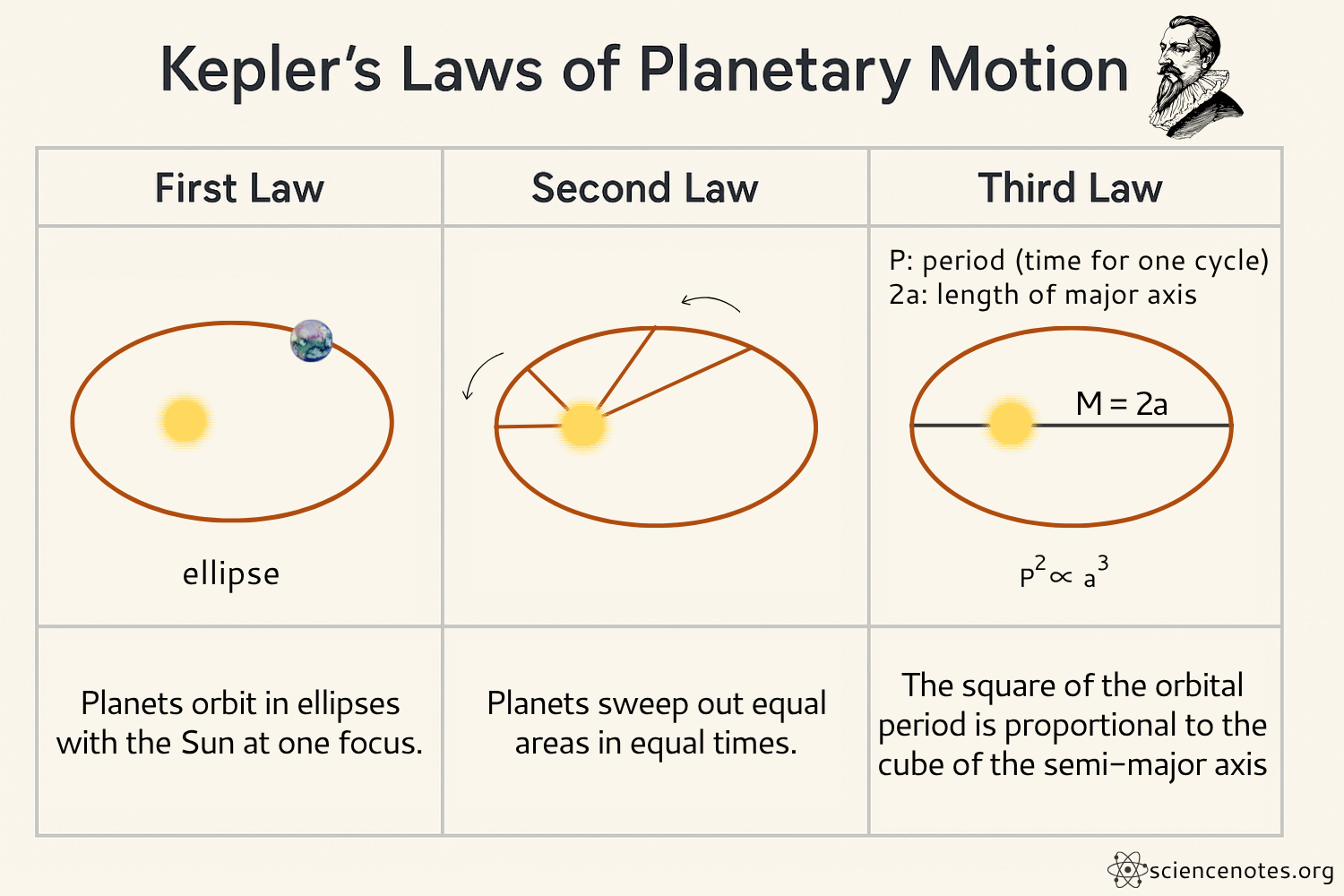
Kepner’s Law #2
Planet sweeps out equal area of at equal periods of time
In Human: Closest planet is to sun, the faster it moves and vise versa. Area swept is equal at all points.

Kepner’s Law #3
the square of a planet's orbital period is directly proportional to the cube of the semi-major axis of its orbit
P² = a³

Which concept was NOT a part of Kepler's Laws of Planetary Motion?
Epicycles are needed to explain the varying brightness of the planets.
The square of the planet's period is equal to the cube of its average distance.
A planet must move fastest in its orbit at perihelion.
All planetary orbits are ellipses.
Epicycles are needed to explain the varying brightness of the planets.
According to Kepler's third law, the square of the planet's period in years is:
equal to the fourth power of its average temperature in degrees Kelvin.
equal to the square of its aphelion distance in A.U.
inversely proportional to its mass in kilograms.
proportional to the cube of its semimajor axis in A.U.
equal to its perihelion distance from the Sun in A.U.
proportional to the cube of its semimajor axis in A.U.
What does Kepler's third law imply about planetary motion?
All planets orbit the Sun at the same speed.
Planets closer to the Sun orbit at a slower speed than planets further from the Sun.
This law implies nothing about a planet's motion.
Planets further from the Sun orbit at a faster speed than planets closer to the Sun.
Planets further from the Sun orbit at a slower speed than planets closer to the Sun.
Planets further from the Sun orbit at a slower speed than planets closer to the Sun
A planet whose distance from the Sun is 3 A.U. would have an orbital period of how many Earth-years?
3
sqrt 3
sqrt 27
81
9
sqrt 27
P² = A³
P = orbital period
A = semi-major axis (avg distance between sun and planet)
You are given A, so P² = 3³
P²= 27. → square it to “undo” the power of 2 on the P (Inverses)
The place in a planet's orbit that is closest to the Sun is called:
vernal equinox.
crossing the ecliptic.
perihelion.
aphelion.
None of these; a planet's distance from the Sun never changes.
perihelion.
The planet with the most eccentric orbit is:
Mars.
Mercury.
Neptune.
Earth.
All planets orbit in circles, so have the same eccentricity.
Mercury.
(Planets closer to sun → most eccentric)
(Planets further frun sun → least eccentric)
If an object is observed to orbit the Sun in an orbit with an eccentricity of 0.9, what type of object is it likely to be?
a comet
a moon
a star
an asteroid
a planet
a comet
Most planets, moons, and typical asteroids travel in much flatter, nearly circular paths with low eccentricities.
Comets regularly feature high eccentricities (often 0.8 or higher) that bring them close to the Sun from the distant edges of the solar system before swinging far back out.
The force of gravity varies with the:
product of the two masses.
inverse of the distance separating the two bodies.
inverse square of the distance separating the two bodies.
Both 1 and 2 are correct.
Both 1 and 3 are correct.
Both 1 and 3 are correct.
product of the two masses.
**inversely proportional to the square of the distance (r2²)

The Law of Universal Gravitation was developed by:
Newton.
Kepler.
Galileo.
Einstein.
Copernicus.
2.Kepler.
The force of gravity between two objects:
increases with the square of their masses, but decreases with the cube of their periods of orbit about the Sun.
depends on the density, not the mass of the bodies.
increases with the masses of the bodies, but decreases with the square of the distances between them.
depends on the temperature, density, and size of the bodies.
increases with the masses of the bodies, but decreases with their separations.
increases with the masses of the bodies, but decreases with the square of the distances between them.
𝐹=𝐺(m1m2/r2)
𝑭: The pulling force of gravity between two objects.
𝑮: The gravitational constant, which is a fixed number used everywhere in the universe
m1 and m2: The masses of the two objects.
𝒓: The distance between the centers of the two objects.
According to Newton's Law of Universal Gravitation, if the Moon were three times further from Earth, the force by Earth on the Moon would:
decrease by a factor of 9.
stay the same.
decrease by a factor of 3.
increase by a factor of 9.
increase by a factor of 3.
Decrease by a factor of 9
𝐹=𝐺(m1m2/r2)
If the distance is multiplied by 3, the new force is divided by
3² (which equals 9).
Therefore, tripling the distance reduces the gravitational pull to
Decrease by a factor of 9. (because distance is in the dem. so its on the bottom)
How much stronger is the gravitational pull of the Sun on Earth, at 1 AU, than it would be if Earth were at 10 AU, in the orbit of Saturn?
100 times stronger
10 times stronger
5 times stronger
250 times stronger
25 times stronger
100 times stronger
Which of these was a contribution of Newton to astronomy?
His differential calculus lets us calculate planetary motions more accurately.
The Sun's gravity is greatest on a planet at perihelion, so the planet must speed up.
Artificial satellites could be put into orbit about the Earth.
The Moon pulls as strongly on us as we do on it.
All of these were due to Newton's work.
All of these were due to Newton’s Work
Geosynchronous satellites orbit at about four Earth radii, where the Earth's gravitational pull is:
1/2 g.
1 g.
2 g.
1/16 g.
1/4 g.
1/16 g.
F = 1/r²
F = Gravitational Force
R = Square of the distance (𝑟) between their centers.
At the satellite's orbit, the distance increases to four Earth radii (4𝑅𝑒).
Squaring this change in distance gives:
1/4² = 1/16g
How much weaker is the gravitational pull of the Sun on Jupiter, at 5 AU, than it would be if Jupiter were at 1 AU, in the orbit of Earth?
The same
25 times weaker
100 times weaker
5 times weaker
10 times weaker
( d1 / d2 )²
(5/1)²= 25 times weaker
Given that the planet orbiting the nearby star 51 Pegasi is about 20X larger than the Earth, but 400X more massive, on that world you would weigh:
half as much as you do here.
20X more that you do here.
twice as much as you do here.
400X more than you do here.
the same as you do here.
Gravity = Mass/Radius²
400/20² = 1
THE SAME AS YOU DO HERE
What is the inverse square law in the context of gravitational force?
Gravitational force increases with the square of the distance.
Gravitational force is unaffected by distance.
Gravitational force decreases with the square of the distance.
Gravitational force is directly proportional to the distance.
Gravitational force decreases with the square of the distance.
If the distance between two objects is tripled, how does the gravitational force change?
It becomes three times greater.
It becomes one third as great.
It remains the same.
It becomes one ninth as great.
It becomes one ninth as great.
Quick trick to remember: gravity follows an inverse square law. Whatever you multiply the distance by, square it, then flip it:
Double the distance → 1/4 the force
Triple it → 1/9
Halve it → 4× the force
Start with Newton's law of gravity: F = G × (m₁ × m₂) / r². The key part is the r² on the bottom, where r is the distance between the objects.
Triple the distance: the new distance is 3r.
Plug it in: the bottom becomes (3r)² = 9r².
Compare to the original: since the distance squared got 9 times bigger and it's on the bottom of the fraction, the force gets 9 times smaller. So F becomes F/9.
A wave's velocity is the product of the:
frequency times the wavelength of the wave.
period times the energy of the wave.
amplitude times the frequency of the wave.
frequency times the period of the wave.
amplitude times the wavelength of the wave.
frequency times the wavelength of the wave.
The number of waves passing the observer per second is:
the wavelength in angstroms.
the frequency in Hertz.
the amplitude in nm.
the period in seconds.
the energy in milliwatts.
the frequency in Hertz.
Frequency = Waves passing per sec
Which of these is constant for ALL types of electromagnetic radiation in a vacuum?
amplitude
photon energy
wavelength
frequency
velocity
velocity
Electromagnetic radiation:
has only the properties of waves.
can only travel in a dense medium.
can behave both as a wave and as a particle.
is the same as a sound wave.
has nothing in common with radio waves.
can behave both as a wave and as a particle.
Which type of electromagnetic radiation travels fastest in a vacuum?
X-ray
visible light
radio
gamma rays
They all travel at the same speed.
They all travel at the same speed.
Which form of electromagnetic radiation is absorbed by carbon dioxide and water vapor in our atmosphere?
infrared
ultraviolet
gamma rays
radio
visible light
Infrared
Which form of electromagnetic radiation would be blocked in the stratosphere by ozone?
visible light
microwaves
ultraviolet
cosmic rays
infrared
Ultraviolet
Of all the forms of electromagnetic radiation, the one with the lowest frequency is:
gamma rays.
microwaves.
ultraviolet rays.
visible light.
radio waves.
radio waves.
The two forms of electromagnetic radiation that penetrate the atmosphere best are:
X-rays and gamma rays.
infrared and microwaves.
visible and infrared light.
ultraviolet and visible light.
visible and radio waves.
visible and radio waves.
Order of the Spectrum (Low to High Frequency)
Read the mnemonic from left to right to go from lowest frequency and longest wavelength to highest frequency and shortest wavelength: [1]
R.M.I.V.U.X.G
Raging = Radio waves
Martians = Microwaves
Invaded = Infrared
Venus = Visible light
Using = Ultraviolet
X-ray = X-rays
Guns = Gamma rays
The visible light window (NM)
400 nm to 700 nm is the span of visible light.
400 nm is Violet (shorter wavelength, higher energy).
700 nm is Red (longer wavelength, lower energy).
Use ROYGBIV backward/forward to fill in the colors between 400 and 700
The visible color of electromagnetic radiation that has the shortest wavelength is:
green.
violet.
blue.
red.
orange.
violet.
Colors appear different to us because of their photons' different:
speeds.
polarization.
magnetic fields.
frequencies.
amplitudes.
frequencies.
Which type of radiation can be observed well from Earth's surface?
X-ray
visible
infrared
gamma ray
ultraviolet
visible