Introduction to Interoception
 Call Kai
 Learn
Learn Practice Test
 Spaced Repetition
 Match
Match Flashcards
 Knowt Play
1/39

There's no tags or description
Looks like no tags are added yet.
Name | Mastery | Learn | Test | Matching | Spaced | Call with Kai | Chat |
|---|
No analytics yet
Send a link to your students to track their progress
40 Terms
What is interoception and what are it’s key aspects?
our ability to feel sensation from our body
is distinct from the five senses
homeostasis is key
is the foundation of our sense of the physical self
self-awareness/emotion
What is restrictive interoception?
how it was defined historically as purely visceral (Sherrington 1948)
only information concerning the functional state of the internal organs
How is the contemporary view of interoception more inclusive than the historical view?
regards general homeostatic sensory capacity (Craig 2002, 2003, 2008)
information concerning the broader physiological state and motivational needs of the body
including pain, temperature and touch which all activate the same pathway
What is homeostasis?
physiological equilibrium
How does interoception relate to an anatomical pathway?
Information about the physiological state of the body follows a similar (parallel) pathway to the brain
similar categories of afferent nerves
signals that follow this pathway are classed as interoception
What are afferents?
sensory information from the body to the brain
sensory neurons
What are efferents?
regulatory signals from the brain to the body
motor neurons
Which direction does the interoception neural anatomical pathway travel?
ascending pathway
What are afferent neurons?
nerve fibres that carry information towards the brain
How do different afferent neurons differ?
different types of fibres carry different types of information and follow different pathways
but afferent nerves that carry information about the physical state of the body (interoception) follow a similar pathway.
Which afferent neurons carry the signals of interoception?
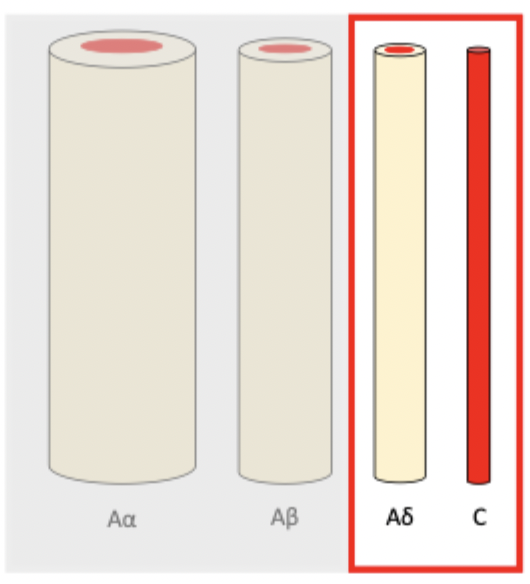
small diameter A-delta and C afferent nerves
including nociceptors (pain)
thermoreceptors (temperature)
osmoreceptors (thirst)
baroreceptors (heart rate)
What is the difference between C afferents and other fibres?
C afferents are unmyelinated nerve fibres
they carry signals slower
What is Myelination and how does it cause different afferents to differ?
myelination is a layer of insulation (fatty sheath) surrounding a neuron
increases efficiency of electrical transmission (nerve signals travel faster)
unmyelinated neurons are comparatively slow
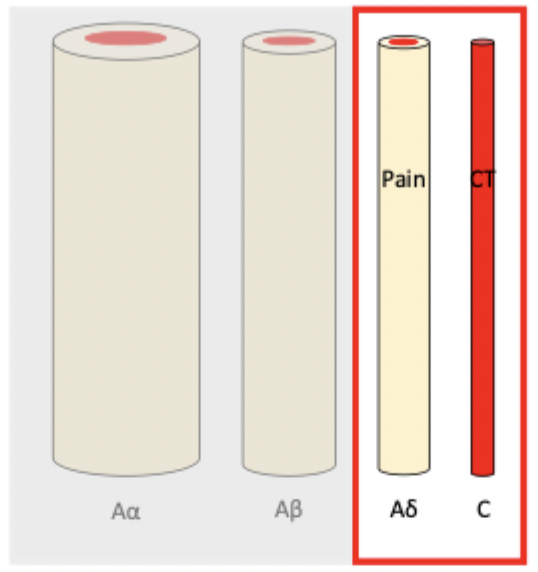
mylinated nerves = nociceptors (pain)
unmylinated nerves = CT afferents (affective touch) - less urgent
How are the cells in the dorsal horn divided?
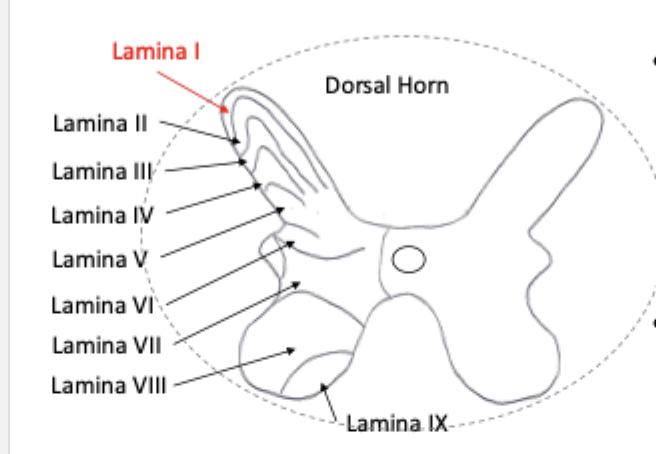
divided into physiologically distinct layers called laminae
What are the characteristics of Lamina I in the dorsal horn?
lamina I is the most superficial layer (marginal layer) of the dorsal horn
all introceptive signals come into this layer (a delta and C fibres)
What is the neural anatomic pathway of interoception from Lamina I to the cortex?
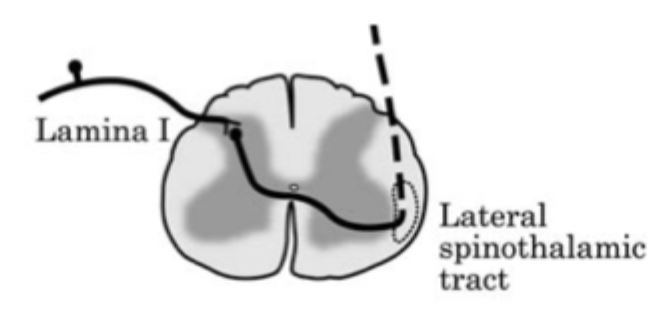
small-diameter afferent nerves project to Lamina I of the dorsal horn of the spinal chord
projects contralaterally to the lateral spinothalamic tract
Lamina I projects to the brain stem (info regarding breathing etc doesn’t go further)
then thalamus, hypothalamus and amygdala
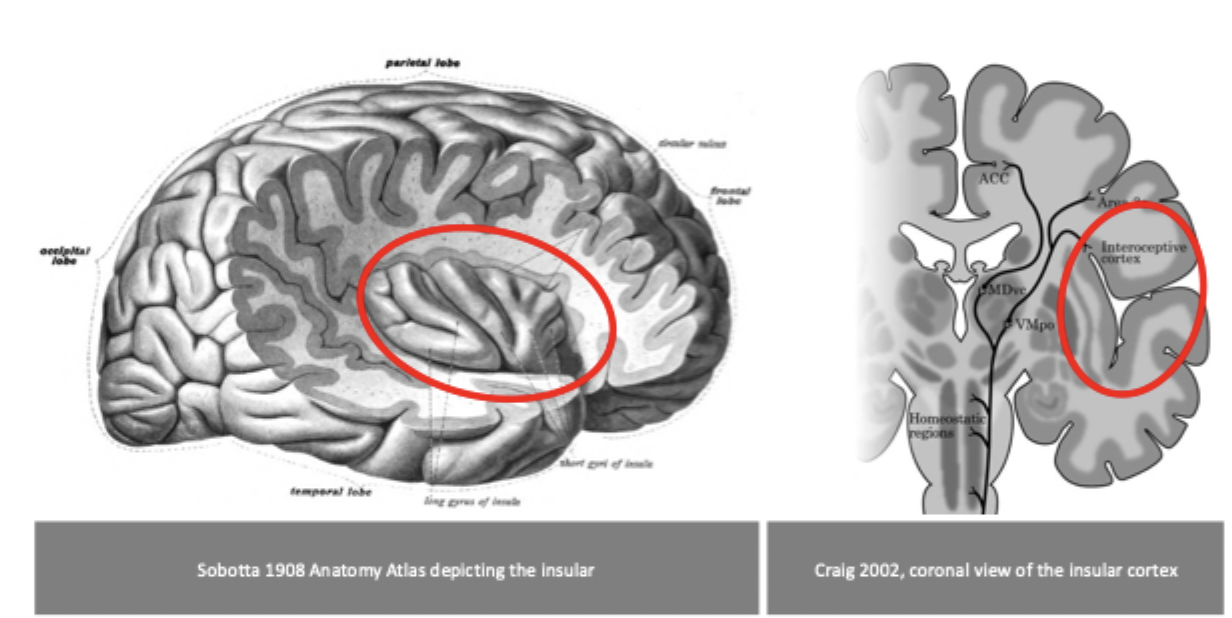
cortex (anterior cingulate and insula - interoceptive cortex)
What are the functions of the interoceptive neural anatomical pathway?
afferent projections from the dorsal horn provide the somato-autonomic reflexes crucial for maintaining homeostasis
these are not emergency mechanisms, but provide continuous feedback
Lamina I also receives decending (efferent) modulation for interoceptive signals
What is the cortical terminus of the neuroanatomical pathway?
the insular cortex (the interoceptive cortex)
Why do we scratch to alleviate an itch?
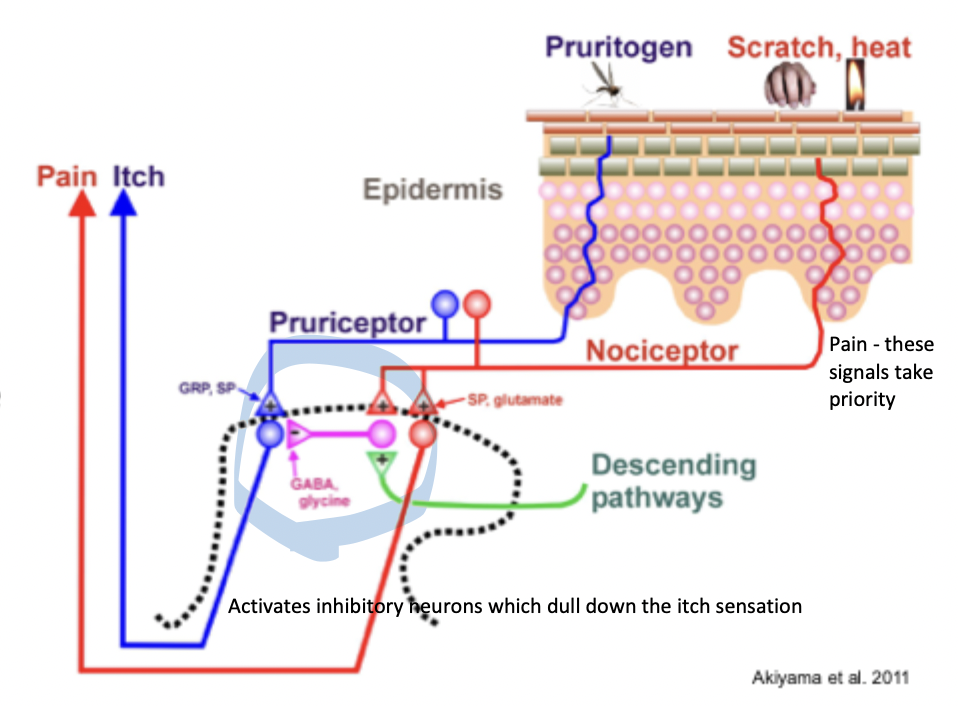
scratching inhibits itch via inhibitory interneurons in the dorsal horn of the spinal cord
the pain signals from scratch take priority - activates inhibitory neurons which dull down the itch sensation
What are the 4 parts of the itch scratch cycle?
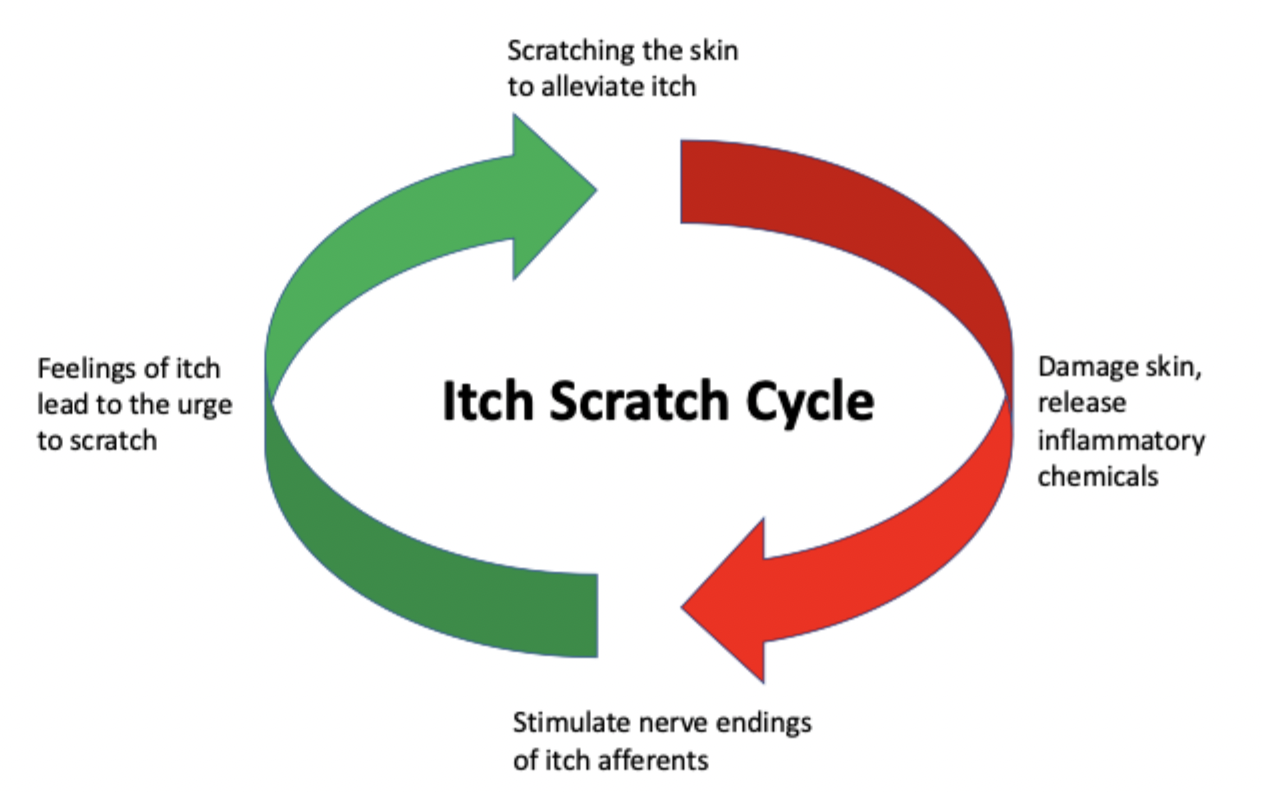
scratching the skin to alleviate itch
damage skin, release inflammatory chemicals
stimulate nerve endings of itch afferents
feelings of itch lead to the urge to scratch
What is the basic idea of interoception and emotion?
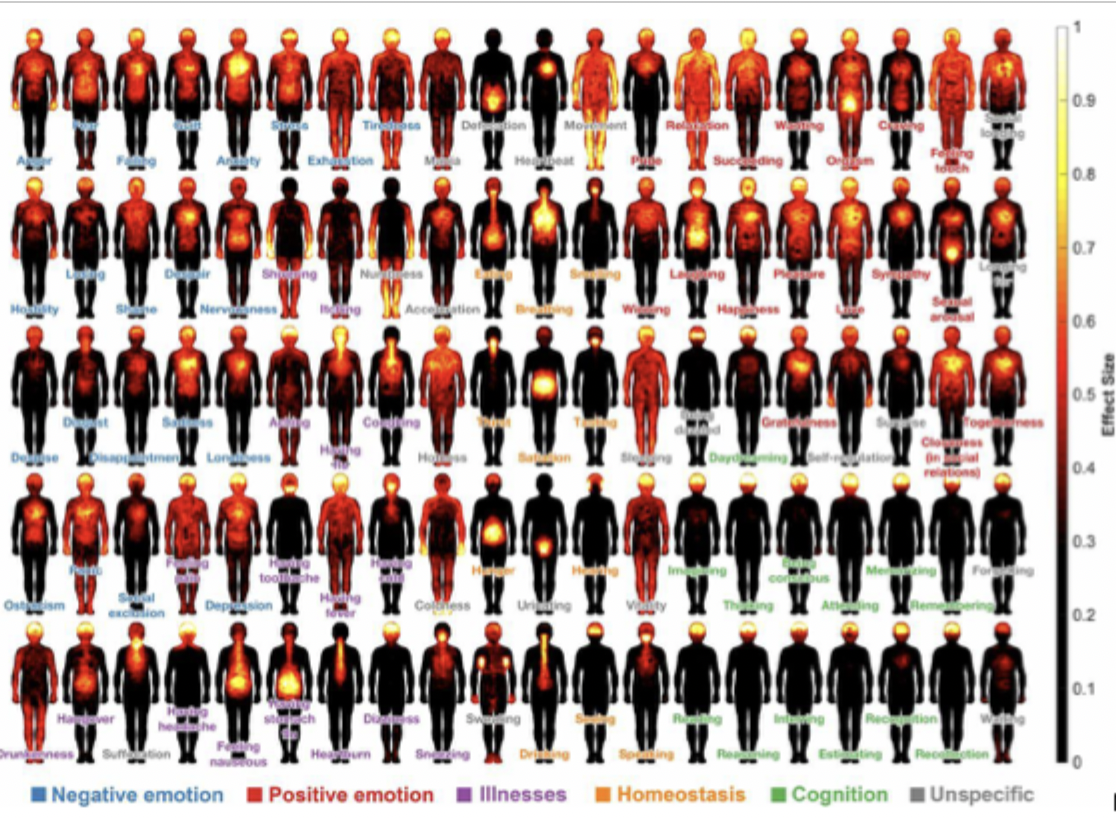
intrinsic link between the physiological state of the body and emotion
understanding our emotions involves interpreting internal bodily signals
emotions can be felt in the body
e.g panic or excitement - heart rate
fear or surprise - muscle tension
What is alexithymia?
having no words for emotions
linked to interoception deficits
What relates to the interconnection between the gut and the brain?
deeply rooted in our language e.g. hangry
neural network communicates with the brain about gastrointestinal homeostasis. Also emotion motivation and decision making
bidirectional - emotions can influence digestive system
What is the historical development of our understanding of where the self is?
Aristotle (greek philosopher) believed the self was in the heart
Limanowski + Hecht (2011) - both head and heart
Alsmith + Longo (2014) - between the head and the torso
What is the relationship between interoception and behaviour?
emotional behaviours evolved to produce goal-directed action that fulfil homeostatic needs of the body
how you feel can be moderated by physiological state of the body
how you feel can influence your behaviour
e.g. cold shower when you’re hot
What are the aspects of physiological motivations?
cognition takes place within the context of the body that needs to stay alive, and be healthy
brains evolved to regulate bodies within a social context
What is the Attentional Blink paradigm used in procedure by Garfinkel et al (2014)
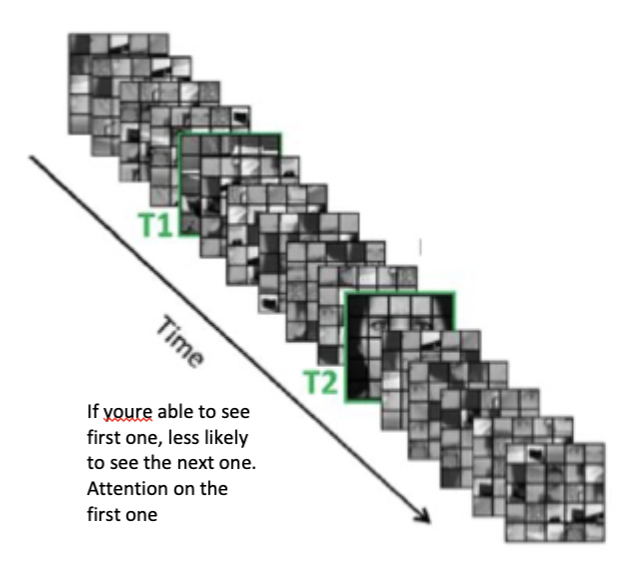
tests temporal capacity of the limits of attention
identification of an initial tarted (T1) during a rapid serial visual presentation (RSVP) of stimuli impairs the ability to detect a second target
stimuli in the RSVP presented in different phases of the heartbeart
What are the different phases of the heartbeat?
systole - when the heart contracts
diastole - when the heart relaxes
What do baroreceptors from the heart convey?
information about the strength and timing of the heart beat which facilitates modulation of blood pressure through vasodilation
these signals also communicate to the brain and regions associated with emotion and cognition (insular, amygdala)
brain knows which phase the heart is in at any time
What did Garfinkel et al present during their procedure and then what were ppts asked?
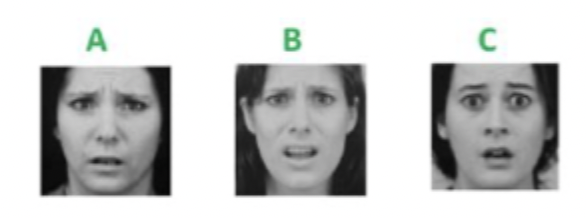
presented a house at T1
T2 was a face (disgust, fear, sad, happy, neutral)
the rest of the stimuli were scrambled images
second task examined recognition of T1 and T2 stimuli presented in preceding RSVP
participants given three options of facial expressions and asked to identify
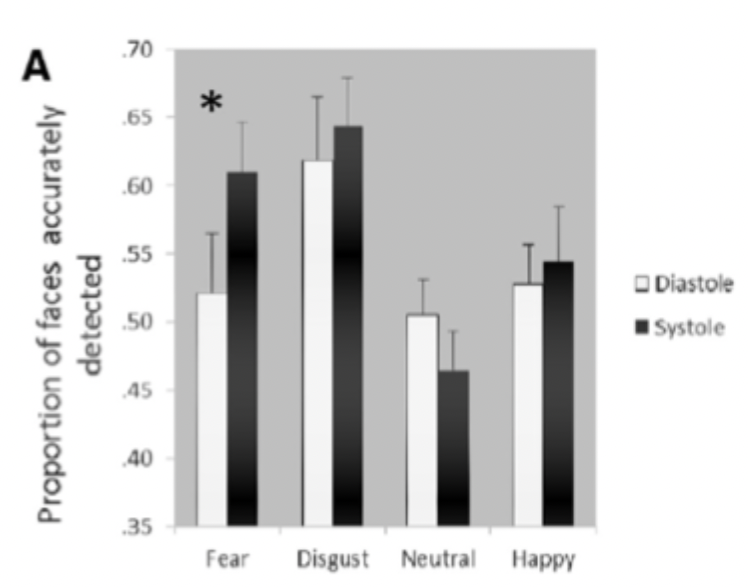
What did Garfinkel et al find regarding systole presentation of stimuli at T2?
timing of stimuli facilitated detection of T2 for fear faces only
systole presentation led to greater proportion of fear faces detected
heart contracting/ in stress bias to threat detection
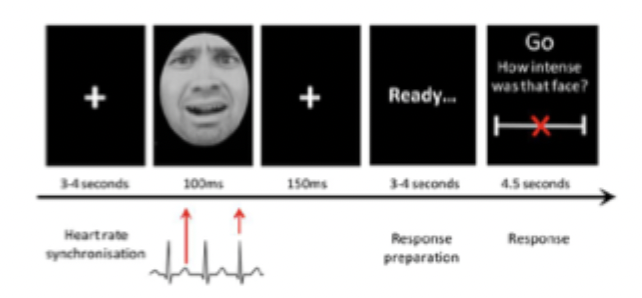
What did Garfinkel’s experiments show when either neutral or fear faces were briefly presented, time locked to heartbeat and emotional intensity ratings were given of the presented face?
same face showed in different conditions, only difference was when it was presented with heartbeat
timing of the stimuli related to intensity judgements
systole stimuli led to greater intensity for fear faces
diastole stimuli trend for greater intensity for neutral faces
greater alertness to fearful stimuli with contraction of heartbeat
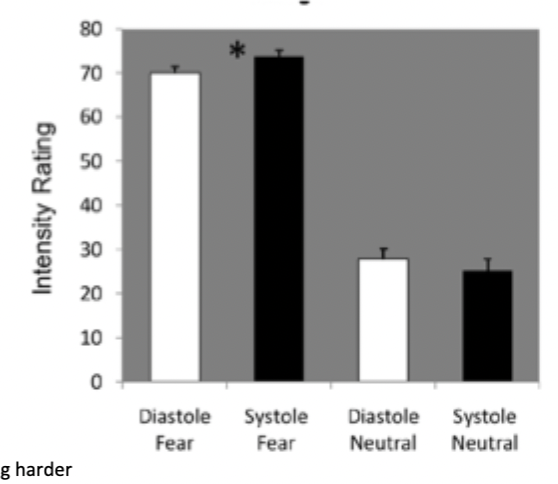
Which variable causes a difference in Garfinkel’s found effect of the interaction between cardiac cycle and emotion intensity?
the effect is exacerbated in individuals with higher state anxiety
What did Garfinkel’s MRI experiments show in the brain?
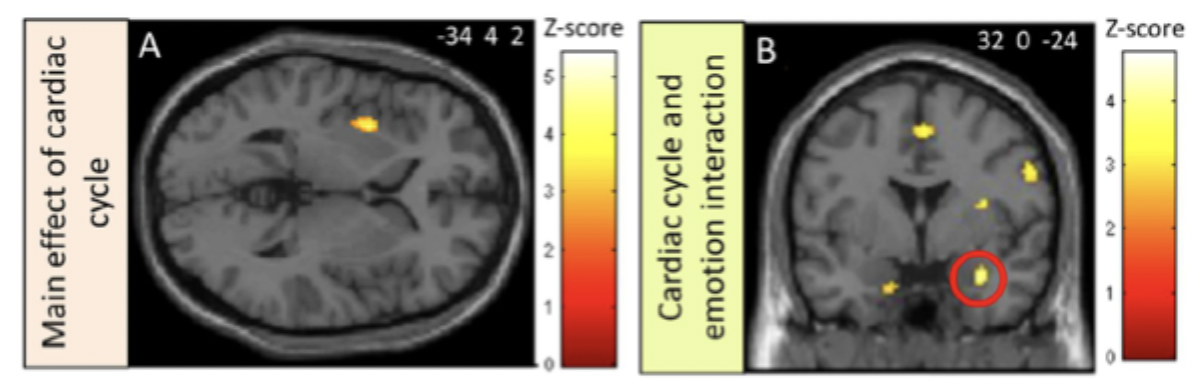
main effect of the stimulus timing associated with activity in the anterior insula
interaction between cardiac timing and emotion (of faces) associated with amygdala activity
What would greater arousal mean?
greater arousal (more and stronger heartbeats) would mean more time in systole compared to diastole
in systole the heart is working hardest
perception of threat is dependent on the level of physiological arousal
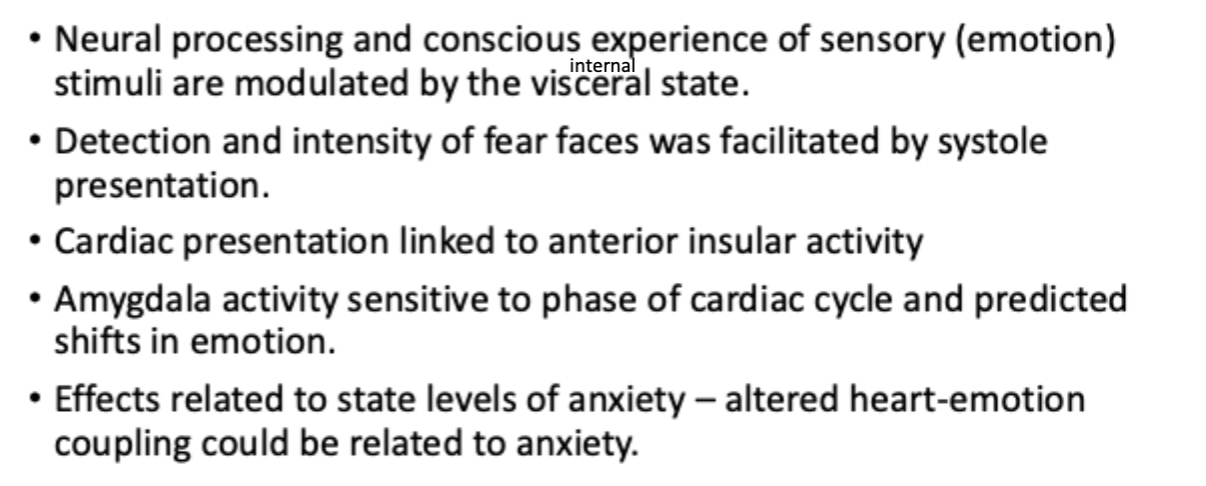
Garfinkel conclusions (screenshot)
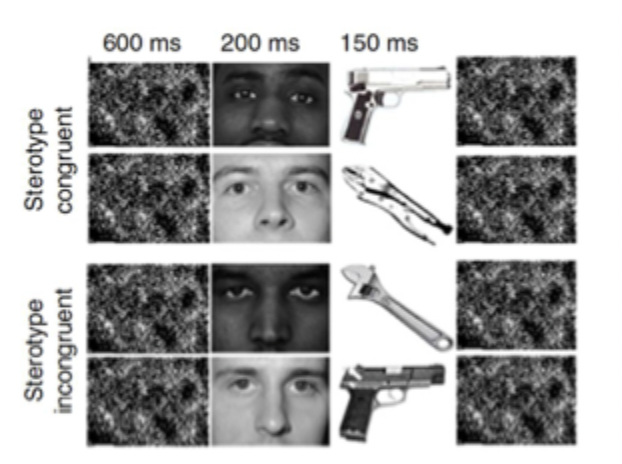
What was Azevedo et al (2017) procedure studying more complex human behaviour - the effect of cardiac cycle on racial stereotyping?
compared stimulus presentation when the muscle is contracting vs relaxing
had to identify targets (tool or a weapon)
primed by either black or white males faces
all sample were white - trying to prime potential black stereotypes using this paradigm
stimuli were presented at systole or diastole
What did Azevedo et al (2017) find studying more complex human behaviour - the effect of cardiac cycle on racial stereotyping?
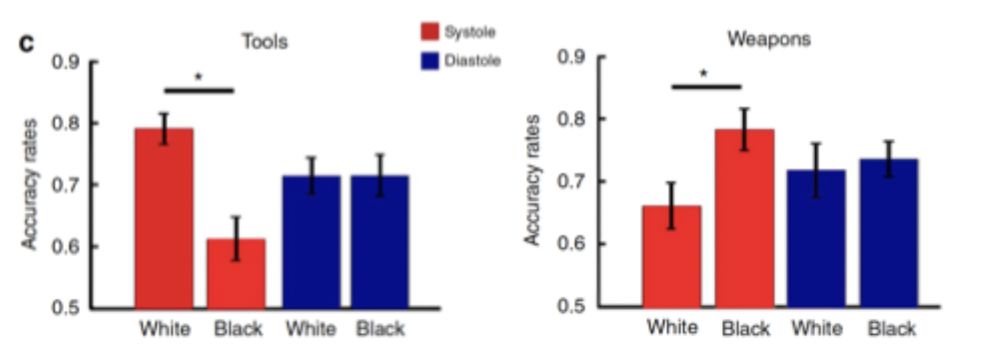
systole exacerbated racially stereotyped responses
e.g. less accurate identifying tools when primed to face of a balck man than to white
What were the results of Azevedo’s first person shooter task in which ppts had to decide whether to shoot or not exposed to different stimuli with racial differences. Presentation was timed with phase of the cardiac cycle
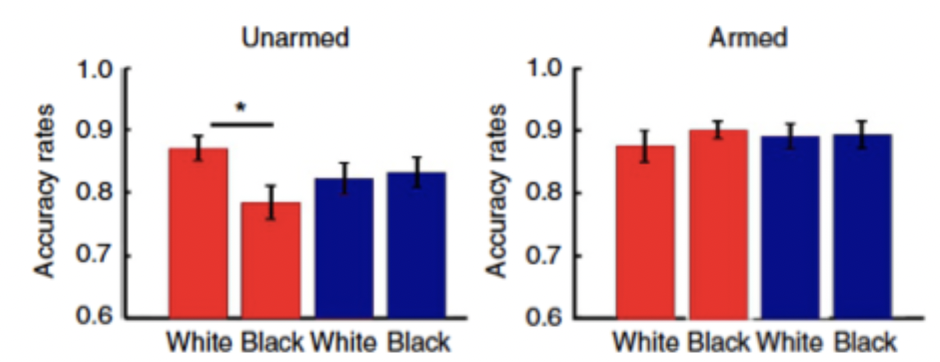
ppts chose to shoot unarmed black men more often than unarmed white men
What can be concluded from Azevedo’s research?
in the context of potential threatening stimuli heaightened representation of cardiac signals in the brain may enhance salience of social cues and promote negative racial stereotypes
important brain-body mechanism influencing processing of salient social cues and subsequent actions
prediction-based on previous social association moderated by current body state