History of Linguistics
 Studied by 1 person
 Call with Kai
 Learn
Learn Practice Test
 Spaced Repetition
 Match
Match Flashcards
 Knowt Play
1/47

There's no tags or description
Looks like no tags are added yet.
Name | Mastery | Learn | Test | Matching | Spaced | Call with Kai |
|---|
No study sessions yet.
48 Terms
1- Middle Ages to Renaissance (200-1500 AD)
Religious Dogmatism (Knowledge was shaped by re ligious beliefs, experimentation was forbidden.), Focus on Materialistic/Objectivist World (influenced by philosophers like Plato and Aristotle.), Scholastic Philosophy (observation over experimentation; understanding the objective reality of the natural world.)
2. Scientific Revolution and Enlightenment:
Objective, Materialistic Intellectualism: Nature was understood through natural laws and observation,
leading to a more scientific approach to understanding the world.
3. 19th Century Linguistics:
Sir William Jones: discovered similarities among Sanskrit, Latin, and Greek, led to the foundation of Comparative Linguistics.
Comparative Grammar and Proto-Indo-European Theory: reconstructing the Proto-Indo-European language by using comparative methods.
Comparative Philology: Focused on comparing languages to understand their historical relationships.
4. Eras of Linguistics:
Traditional Linguistics: historical and comparative studies
20th Century Linguistics: modern, descriptive linguistics and synchronic (present-time) studies of language.
5. Schools of Linguistics:
Prague School: language as a scientific field, Roman Jakobson and Nikolai Trubetzkoy → language as a system of signs (structural)
London School: Founder Henry Sweet, (later influenced by Bronislaw Malinowski) linguistic context and structure.
Copenhagen School: Influenced by Hjelmslev, focused on structuralism in language.
6. Generativism:
Franz Boas and Edward Sapir: Early American linguists who laid the groundwork for the generative approach.
Noam Chomsky: Pioneered Generative Grammar, which focused on the innate structures of language and distinguished generativists from structuralists.
From 500 BCE (Golden age/era) to 476
Ancient civilizations: One tank one blood - Greek perspective of fraternity
375: Rome was divided into two because of Great migration (barbaric tribes push each other): East (Byzantium) and West (Rome),
Linguistics for philosophy: Stoics (basic linguistics studies), Alexandrians (literary works, analyzing language, focusing on the relationship between words, sentences and their meanings (syntax and semantics)
First Latin grammar book
Middle Age: (476 - 1453 or 1492) (Dark age)
1453: Conquest of Istanbul, Fall of Constantinople: The scientific development: ball as a weapon (gunpowder) We can destroy bourgeois’ castles.
1492: The discovery of America: Geographical and economical development - Human beings developed, so they affected all the world.
Scholastic era (philosophy): Aristotle and Plato and Aquines (Monk), the only reading should be for god’s sake (religiously) (written by church → Latinnis holy, it is perfect, and it should be studied for the God.),
Dark age: Epidemic, plague, political collapsing, economical crisis → The rise of Rome (Christianity)
571+: The golden age of Islam
They questioned: numerical system: math, physics, astronomy, alchemy
theories of translation: theey translated from Greek philosophy
Intellectuality: The capacity for critical thinking, reasoning, and the pursuit of knowledge.
Crusades (economic power)
1200s - Scholastic Philosophy
Plato + Aristo + Christianity
Language should be studied for religion
Eternal sin: you are not free
The first university: Bologna (religious). Oxford and Cambridge in England
Grammar translation method: to teach Latin. Latin is not spoken, so it is hard to learn it.
One of the first modern scientists
Bacon → Monk:
Physics, optics → experiment (mathematical calculations) and observation
Why they allowed him? He discovered the glasses of the Pope.
Speculative grammar
modists → modestae (signs)
modi essendi (essence, in external world), modi intelligenti (perception of the reality), modi significandi (modes of signifying) - Aristo and Chomsky (universalists)
Language is the mirror of the reality
Studying signs
1218 - Magna Carta
Constitutional monarchy
Lords can decrown the King if they want.
Renaissance (Englightenment)
Humanism, literacy (Martin Luther), Dante (Italian) and Chaucer (English), Translating ideas in their own languages, Middle class emerged (Powerful social group: merchants, artisans, bankers, and skilled tradespeople,), Progressing (Democracy)
1789 - French Revolution
Nation building
Freedom (liberalism) equality (communism, socialism etc.), fraternity (common culture and language → brotherhood, sisterhood)
Liberté, égalité, fraternité
freedom → curiosity → experiment and experience
John Locke, Francis Bacon, Isaac Newton (English scholars)
Experiment and experience after Bacon (English)
Science: empiricism (Aristo supporters like John Locke), rationalism (Plato supporters like Descartes)
In Europe, eternal sin: You are not free —> British: “Every human is born with free will.”
British hegemony, France’s use of excessive force. British: “Give me your freedom, I will give you the chance of being one of the citizens of the super empire.”
Romanticism in Europe
They were united because of France. France banned speaking German within the boundaries of France.
human feelings
emotions and soul: Volkgeist → the spirit of a nation,
Herder → KULTUR, and BILDUNG (build yourself in a society)
human reasoning
1780s Sir William Jones
Judge, was sent to India, Analyzed Veda Books (Belong to Aryan tribe, religious texts originating in ancient India)
Sanskrit is similar to Latin: Comparative method, Studied Sanskrit to construct a Proto Indo-European language theory. There is a common ancestor of the Indo-European language family
1789 - French Revolution
Riot against Monarchy, “We are free, democratic people with the power to rule ourselves.”
19th Century Linguists
value-free (believe free), objective science, observable facts, sense and data
Different Eras of Linquistics
eras of linguistics
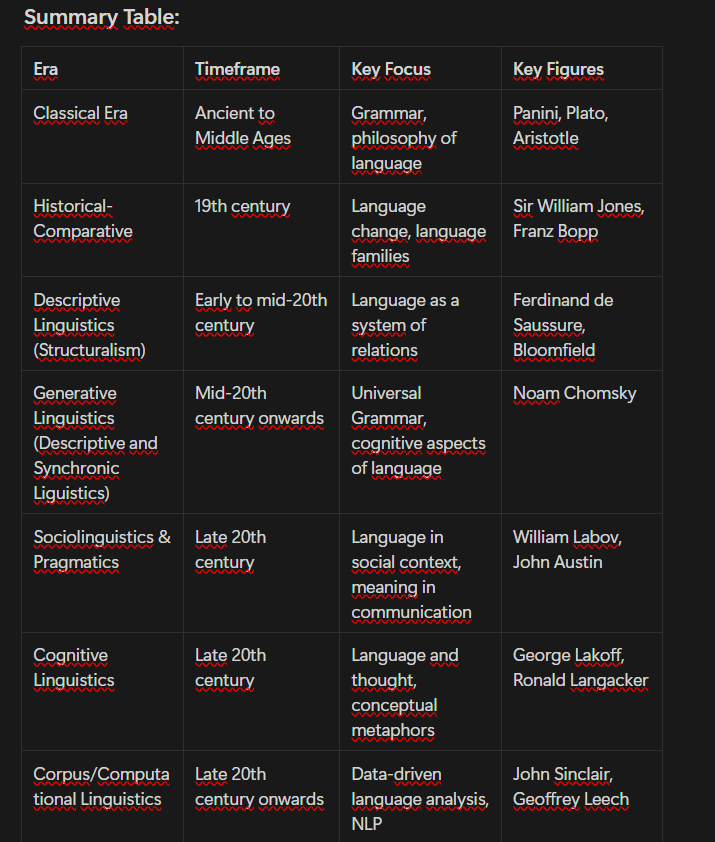
Synchronic linguistics
the study of a language at a specific point in time, focusing on its structure, grammar, and usage without considering historical changes.
Descriptive linguistics
focuses on describing and analyzing the elements of a language as it is used in practice, rather than prescribing how it should be used. understand the language in its natural state.
19th Century Linguistics (1800s)
Historical Linguistics: how languages evolve over time, Diachronic (historical development across different periods), Language families, phonetics and phonology (sound changes), morphology and syntax (words and sentence changes)
Comparative Linguistics: analyzing the grammatical structures of different languages to identify similarities and differences, Systematic Analysis, Universal Principles, Linguistic theory of language universals
Comparative Philology
Precursor to modern historical linguistics, Textual Analysis, Etymology, Cultural and Historical Connections
Historical Linguistics
Focuses on the diachronic study of language change. Unlike synchronic linguistics, which looks at a language at a specific point, diachronic linguistics traces historical developments and transformations across different periods.
Comparative Linguistics
Analyzes grammatical structures across languages to identify patterns.
Comparative Philology
Studies historical texts and literature to understand language evolution
Traditional Philology before 1911 (Modern Linguistics Saussure)
Study of language and literature (historical texts and their interpretations.)
1911 (Modern Linguistics, Saussure)
“Language should be studied for itself and in itself.”
Language is a scientific field → Emergence of Modern Linguistics
“Language is a system of signs.” - Saussure
Scructuralist, Founder of structuralism, Influenced Prague school, London school, Copenhagen school, Descriptivists
⭐⭐⭐ Generativists are not structuralists.
Schools of Linguistics Circle:
Different views about the study of language, Prague School, London School, Copenhagen School, American:
Prague School
Roman Jakobson (founder), Vilém Mathesius, Nikolai Trubetskoy
London School
Henry Sweet, Malinowski, Firth, Halliday
Copenhagen School
Hjemslev
American
The Descriptivists: Franz Boas (Founder), Sapir, Whorf, Bloomfield, Harris
The Generativists: Noam Chomsky (not structuralist)
WILHELM YON HUMBOLT
Primarily a judge, not a linguist but more of a philosopher/thinker, Believed in National Character: The character of nations can be reflected in language, Language serves as a tool for a nation's development, Focused on language and culture, influencing Boas and anthropological linguistics,
Mind and Language: Language is the mirror of worldview, and worldview shapes the langauge. language and culture are intertwined, with languages not just reflecting but also shaping how people experience and interpret their world.
a priori vs. post priori
Language as the "organon" (tool) and "kriterium" (criterion) of the mind
a priori vs. post priori
A Priori Languages (e.g., Latin, Classical Greek): Associated with abstract principles, universal structures, and philosophical expression.
Post Priori Languages (e.g., Nahuatl, Inuktitut): Rooted in direct, practical experience, with vocabulary and structures shaped by local and immediate contexts.
Language as the "organon" (tool) and "kriterium" (criterion) of the mind
language is both a tool for expressing thought and a framework that shapes thinking itself.
language is not just a passive tool for communication; it actively shapes our worldview and cognitive processes. It is an energia (process).
language sets criteria for our worldview and limits our thoughts, explaining linguistic diversity.
Language isn’t innate, but the capacity for it is.
Influences universal grammar and Chomsky’s language faculty.
Questions the universal conceptual image of a language as a representation
Ferdinand de Saussure
Father of Modern Linguistics, Rejects the understanding language as a living organism and studying it by observing only sound changes because:
Language is a system of signs —> systematical process, not an organism
Synchrony vs. Diachrony, "état de langue" (state of language), Syntagmatic and Paradigmatic Relations, Chess Analogy, Signifier and Signified
Synchrony vs. Diachrony:
Language can be studied as a system existing at a given point in time (synchrony) or through historical changes (diachrony).
Diachrony: observable linguistic changes → sound change
Diachronic approaches alone are insufficient for understanding language change.
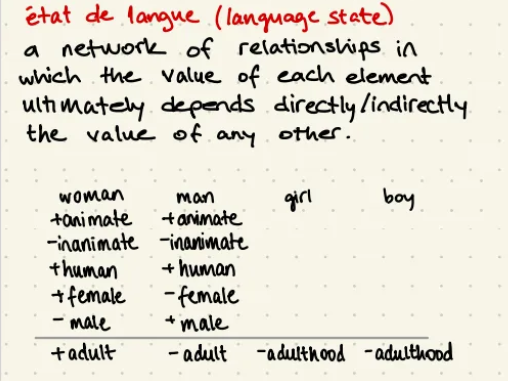
"état de langue" (state of language)
specific, static state or condition of a language at a particular point in time, rather than its evolution or historical changes.
a network of relationships in which the value (meaning) of each element in language depends on its relation to other elements. → each word or concept gains meaning not in isolation but through its contrast and connection to others.
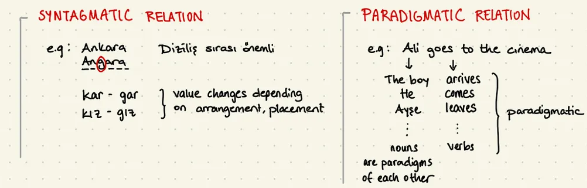
Syntagmatic and Paradigmatic Relations
Syntagmatic: Horizontal relationships, where elements combine in a sequence (e.g., "The cat sleeps" “Ankara, Angara”).
Paradigmatic: Vertical relationships, where elements can replace each other in the same slot (e.g., The cat ate. ↔ The dog ate.).
Together, these relations help structure meaning in language, defining both the flow of words and the choices available at each position.
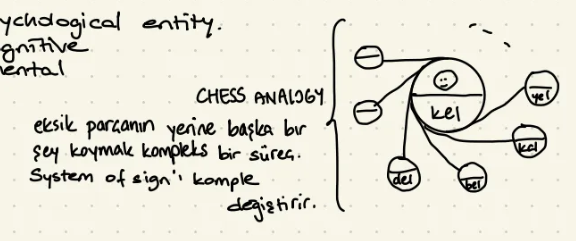
Chess Analogy
Language functions like a chess game, with components, relationships, and roles. It is highly systematic.
pieces = having values according to the other pieces and instant play, any move pieces → changes the relationship between thr other potential pieces → I like cats, I like dogs, I drink cat (no), I drink milk (yes), cats (/s/), dogs (/z/) → diachronic point of view lacks this “systematic” character → observer (diachronic, synchronic) vs. participant
Signifier and Signified
Language is a system of signs. → sound-image/concept → speaking circuit
Linguistic sign is a psychological, cognitive and mental entity, with the signifier as the sound-image and the signified as the concept.
Form, Not Substance
Language is considered a form, not a substance, emphasizing structure over materialism → substance in 19th century
He emphasized that language is a system of signs rather than a physical or material entity.
Language as a Social Fact
Inspired by Durkheim’s notion of collective minds.
social fact = have concrete effects (SKIRT) → So they are things (outer world) → physical parole and general system
langue and parole
Langue (general system) → underlying system of language shared by a community → a blueprint or code that exists in the collective mind of a society, enabling individuals to communicate effectively.
Parole (physical) → the actual, individual use of language in real-life contexts, dynamic, constantly changing, and specific to each individual’s expression.
Unlike langue, parole is individual and unique to each speaker.
Somene can say “I like cats” with a particular accent, intonation, or vocabulary choice. This specific act is parole.