Portage BIOD152: Module 7 The Urinary System
 Call Kai
 Learn
Learn Practice Test
 Spaced Repetition
 Match
Match Flashcards
 Knowt Play
1/30

There's no tags or description
Looks like no tags are added yet.
Name | Mastery | Learn | Test | Matching | Spaced | Call with Kai | Chat |
|---|
No analytics yet
Send a link to your students to track their progress
31 Terms
True or False: The bladder drains into the ureters.
false
A person sustained blunt force trauma to the back at the T5 level, with no spinal cord injury. Would you suspect the kidneys to be damaged? Why or why not?
No, the kidneys lie between the T-12 and L-3
Describe the consistency and purpose of the renal fascia.
The outer renal fascia is dense fibrous connective tissue which keeps the kidney in place inside the abdominal cavity.
Name the layer and the parts of the nephrons located in the region highlighted in green, below.
Located within the cortex are the glomerular capsule and the distal and proximal convoluted tubule sections of the nephrons.

These arteries flow in between the renal pyramids.
Interlobar
After filtration occurs, next blood travels into these vessels.
efferent arteriole
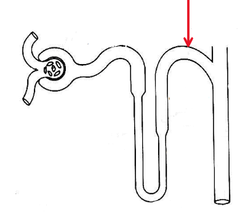
Name the region in the diagram below, indicated by the red arrow.
DCT (Distal convoluted tubule)
In females, the bladder is located _____ to the uterus and _____ to the vagina.
inferior/anterior , anterior
Describe the purposes of the urethral sphincters.
● The involuntary-controlled internal urethral sphincter is located near the bladder and keeps the urethra closed to prevent urine from leaving the bladder.
● The voluntary-controlled external urethral sphincter, composed of skeletal muscle, surrounds the urethra as it passes through the pelvic floor.
A patient was just placed under general anesthesia. He is now awake and telling you he is having a hard time excreting urine. What is most likely causing the difficulty?
Urinary retention due to slowed detrusor muscle
This region of the male urethra exits the body.
Spongy
What causes the extremely high blood pressure in the glomerular capillaries?
The afferent arteriole, which is fed by the interlobular artery, is much larger in diameter than the efferent arteriole. The difference in diameter causes an extremely high blood pressure in the glomerular capillaries.
Micturition can be controlled consciously because of:
Voluntary control over the external sphincter
This is the pressure that depends upon a person's blood pressure from the heart and vessels:
Hydrostatic pressure
Calculate the net filtration pressure for your patient given the following values. Show your work. (Not all values listed may be used).
- Colloid osmotic pressure = 25
- Capsular pressure= 15
- Hydrostatic pressure = 50
- GFR= 120
(Outgoing forces - incoming forces)
HP- (COP + Capsular pressure)
50mmHg - (25mmHg +15mmHg))
= 10mmHg (net outward pressure)
Describe in detail what happens during an emergency to control the rate of blood to the kidney.
During these times the renal autoregulatory system is superseded by higher level nervous system controls. When the nervous system takes over regulation, the afferent arterioles diameter is narrowed by sympathetic nerve fibers. The release of the hormone epinephrine by the adrenal medulla causes a decrease in renal blood flow and decreases the GFR. Constriction of the renal arteries is only to be used for a short time.
Which of the following statements is false concerning the RAA system?
It responds when blood pressure becomes too high.
The greatest amount of _______ occurs in the cells of the PCT.
Reabsorption
True or False: Na+ can leave the ascending limb but not the descending limb.
True
Which of the following is true concerning ADH?
It retains up to 99% of water in the filtrate.
What is countercurrent flow? How does the nephron use this to maintain homeostasis?
Countercurrent flow is the movement of fluids in opposite directions through adjacent channels. In the nephron, filtrate flows in one direction through the renal tubules while blood in the adjacent blood vessels flows in the opposite direction.
Describe the action of aldosterone on the concentrations of sodium and hydrogen in the filtrate.
Sodium is removed from the filtrate while hydrogen is pumped inside the filtrate.
Describe the action of a drug that increases the rate of flow through the nephron.
This would be a diuretic. When the filtrate moves at a faster rate through the nephron it allows less time for ions to be removed from the filtrate.
Which of the following is true concerning cardiovascular baroreceptors?
They are mechanoreceptors found in the aortic arch and carotid sinus.
Which of the following is an abnormal solute in urine?
Bile pigment
Water in the body is primarily found in what body compartment?
Intracellular
Urine with a pH of 5.0 is:
within normal range; acidic
The protein buffer system:
is the main buffer system of the intracellular fluid
A person is hyperventilating. This falls under what control mechanism? Explain what hyperventilation accomplishes.
Respiratory control- Hyperventilation is an increase in the respiratory rate, helping to remove additional CO2. Within minutes increasing amounts of CO2is removed. Removing CO2 uses up H+ causes the pH to rise (becomes more alkaline) and restores correct blood pH.
(Optional) this reaction shifts to the left: CO2+ H2O ↔ H2CO3 ↔ H+ + HCO3-
What control mechanism can remove acids and bases from the body?
Renal control (Kidneys)
Your patient was just admitted to the hospital with renal failure. For the following questions, use the blood values of: pH =7.1, PCO2 = 30 mm, HCO3- = 20 mEq/LA. Determine if the patient is in acidosis or alkalosis.
B. Is the cause respiratory or metabolic?
C. Is the condition being compensated?
D. If compensated, what is the body doing to compensate?
A. Acidosis (