JCC: subjective correction for astigmatism.
 Call Kai
 Learn
Learn Practice Test
 Spaced Repetition
 Match
Match Flashcards
 Knowt Play
1/31

There's no tags or description
Looks like no tags are added yet.
Name | Mastery | Learn | Test | Matching | Spaced | Call with Kai | Chat |
|---|
No analytics yet
Send a link to your students to track their progress
32 Terms
what is JCC used for
jackson crossed cylinder is used for the corection for astigmatism that was suggested by retinoscopy
also called crossed cylinder
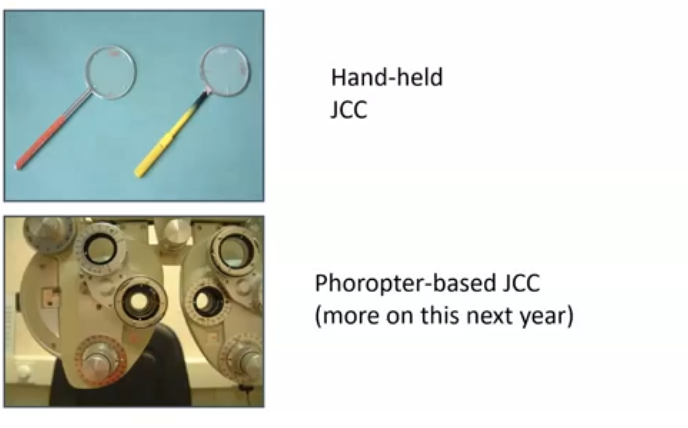
equipment needed
hand held JCC
phoropter based JCC
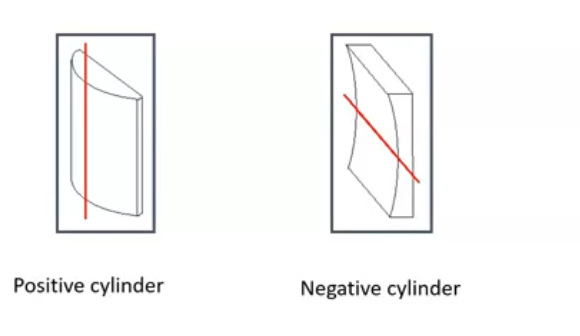
what is a crossed cyliner lens
a plano positive/plano negative cylinder arranged at right angles to each other
contains 2 cylindrical powers of equal magnitude but opposite signs orineted 90 degrees apart
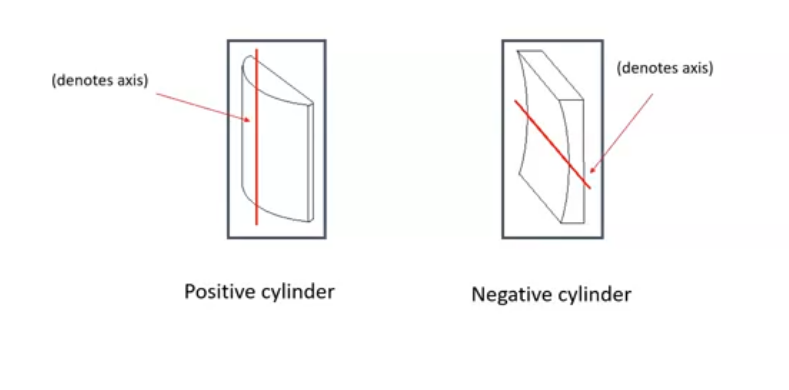
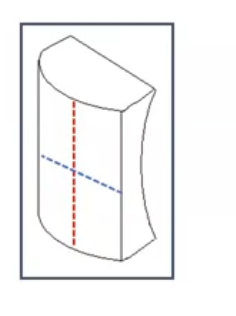
cross cyl lens
equal and opposite powers along their principal meridians
negative power in vertical meridian shown by dashed line
positive power in horizontal meridian in blue
2 plano cylinders
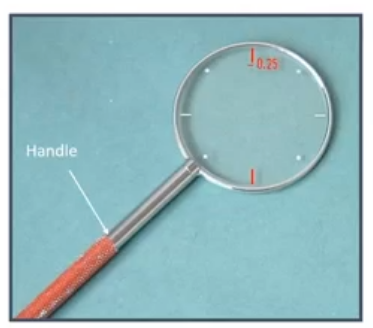
hand held cross cyl
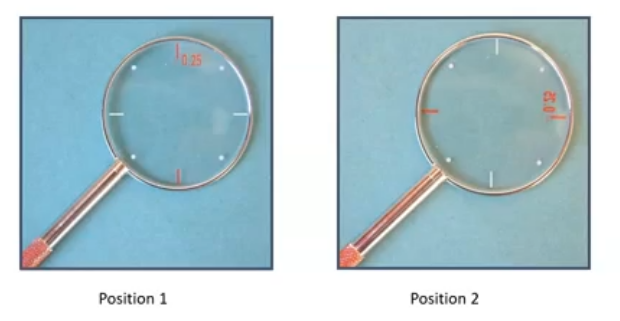
the red markings : the -0.25 is showing us that this is the axis of the -0.25 cylinder
white markings - axis of the positive cylinder
does NOT mean that the power along this meridian is -0.25D
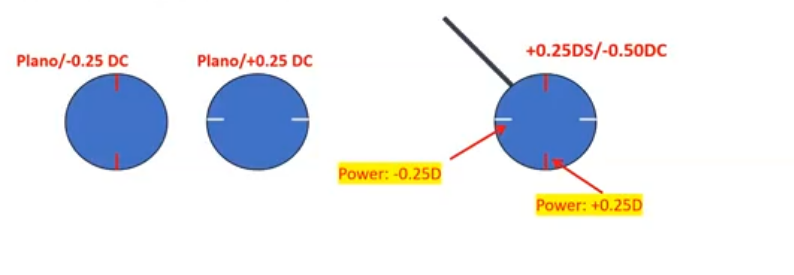
plano +0.25 and plano -0.25
when combined it forms a sphereo cylindrical prescription of
+0.25DS/-0.50DC
( most posiitve for sphere, S+C= CYL so +0.25 + c = -0.25 : -0.50 )
axis of the + and - are 90 degrees from one another, and are set 45 degrees on either sid of the handle which holds the lens
power along the red axis is 0 as plano
astigmatic interval
distance between the 2 focal lines created by the spherocylindrical lens
often the handle etched on it eg 0.50 , this indicates the astigamatic interval so its -+ 0.25 cross cyl
eg +0.25/-0.50 × 90
this lens has a power of +0.25 along 90 and -0.25 along 180
+0.50/-1.00 x ..
this is a x-cyl lens too as the powers are euqal and opposite along its 2 principal meridian
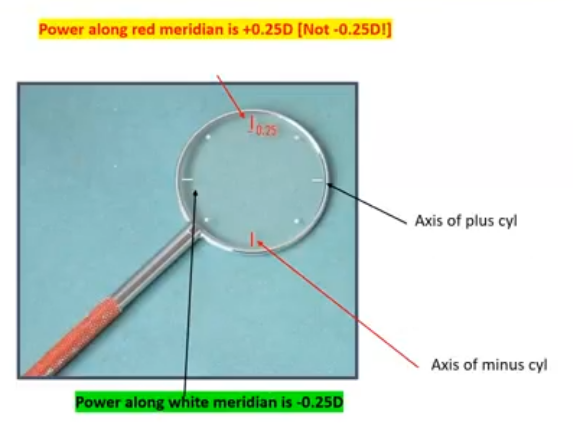
equal and opposite
the power along the red meridian is +0.25
power along the white meridian marked +0.25 is -0.25
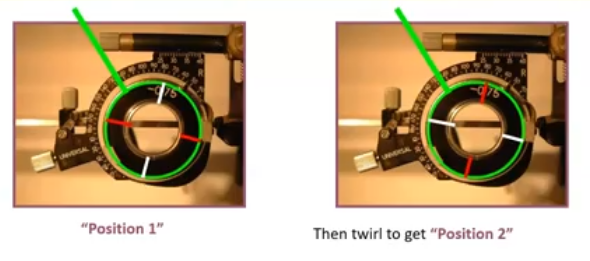
twirling the JCC (flip)
twirling gives 2 positions
when asking to compare the circles, ask which of these two lenses make the circles look clearer and rounder
finding out whether the px prefers a minus cylinder of 180 or plus cylinder of 90
or minus at/plus at 45/135: the dots

targets to be viewed by px during JCC
look at circles/dots as they contain all the orinetations
1: concentric cirlces- verhoeffs rings
there are 2 sizes of VR. use smaller rings if VA with BMS/BVS is good
2: dot target , again choose smaller dots if VA with BMS/BVS is good
3: some choose to use letters that are just above the resolution limit eg if currect best VA is 6/7.5, choose circular letter on 9m line/ should be letter at the end/start of the line, not in the middle
so O and C would be appropriate
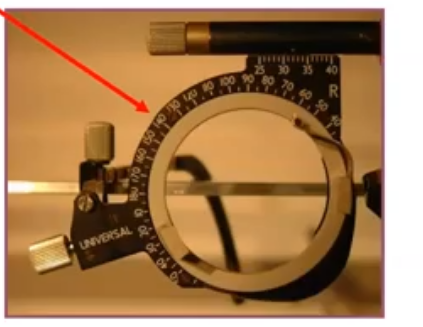
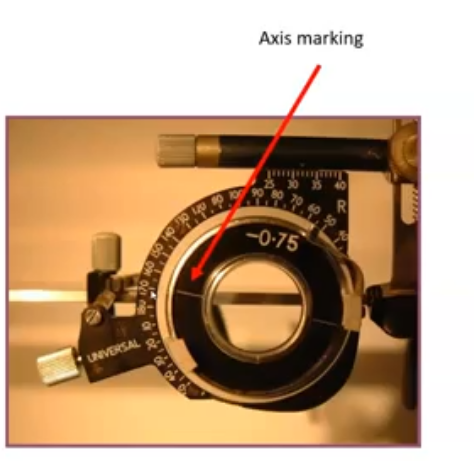
trial frame axis notation
numbered in degrees
progresses anti clockwise when looking at the px
when inputting a cylinder lens can use this to line the axis with cyl
cyl lens should go i the slot closest to the axis notation , closest to the patients eye
dont put any lenses infront of cyl lenses as this obstructs the view of the cyl axis
what is the JCC based around?
based around the manipulation of the size of theinterval of sturm
the position of the circle of the least confusion (CLC) - a circle in between the 2 focal lines, in relation to the retina
need to detemrine the power and axis of cylinrical lens neeed to correct px astigmatism
done either by refining cyl that was found on ret/autorefractor or
by introducing a dnt ehn refininf if no cyl was found on ret
positive or negative cyls when using JCC
+3.00/-1.00 × 180 is the same as +2.00/+1.00 × 90
tend to refract using negative cyl
can use the JCC with +cyl or -cylas its the same either way
mainly -ve cyl so method used is -ve cyl using JCC
so only paying attention to the -ve markings on the JCC (usually red)
how does the JCC work
need to consider the cylinder power and axis eterminayion deparately
first consider the power of the correcting cyl
what is the interval of sturm
space between the 2 focal lines formed by an astigmatic eye or lens system
what is the CLC
between the 2 focal lines, there is a plane where the blur is minimal and approx circular
this plane is the circle of least confusion and is the ideal place for the retina to be partially corrected or uncorrected astigmatic eye
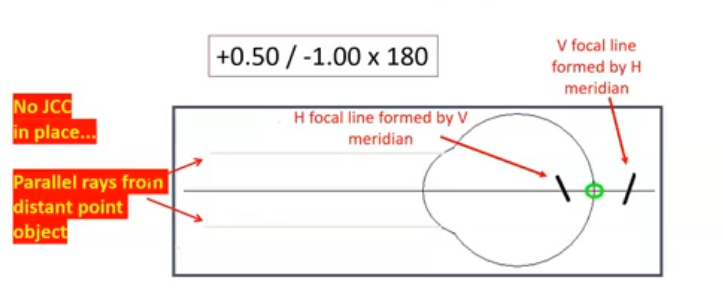
eg: px has mixed, with the rule astigmatism
+0.50/-1.00 × 180
1 focal line in front of retina, one behind retina at right angle : mixed
between the 2 focal lines is the circle of least confusion (green)
along 180 eye is hyperopic by +0.50, so focal line (V) is behind retina
along 90 eye is myopic by -1.00, so focal line (H) is in front of the retina
CLC is on the retina if one focal line in front other behind, whilst having equal and opposite power
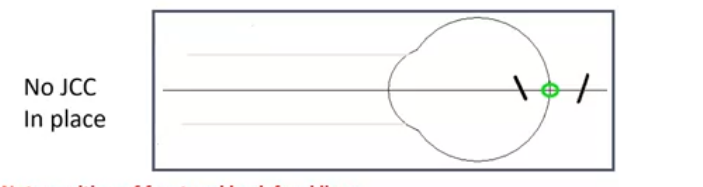
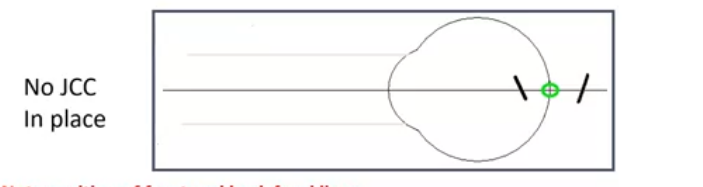
same eg: +0.50/-1.00 ×180
no JCC in place here
note position of front and back focal lines
note size of iterval of sturn also position of CLC
normally have to use a sphere to bring CLC onto the retins (BMS) if clc was initailly in front or behind it
so we only begin to use the JCC when we have used a sphere to place the CLC onto retina
in this eg we dont need a sphere as the clc is already on the retina
place the JCC before the trial frame: for +0.50/-1.00 × 180
axis 90 offering -0.25 on JCC ( jcc is the light blue line)
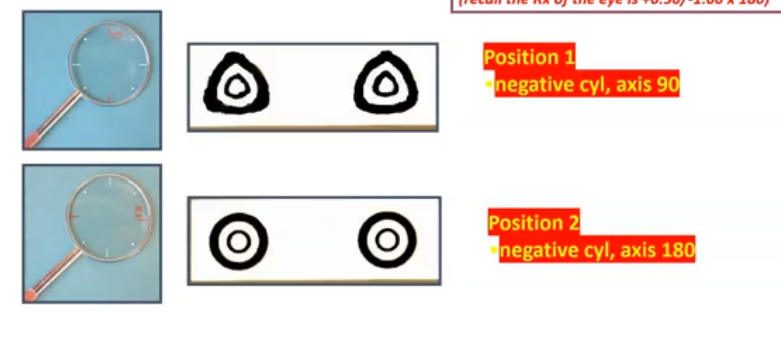
ask px to look at the circles ask=nd ask if clearer one way or the other
focal lines get closer if the cyl axis is correct for the eyes astig
when JCC is introduced, the interval of sturm changes in size
in this, the IoS is getting larger as the -ve cyl axis is wrong, its 90 when the eye needs 180
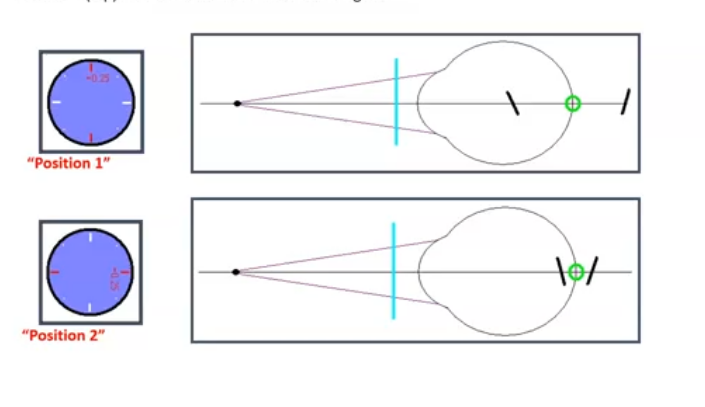
JCC now flipped: rotates axis 90 degrees: +0.50/-1.00 × 180
in position 2, the minus cyl markings are at 180
position 2 better as the focal lines are closer together
comparing whether the JCC is better with position 1 or position 2 when asking if the circles look rounder with position 1 or position 2
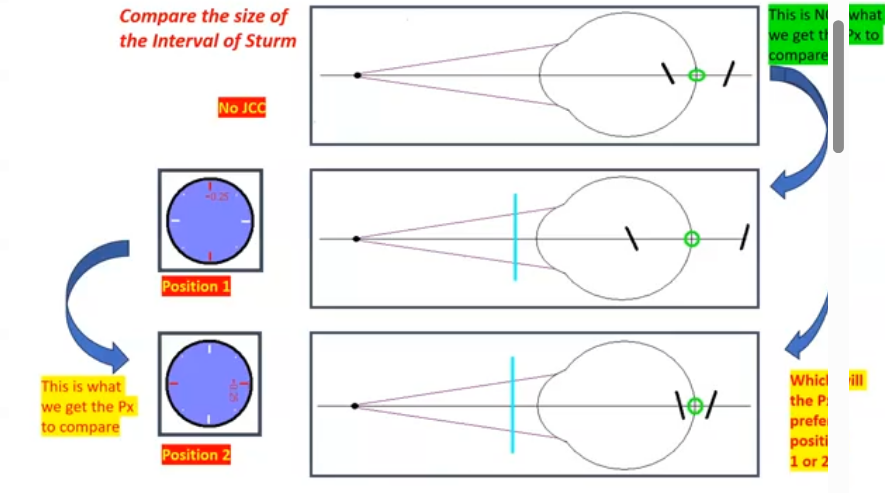
compare the size of the IoS
at position 1: IoS is bigger so worse when minus cyl at an axis of 90
better when axis is 180 minus cyl
in eg: +0.50/-1.00 ×180 this is what the px will see
end point is reached when the circles appear thr same for position 1 and 2
effect of adding a -ve cyl from the trial case
if a cylinder from the trial case with the correct axis for that eyes astigmatism , the cylinder will only change the location of one of the eyes focal lines
this is because the trial case cyl has power along one principal meridian only
along the axis of the trial case there is no power, hence no power is added to that meridian
before the -ve cyl from trial case is added, the CLC should be on the retina hence one focal line is in front other behind
the effect of addin an apooropriately oreintated minus trial case cylinder is to move the front focal line back, and rear focal line will remain unchanged
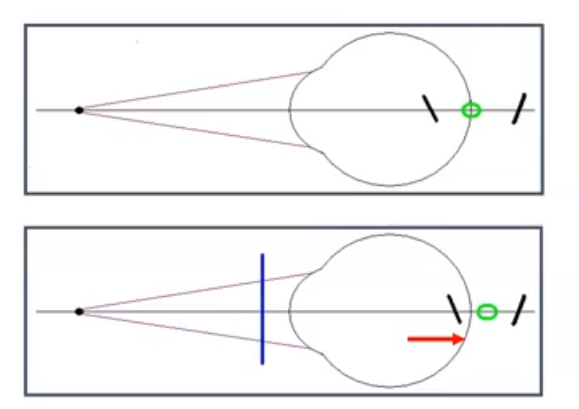
when a minus cyl with approrpoiate axis is added…
blue line shows negative plano cylinder in front of the pateints eye
moves the front focal line back
focal line in the rear has no power so doesnt affect this so doesnt move
IoS gets smaller
CLC is behind the retina so positive sphere power needs adjusting so clc falls back onto the retina.
positive sphere power shifts everything to the left
what do we do when the CLC is pushed backwards - behind the retina
the negative cyl from the trial case has pushed the CLC backwards so we need to add a +ve sphere to move the CLC back onto the retina when we have introduced the - ve cyl rom trial frame
need to add half the amount of cyl introduced of positive sphere
eg if -1.00DC added, then +0.50DS should be added to the trial frame sphere
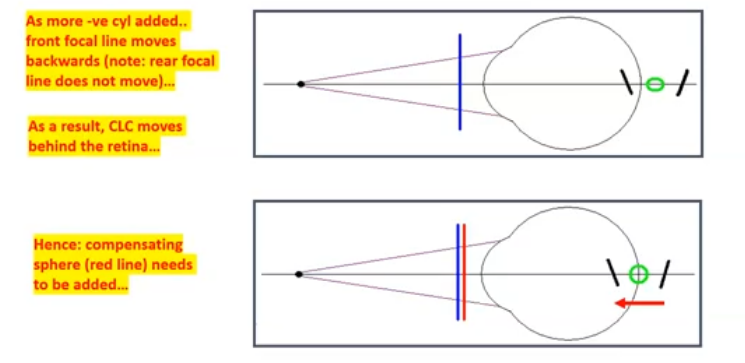
sphere compensation for a change in cyl power
if BMS is +1.00DS and then we add -0.25C x 180 , we dont need to modify the sphere = +1.00/-0.25 × 180
but if we add a further -0.25DC then we need to modify the sphere by +0.25 DS when we add a further -0.25 DC; hence +1.25/-0.50 × 180
if we dont modify the sphere then the i ve cyl will move the clc behind the retina
mainly important in presbyopics
if we make cyl power more negative by -0.50 then need to makw the sphere more positve by adding +0.25 to sphere in trial frame
sphere comp when reducing cyl power
so for every -0.50 DC removed, need to reduce the trial frame sphere power by +0.25 DS
eg. +1.00/-1.00 × 180
using JCC, we decide we need to reduce the cyl by -0.25DC
so +1.00/-0.75 × 180 is now in place
but if we reduce cyl a further -0.25 DC then we need to reduce sphere by +0.25 DS
so we end up with +0.75/-0.50 × 180
eg 1.00/-1.00 × 90
if when cyl power rises to -1.50
add +0.25 DS
= -0.75/-1.50 × 90
how is the JCC used for both cyl power and axis
when checking cyl axis the handle of the JCC is held along the cyl axis in the trial frame
so if axis in trail frame is 170, handle is held along axis, so its held at 80
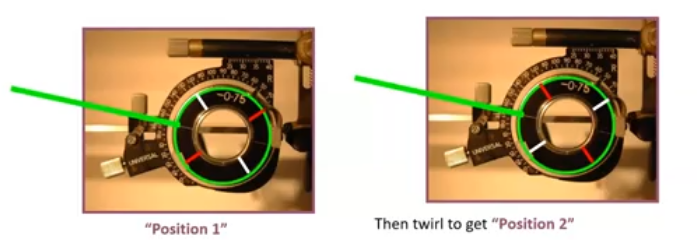
how is JCC used when checking cyl power
hold the axis markings of the JCC along axis of the cyl in the trial frame
red markings along axis of cylinder so perpendicular to the extimated cyl axis