Matter & Basic Atomic Structure
 Call Kai
 Learn
Learn Practice Test
 Spaced Repetition
 Match
Match Flashcards
 Knowt Play
1/24

There's no tags or description
Looks like no tags are added yet.
Name | Mastery | Learn | Test | Matching | Spaced | Call with Kai | Chat |
|---|
No analytics yet
Send a link to your students to track their progress
25 Terms
What is matter?
Matter is anything that occupies space and has mass.
What is mass?
Mass is the quantity of matter contained in an object.
It is different from weight, which depends on the gravitational force acting on that mass.
What are the three basic building blocks of matter? (Developed)
Atoms → molecules → matter/tissues
Atoms are the fundamental units of elements.
Atoms can combine to form molecules.
Molecules combine into increasingly complex forms of matter, including biological tissues.

What is an atom? What does it primarily consist of?
An atom is the smallest particle of an element that retains the properties of that element.
Atoms consist primarily of:
Protons
Neutrons
Electrons
What is the basic structure of an atom?
An atom consists of:
A small, dense nucleus containing protons and neutrons
Electrons occupying shells around the nucleus
Most of the atom's mass is concentrated in the nucleus.

What are the location, charge and approximate mass of a proton?
Location: nucleus
Charge: +1
Mass: approximately 1 atomic mass unit (amu)
A proton is about 1836 times more massive than an electron.
What are the location, charge and approximate mass of a neutron?
Location: nucleus
Charge: 0 (neutral)
Mass: approximately 1 amu
Its mass is very slightly greater than that of a proton.
What are the location, charge and approximate mass of an electron?
Location: electron shells surrounding the nucleus
Charge: −1
Mass: approximately 0.000549 amu
Its mass is tiny compared with protons and neutrons.

Why is a normal atom electrically neutral?
A normal atom contains an equal number of protons and electrons.
Therefore:
positive charge of protons + negative charge of electrons = net charge of 0
What determines which element an atom is? Example
The number of protons in its nucleus.
This is called its atomic number (Z).
For example:
Carbon: Z = 6 → 6 protons
Tungsten: Z = 74 → 74 protons
Changing the number of protons changes the element itself.
What is the atomic number (Z)?
The atomic number is the number of protons in the nucleus.
For a neutral atom:
Number of protons = number of electrons = Z
What is the atomic mass number (A)?
The atomic mass number is the total number of protons and neutrons in the nucleus.
A = protons + neutrons
Therefore:
Number of neutrons = A − Z
An atom has an atomic number of 8 and mass number of 16. How many protons, neutrons and electrons does a neutral atom contain?
Protons: 8
Neutrons: 16 − 8 = 8
Electrons: 8
So it contains 8 protons, 8 neutrons and 8 electrons.

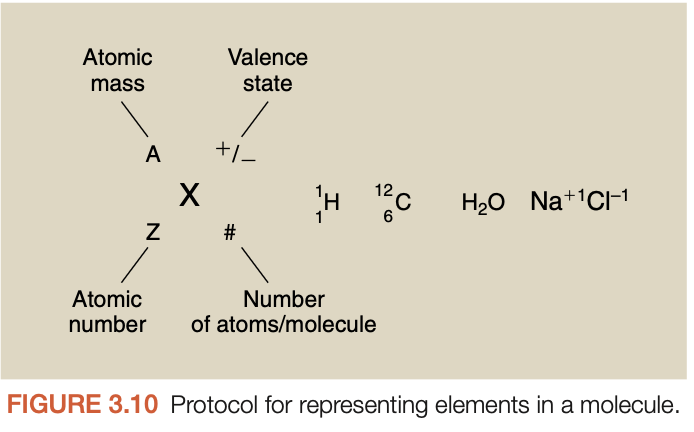
How are atomic number and mass number represented in atomic notation? (Use element symbol X + example)
Using the element symbol X:
ᴬZX
where:
X = chemical symbol
A = atomic mass number
Z = atomic number
Example:
¹²₆C
Carbon-12 therefore has:
6 protons
6 neutrons
6 electrons if neutral
What is an atomic mass unit (amu)?
An atomic mass unit is a unit used to express the masses of atoms and subatomic particles.
Approximately:
Proton ≈ 1 amu
Neutron ≈ 1 amu
Electron ≈ 0.0005 amu
Therefore, nearly all atomic mass comes from the nucleus.
What is the Bohr model of the atom?
The Bohr model describes an atom as having:
A small, dense, positively charged nucleus
Electrons arranged at specific energy levels or shells surrounding the nucleus

Why is the Bohr model of the atom relevant in radiography?
This model is particularly useful because electron shells and their energies become very important when learning ionisation and X-ray production.
What are electron shells?
Electron shells are specific energy levels surrounding the nucleus in which electrons are arranged.
They are labelled from the innermost outward:
K, L, M, N, O, P, Q
The K shell is closest to the nucleus.
How does an electron's energy change with its distance from the nucleus?
Electrons farther from the nucleus occupy higher energy levels.
Therefore:
Inner-shell electrons → lower energy level
Outer-shell electrons → higher energy level
The innermost K-shell electrons are held particularly tightly to the nucleus.
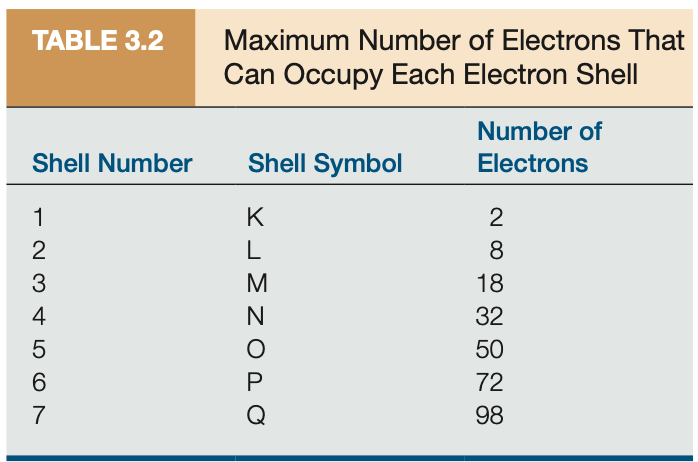
What is the maximum number of electrons that can occupy an electron shell? Few examples
The maximum number can be calculated using:
2n²
where n = shell number.
For example:
K (n=1) → 2
L (n=2) → 8
M (n=3) → 18
N (n=4) → 32
What force keeps negatively charged electrons associated with the positively charged nucleus?
Electrostatic attraction between:
negatively charged electrons
positively charged protons in the nucleus
This attraction provides the inward force that keeps electrons associated with the atom.
What is electron binding energy?
Electron binding energy is the energy required to remove an electron from its shell.
The more tightly an electron is bound to the nucleus, the greater its binding energy.
Which electrons generally have the greatest binding energy?
Inner-shell electrons, particularly those in the K shell, because they are closest to the positively charged nucleus.
Binding energy generally decreases for shells farther from the nucleus.
How does atomic number affect electron binding energy?
As atomic number (Z) increases, the positive charge of the nucleus increases.
This produces stronger attraction between the nucleus and its electrons, so electrons in a given shell generally have greater binding energies in higher-Z atoms.

Why is tungsten particularly important to radiography?
Tungsten has a high atomic number (Z = 74) and tightly bound inner-shell electrons.
Its atomic properties make it particularly important in X-ray production.
