RC9 - Individual differences and risk I (keyterms, mp + scenario questions)
0.0(0)
Studied by 0 people Call Kai
 Learn
Learn Practice Test
 Spaced Repetition
 Match
Match Flashcards
 Knowt Play
Card Sorting
1/27

There's no tags or description
Looks like no tags are added yet.
Last updated 3:17 PM on 5/29/26
Name | Mastery | Learn | Test | Matching | Spaced | Call with Kai |
|---|
No analytics yet
Send a link to your students to track their progress
28 Terms
1
New cards
What is objective numeracy?
The ability to understand and use basic mathematical and probabilistic concepts — associated with education, age, and gender
2
New cards
What is subjective numeracy?
A person's confidence in their ability to understand numeric information and use mathematical concepts, plus their preference for numbers over words — includes numeric self-efficacy
3
New cards
What is the difference between objective and subjective numeracy?
Objective numeracy measures actual math ability (correct answers); subjective numeracy measures perceived confidence and preference for numbers — they correlate positively but the relation is far from perfect
4
New cards
What is the Berlin Numeracy Test?
An adaptive numeracy questionnaire — correct answers lead to harder questions; strengths: reliable and valid; weaknesses: limited scope, time-consuming, may cause anxiety
5
New cards
What are the strengths and weaknesses of the SNS (Subjective Numeracy Scale)?
Strengths: easy to administer, no anxiety, reflects confidence and preference, valid. Weaknesses: people may over/underestimate themselves, measures no actual numeracy, limited focus
6
New cards
What are five habits that distinguish highly numerate from less numerate people?
1. Information seeking rather than avoidance 2. Attention to numeric information while ignoring irrelevant info 3. Better recall of numeric information 4. Greater sensitivity to numbers (feel for numbers) 5. Deriving affective/evaluative meaning from numbers
7
New cards
Why are less numerate people more susceptible to attribute framing?
They rely more on non-numeric, emotional cues and are more influenced by whether options are framed positively or negatively — they process the label rather than the underlying number
8
New cards
What is the role of integral affect in low numeracy?
Less numerate people rely more heavily on built-in emotional responses (integral affect) when processing risk information, rather than the numeric content itself
9
New cards
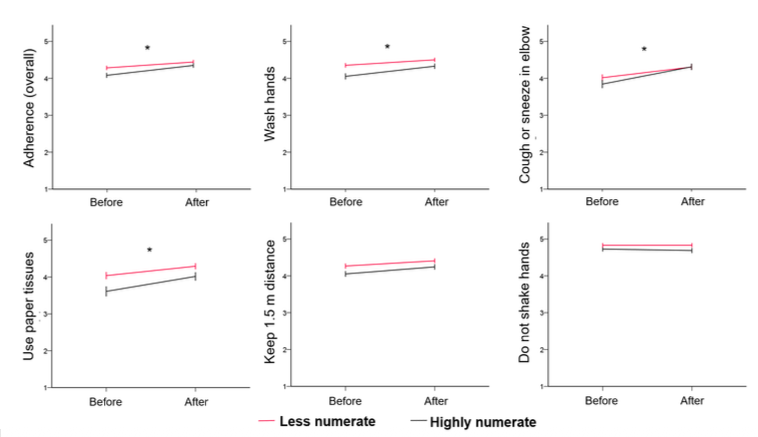
What did Vromans et al. (2024) find about the r-number and numeracy?
Less numerate people found the r-number harder to understand; evaluative labels and visual aids did not significantly improve understanding; highly numerate people showed greater increases in adherence to preventive measures after exposure
10
New cards
What did Bruine de Bruin & Carman (2012) find about the use of 50%?
Low-education and low-numeracy respondents were more likely to use 50% as a probability estimate — not as a genuine estimate but as a way of expressing "don't know"
11
New cards
What is graph literacy?
The ability to extract data and meaning from graphically presented information, whether static or interactive — can be measured objectively (correct answers) or subjectively (self-perceived ability)
12
New cards
Who benefits most from visual aids, according to Garcia-Retamero & Galesic (2010)?
People with low numeracy but relatively high graph literacy — visuals compensate for weak math skills when graph comprehension is sufficient
13
New cards
Who does NOT benefit from visual aids?
People with both low numeracy AND low graph literacy — they get confused by visuals and perform better with plain text
14
New cards
What is the key design principle for icon arrays based on Garcia-Retamero & Galesic (2010)?
Show the full population at risk (not just affected individuals) — displaying both numerators and denominators supports part-to-whole understanding and produces the highest accuracy
15
New cards
What did Garcia-Retamero & Galesic (2010) find about absolute vs. relative risk reduction?
Absolute risk reduction (ARR) produces significantly better risk estimates than relative risk reduction (RRR); adding visual aids improves performance in both conditions
16
New cards
What is the cross-cultural finding from Garcia-Retamero & Galesic (2010)?
US participants made more errors than German participants without visual aids (especially with RRR); adding visuals eliminated this difference entirely
17
New cards
What is the main conclusion of "Beyond Comprehension" (numeracy paper)?
Numeracy goes beyond understanding numbers — it determines which psychological mechanisms activate in the brain; high-numeracy individuals use analytic processing and derive sharper affective meaning from numbers; low-numeracy individuals rely on non-numeric emotional cues
18
New cards
What are framing effects, and how does numeracy moderate them?
Framing effects = different choices based on how identical outcomes are worded (e.g., gain vs. loss framing); high-numeracy individuals mentally convert formats to a comparable standard and stay consistent; low-numeracy individuals are significantly more affected
19
New cards
What is the difference between analytical mode and intuitive mode in information processing?
Analytical mode = deliberate, logical, math-based; intuitive mode = fast, automatic, affect-driven. High-numeracy individuals use both well; low-numeracy individuals lack numerical intuition and fall back on non-numeric cues
20
New cards
What is affective meaning in the context of numeracy?
The emotional valence (good/bad feeling) a person derives from a number — high-numeracy individuals extract sharper, more precise affective reactions from numbers than low-numeracy individuals
21
New cards
What is the paradox of high numeracy identified in "Beyond Comprehension"?
High-numeracy individuals can "overuse" numbers — in one experiment they rated a bet with a tiny loss chance as more attractive than the same bet without the loss, because the small loss intensified the positive affective value of the gain by contrast
22
New cards
What are four strategies for communicating risk to less numerate audiences?
1. Provide numeric information (don't withhold it) 2. Reduce cognitive effort — do the math for them 3. Provide evaluative labels to give numbers meaning 4. Increase visual salience to direct attention to key information
23
New cards
What are evaluative labels and why do they help?
Descriptive words (e.g., "excellent", "poor") added directly to abstract numbers — they give low-numeracy individuals immediate qualitative meaning without requiring them to interpret raw figures
24
New cards
What is the population at risk and why does it matter for icon arrays?
The total group of patients (healthy + sick, treated + untreated) — showing this full population rather than only the affected individuals helps people grasp part-to-whole relationships and prevents denominator neglect
25
New cards
What is numeracy independent of, and why does that matter?
Numeracy is independent of general intelligence — it is a distinct predictor of decision-making quality, meaning someone can be intelligent but still have low numeracy
26
New cards
What is attribute substitution, and how does it relate to low numeracy?
When people reduce complex decisions to a simpler representation — low-numeracy individuals are especially prone to substituting a numeric judgment with an emotional or narrative cue instead
27
New cards
What does "50% as don't know" tell us about measuring risk perception?
When low-numeracy respondents say 50%, they often mean they don't know — communicators should not interpret 50% as a genuine probability estimate from this population
28
New cards
What is numeric self-efficacy and how does it compare to objective numeracy?
Numeric self-efficacy = confidence in one's math ability; correlates positively with objective numeracy but is imperfect — some people significantly overestimate or underestimate their actual abilities