BIO 201 Lecture Exam 2 (Ch. 6 & 7)
0.0(0)
Studied by 1 person Call Kai
 Learn
Learn Practice Test
 Spaced Repetition
 Match
Match Flashcards
 Knowt Play
Card Sorting
1/95

Last updated 9:05 PM on 2/22/23
Name | Mastery | Learn | Test | Matching | Spaced | Call with Kai | Chat |
|---|
No analytics yet
Send a link to your students to track their progress
96 Terms
1
New cards
Functions of calcium in the body
blood clotting, helps muscles to contract, and regulates normal heart rhythms and nerve functions, overall bone health/strength
2
New cards
Where do the calcium and other minerals (phosphorous, magnesium, and manganese) come from that make up the hydroxyapatite?
Our diet!
3
New cards
Mitosis of chondrocytes at the epiphyseal plate occurs in a
10 year old child. This is the hallmark event of:
10 year old child. This is the hallmark event of:
Interstitial growth (chondrocytes secrete new matrix within the cartilage and this causes it to grow in length)
4
New cards
What happens to bone density during deposition? What happens to blood calcium? How is this regulated?
* bone density increases (osteoblasts)
* lower blood calcium levels
* PTH
* lower blood calcium levels
* PTH
5
New cards
What happens to bone density during resorption? What happens to blood calcium? How is this regulated?
* bone density decreases (osteoclasts)
* higher blood calcium levels
* PTH (removes calcium from bone regardless of bone integrity)
* higher blood calcium levels
* PTH (removes calcium from bone regardless of bone integrity)
6
New cards
How do the bones respond to increased mechanical force? What about decreased mechanical force?
Increased mechanical forces → increase bone formation
Decreased mechanical forces → decrease bone formation & increase resorption
Decreased mechanical forces → decrease bone formation & increase resorption
7
New cards
How does the body correct LOW Ca++ levels(hypocalcemia)?
Increase amounts of PTH released → normal levels
Take some calcium from bone into blood
Take some calcium from bone into blood
8
New cards
How does the body correct HIGH Ca++ levels (hypercalcemia)?
Calcitonin released from thyroid → normal levels
Decrease amounts of PTH released → normal levels
Put extra calcium in blood into bones
ex: risk factor can be kidney stones
Decrease amounts of PTH released → normal levels
Put extra calcium in blood into bones
ex: risk factor can be kidney stones
9
New cards
Calcium and what other minerals make up the hydroxyapatite?
phosphorous, magnesium, and manganese
10
New cards
Name 3 kinds of fibers that make up connective tissue.
1. collagen fibers
2. reticular fibers
3. elastin fibers
11
New cards
Osteoid =
organic matrix (mainly collagen)
12
New cards
Name 4 kinds of cells that make up connective tissue.
\n
1. fibroblasts
2. chondroblasts/chondrocytes
3. osteocytes/osteoblasts
4. adipocytes
1. fibroblasts
2. chondroblasts/chondrocytes
3. osteocytes/osteoblasts
4. adipocytes
13
New cards
Name as many examples of connective tissue that you can think of.
* dense regular
* dense irregular
* fluid (blood)
* loose
* adipose
* bone
* cartilage
* dense irregular
* fluid (blood)
* loose
* adipose
* bone
* cartilage
14
New cards
What is the difference between regeneration and fibrosis with regard to tissue repair?
\n Regeneration involves replacing injured cells with cells of the same type, while fibrosis involves replacing parenchyma tissue with connective tissues, leading to the formation of permanent scar tissue.
15
New cards
What are some problems with scar formation?
* can can pain
* can cause tightness
* can cause itching
* can reduce function and movement (scar tissue contains less elastin than normal skin)
* can cause tightness
* can cause itching
* can reduce function and movement (scar tissue contains less elastin than normal skin)
16
New cards
Name 3 types of cartilage.
1. Hyaline cartilage
2. Fibrocartilage
3. Elastic cartilage
17
New cards
What is the difference between ligaments and tendons?
Tendons connect muscle to bone, while ligaments connect bone to bone.
18
New cards
Name as many differences between spongy and compact bone that you can think of.
Spongy is more porous, composed of trabeculae, and is found within/inside the end of the bone shaft of long bones (epiphysis), while compact bone is more hard/dense, made of osteons, and makes up the hard outside of bones (surrounds the spongy bones).
19
New cards
Name the organic and inorganic substances that are secreted by osteoblasts, which are actually the components that make up the hard substance we know as bone.
secrete unmineralized bone matrix or Osteoid: collagen & calcium-binding proteins
20
New cards
Describe Wolff’s Law
Bones that bear a lot of weight remodel at a high rate; our bones become thicker and stronger over time to resist forces placed upon them and thinner and weaker if there are no forces to act against.
21
New cards
Describe what is happening at the epiphyseal plate during growth in length of a long bone.
\
* The cartilage in the region of the epiphyseal plate next to the epiphysis continues to grow by **mitosis**.
* On the epiphyseal side of the epiphyseal plate, cartilage is formed. On the diaphyseal side, cartilage is ossified, allowing the diaphysis to grow in length
* The cartilage in the region of the epiphyseal plate next to the epiphysis continues to grow by **mitosis**.
* On the epiphyseal side of the epiphyseal plate, cartilage is formed. On the diaphyseal side, cartilage is ossified, allowing the diaphysis to grow in length
22
New cards
Define remodeling. Where are the osteoblasts during remodeling? What are they doing? Where are the osteoclasts? What are they doing?
* Remodeling = resorption + deposition
* Osteoblasts are located on the surface of bone and are responsible for laying down new bone until the resorbed bone is completely replaced.
* Osteoclasts when active are located in resorption bay and have a ruffled border; these cells are responsible for destroying/eating bone
* Osteoblasts are located on the surface of bone and are responsible for laying down new bone until the resorbed bone is completely replaced.
* Osteoclasts when active are located in resorption bay and have a ruffled border; these cells are responsible for destroying/eating bone
23
New cards
Name some circumstances that would make a person more likely to develop osteoporosis (the “risk factors”).
* most often aged, postmenopausal women
* decrease in sex hormone secretion (due to age)
* Petite body form
* Insufficient exercise to stress bones
* Diet poor in calcium and protein
* Smoking
* Hormone-related conditions (Hyperthyroidism, Low blood levels of thyroid-stimulating hormone, Diabetes mellitus)
* Immobility
* Males with prostate cancer taking androgen-suppressing drugs
* decrease in sex hormone secretion (due to age)
* Petite body form
* Insufficient exercise to stress bones
* Diet poor in calcium and protein
* Smoking
* Hormone-related conditions (Hyperthyroidism, Low blood levels of thyroid-stimulating hormone, Diabetes mellitus)
* Immobility
* Males with prostate cancer taking androgen-suppressing drugs
24
New cards
How can we help prevent osteoporosis, or at least slow its progression?
1. plenty of calcium in diet in early adulthood
2. reduce carbonated beverage and alcohol consumption
3. plenty of weight-bearing exercise
25
New cards
Approximately when does epiphyseal plate closure occur in males and females?
* females at 18
* males at 21
* males at 21
26
New cards
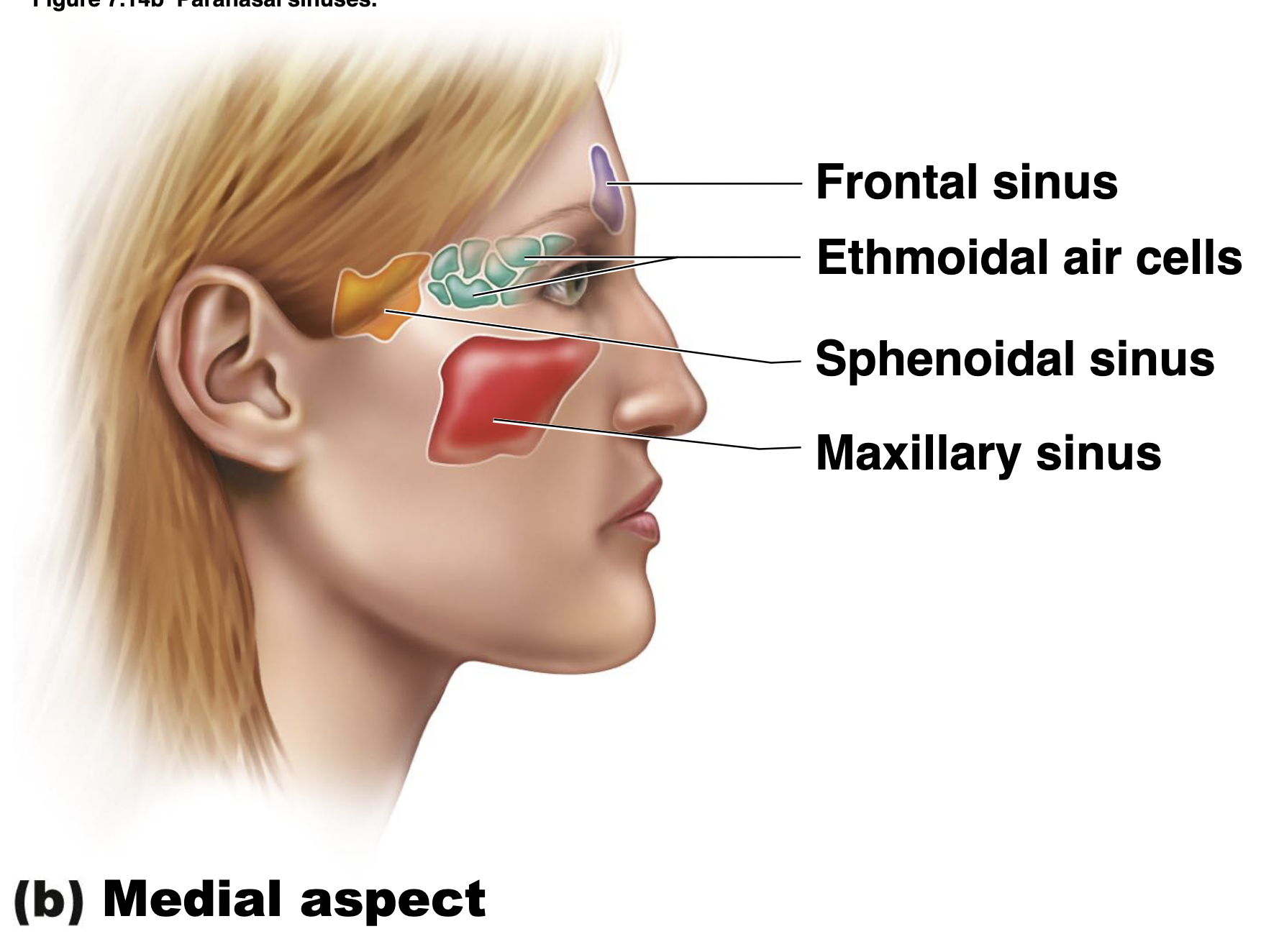
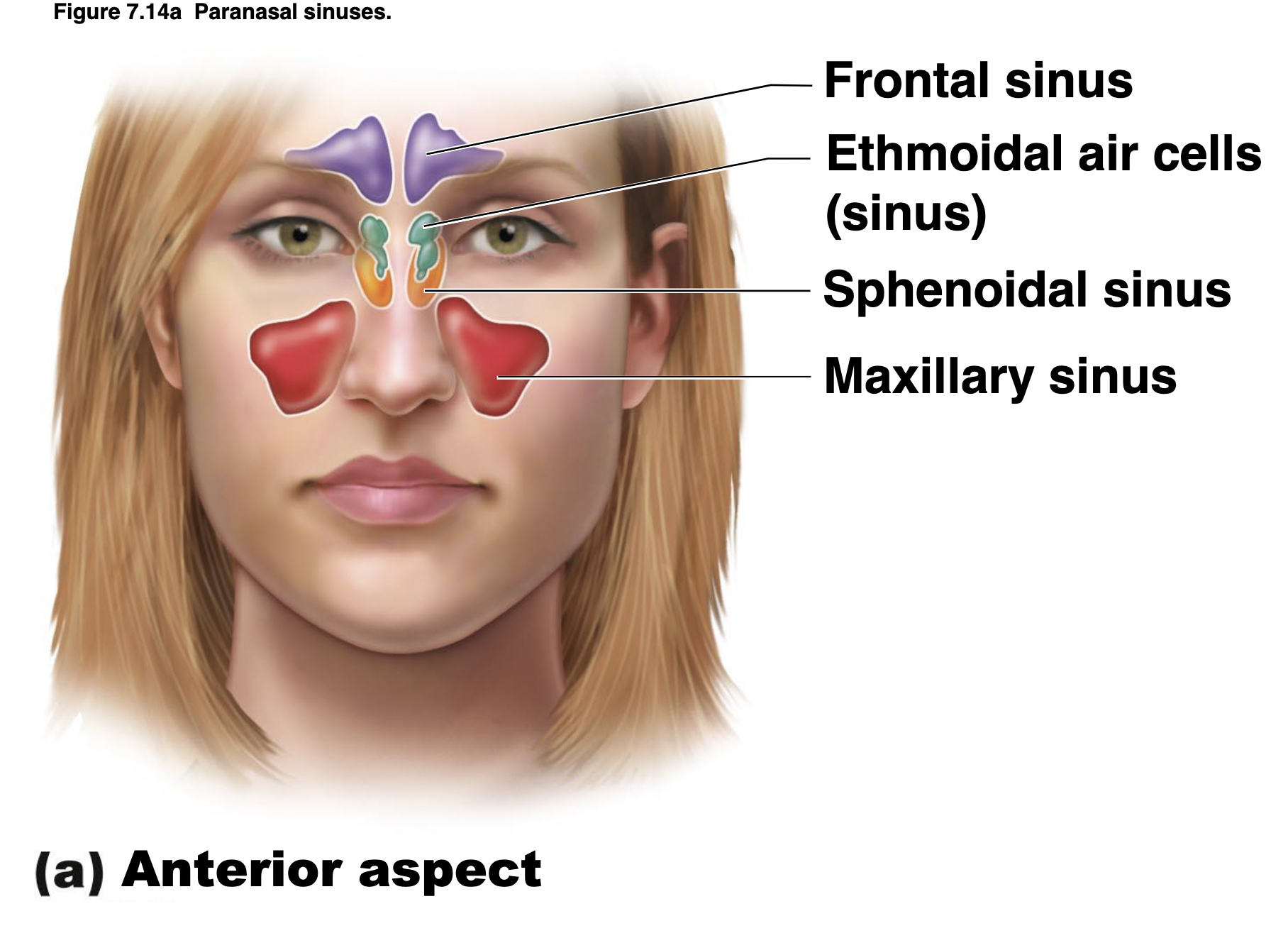
What are the purposes of the paranasal sinuses? Name them.
* to lighten the weight of the skull bones
* serve as resonators for sound production
* lined with cells that secrete mucus (drains into the nasal cavity) to keep the nose from drying out during breathing
* maxillary sinus
* ethmoid sinus
* sphenoid sinus
* frontal sinus
* serve as resonators for sound production
* lined with cells that secrete mucus (drains into the nasal cavity) to keep the nose from drying out during breathing
* maxillary sinus
* ethmoid sinus
* sphenoid sinus
* frontal sinus
27
New cards
Where is the mastoid sinus? What are some problems that might arise from having sinuses in this location?
Located just behind the ear; this placement is prone to infection
28
New cards
What drives bone remodeling?
calcium levels (homeostasis), and mechanical stressors
29
New cards
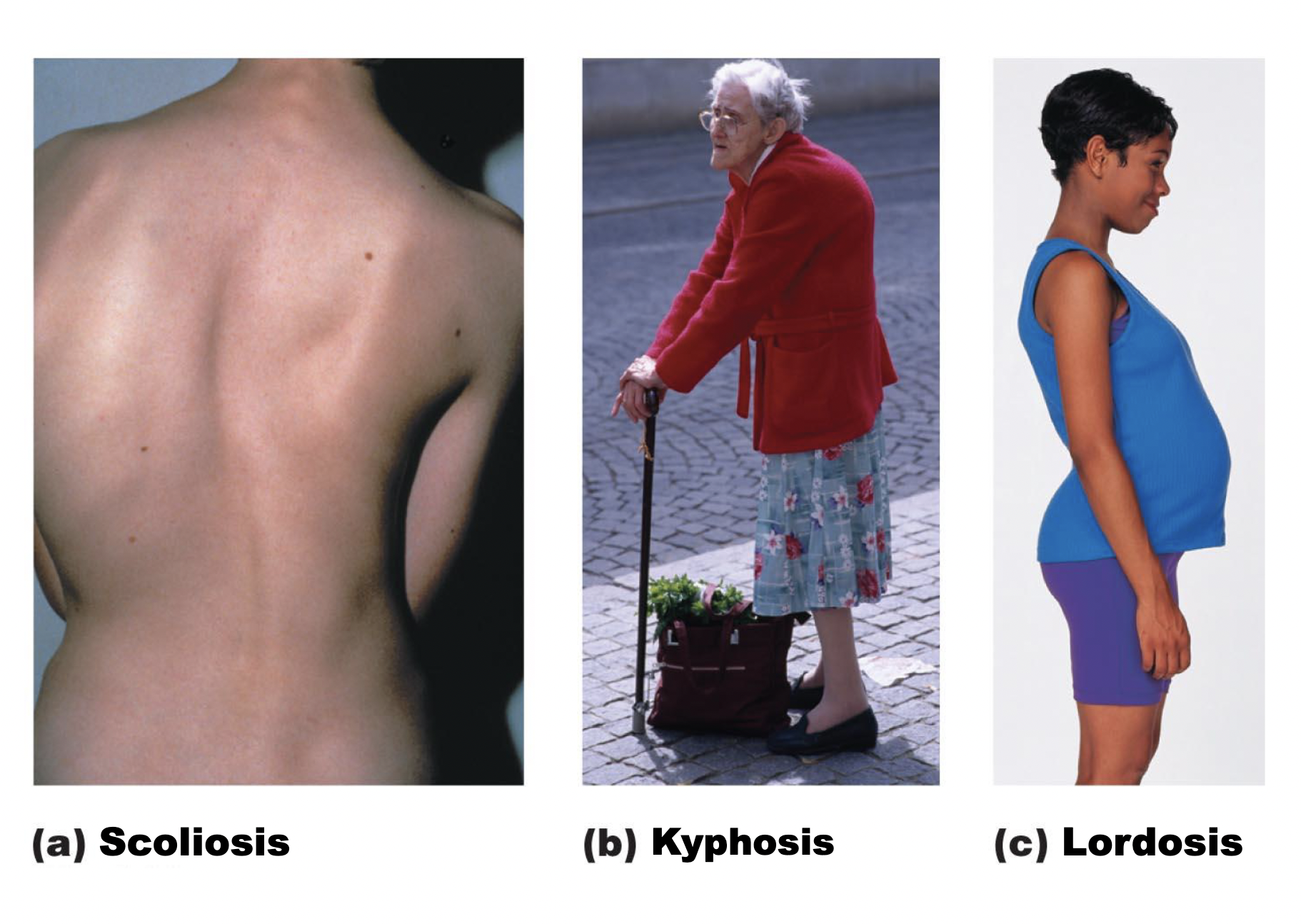
**scoliosis**
a sideways curvature of the spine
30
New cards
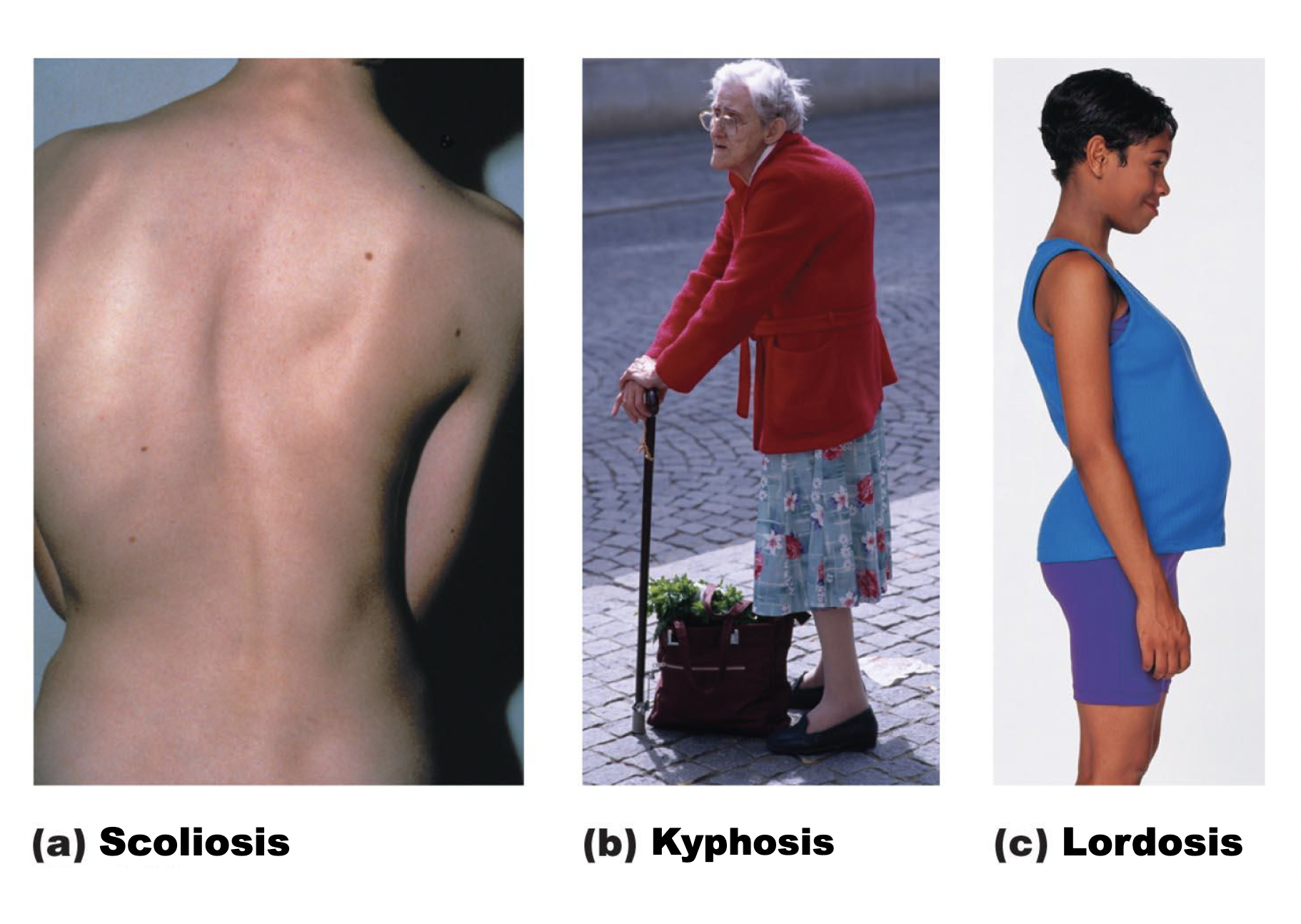
**lordosis**
the natural curve of the lower back (lumbar) area of the spine. but with an extreme curve, the lower spine will have a deep curve, causing the abdomen to stick out and causing the pelvis to curve back and up.
31
New cards
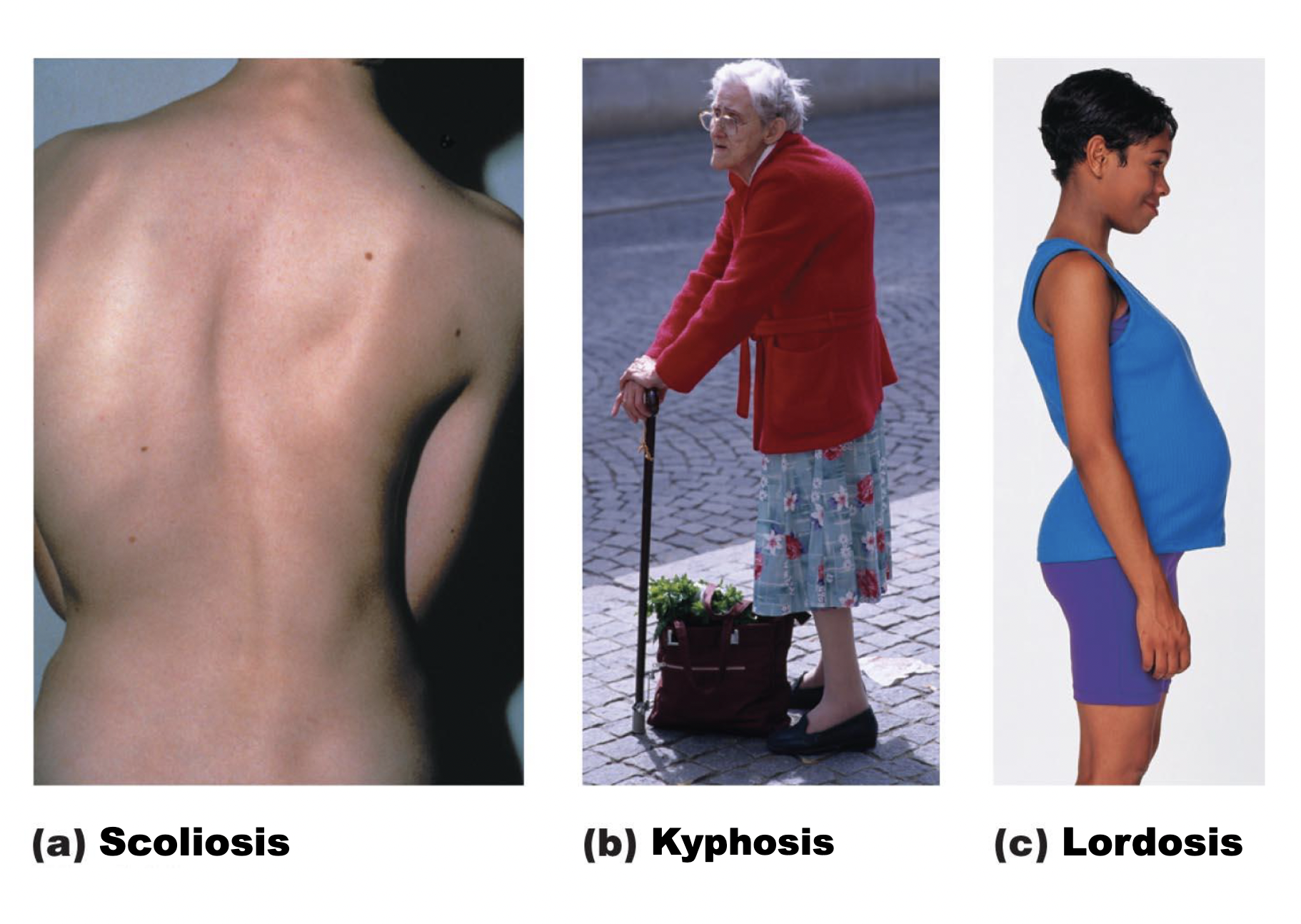
**kyphosis**
An increased front-to-back curve of the spine (looks like a hunchback)
32
New cards
**Atlas**
is the first cervical (neck) vertebra which is present just under the head; supports the skull
33
New cards
**Axis**
is the second cervical (neck) vertebra; it forms the pivot upon the atlas.
34
New cards
Which bone of the lower leg is the weight bearing bone?
The **tibia**; it is significantly larger and stronger than the fibula
35
New cards
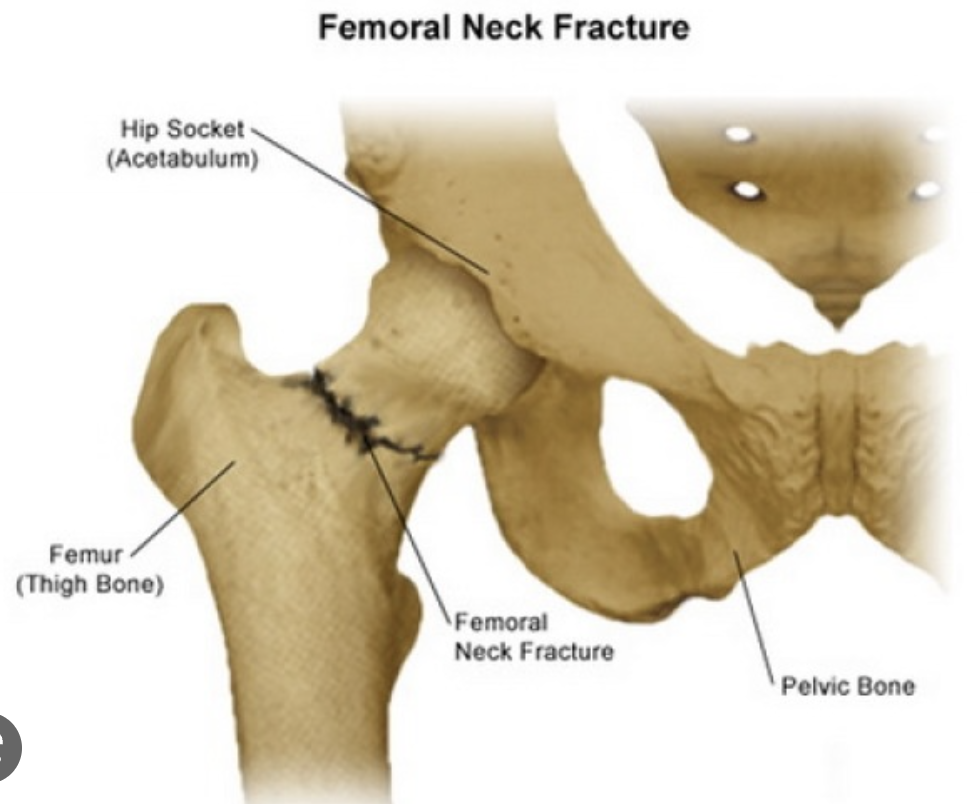
Which portion of the femur is most likely to fracture in little old ladies?
The femoral neck; can fracture in relation to osteoporosis
36
New cards
Name 3 functions of the skeletal system besides support, movement and protection.
* produces blood cells
* stores and releases minerals and fat
* endocrine regulation
* stores and releases minerals and fat
* endocrine regulation
37
New cards
Why are babies born with fontanels (spaces between the bones of the skull where bone formation isn't complete)?
* Important for the normal growth and development of the baby's brain
* Allows the skull to be molded during birth
* Allows the skull to be molded during birth
38
New cards
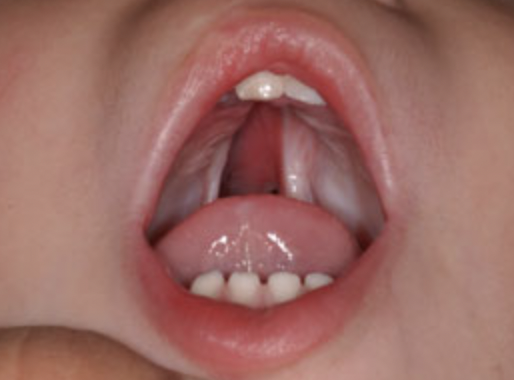
What is cleft palate?
is an opening or split in the roof of the mouth that occurs when the tissue doesn't fuse together during development in the womb
39
New cards
Osteoporosis
Bone resorption is greater than bone deposition and bones become porous and less dense.
40
New cards
Paget's disease
Abnormal bone deposition with more spongy bone compared to compact bone
41
New cards
Osteomalacia
Bone is deposited but does not mineralize well, (calcium salts are not deposited) causing softness of bone.
42
New cards
Rickets
Bone is soft due to inadequate mineralization of calcium, usually due to a Vitamin D deficiency in children. Leads to bowed legs and other bone deformities
43
New cards
Comminuted
\n Bone is broken in three or more pieces; common in elderly
44
New cards
Compression
Bone is crushed; common in excessively porous bone such as in osteoporosis
45
New cards
Spiral
Fracture occurs when an extreme rotating or twisting force occurs on the bone; common sports fracture
46
New cards
Epiphyseal
Fracture at the ends of long bones, where epiphysis separates from diaphysis.
47
New cards
Greenstick
Bone break is incomplete where one side fractures and the other side bends; common in children.
48
New cards
Depressed
Broken bone is pressed inwards; common in skull fractures
49
New cards
Diaphysis
This region is elongated with long bone growth
50
New cards
Epiphyseal line
The presence of this structure signals the end of long bone growth
51
New cards
Epiphyseal plate
The site of proliferating chondrocytes
52
New cards
Appositional growth
The growth pattern of bone where bone matrix is laid down on the surface to thicken the width of the bone
53
New cards
Vitamin D promotes…
calcium absorption in the GI tract
54
New cards
Interstitial growth
The term for the lengthening of a long bone; occurs in childhood and puberty
55
New cards
Osteogenic cells
These cells are bone stem cells
56
New cards
Osteocytes
These cells are matured osteoblasts, embedded in the bone matrix.
57
New cards
Osteoblasts
These cells lay down bone matrix; bone builders
58
New cards
Osteoclasts
These cells dissolve the bone matrix; bone eaters
59
New cards
\n Chondrocytes
These cells lay down cartilage
60
New cards
Chondro =
cartilage
61
New cards
The medullary cavity and spongy bone in infants is filled with…
red marrow
62
New cards
What is the structural unit for compact bone?
osteons
63
New cards
What makes up 65% of bone mass?
hydroxyapatites (mineral salts)
64
New cards
90% of bone protein =
collagen
65
New cards
An osteon contains osteocytes, lamellae, and a central canal (Haversian system), and is found in compact bone only.
True
66
New cards
What is the primary hormone involved in bone growth?
The growth hormone
67
New cards
What type of tissue is laid down first in long bones?
Hyaline Cartilage
68
New cards
Which hormone increases osteoclast activity to release more calcium ions into the bloodstream?
Parathyroid hormone (PTH)
69
New cards
Wolff's law tells us that
the thickness and shape of a bone is dependent on the stresses placed upon it.
70
New cards
Normal bone formation is dependent on sufficient intake of…
calcium, phosphate, vitamin D
71
New cards
If a child has a deficiency in growth hormone, what can occur as a result?
Decreased chondrocyte activity at the epiphyseal plate
72
New cards
The central canal that runs through each osteon allows for
a passageway for blood vessels and nerve fibers.
73
New cards
The resilience of bone seems to be due to which of the following?
The bonds between collagen fibers that can break to diffuse energy and then re-form
74
New cards
Which hormone is MOST directly involved in regulation of blood calcium levels?
Parathyroid hormone (PTH)
75
New cards
These cells produce cartilage and are active at the epiphyseal growth plate.
Chondrocytes
76
New cards
A friend gives you a bone that is cube-shaped, about one inch long and one inch wide and asks you to classify it since your friend knows you are taking Anatomy and Physiology. You have been studying and tell your friend it is classified as a…
short bone
77
New cards
Thinking of the principle of complementarity, which of the following types of bone tissue helps to lighten the overall weight of a bone and provides spaces for blood vessels and bone marrow?
trabecular bone
78
New cards
Why are the bones of young children much more flexible than those of older adults?
The bones of young children are not completely calcified as they are still growing while the bones in older adults will be completely calcified, making older bones more hard and rigid.
79
New cards
When undergoing bone remodeling and repair throughout life, we need to be able to break down bone (resorption). Which cell is best suited for this function?
Osteoclast
80
New cards
These cells are also called bone progenitor cells and give rise to osteoblasts, osteocytes, and bone-lining cells.
Osteogenic cells
81
New cards
These cells are large, multi-nucleate cells similar to macrophages and secrete enzymes that dissolve bone material to be reabsorbed.
Osteoclasts
82
New cards
These cells are mature bone cells that sit in lacunae and monitor the bone tissue for stress.
Osteocytes
83
New cards
The structure of bone tissue supports its function. Which of the following bone tissues is adapted to support weight and withstand twisting stress?
Compact bone
84
New cards
Which structures help to provide nutrients to the osteocytes in lacunae and also help the osteocytes to monitor the bone tissues?
canaliculi
85
New cards
**Intramembranous ossification** is
the process of bone development from fibrous membranes
86
New cards
If you fractured the shaft of your humerus, this would be a break in the
diaphysis
87
New cards
Choose which bone marking type would most likely increase in size when a weight-lifter repeatedly exercises the muscles that attach and pull on that bone.
tuberosity
88
New cards
Which type of tissue is produced first in long bone development and provides the framework for the bone?
hyaline cartilage
89
New cards
Which of the following is the name of a bone marking that tends to be a round or oval opening through bone?
foramen
90
New cards
Which nutrients are important for proper bone health?
Calcium
Vitamin D (calcitriol)
Vitamin C
Vitamin K
Protein
Vitamin D (calcitriol)
Vitamin C
Vitamin K
Protein
91
New cards
Foramen
an opening in a bone through which \n certain structures like nerves or blood vessels \n pass
92
New cards
Suture
a type of fibrous joint between bones, \n especially bones of the skull and face
93
New cards
Fontanelle
a fibrous membrane connecting \n bones of the fetal skull
94
New cards
Sinuses
mucus-lined cavities in bones of the \n skull that serve to lighten the skull and humidify \n inhaled air (paranasal sinuses only).
95
New cards
Deposition =
process where new bone is formed
96
New cards
Resorption =
destruction of bone tissue