GEL 12 Midterm 4
 Call Kai
 Learn
Learn Practice Test
 Spaced Repetition
 Match
Match Flashcards
 Knowt Play
1/40

Earn XP
Description and Tags
Summer Sessions
Name | Mastery | Learn | Test | Matching | Spaced | Call with Kai | Chat |
|---|
No analytics yet
Send a link to your students to track their progress
41 Terms
What are not dinosaurs
Marine Reptiles and flying reptiles
Aquatic adaptions
Long skull
conical teeth
long or short neck, squat
streamlined bodies
tails laterally compressed, short
paddle-like limbs
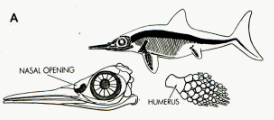
Ichthyosaur
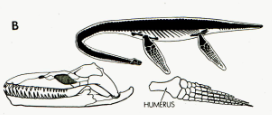
Plesiosaur
Mosasaur
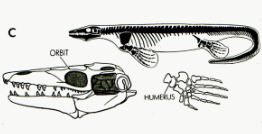
Mosasaur
Marine varanoids
Mid to late Cretaceous
Well-designed for a diet of fish
Fed on various invertebrates, including ammonites
Plesiosaurs
Late Triassic to Late Cretaceous
Ranged in size 2-14m
strong limb girdles
Powerful paddle-like limbs
Long necks
Flippers are more like wings than oars
Joints allow up-and-down movement
downstroke more powerful
Ichthyosaurs
Highly derived marine reptiles with streamlined
fusiform bodies
large dorsal fins
elongated skull
large eyes
Late Triassic to Late Cretaceous
go extinct before the end of the Cretaceous
Strealined body form with doplphins
propel with tail; steer with paddles
dolphins-up and down- mammals
Ichthyosaurs- side to side- reptile
Ichthyosaur reproduction
Fully adapted for life in sea
did NOT lay eggs on land
gave birth to live young in sea
Pterosaurs
Flying reptiles
NOT DINOSAURS
semi-erect posture
Pterosaur features
enlarged sternum
elongated 4th digit
pteroid bone
Rhamphorhynchids
hook-beak
small bodies
long tails
no crests on head
Pterodactyloids
Wing finger
larger bodies
no tails
crests on head common
Archaeopteryx like birds
Feathered wings and feathered tail
backward-pointing pubis
backwards-pointing pedal digit I hallux on foot
Archaeopteryx different from birds
Long bony tail instead of a pygostyle
Unfused digits with unguals (claws)
Teeth in the skull
Archaepterx lacks
toothless beak
keeled sternum
no claws on their wings
a pgostyle
Other dinosaurs
many other clearly NON-avain dinosaurs had pygostyles
Wings
Climbing a steeper slope
flap wings from head to tail
Gives extra traction to bird while climbing
WAIR
Wing assisted incline running
Flight and Wair
Angle of attack of wing in WAIR and flight stroke are VERY similar
Trees down Model arboreal hypothesis
Ancestors of birds were tree dwellers bird went through a gliding stage
Ground up model terrestrial hypothesis
No aboreal (tree dwelling) phase, nor gliding stage
The Compromise hypothesis
Wings evolved first to aid young in running up sides of trees, cliffs, etc later modifications allowed true flight
Functions of feathers
Thermoregulation
colorations/mates
sensory
Extinctions
Most species become extincit after a few millions years
Background of extinction
Constantly going on, but is during static periods of biodiversity, it is balanced by the origination of new species
Mass extinction
The extinction rate far outweighs the origination rate for new species
Global climate change
Intrinsic factors (GC)
Atmospheric composition
Global climate change
rates of carbon burial
rates of volcanism
Plate tectonics
Continental configuration
distribution/shape of the ocean basins
ocean circulation
Global climate chnage
Sea level changes Intrinsic
Area/size relationship of continents
effects on habitable area
effects on climate
Potential Contributing biological factors INTRINSIC FACTOR
Competitions
predator-prey interactions
epidemics
Extrinsic factors
orbital changes
solar system evolution
cosmic factors
orbital changes
changes in axial tilt and shape of the earths orbit
Solar system evolution
Rates and sizes of impactors
Cosmic facots
Radiation from supernovae
Evidence for dinosaur killing asteroid
Iridium anomaly
shocked quartz
tsunami deposits
fern spore spike
crater
Animals that survived
Early mammals
avain dinosaurs
reptiles and amphibians
aquatic invertebrates
Why animals survived
Small didn’t need a lot of food to survive
High reproduction rates grew large populations fast
Subterranean and aquatic animals lived in burrows and swamps and deep rivers