sinuses
 Call Kai
 Learn
Learn Practice Test
 Spaced Repetition
 Match
Match Flashcards
 Knowt Play
1/27

Earn XP
Description and Tags
Name | Mastery | Learn | Test | Matching | Spaced | Call with Kai | Chat |
|---|
No analytics yet
Send a link to your students to track their progress
28 Terms
brachydont
what type of teeth
where is the crown
where is the root embedded
low crowned teeth
carnivores
crown above the gingiva, constricted neck at the gum line and root embedded in the jaw bone
crown encased in enamel and root in cementum
deciduous permanent
hypsodont
high crowned teeth
continue to erupt throughout life
eg permanent teeth of horses and cheek teeth of ruminants
aradicular
open rooted
no true root
radicular
closed roots
have roots which close
contact vs occlusal surface
-contact- adjacent teeth touch
occlusal- where opposing teeth touch
horse- incisors
crowns
enamel surfaces
occlusal plane and how this changes relative to the jaw
what do the roots do
high crowns
folded enamel surfaces
wider occulsal plane than the jaw is structured
rootes converge
occlusal plane shifts angle from steep to shallow relative to the jaw
pig
incisor direction
what do canines present as and for what reason
features of p/m
incisors project rostrally
canines present as continuously erupting tusks for digging and tearing
P/M have rounded cusps for crushing and grinding
homodont vs heterodont
homo- teeth around same shape
hetero- teeth have different form and functions in different parts of tooth ro
monophydont vs polyphydont
mono- one set of teeth for life
poly- multiple
dental formulae
indicate number of tpe of tooth for a given species
dog
eruption times
brachycephalic- what do they lack, feature of their roots
type of teeth?
eruption times differ between breeds
gums recede with age
brachycephalic dogs do not possess all canine cheek teeth, some teeth may have fused roots
carnasial teeth- in carnivores and for processing food
horse
continuous and considerable wear
surfaces enlarged
higher crowns
delayed dev of roots
complex folding of enamel
canines in horses
rudimentary in diastema
root is bigger than crown
pre molars in horses
vestigial wolf teeth
p and m form continuous surface
very high wear
erupt continuously
upper wider than lower
horse incisors
crown
enamel surfaces
roots
high crowns
folded enamel surfaces
roots converge
rodents and lagomorpjhs
reduced number of teeth- no canines and very large diastema
no pulp cavity so teeth are insensitive- clipping is okay
Ox
no upper canines or incisors- replaced by a hard fibrous dental pad
incisors do not erupt continuously
lower canines very simlar to incisors
p and m increased size caudally, similar to horse, do not erupt continuously, pronounced enamel ridges
maloclussion
upper and lower teeth do not align
pig
incisors project roastrally
canines present as continually erupting tusks for digging and tearing
p/m have rounded cusps for crushing and grinding
external nose
features
where does it extned
what opens into the area it extends into
flexible and cartilaginous
unmodified skin
extends into vestibule and in these areas covered by mucosa
nasolacrimal duct opens into this vestiule area
nasal cavities
nasal septum
where does it run long
where does it meet
what does equine nasal cavity meet
runs along entire length of hard palate
divides left and right nasal cavities
bone caudally
cartilage rostrally
meets cephalic hard palate
horse septum attached to entire hard palate length
horse bigger than dog
equine nasal cavity thus leads to pharynx
nasal conchae and what is it separated by
most caudal part almost filled by ethmoid turbinates
increase complex and sense of smell
each concha is separated by narrow clefts
form limits of dorsal,middle, ventral and common meatuses
frontal sinus
where does it open into
via… in horses
opens into nasal cavity in ethmoid meatus
via caudal maxillary sinus in horses
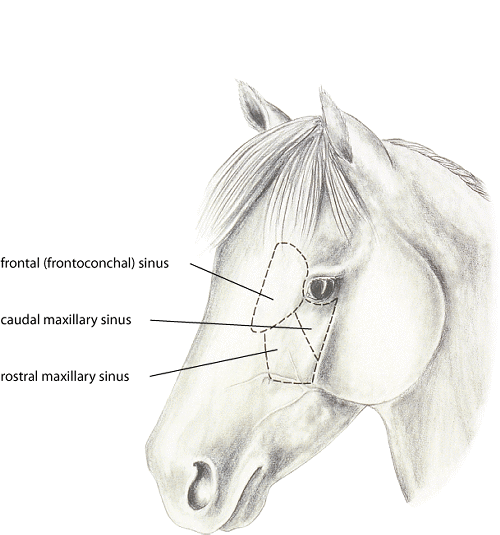
maxillary sinus
where does it open into and where
what is it associated by
opens into nasal cavity in caudal/lateral part of upper jaw
associated with hard palate, sphenoid bones, orbbit and ventral concha
paranasal sinnyses
where is it connected and how
what do all domestic species possess
no..?
connected to nasal cavty through very small channels
all domestic species possess frontal and maxillary sinuses
no contra lateral sinus connection
paranasal sinuses in horse
features of maxillary sinus- 2 parts
what is maxillary sinus connected to
extensive maxillary sinus with caudal and rostral parts
maxillary sinus is connected to middle nasal meatus
maxillary sinuses of young horses are almost filled with tooth rots of cheek teeth
reserve cheeck teeth crowns become shorter with age as the maxillary sinus shrinks