thymocyte selection
 Call Kai
 Learn
Learn Practice Test
 Spaced Repetition
 Match
Match Flashcards
 Knowt Play
1/19

There's no tags or description
Looks like no tags are added yet.
Name | Mastery | Learn | Test | Matching | Spaced | Call with Kai | Chat |
|---|
No analytics yet
Send a link to your students to track their progress
20 Terms
What is the pathway of T cell development from origin to function? (overview)
T cell progenitors develop in the bone marrow, migrate to the thymus, undergo positive and negative selection, mature, then migrate to peripheral lymphoid organs (lymph nodes, spleen, Peyer's patches). Upon encountering foreign antigens, they activate, proliferate, differentiate into effector cells, and move to sites of inflammation or infection.
Why is the thymus important for the immune system?
The thymus is where T cells undergo selection and maturation. The "T" in T cell stands for thymus. Without a functional thymus, there are no functional T cells, as demonstrated by DiGeorge syndrome patients who lack a thymus and have severe T cell deficiency. The thymus grows until puberty and then degenerates. Over time, it becomes very small and is largely replaced by fat tissue.
Why do thymocytes need to be selected?
Because T cell function depends on cell-to-cell contact with MHC molecules, which are highly polymorphic (different sets in each individual). TCRs are randomly rearranged, so each individual's TCRs must be adjusted to recognize their own MHC molecules while avoiding autoreactivity.
What is MHC restriction?
MHC restriction means that a TCR selected on a given MHC molecule in the thymus is restricted to respond only to foreign antigens presented by that specific MHC. The TCR won't bind to the same foreign peptide presented by a different MHC molecule.
What happens during thymocyte development?
• Commitment to the T cell lineage (gamma-delta or alpha-beta T cell)
• T cell receptor (TCR) rearrangement
• Proliferation
• TCR selection and tolerance induction
• Functional maturation to resting mature T cells

Explain the "hat and MHC" analogy for TCR selection.
A thymocyte makes a TCR (like a hat) without knowing in advance which MHC it will encounter. If the TCR fits into the MHC (like a hat fitting a head), the cell is selected and survives. If it doesn't bind, the TCR undergoes apoptosis and the cell dies.
What are the stages of thymocyte development?
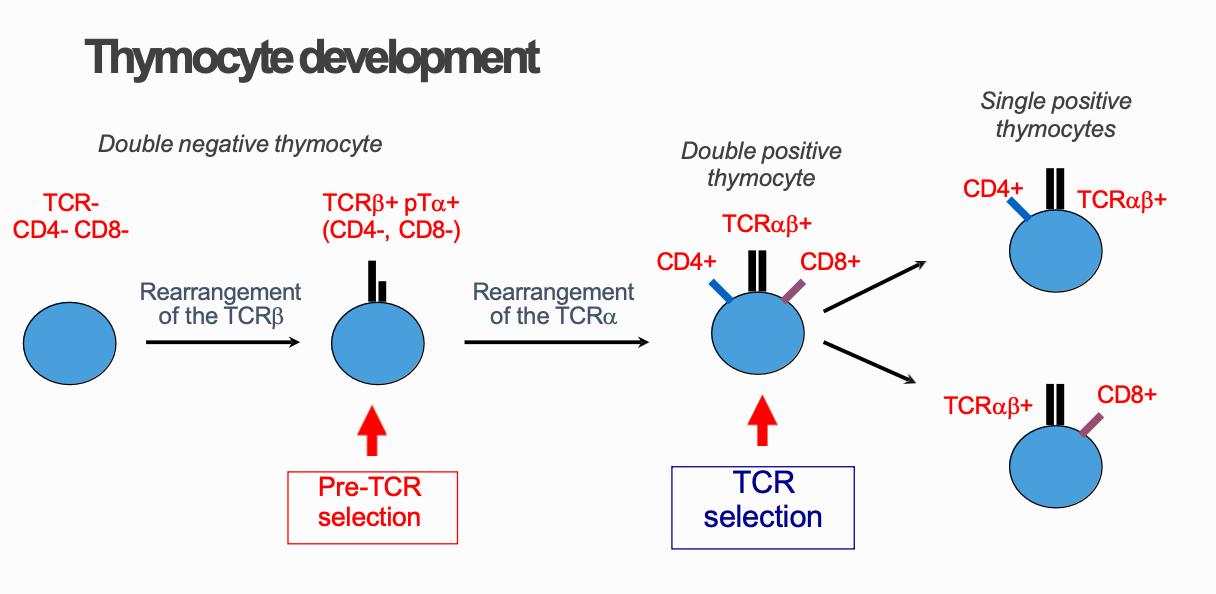
Double - thymocyte stages: (The cell does not express CD4 or 8 co-receptors at this stage)
At the beginning of T-cell development, the thymocyte is at the double-negative (DN) stage. It does not express either CD4 or CD8, so it is CD4⁻ CD8⁻. At this early stage, it also does not yet express a complete TCR.
The rearrangement of of the TCR-Beta begins
Once the TCR-Beta successfully rearranged they get expressed on the surface of the thymocyte
There is no alpha chain so it has to pair up with surrogate alpha chain which is known as pre-T alpha
It then undergoes the Pre-T alpha selection. Pre-TCR signaling (selection) causes several important changes:
Stop further rearrangement of the TCR β locus → allelic exclusion
Proliferation of the thymocyte
Start rearrangement of the TCR α locus (note that rearrangement of the TCR-alpha locus causes deletion of the TCR-delta locus!)
Shut off pre-Tα (pTα) transcription
Commitment to the αβ T-cell lineage
It is during this time the thymocyte decides whether it will become Alpha-Beta T cell or Gamma-Delta T cell. So for ex. if the Gamma-Delta signaling is successful it will switch off the Beta-Alpha chain rearrangement and then it commit to Gamma-Delta T cell.
(The rearrangement of γ, δ, and β genes begins at roughly the same time. Because of this, a developing thymocyte may temporarily express both a γδ TCR and a pre-TCR before the developmental pathway is determined).
Double Positive stage: (They express CD4 and CD8 co-receptors)
Upregulation of CD4 and CD8 and becomes double+ thymocyte
The selection of the TCR (positive and negative selection)
The cell either becomes CD4 or CD8 after the selection (naive cells)(Single positive thymocyte stage)
Single positive thymocytes mature to resting naive T cells that are exported to the periphery, ready to be activated by foreign peptide + self MHC
What is the difference in diversity between alpha-beta and gamma-delta T cells? And where do gamma-delta T cells primarily migrate after development?
Alpha-beta T cells have higher diversity than gamma-delta T cells. Gamma-delta T cells are produced in waves during early embryonic development with preference for certain V gene segments, while alpha-beta T cells develop later and have greater TCR diversity.
Gamma-delta T cells primarily migrate to mucosal sites, while alpha-beta T cells go to peripheral lymphoid organs.
How is TCR diversity generated?
1. Gene segment recombination: Random recombination of V (variable), J (joining), and D (diversity) gene segments.
2. Nucleotide modification: Removal of nucleotides (P nucleotides) or addition of nucleotides (N nucleotides) between gene segments during ligation.
3. Combinatorial diversity: Different ways that beta chains pair with alpha chains, or gamma chains pair with delta chains.
NOTE!
The random rearrangement of TCR chains, and polymorphic MHC, will lead to the generation of some autoreactive TCR.

Negative selection-Central tolerance
After positive selection, thymocytes undergo negative selection in the thymic medulla. Here, dendritic cells and medullary thymic epithelial cells present self-peptides to the developing T cells.
The presented peptides can come from:
Cell-associated proteins – common proteins normally found inside cells.
Circulating proteins – proteins from the blood that are taken up by dendritic cells.
Cross-presentation – dendritic cells present peptides derived from proteins of other cells.
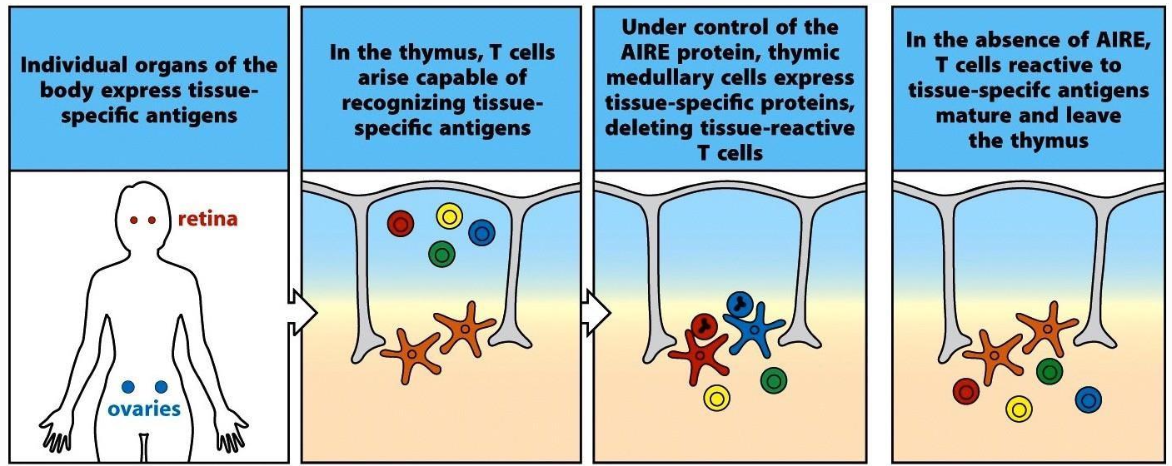
Tissue-specific proteins – a subset of medullary thymic epithelial cells expresses proteins that are normally found only in specific peripheral tissues. This expression is regulated mainly by the transcription factor AIRE.

where can we find the mature T cells and the developing t cells in the thymus?
The mature cells can be found in the medulla (There you can find medullary epithelial cells, DC and macrophages)
The developing ones are found in the cortex part of the thymus (In the cortex the main cells are cortical epithelial cells and you also find macrophages)

What is AIRE and what is its function?
AIRE (Autoimmune Regulator) is a transcription factor expressed in medullary epithelial cells. It controls the thymic expression of peripheral tissue-specific antigens, allowing the thymus to present diverse self-antigens for negative selection.
AIRE-dependent self-antigens may also contribute to the development/positive selection of some regulatory T cells (Tregs).
Why is it important that medullary epithelial cells express tissue-specific proteins?
Different organs express different tissue-specific antigens. By expressing these antigens in the thymus, medullary epithelial cells allow T cells to encounter and be eliminated if they recognize these tissue-specific antigens, preventing autoimmunity to specific organs.
What is Autoimmune Polyendocrine Syndrome (APS)?
APS results from genetic defects in the AIRE gene (found in Finland, Sardinia, and Iranian Jews). Without functional AIRE, medullary cells cannot express tissue-specific antigens, so autoreactive T cells are not deleted. This leads to lymphocyte disruption of endocrine organs.
How are natural regulatory T cells generated during negative selection?
Natural regulatory T (nTreg) cells are generated when thymocytes recognize self-antigen with slightly higher affinity than the intermediate level required for normal positive selection. This occurs during the negative selection process.
What transcription factor do regulatory T cells express and what cytokine do they depend on? And what is the function of regulatory T cells in the periphery?
Regulatory T cells express the transcription factor FoxP3 and depend on the cytokine IL-2 for their survival.
Regulatory T cells suppress autoreactive and potentially pathogenic lymphocytes in the periphery, helping to maintain immune tolerance and prevent autoimmune responses.
What is alloreactivity and how does it relate to organ transplant rejection?
Alloreactivity occurs when T cells recognize MHC molecules from a foreign donor as foreign. This causes the immune system to attack transplanted organs because they express different MHC molecules, leading to organ rejection.
MHC matching is necessary to reduce alloreactivity. If MHC cannot be perfectly matched, patients typically receive corticosteroids to suppress the immune response and prevent rejection.
How does TCR affinity requirements differ between developing thymocytes and mature peripheral T cells?
In developing thymocytes: Affinity must be intermediate (not too high, not too low) for survival.
In peripheral T cells (mature): If affinity is too low, cells simply ignore the antigen and survive. If affinity is high, cells become activated, proliferate, and become effector T cells.

What is thymus deficiency and what are its consequences?
Thymus deficiency results from chromosome deletion (autosomal recessive). Affected individuals lack T cells and suffer from recurrent infections. Live vaccines must be avoided because these individuals cannot mount an immune response to control live attenuated vaccines.
What are nude mice and why are they used in research?
Nude mice have a spontaneous mutation in the Foxn1 gene, affecting both hair follicle development and T-cell development. They lack T cells and are used in cancer research for tumor engraftment because they cannot reject transplanted tumors.