Chapter 3: proteins
 Call Kai
 Learn
Learn Practice Test
 Spaced Repetition
 Match
Match Flashcards
 Knowt Play
1/69

There's no tags or description
Looks like no tags are added yet.
Name | Mastery | Learn | Test | Matching | Spaced | Call with Kai | Chat |
|---|
No analytics yet
Send a link to your students to track their progress
70 Terms
Are proteins rigid structures?
No. Proteins are dynamic and constantly fluctuate between closely related conformations.
What causes proteins to constantly move?
Thermal energy/Brownian motion.
What is a conformer?
One of several closely related conformations that a protein can rapidly switch between.
Why is protein flexibility important?
Protein function often depends on structural movements, such as exposing or closing binding sites.
What is a protein domain?
A region of a protein that can fold independently into a stable 3D structure.
What are intrinsically disordered regions (IDRs)?
Flexible protein regions that do not adopt one stable 3D conformation.
What are protein modules?
Highly versatile protein domains that are reused in many different proteins.
Give examples of protein modules.
SH2 and SH3 domains.
How many standard amino acids are used to build proteins?
20.
How many possible sequences exist for a protein of n amino acids?
20ⁿ.
Why don't cells produce every possible protein sequence?
Natural selection favors sequences that fold properly and perform useful functions.
What is a protein family?
A group of evolutionarily related proteins with similar sequences and structures.
Which is often more conserved during evolution: amino acid sequence or 3D structure?
3D structure.
What are paralogs?
Related proteins that evolved from gene duplication and often perform different functions.
What are orthologs?
Related proteins in different organisms that generally perform the same function.
What is domain shuffling?
Evolutionary combination of existing protein domains into new arrangements.
What is a binding site?
A region of a protein surface that interacts with another molecule.
What is a protein subunit?
An individual polypeptide chain within a multi-subunit protein.
What is quaternary structure?
The arrangement of multiple polypeptide subunits in a protein complex.
What is a dimer?
A protein complex containing two subunits.
What is a tetramer?
A protein complex containing four subunits.
What is a homomeric protein?
A protein made from identical subunits.
What is a heteromeric protein?
A protein made from different types of subunits.
How many subunits does hemoglobin have?
Four.
What are hemoglobin's four subunits?
Two α-globin and two β-globin.
What molecule binds oxygen in hemoglobin?
Heme.
How many O₂ molecules can one hemoglobin carry?
Four.
What is the difference between globular and fibrous proteins?
Globular proteins are compact/rounded; fibrous proteins are elongated and often structural.
What protein is found in hair and nails?
α-Keratin.
What type of structure does keratin form?
Coiled-coils that assemble into intermediate filaments.
What is collagen?
A fibrous protein that provides tensile strength to connective tissues.
What is the structure of collagen?
Three polypeptide chains wound into a triple helix.
What amino acid occurs every third position in collagen?
Glycine.
What amino acid forms disulfide bonds?
Cysteine.
What is a disulfide bond?
A covalent S-S bond between two cysteine side chains.
What is the primary function of disulfide bonds?
Stabilizing protein structure.
Where are disulfide bonds commonly formed?
In the endoplasmic reticulum.
Why don't disulfide bonds usually form in the cytosol?
The cytosol is a reducing environment that favors breaking S-S bonds.
Are disulfide bonds covalent or noncovalent?
Covalent.
What is self-assembly?
The spontaneous formation of a biological structure from its component molecules under appropriate conditions.
Give two examples of structures capable of self-assembly.
Tobacco mosaic virus and bacterial ribosomes.
What are assembly factors?
Proteins that guide assembly but are not part of the final structure.
Why are biological structures often built from smaller subunits?
It reduces genetic information requirements, allows reversible assembly, and allows errors to be corrected.
What can repeated identical protein subunits form?
Dimers, rings, tubes, helices, filaments, and other large assemblies.
What are amyloid fibrils?
Highly stable protein aggregates with a characteristic β-sheet structure.
What diseases are associated with abnormal amyloid formation?
Alzheimer's and Parkinson's diseases, among others.
What is a prion?
A misfolded protein that can induce normally folded proteins to adopt the abnormal conformation.
What is the key feature of prion propagation?
Misfolded proteins convert normal proteins into the same misfolded form.
What is the normal prion protein called?
PrP.
What is the abnormal form called?
PrP.
Name four prion diseases.
CJD, kuru, scrapie, and BSE.
What is the term for the portion of each amino acid that gives the amino acid its unique properties?
Side Chains
In the crowded conditions of the cytosol, molecular chaperones not only assist in protein folding, but also help specify the final three-dimensional shape of the protein.
False: they only help with folding
Predict what would happen to the secondary structure of a protein if an alcohol that disrupts hydrogen-bonding were added.
The α helices would unfold, disrupting protein structure.
The β sheets would unfold, disrupting protein structure.
Under which one of the following conditions is the complete structure of a protein designated as its quaternary structure?
The protein contains more than one protein subunit.
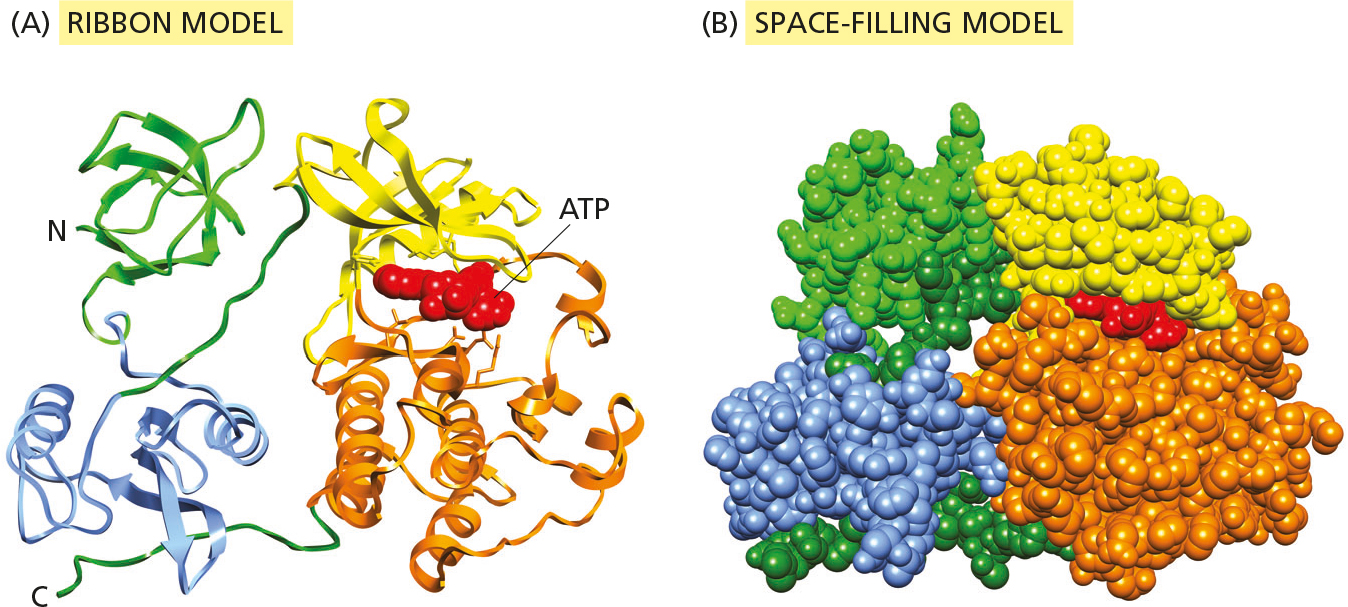
How many protein domains make up the Src protein kinase shown in the figure?
3: Src is made up of three protein domains: an SH2 domain (a single color), an SH3 domain (a single color), and a kinase domain (with two colors).
The relatively unstructured lengths of polypeptide chain that connect domains of protein can act as flexible hinges between domains.
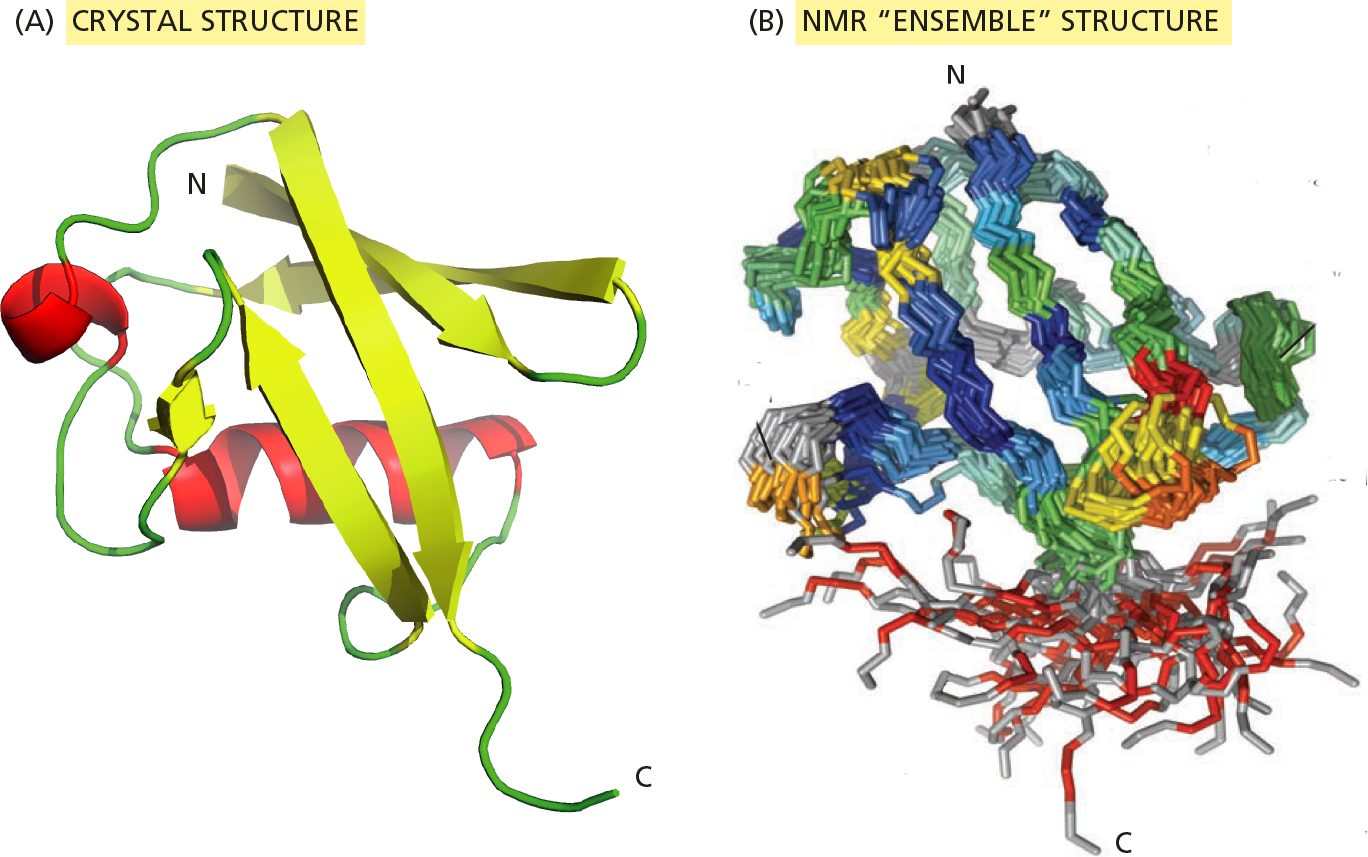
The crystal structure of ubiquitin at 0.18 nm resolution is shown as a ribbon diagram in the figure Part A, colored according to secondary structure. The NMR structure of ubiquitin, with red and yellow indicating high mobility regions of the protein, is shown in Part B.
Is the crystal structure or the NMR structure a more accurate representation of ubiquitin as it exists inside the cell? Why?
The NMR structure, because the atoms in cellular proteins are constantly moving.
A polypeptide chain of any sequence adopts a unique stable conformation that can be useful for the cell.
False: Only a very small fraction of the vast set of conceivable polypeptide chains would adopt a stable three-dimensional conformation—by some estimates, less than one in a billion.
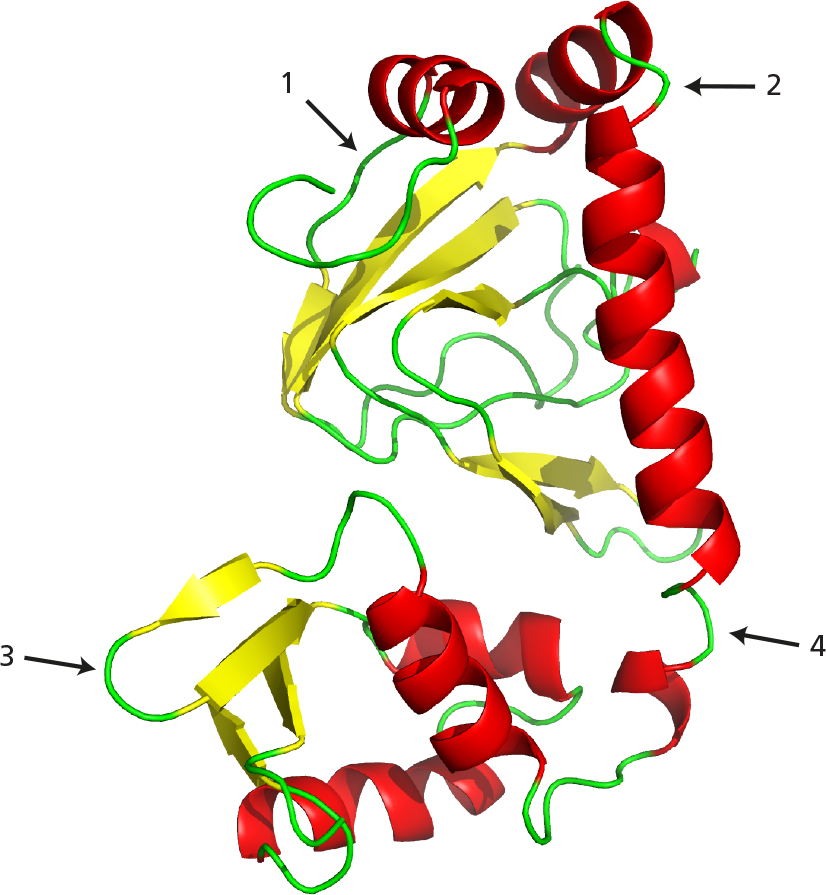
Often, the hard part of protein structure determination by x-ray diffraction is getting good crystals. In difficult cases, there are two common approaches for obtaining crystals: (1) using fragments of the protein and (2) trying homologous proteins from different species.
Examine the protein in the figure. Where would you cleave this protein to obtain fragments that might be expected to fold properly and perhaps form crystals?
Cleavage at point 4 would separate two protein domains that are connected by a single polypeptide chain and fold independently of each other.