Nervous System: Comprehensive Human Anatomy:
 Call Kai
 Learn
Learn Practice Test
 Spaced Repetition
 Match
Match Flashcards
 Knowt Play
1/83

There's no tags or description
Looks like no tags are added yet.
Name | Mastery | Learn | Test | Matching | Spaced | Call with Kai | Chat |
|---|
No analytics yet
Send a link to your students to track their progress
84 Terms
What happens to a muscle that is paralyzed or not used?
It quickly atrophies and changes shape.
What is cardiac muscle necrosis?
It is the death of cardiac muscle tissue due to a sudden block of a coronary artery.
What are the two main parts of the nervous system?
The central nervous system (CNS) and the peripheral nervous system (PNS).
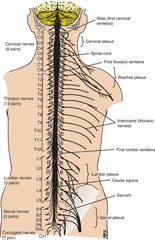
What does the central nervous system consist of?
The brain and spinal cord.
What is the function of the somatic nervous system?
It acts upon the body's external environment through voluntary responses.
What does the autonomic nervous system control?
It controls the body's internal environment through involuntary responses.
What are the two types of processes in a neuron?
Dendrites and axons.

What is the role of dendrites in a neuron?
They conduct nerve impulses toward the cell body.
What is the function of axons in a neuron?
They conduct impulses away from the cell body.
What is gray matter composed of?
Nerve cell bodies embedded in neuroglia.
What does white matter consist of?
Nerve processes (axons) and blood vessels embedded in neuroglia.
What is the shape of gray matter in the spinal cord?
It is organized in a characteristic H-shaped or butterfly-shaped pattern.
What are the three membranes surrounding the CNS?
Dura mater, arachnoid mater, and pia mater.

What is the function of the meninges?
They protect, anchor, and stabilize the CNS and contain cerebrospinal fluid.
What does the peripheral nervous system consist of?
Cranial and spinal nerves and their associated ganglia.
What are cranial nerves?
12 pairs of nerves that branch off the brain and upper spinal cord.
How many pairs of spinal nerves are there?
31 pairs.
What do anterior rootlets and roots consist of?
Bundles of efferent (motor) nerve fibers carrying impulses away from the CNS.
What do posterior rootlets and roots contain?
Bundles of afferent (sensory) nerve fibers that carry impulses to the CNS.
What is the role of the anterior rami of spinal nerves?
They supply muscles and skin over the anterolateral body wall and all muscles and skin of the limbs.
What do posterior rami supply?
They supply the muscles and skin of the back.
What is a ganglion?
A cluster of neuron cell bodies located outside the CNS.
What is the significance of the posterior root ganglion?
It contains the cell bodies of sensory neurons.
What happens if there is a lesion in the anterior roots?
It affects only motor neuron fibers.
What happens if there is a lesion in the anterior rami?
It affects both motor and sensory fibers.
What is the central canal in the CNS?
A canal containing cerebrospinal fluid that runs the internal length of the CNS.
What is the role of neuroglia in the CNS?
They support and protect neurons.
What is the primary function of the nervous system?
To control and integrate the activities of different parts of the body.
What are the two main branches of spinal nerves?
Anterior rami and posterior rami
What is the function of the meningeal branch of spinal nerves?
It supplies the vertebrae and the spinal meninges.
What are rami communicantes associated with?
The sympathetic part of the autonomic nervous system (ANS).
What are the two patterns of distribution for anterior rami?
Simple segmentation and plexuses.
How do intercostal nerves relate to anterior rami?
Each intercostal nerve is an independent structure that retains its identity with the spinal nerve of origin.
What is a nerve plexus?
A network formed by several adjacent anterior rami that intermix their neuron processes.
Name a major nerve formed from the brachial plexus.
The median nerve.
What is the primary function of the autonomic nervous system (ANS)?
Motor control of smooth muscle, cardiac muscle, and glands.
Which part of the brain controls the ANS?
The hypothalamus.
What is the difference between the somatic nervous system and the ANS?
The somatic nervous system has a one-neuron pathway, while the ANS has a two-neuron pathway.

What are the two divisions of the ANS?
Sympathetic division and parasympathetic division.

What does sympathetic activity prepare the body for?
Emergency situations.
What is the effect of parasympathetic activity on heart rate?
It decelerates heart rate.
How do sympathetic and parasympathetic systems function in sexual function?
Parasympathetic activity produces erection, while sympathetic activity results in ejaculation.
Where are the preganglionic neuron cell bodies of the sympathetic division located?
In the lateral gray horn of the spinal cord from T1 to L2.
What is the traditional term for the sympathetic division based on its origin?
Thoracolumbar outflow.
What are the sympathetic trunks?
A series of ganglia linked together in a segmental arrangement along the vertebral column.
How many thoracic chain ganglia typically exist?
11 to 12 thoracic chain ganglia.
What is the ganglion impar?
The single midline coccygeal ganglion at the caudal end of the sympathetic trunks.
What happens at the synapses between pre- and postganglionic neurons in the sympathetic division?
Synapses occur in ganglia related to each pathway.
What is the total distance a motor neuron can extend from the spinal cord to muscle fibers?
About 3 feet (90 cm).
How far can a sensory neuron extend from the skin to the spinal cord?
About 5 feet (1.5 m).
What is the role of the sympathetic division in sweat gland activity?
Sympathetic stimulation activates sweat gland secretion.
What is the effect of sympathetic activity on gut peristalsis?
It decreases peristalsis in the gut tube.
What happens to the pupils during sympathetic activity?
They dilate.
What is the effect of parasympathetic activity on the bladder wall?
It contracts the bladder wall.
What is the primary function of the anterior rami in simple segmentation?
Each anterior ramus wraps around the trunk separately from neighboring rami.
What are the two main divisions of the autonomic nervous system?
Sympathetic division and parasympathetic division.
What is the primary function of the sympathetic division?
To prepare the body for 'fight or flight' responses.
What is the primary function of the parasympathetic division?
To promote 'rest and digest' activities.
Where do preganglionic sympathetic neurons originate?
In the thoracolumbar region (T1 to L2) of the spinal cord.

What is the term for the area of skin supplied by a single spinal nerve?
Dermatome.

What is the craniosacral outflow?
The origin of preganglionic parasympathetic neurons from the brain and sacral spinal cord.
Which cranial nerves contain preganglionic parasympathetic fibers?
CN III (oculomotor), CN VII (facial), CN IX (glossopharyngeal), and CN X (vagus).
What are pelvic splanchnic nerves?
Nerves that carry preganglionic parasympathetic fibers from sacral spinal nerves S2 to S4.
How do postganglionic fibers of the parasympathetic division compare to those of the sympathetic division?
Parasympathetic postganglionic fibers are shorter and nonmyelinated.
What is the role of visceral afferent neurons?
To provide sensory information about the body's internal environment.
What types of receptors are involved in visceral reflexes?
Chemoreceptors, baroreceptors, and osmoreceptors.
What is a common clinical use of understanding dermatomes?
To determine the functioning of sensory components of spinal nerves or spinal cord segments.
What is the segmental innervation of the biceps brachii tendon reflex?
C5 and C6.
What is the segmental innervation of the patellar tendon reflex?
L2 to L4.
What is one way drugs can modify autonomic nervous system activity?
By blocking sympathetic nerve endings to lower blood pressure.
What are the three types of blood vessels?
Arteries, veins, and capillaries.
What is the significance of the overlap in dermatomes?
At least three contiguous spinal nerves must be sectioned to produce complete anesthesia in any one dermatome.
What is the anatomical classification of sacral autonomic fibers?
They are considered part of the sympathetic division.
What is the role of the vagus nerve in the autonomic nervous system?
It carries visceral afferent fibers and preganglionic parasympathetic fibers to the thoracic and abdominal viscera.
What happens during extreme visceral activity?
It may evoke conscious sensations of pain and/or nausea.
What is the clinical significance of reflex testing?
It helps assess the integrity of the nervous system and specific spinal segments.
What is the function of the sympathetic trunk?
To facilitate communication between sympathetic ganglia and spinal nerves.
What is the typical pattern of dermatomes on the trunk?
They form a relatively simple bandlike pattern.
What is the role of the anterior nerve roots in the autonomic nervous system?
They carry preganglionic fibers out of the spinal cord.
How do myelinated visceral afferent fibers travel?
They travel with both sympathetic and parasympathetic nerves without synapsing in ganglia.
What is the clinical application of understanding segmental innervation of muscles?
It aids in diagnosing muscle paralysis and nerve injuries.
What is the relationship between autonomic fibers and blood vessels?
Autonomic fibers regulate blood vessel diameter and blood flow.
What is the significance of the sacral autonomics in the sympathetic division?
They provide a more accurate anatomical classification of autonomic fibers.
What is the effect of sectioning sympathetic innervation to blood vessels?
It can induce vasodilation and improve blood flow through collateral circulation.