6.2. Nuclear medicine - Positron Emission Tomography
 Call Kai
 Learn
Learn Practice Test
 Spaced Repetition
 Match
Match Flashcards
 Knowt Play
1/18

Earn XP
Description and Tags
Name | Mastery | Learn | Test | Matching | Spaced | Call with Kai | Chat |
|---|
No analytics yet
Send a link to your students to track their progress
19 Terms
What is PET scanning?
A diagnostic test in nuclear medicine that uses radioisotopes in the form of radiopharmaceuticals to visualise and measure how tissues and organs function at a cellular level
What is the most common radiopharmaceutical used in PET?
Fluorodeoxyglucose (FDG), used in approximately 90% of scans
What does PET visualise and measure?
How tissues and organs work at the cellular level, changes in metabolic processes, blood flow, regional chemical composition, and absorption
How are signals detected in PET scanning?
Gamma photons are detected due to electron-positron annihilation
What is electron-positron annihilation?
When an electron and its antiparticle (positron) meet and annihilate each other, producing two gamma photons (e- + e+ → γ + γ)
What does FDG stand for?
Fluorodeoxyglucose
What is a positron?
The antiparticle of an electron — same mass, opposite electrical charge, produced naturally in certain types of radioactive decay
How does FDG work in PET scanning?
It is taken up by glucose transporters in cells; areas of high metabolic activity absorb more FDG and appear bright
Why do cancer cells show high FDG uptake?
They multiply rapidly and do not undergo programmed cell death, so they absorb far more FDG
What does low FDG uptake indicate?
Areas of low metabolic activity, often caused by obstruction of blood flow
What cardiac conditions can FDG-PET detect?
Cardiovascular disease, hardening of arteries, and stroke risk prediction
What brain conditions can FDG-PET detect?
Alzheimer's disease, haematomas, epilepsy, and tumours
What lung conditions can FDG-PET detect?
Tumours and infection
What is combination scanning in PET?
Combining PET with CT or MRI to provide both anatomical and metabolic information in precisely matched images
What are the advantages of PET scanning?
Functionality at cellular level due to metabolic changes, can compare between different metabolic states such as rest vs stress (heart), 3D images produced, painless, considered non-invasive
What are the disadvantages of PET scanning?
Misalignment of images, false negatives possible (low FDG in low-volume or low-metabolic-rate tumours), and risk of misdiagnosis of metabolic changes
Which of the following is an advantage of PET as an imaging modality:
A comparison is possible between different metabolic states
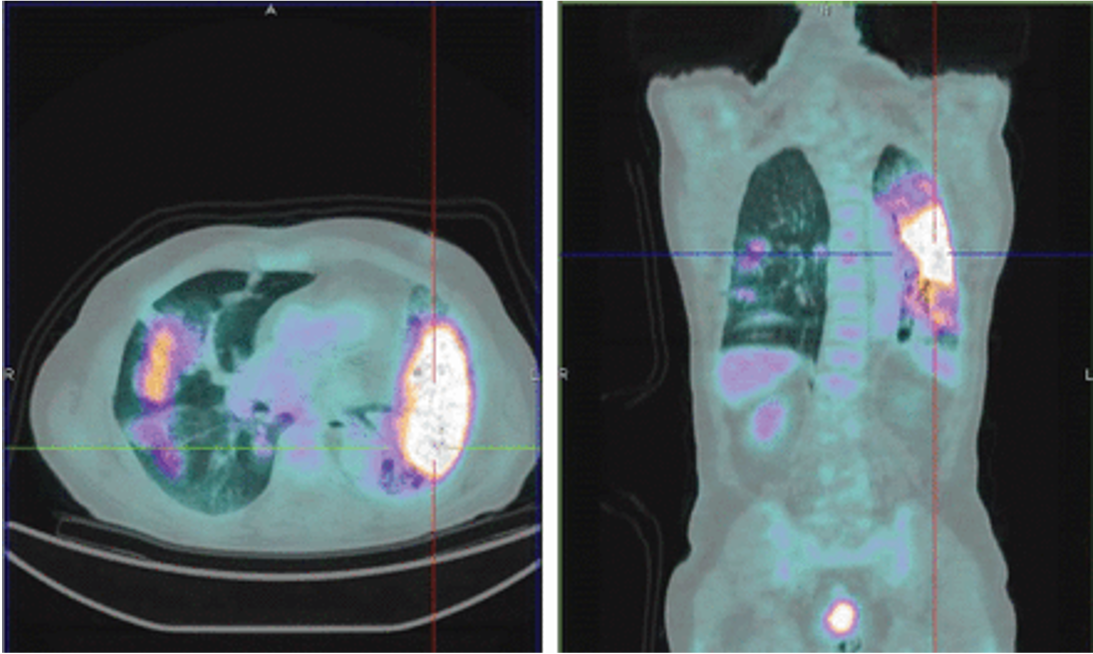
The following PET image is indicative of:
A diffuse infection
Is this the CORRECT equation for electron-positron annihilation?
2e⁻ + e⁺ → γ + γ
False, e⁻ + e⁺ → γ + γ