Population Ecology Flashcards (Currier/Morano/Chi)
 Call Kai
 Learn
Learn Practice Test
 Spaced Repetition
 Match
Match Flashcards
1/29

There's no tags or description
Looks like no tags are added yet.
Name | Mastery | Learn | Test | Matching | Spaced | Call with Kai | Chat |
|---|

30 Terms
Biotic factors
Parts of an ecosystem that are living or used to be living
Abiotic factors
Parts of an ecosystem that have never been living
Habitat
The specific environment in which an organism lives
Population
a group of individuals that interbreed and produce fertile offspring
Population
members of a species that live in the same area
Niche
An organism's role in its environment.
Ecosystem
Community
all the populations in a particular area
Population Size
The number of individuals in a population at a given time
Population Density
the number of individuals within a population per unit area
Population Distribution
How organisms are arranged within an area
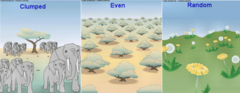
random distribution
Organisms arranged in no particular pattern
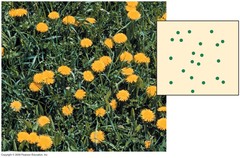
Uniform distribution
Organisms evenly spaced

Clumped distribution
Organisms grouped near resources; most common distribution in nature

Age Structure
Relative number of organisms of each age group within population

Sex Ratios
Proportion of males to females
Survivorship Curves
A population's relative birth and death rates (mortality and natality) affect how it grows.

r selected populations
live in unstable environments, have a short lifespan, have many offspring, are small, and provide little to no parental care
k selected populations
live in stable environments, have a long lifespan, have few offspring, are larger, and provide long parental care
Migration
seasonal movement into and out of an area, can temporarily affect population size
Immigration
occurs when an outside population enters an existing population
emigration
occurs when part of a population leaves
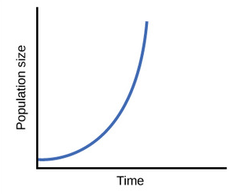
exponential growth
occurs when a population increases by a fixed percentage every year
logistical growth
occurs when growth almost always slows and stops due to limiting factors.
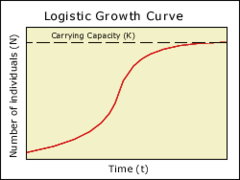
carrying capacity
the largest population size that an environment can sustainably support
species
a group of individuals that interbreed and produce fertile offspring
ecosystem
all the living things and their physical environments within a particular area
limiting factor
characteristic of the environment that restricts population growth
density dependent factors
biological variables whose effects on a population's growth or size change depending on how crowded the population is (i.e., competition and disease)
density independent factors
environmental forces that change the size of a population regardless of how crowded or dense that population is (i.e., pollution, weather, natural disasters like wildfires)