Measures of Frequency, Association, and Effect
 Call Kai
 Learn
Learn Practice Test
 Spaced Repetition
 Match
Match Flashcards
 Knowt Play
1/73

There's no tags or description
Looks like no tags are added yet.
Name | Mastery | Learn | Test | Matching | Spaced | Call with Kai | Chat |
|---|
No analytics yet
Send a link to your students to track their progress
74 Terms
Ratio
_________ is a relationship between two numbers
Proportion
___________ : A ratio where the numerator is included in the denominator, it's prevalence.
Rate
A _______ is a proportion with the specification of time
Proportions
rates
____________ tell us what fraction of a population is affected, while _______ tell us how fast a disease (or other condition) is occurring in a population
Prevalence
_____________ is the number of instances of disease (or other condition) in a known population, at a designated point in time
proportion
0, 100
The prevalence is a __________ and it can take on any value between ____ and ____
Prev. = (# of animals that have a disease at a particular point in time)/(total # of animals in the population at that point in time)
*What is the equation for prevalence?
Point
_________ prevalence measures the frequency of all current events (old and new) at a given instant in time
50% = 50/100
You go out to a farm today and find that 50 of the 100 have mastitis at your visit, what is the point prevalence of cows with mastitis on that farm?
Period
__________ prevalence measures the frequency of all current events (old and new) for a prescribed period of time
75% = (25 + 50)/100
You visit a farm over the course of a week. You find that 25 cows have mastitis on Monday and then you come back on Friday to find 50 more have mastitis. There are 100 cows on the farm. What is the period prevalence of cows with mastitis from Monday to Friday?
(5/20) = 25%
Daisy Dairy has 20 cows. On 1/22/20, you are called out to evaluate all 20 cows for mastitis. Your examination indicates that 5 cows have mastitis. What is the prevalence of cows with mastitis on Daisy Dairy on 1/22/20?
Incidence
__________ is the proportion of new cases that occur in a population over a specified period of time
1. The number of new cases
2. The period of time over which the new cases occur
3. The number of animals at the beginning of that period
What are the three essential components of incidence?
incidence risk
____________ _______ is the proportion of at risk (e.g., nondiseased animals) at the beginning of the period of study that become diseased during the period
Incidence risk = (# of animals that become diseased during a particular period of time)/(# of healthy animals in that population at the beginning of that period)
*What is the equation for incidence risk?/How would you calculate it?
10/20 = 50% is the incidence risk during 2019
Of the 20 (mastitis free) cows on the Daisy Dairy at the start of 2019, 10 cows develop mastitis over the course of the year.
What is the cumulative incidence of cows developing mastitis during 2019 on the Daisy Dairy?
the denominator should be adjusted by subtracting half the value of the number removed
How should you adjust your calculation of incidence risk if animals are removed due to reasons not related to the disease of interest (e.g., die or sold) during the observation period?
Incidence Risk = (# of animals that become diseased during a particular period of time) / ((# of healthy animals in the population at the beginning of that period) - (0.5* # of withdrawn animals))
How would you calculate incidence risk if during the period of observation, animals are removed due to reasons unrelated to the disease of interest?
Incidence risk = 10/(20-(.5*2)) = 10/19 = 0.53 --> 53%
Of the 20 (mastitis free) cows on the Daisy Dairy at the start of 2019, 10 cows develop mastitis over the course of the year
If during 2019, one cow died and one was sold, what would the incidence risk of mastitis be then?
incidence rate
The _____________ _______ measures the rapidity with which new cases occur over time
numerator: Number of new cases of disease that occur in a population during a particular period of time
denominator: the sum, over all individuals, of the length of time at risk of developing disease
*When calculating incidence rate, what is our numerator and what is our denominator?
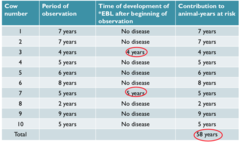
total # of cases: 2
length of time at risk: 58 years
2/58 = 2 per 58 animal-years at risk
Using the chart attached. What is the incidence rate of cows developing EBL?
nope, it is presented as a number of cases per number of animals observed for a given period of time - e.g. 8.1 new cases if observing 1,000 calves for a year
How is incidence rate reported? is it a percent, like with incidence risk or prevalence?
◦ If the disease is of short duration, and subsequent recovery (or immunity) is brief, affected individuals can continue to be included in the population at risk, without interruption
◦ Alternatively, recovery periods can be defined, in which circumstance animals re-enter the population at risk after expiry of the periods
If the incidence rate has been estimated from one time period, it can be extrapolated to other periods assuming that the rate is constant
What if we are looking at a disease with recurrence during the study time period? How do we factor those cases into calculation of incidence rate?
Disease or condition (illness) present
What is Morbidity?
Death
What is Mortality?
Death due to a specific disease or event in a population
What is Case Fatality?
incidence risk
Morbidity, mortality, and case fatality are most commonly reported as an ____________ _______ (proportion)
prevalence
In addition to incidence risk, morbidity can be measured as a __________
Mortality risk = (# of animals that die due to a particular disease during a particular period of time)/(# of animals in the population at the beginning of that period)
*How would you calculate mortality risk?
Case Fatality Risk = (# of animals that die due a specific disease during a particular period of time)/(# of animals in the population that have the disease during the period)
*How would you calculate case fatality risk?
it is used to assess the magnitude of the relationship between an exposure and an outcome
What are measures of Association used to assess?
(the incidence risk of the event occurring in the exposed group)/(the incidence risk of the event occurring in the nonexposed group)
*How do you calculate risk ratio?
prospective cohort studies and clinical trials
What type of studies should a risk ratio be applied to?
risk ratio!
What measure of association should be used in a cohort study or clinical trial (risk or odds ratio)?
need to somehow be able to detect new cases or whatever condition it is you are onserving
Knowing that incidence risk is used to calculate risk ratio, what does this mean you need to be able to detect in order to calculate a risk ratio?
(10/(10+90))/(5/(5+95)) = 2.0
Cows that were not pre-dipped were twice as likely to develop mastitis as compared to cows that were pre-dipped
The incidence risk of contracting mastitis in a group of cattle where pre-dipping was not used was 10 cases in 100 cows during 2019 (exposed group)
The incidence risk of contracting mastitis in a group of cattle where pre-dipping was used was 5 cases in 100 cows during 2019 (non-exposed group)
What is the risk ratio? What is your interpretation?
cross multiply (the odds of the event occurring in the exposed group(a/b))*(the odds of the event occurring in the non-exposed group(c/d))
= (a * d)/(b * c)
*How do you calculate an odds ratio?
it means that exposure is positively associated with the disease
An odds ratio that is greater than 1 indicates what about the relationship between exposure and disease?
exposure is protective of disease
An odds ratio that is less than 1 indicates what about the relationship between exposure and disease?
exposure has no effect on disease
An odds ratio that is equal to 1 indicates what about the relationship between exposure and disease?
rarer
Odds ratio and risk ratios become more similar in numerical value, the ________ a condition of interest is.
(5 * 98)/(2*95) = 2.6
Cows that were not pre-dipped had 2.6 times the odds of developing mastitis compared to cows that were pre-dipped
The odds of contracting mastitis in a group of cattle where pre-dipping was not used was 5 cases in 100 cows during 2019 (exposed group)
The odds of contracting mastitis in a group of cattle where pre-dipping was used was 2 cases in 100 cows during 2019 (nonexposed group)
What is the odds ratio and what is your interpretation?
in prospective studies (e.g., cohort studies and clinical trials)
What type of studies are risk ratios appropriate to calculate?
Odds ratios can be calculated for retrospective, crosssectional, and prospective studies
◦ It is the only appropriate measure for cross-sectional and case-control studies
◦ It can also be calculated for prospective studies, but in prospective studies the risk ratio is preferable
What type of studies are odd ratios appropriate to calculate?
odds ratio
What measure of association should you use for a cross-sectional or case-control study?
it should be accompanied by a p-value or a confidence interval
How can you assess the significance of a risk ratio or odds ratio?
it gives the statistical significance - or how likely it is that our results will be due purely to chance
What does a p-value provide us with?
p < 0.05
What is the typical p-value, wherein less than this number is used to determine statistical significance?
significant
If the confidence interval calculated for a risk ratio does not include 1, then the risk ratio is ________________ (significant/not significant)
not significant
If the confidence interval calculated for a risk ratio includes 1, then the risk ratio is ________________ (significant/not significant).
absolute risk difference
The difference in the incidence of disease in exposed animals and the incidence of disease in unexposed animals is known as the ___________________________ in the exposed animals.
excess
Absolute risk is a measure of "________" risk attributed by exposure. The exposure in question is rarely responsible for all outcomes (i.e., there is some "background risk")
significant
If the confidence interval calculated for the absolute risk difference does not include 0, then the AR is _____________ (significant/not significant)
not significant
If the confidence interval calculated for the absolute risk difference includes 0, then the AR is _____________ (significant/not significant)
attributable fraction (AF)
The proportion of the disease burden among exposed animals that is caused by the exposure is known as the _____________________
Population Absolute Risk Difference (PAR)
Population Attributable Fraction (PAF)
Absolute risk difference (AR) & Attributable fraction (AF) can be exrapolated to a population to become _________________________ & _____________________, respectively.
magnitude
The AR includes the baseline incidence and hence gives an indication of the ____________ of the effect of a causal factor in the population
Attributable Fraction (AF)
_____________ __________ is the proportion of the disease burden among exposed animals that is caused by the exposure
it assumes that the exposure is positively associated with disease
The calculation for Attributable fraction assumes what about the exposure and disease?
PAR (Population Absolute Risk Difference)
The focus of _______ is the increase in risk in the entire population that is due to the exposure
that 50% of the outcomes in the exposed group is attributable to the exposure
If the Attributable fraction is 50%, what is the interpretation?
in absolute risk difference: we evaluate the excess risk for a group of exposed populations
whereas, in population absolute risk difference: we evaluate the excess risk for the entire population
What's the difference between population absolute risk difference and absolute risk difference?
there is an excess risk of 2.5% due to the exposure in the entire population Or, for every 100 animals in the population, 2.5 developed the disease due to the exposure
The population absolute risk difference (PAR) is 2.5% - what is the interpretation?
PAF (Population Attributable Fraction)
Assuming a causal relationship, _________ indicates the proportion of disease in the whole population that is attributed to the exposure, and would be avoided if the exposure was removed from the population
PAF focused on the disease in the entire population rather than the exposed group
How is Population Attributable Fraction different from attributable fraction?
33% of disease in the population is attributed to the exposure
Or, 33% of disease in the population could be prevented if the exposure was removed
The Population Attributable Fraction is 33% what is the interpretation?
Excess risk due to the exposure in the exposed group
What is Absolute Risk Difference?
Excess risk due to the exposure in the entire population
What is Population AR (PAR)?
Proportion of cases in the exposed group that are due to the exposure
What is Attributable Fraction (AF)?
Proportion of cases in the entire population that are due to the exposure
What is Population Attributable Fraction (PAF)?
It is the number of animals needed to be treated (vaccinated) to prevent one case
What is number needed to treat?
It is the number of animals needed to be exposed to cause harm in one animal
What is number needed to harm?