Endocrine and Circulatory Systems Overview
 Call Kai
 Learn
Learn Practice Test
 Spaced Repetition
 Match
Match Flashcards
 Knowt Play
1/68

Earn XP
Description and Tags
A collection of vocabulary flashcards covering key concepts from the endocrine, circulatory, and lymphatic systems.
Name | Mastery | Learn | Test | Matching | Spaced | Call with Kai |
|---|
No analytics yet
Send a link to your students to track their progress
69 Terms
Hormones
Chemical messengers secreted into the blood to reach specific target cells.
Target Cells
Specific cells that possess receptors for a particular hormone.
Hypothalamus
The brain region that coordinates all activity of the pituitary gland.
Anterior Pituitary
A true endocrine gland that secretes 7 hormones (TSH, hGH, ACTH, FSH, LH, PRL, MSH).
Posterior Pituitary
An extension of the central nervous system that secretes ADH and Oxytocin.
Antidiuretic Hormone (ADH)
Hormone from the posterior pituitary that decreases urine output.
Oxytocin
Hormone that assists in labor, delivery, and reproductive processes.
Thyroid Gland
Located on the anterior trachea; requires Iodine to produce Thyroxine to increase metabolism.
Goiter
A physical enlargement of the thyroid gland often resulting from iodine deficiency or dysfunction.
Parathyroid Hormone (PTH)
Monitors and regulates calcium levels in the blood.
Thymus
Plays a major role in the immune response from childhood until puberty.
Adrenal Cortex
The outer layer of the adrenal gland that secretes vital steroid hormones.
Adrenal Medulla
The inner layer of the adrenal gland that secretes Epinephrine and Norepinephrine.
Pancreatic Alpha Cells
Produce glucagon to increase blood glucose levels.
Pancreatic Beta Cells
Produce insulin to lower blood glucose levels.
Androgens
Male reproductive hormones (like testosterone) produced in the testes.
Estrogens
Female reproductive hormones produced in the ovaries for oocyte maturation.
Pineal Gland
Produces melatonin to regulate sleep/wake cycles.
Hematocrit
The percentage of whole blood volume made up of formed elements (mostly RBCs).
Hemoglobin
The molecule within RBCs that bonds to oxygen and CO2.
Rouleau
A single-file stack of red blood cells that allows passage through small capillaries.
Neutrophils
The most common white blood cell and usually the first to arrive at an injury site.
Monocytes
Leukocytes that function as free macrophages.
Platelets
Cell fragments shed from megakaryocytes used for blood clotting.
Chemotaxis
The process where WBCs are attracted to a specific chemical stimulus at an injury site.
Red Bone Marrow
The primary location for blood cell formation.
Sickle Cell Disease
A condition where RBCs become misshapen, hindering oxygen transport.
Hemophilia
A disorder where the blood does not clot normally.
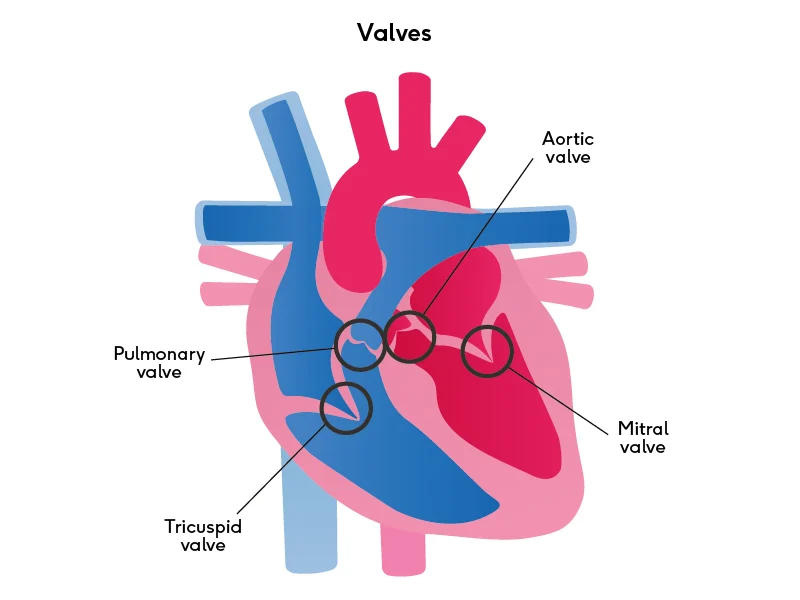
flow of blood through heart
Right Atrium: Deoxygenated blood returns from the body via the superior and inferior vena cava into the right atrium.
Right Ventricle: Blood passes through the tricuspid valve into the right ventricle.
Pulmonary Artery: The right ventricle pumps blood through the pulmonary valve into the pulmonary artery, which carries it to the lungs.
Lungs: In the lungs, the blood releases carbon dioxide and picks up oxygen.
Left Atrium: Oxygen-rich blood returns from the lungs to the left atrium through the pulmonary veins.
Left Ventricle: Blood passes through the mitral valve into the left ventricle.
Aorta: The left ventricle pumps blood through the aortic valve into the aorta, the main artery that distributes oxygenated blood to the rest of the body.
Four chambers of the heart
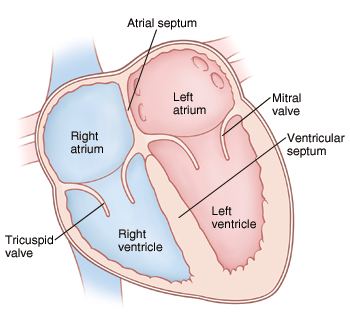
heart valves
Arteries
Blood vessels that pump blood away from the heart.
Veins
Blood vessels that bring blood back toward the heart.
Capillaries
The smallest vessels and the primary site for gas exchange.
Pericardial Fluid
Fluid within the pericardial cavity that reduces friction as the heart beats.
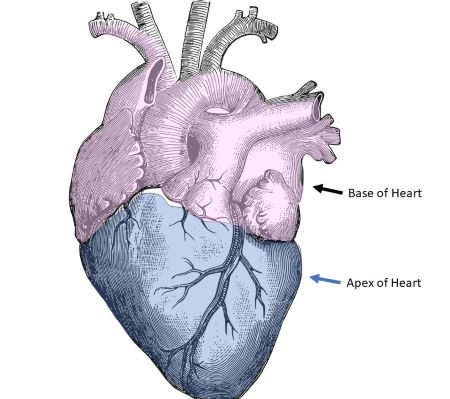
Base of the Heart
The superior portion of the heart.
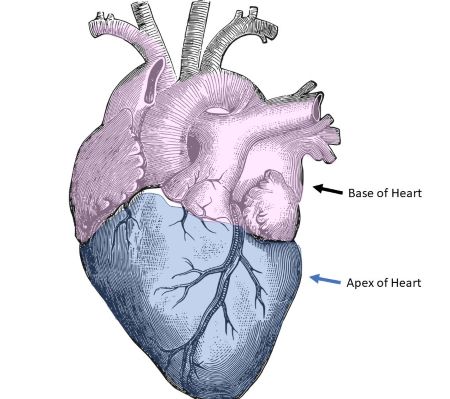
Apex of the Heart
The inferior, lateral pointed tip of the heart.
Nodal Cells
Specialized cells that allow cardiac muscle to contract without nervous system input.
Intercalated Discs
Structures that allow the heart to be stimulated and contract as a single unit.
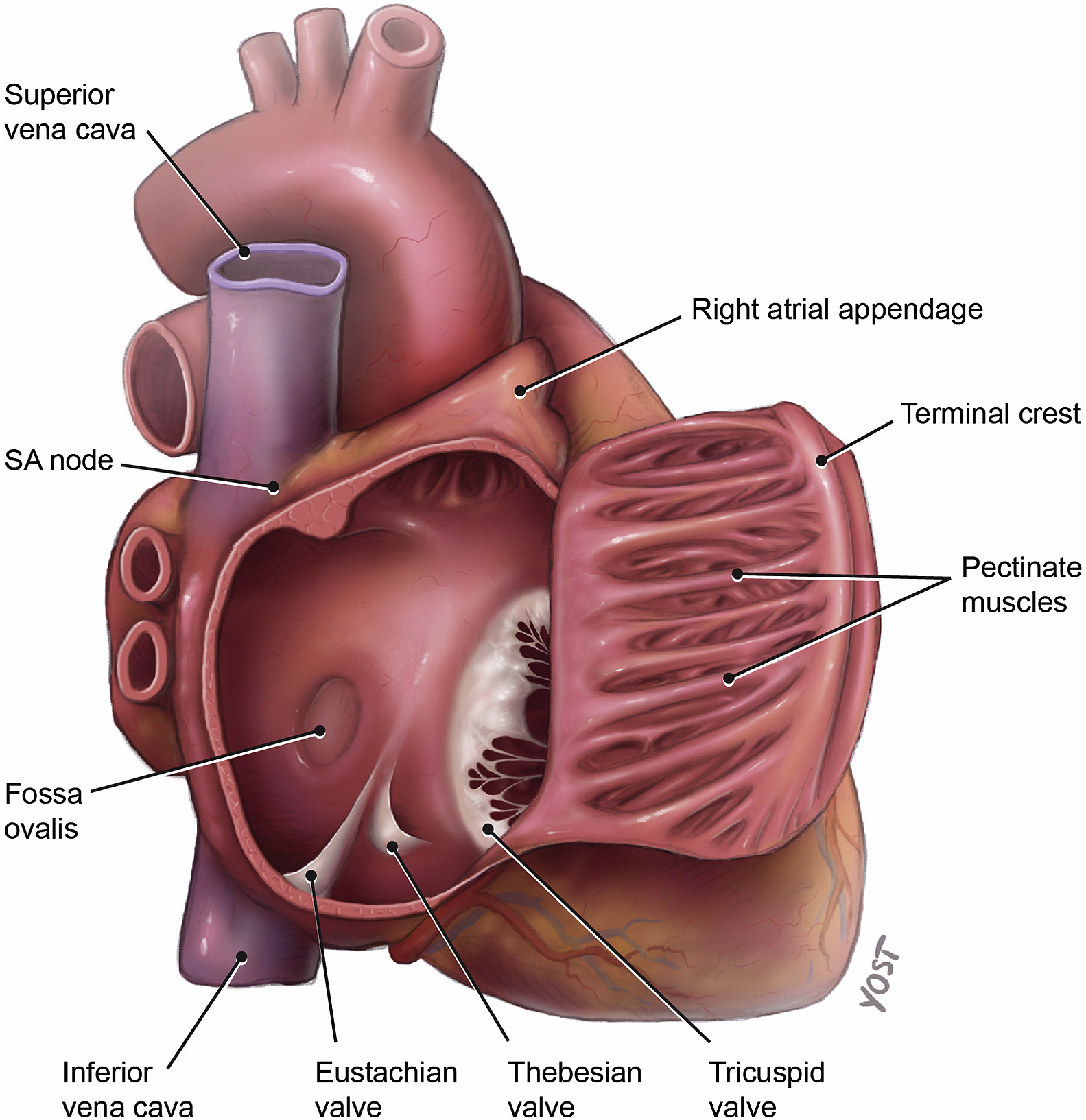
Fossa Ovalis
A depression in the right atrium; a remnant of the fetal foramen ovale.
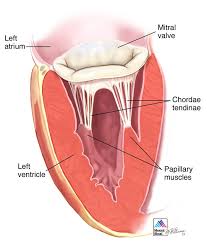
Chordae Tendineae
"Heart strings" that anchor the valves to papillary muscles.
Coronary Sinus
The vessel where major cardiac veins drain before entering the right atrium.
Systole
The contraction phase of the cardiac cycle.
Diastole
The relaxation phase of the cardiac cycle.
Bradycardia
A slow heart rate, typically below 60 bpm.
Tachycardia
A fast heart rate, typically above 100 bpm.
SA Node
The primary pacemaker of the heart's conduction pathway.
Tunica Media
The middle layer of a blood vessel wall containing smooth muscle.
Vasa Vasorum
Small vessels that supply blood to the walls of large arteries and veins.
Fenestrated Capillaries
Capillaries with pores that allow for the diffusion of large molecules and proteins.
Venous System
Acts as a blood reservoir, holding the majority of the body's blood at any given time.
Aortic Arch Branches
The Brachiocephalic, Left Common Carotid, and Left Subclavian arteries.
Carotid Sinus
An important structure for monitoring blood pressure and chemistry.
Circle of Willis
A network of arteries providing extensive blood supply to the brain.
Hepatic Portal System
A venous network that carries nutrient-rich blood from digestive organs to the liver.
Umbilical Vein
Carries oxygenated blood from the placenta to the fetus.
Umbilical Arteries
Carry deoxygenated blood from the fetus to the placenta.
Foramen Ovale
A fetal heart opening that allows blood to bypass the lungs.
Subclavian Veins
The location where lymph fluid drains back into the venous system.
Lymphedema
Swelling caused by a blockage or problem within the lymphatic vessels.
Thoracic Duct
The main duct collecting lymph from the left side of the head, chest, and the entire lower body.
T Cells
Lymphocytes responsible for cell-mediated immunity.
B Cells
Lymphocytes that produce antibodies.
Natural Killer (NK) Cells
Lymphocytes that provide innate immune surveillance.
Lymphocytopoiesis
The production of lymphocytes.
Afferent Vessels
Lymphatic vessels that bring lymph into a lymph node.
Efferent Vessels
Lymphatic vessels that carry filtered lymph out of a lymph node.
Hilum
The region of an organ where arteries, veins, and lymphatic vessels enter or exit.
Spleen
Filters blood, removes damaged RBCs, and can initiate T and B cell responses.

