PSYC 321 - Research Methods
 Call Kai
 Learn
Learn Practice Test
 Spaced Repetition
 Match
Match Flashcards
 Knowt Play
1/62

There's no tags or description
Looks like no tags are added yet.
Name | Mastery | Learn | Test | Matching | Spaced | Call with Kai | Chat |
|---|
No analytics yet
Send a link to your students to track their progress
63 Terms
3 goals of science
description of reality
prediction of reality
explanation of reality
inductive vs deductive research
Inductive research
Starts with data and ends with theory
Deductive research
Form a theory and ends with data ( due to testing the theory )
common sense findings aren’t always that obvious
true
the emprical research cycle / the scientific method
Notice that sometimes drawing a conclusion means restarting and modifying the problem statement

why do we only have meso-level theories?
we dont have a law that can be applied to every single person in the world
theory
A statement that proposes to explain relationships among phenomena of interest.
what is parsimony ????
???
properties of a good theory
Parsimony
Precision
Testability/ falsifiability
Usefulness ( nothing as practical as a good theory )
Generalizability
basic research vs applied research
basic research might look at biology, chemistry, anxiety chemicals it is more theoretical and to derive principles
applied research might look at conversations, actions it is more practical and solves a practical problem
they should inform each other
is socio-psychology is core to psychology?
true
Levels of analysis in IO
organizaiton level (organisation climate, like uni policies and infrastructure)
group level ( team cohesion, deparment culture in a toxic manager)
individual level ( how they behave towards family, employees, supervisors )
the consequence of “the whole is greater than the sum of its parts”
though we study the individual level because most problems are top-down… we need to look at the other levels
when to use qualitative vs quantitiatve research?
qualititative research:
dont know a lot about topic
quantitiative research:
you have a theory you want to test and how to operationalize it
what are primary research methods?
A class of research methods that generates new information on a particular research question.
3 PRIMARY RESEARHCH DESIGNS used in IO Psych
True experiment, quasi-experiment, non-experiment/survey
true experiment
what?
randomized assignment to groups…
highly controlled variables
Can exist outside the lab in natural settings
generalizability ?
VERY questionablke gneralizability
importance?
THE BEST FOR ESTABLISHING CAUSALITY
if you have true randomization in a true experiment you have all the control you need
TRUE
a survey can be used in a true experiment
TRUE
quasi-experiments
what?
lack of randomization ( ex: gender-based assignment)
limited control ( ex: can’t control the independent variable )
generalizability ?
higher generalizaibility
causal inferences
Aka A causes B
non-experiment/ survey design
what ?
A type of research method for conducting studies that does not involve the manipulation of variables or assignment of participants.
instead data is just collected ( ex: randomly assigned surveys, observations )
generalizability ?
higher generalizability to real-life
The lack of randomization or control can be accounted for statistically
csecondary research design
what?
A class of research methods that examines existing information from research studies that used primary methods
types?
archival research
meta-anlysis
data minig
con?
less control
garbage in and garvae out
data mining
defined by volume, velocity, and variety
CON: generalizability - how much is noise
data mining / big data is defined by 3 things
1. Volume — there are a lot of cases and many variables per case.
2. Velocity — data collection occurs at a rapid and continuously increasing pace.
3. Variety — data come in many forms, both inside and outside of an organiza-tion by both active and passive means.
how does big data restrain the types of data you can use ?
usually only cintains binary data like purchases/not-purchased
affinity index relation to big data
statistic that is based on the probability of two (or more) items being paired together.
helps to establish relationship between severa variables
meta analysis
when 20 studies say one thing and 10 say another, how are we to determine what is the truth?
M-A is a statistical procedure designed to combine the results of many indi-vidual, independently-conducted empirical studies into a single result or outcome.
Need to adjust for variations within set up and samel sizes and level of analysis
how does the fie file drawer effect, effect meta-analysis ?
Research studies that yield negative or non-supportive results are not published as often as studies that have sup-portive findings, and therefore are not made widely available to other researchers.
this means that M-A might not have access to relevant studies
Is IO a quantitative heavy field ?
YES
what is qualitative research and the 2 types of .qualitative research in IO
A class of research methods that involves collecting and analyzing data that are non-numerical in nature.
2 types:
thematic analysis
ethnogrpahy
thematic analysis
idenitfying patterns within the data (ex: themes in their written responses)
gather examples that fit within that patterns
ethnography
Scientific study of a group of culture
NOT particularly identifying set patterns but rather just describe
emic perspective vs etic perspective in ethnography
they take thehe insider’s view is called the emic perspective ehen researching , whereas they take the external view which is the etic perspective when generating conclusions .
steps in thematic analyysis
Familiarization with data
Systematic encoding data
Generate themes
Check if any themese are missing
Polish theme definitions
Produce a report
what are constructs ?
Psychological entities or concepts of interests
ex: happiness
what is conceptual criteria and actual criteria ?
conceptual criteria - is the construct in question
actual criteria - is the operational definition
what is an operational definition?
Defining constructs in a way that is observable
ex: frequency of smiles within 2 hours of the movie
criterion deficiency and how do we account for this ?
Degree to which actual criteria fails to overlap conceptual criteria
We can reduce but not eliminate the criterion deficiency
this appears because we’re not capturing an aspect of the actual concept
we can control this using statistical analysis

criterion relevance
Degree to which actual criteria and conceptual criteria coincide

criterion contamination and how do we handle it ?
things that we’re capturing that are not a part of the concept is called criterion contamination
we can account for this using statistical analysis
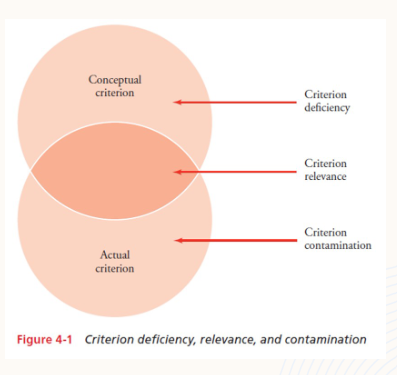
criterian contaminations can be caused by 2 things distorting the conceptual criteria
Bias – extent actual criteria consistently measures something
Error – extent to which actual criteria is related to nothing at all
reliability in measurements
is the test producing stable and consistent results ( ex: a clock that is always 3 minutes off )
validity measurments
how well a judgement accurately measures a concept ( ex: a clock that is correct down to the miliseconds )
can something be reliable and not valid
TRUE
can something be valid but unreliable
FALSE
4 threats to internal validity
History effect
Maturation effect
Selection effect
Attrition effect
history effect
historical event that has nothing to do what you’re trying ot measure but is eeffecting things ( ex: how much you hate math effecting your math scre )
maturation effect
???
selection effect
selection bias… bias in people opting into something ( ex: motivated people will sign up to trial your new study method trial )
there are probably some factors that differenitate uninterested people from the people who opt in, are they relevant factors idk
attrition effect
bias in people opting out of something ( ex: 10y study… people wll drop out )
there are probably some factors that differenitate those people from the people who stayare they relevant factors idk
sources of data
• Organizational record
• Questionnaire ( self-reports.. risk people lying and a small incentive is all you need )
• Observations ( to prevent people acting unnatural you need them to trust you )
• Interview/ Focus group (more group discussion-oriented)
correlation coefficent
refers to the mangitude of relationship between 2 variables
ranges from -1 to 1
the higher the absolute value the stronger the relaitonship
what does a negative correlation mean ?
as one variable goes up, the other goes down
what does a positive correlation mean ?
as one variables goes up, the other vairable goes up
3 criteria for causality
covariance
when x is moving then y is also moving
time order of events
x needs to move first and then y moves
lack of alternative
no other secondary variable z, can be behind this
correlation is not equal to causation
Difficult to infer from non-experimental method
does one study prove anything in science?
FALSE. It takes several years of study. Research is an iterative process.
2 most important factors in the design of a research study
Naturalness of the research setting
We want a "high fidelity" research setting
the greater the realism of the research setting, the more generalizable the results.
Fidelity: how close a setting is to reality
Degree of control
Having control over how the study goes… but researchers are not God
An example of a study with a low degree of control: asking for participants that speak 2 rare languages…
internal validity
The degree to which the relationships evidenced among variables in a particular research study are accurate or true.
this type of validity depends largely on the study's procedures and how rigorously it is performed.
external validity
The degree to which the relationships evidenced among variables in a particular research study are generalizable to real-life application.
another word for generalizability
external validity
predictor vs criterion variable s
predictor variables predict criterion variables
they don’t have a causal relationship! Just a predicitve one.
ex: , gpa predicting academic performance,
Correlation coefficient vs spread of data points on a scattter plot
The tighter the spread the stronger the relationship
how often do we establish causality
Rarely. We focus on correlation. We cannot give proven to be effective strategies.