Lecture 5: How pollutants exert their toxicity
 Call Kai
 Learn
Learn Practice Test
 Spaced Repetition
 Match
Match Flashcards
 Knowt Play
1/40

There's no tags or description
Looks like no tags are added yet.
Name | Mastery | Learn | Test | Matching | Spaced | Call with Kai | Chat |
|---|
No analytics yet
Send a link to your students to track their progress
41 Terms
Toxicology (background)
Paracelsus established the role of chemistry in medicine and is responsible for two founding concepts:
A toxic agent is a chemical entity
The distinction between beneficial and harmful properties of chemical is to the magnitude of exposure/dose
Toxicology
Toxicology is the study of adverse effects of chemicals on biological systems
*biological systems span from individual cells to whole ecosystem
Environmental toxicology
Environmental toxicology is the multidisciplinary study of the impacts of chemicals on human health and the environment.
Important considerations of environmental toxicology
What is the source of the chemical to that environment?
How are organisms exposed?
How can the chemical effect cells – organisms – populations – ecosystems?
What are the risks, and how can they be mitigated?
One Health
An emerging concept which encompasses Environmental Toxicology – considers human and environmental health together for good management practice (everything is interconnected, so it should be treated as such)
Types of toxic effects
Some effects are harmful, whereas others are not (e.g. medicine delivered at a therapeutic dose produces a desired effect). Types of toxic effects:
Allergic reactions
Idiosyncratic reactions
Immediate v. delayed toxicity
Reversible v. irreversible toxic effects
Local v. systemic toxicity
Allergic reactions
An adverse reaction of the immune system to a chemical in response to a previous exposure to that chemical or to a structurally similar one
Idiosyncratic reactions
Abnormal reactivity of an individual to a chemical based on its genetics or other individual sensitivity factors (e.g. lactose intolerance)
Immediate v. delayed toxicity
Toxic effects can develop rapidly after a single exposure (e.g., pesticides cause immediate death of insects) or may be delayed (e.g., carcinogens can cause tumours decades after exposure)
Reversible v. irreversible toxic effects
Some tissues are able to repair themselves (e.g., liver and gastrointestinal injuries have high ability to regenerate). Other tissues such as CNS are unable to regenerate after damage. Cancers and birth defects cause by chemical exposure are considered irreversible toxic effects
Local v. systemic toxicity
Local effects occur where contact is first made by the chemical and biological system (e.g., a rash occurring on dermal contact). Systemic effects require the absorption and distribution of a chemical from its entry point to a distant site where the toxic effect takes place
Guidelines for toxicity testing
Toxicity testing involves exposing an organism or groups of organisms, to varying doses of chemicals to see what happens
How is toxicity measured?
Dose–response relationships are the association between the amount of a chemical a biological system is exposed to, and the extent to which an effect is observed
Dose is expressed as mass or concentration (unit of measurement relative to exposure route)
dermal = per surface area of skin expose (e.g. mg/cm2)
inhaled = per volume air breathed (e.g. ng/L, mg/L)
ingestion = per L water (e.g. ng/L, mg/L) per mass food (g.g. mg/kg, μg/g) per kg of body weight (e.g. mg/kg, μg/g)
Dose-response curve
Characterised by a continuous scale of doses that lead to an increase in the magnitude of a specific response. Common effect includes enzyme inhibition, change in behaviour, feeding inhibition, growth inhibition, death and reproductive inhibition. There are two types of dose-response relationships:
Graded response (for individuals)
Quantal response (for populations)
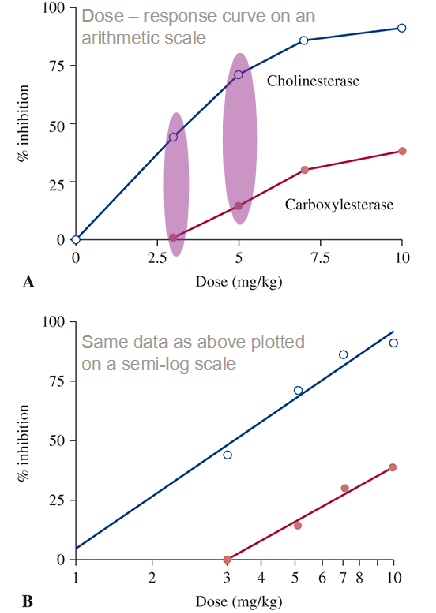
Example of a graded dose-response relationship
The dose-response relationship between different doses of the organophosphate insecticide chlorpyrifos and esterase enzyme inhibition. Testing the effect on chlorpyrifos on the inhibition of:
Cholinesterase in the brain (blue)
Carboxylesterase in the liver (red)
Degree of inhibition is dose-related, but the degree of inhibition per unit of concentration is different between enzymes.
At a dose of 3 mg/kg chlorpyrifos:
brain cholinesterase will be inhibited by ~50%
there is no effect on liver carboxylesterase
At a dose of 5 mg/kg chlorpyrifos:
both enzymes inhibited, but to different extents
primary toxicological response related to cholinesterase inhibition in brain
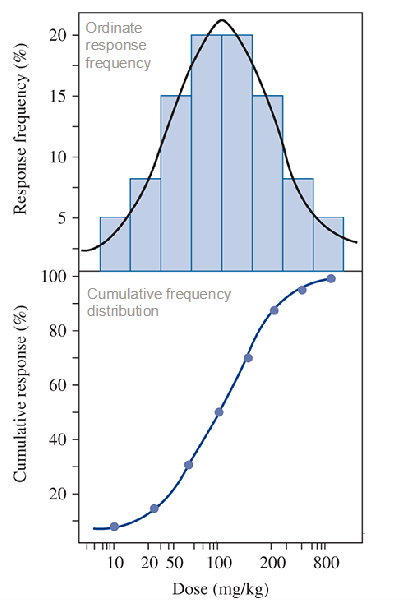
Example of a quantal dose-response relationship
The distribution of the observed responses of a group or population of
varying doses of a chemical. Identifies if the effect was observed in an individual, within the population:
shows biological variation within a species/population
typically exhibits a Normal or Gaussian distribution (e.g. a Bell curve)
the bars represent the percentage of organisms that responded at each dose
When looking at a population level, we typically want to know the primary toxicological response
Why do species, and individual species within a population have different responses to dose?
Individual differences
Chemical more toxic one individual than another.
Species differences
Chemical more toxic to one species than another.
Target organisms
Some substances are very toxic to one organism or group of organisms while being relatively harmless to others
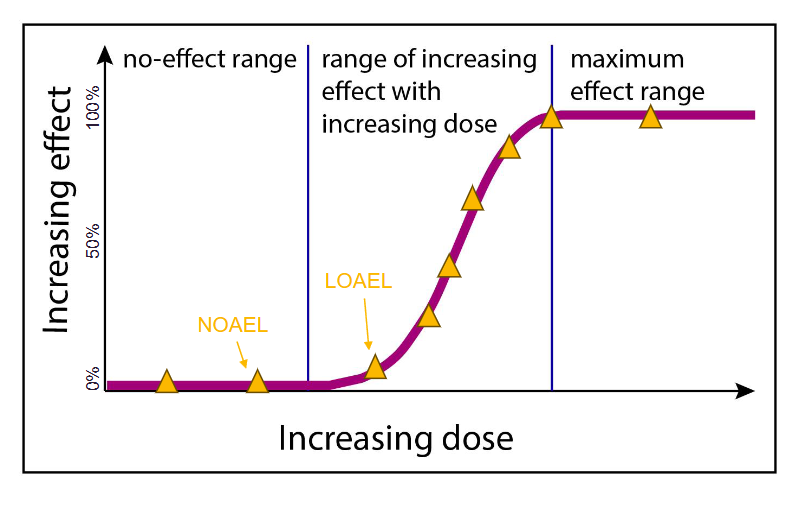
Threshold approach to evaluating dose–response curves
No Observed Adverse Effect Level (NOAEL)
the highest dose an organism was exposed to, but no significant adverse effect was observed
Lowest Observed Adverse Effect Level (LOAEL)
the lowest dose an organism was exposed to that a significant adverse effect was observed
this is for the primary toxicological effect
Statistical/probability distribution models approach to evaluating dose–response curves
Benchmark Dose (BMD)
the dose that produces an effect at a specified
response leveltypically, up to 10% (e.g. BMD5 is the dose that produces an effect in 5% of the population)
specific to the primary toxicological effect
Effective dose (ED)
the dose that produces an effect at a specified response level (e.g. ED20 is the dose that produces an effect in 20% of the population)
not specific to the primary toxicological effect
can be for therapeutic or toxic effects
Lethal Dose (LD)
the dose that causes death in a specified percentage
of the population (e.g. the effect is death)
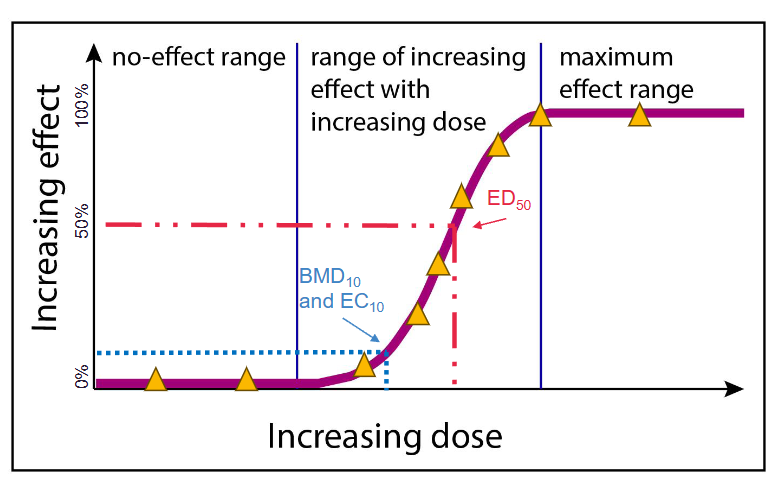
Advantages of statistical models over threshold
approaches
Advantages
they consider information from the entire dose-response curve
rather than focusing on a single test dose such as is done with the NOAEL/LOAEL approach (e.g. uses all available relevant information)
uses a consistent benchmark-response level that crosses a range of studies and endpoint
is less influenced by the arbitrary selection of doses
allows potency comparison between endpoints
Disadvantages
it may not be possible to define the shape of the dose-response curve
because of limited dose groups or the number of animals per group
requires greater statistical expertise than threshold approach
Therapeutic Index (TI)
The ratio of the dose required to produce a toxic effect (TD) and the dose required to produce a therapeutic effect (ED)
𝑻𝒉𝒆𝒓𝒂𝒑𝒆𝒖𝒕𝒊𝒄 𝒊𝒏𝒅𝒆𝒙 = 𝑻𝑫𝟓𝟎/𝑬𝑫𝟓𝟎
Used in clinical toxicology, TI is an index of comparative toxicity of two
different chemicals
It’s an estimation of the relative safety of a drug
The larger the ratio, the greater the relative safety
Disadvantage of Therapeutic Index
Therapeutic Index doesn’t consider the slope of the dose–response curves
Margin of safety
Margin of safety can overcome the pitfalls of TI by using:
ED99 for the desired effect
LD1 for the undesired effect
𝑻𝒉𝒆𝒓𝒂𝒑𝒆𝒖𝒕𝒊𝒄 𝒊𝒏𝒅𝒆𝒙 = L𝑫𝟓𝟎/𝑬𝑫99
Shapes of dose-response curves
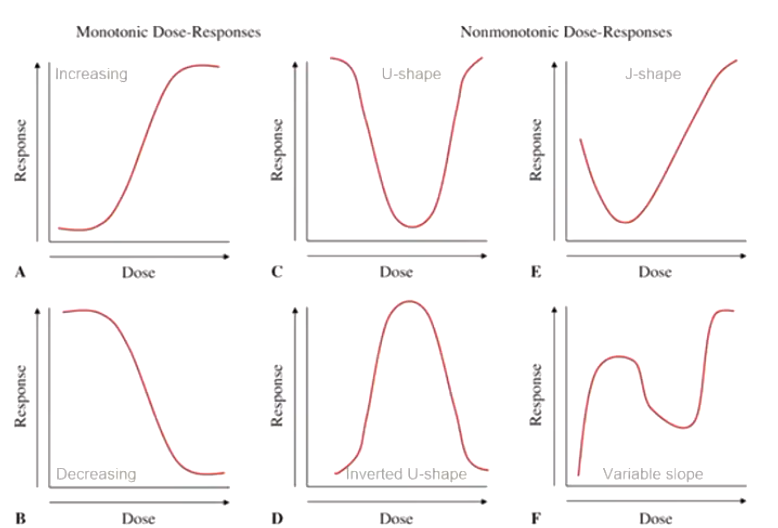
It is often assumed that chemicals will elicit a monotonic response
where increased dose causes a steady increasing or decreasing response
U-shape or J-shape can be observed when some chemicals are required for normal physiological function and/or survival
inverted U-shape or multiple inflection points with variable slope indicate detoxification mechanism or fast rate of repair in species
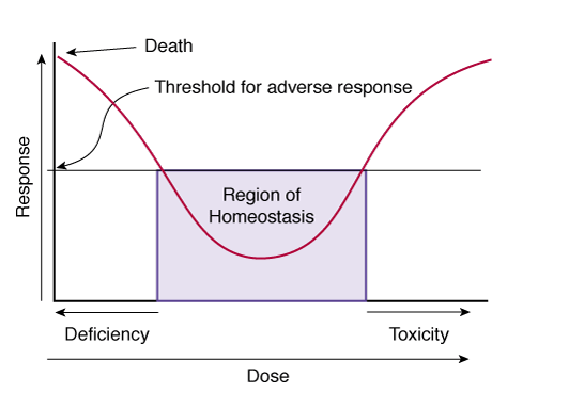
Dose-response curve for homeostasis
Nutrient and vitamin concentrations (Cu, Mg, Zn) need to be maintained within a specific range that allows for homeostasis. At very low doses there is an adverse effect (deficiency) and at very high doses responses appear from toxicity e.g. vitamin A can cause liver toxicity and birth defects at high doses, and immune and skin issues at deficiency
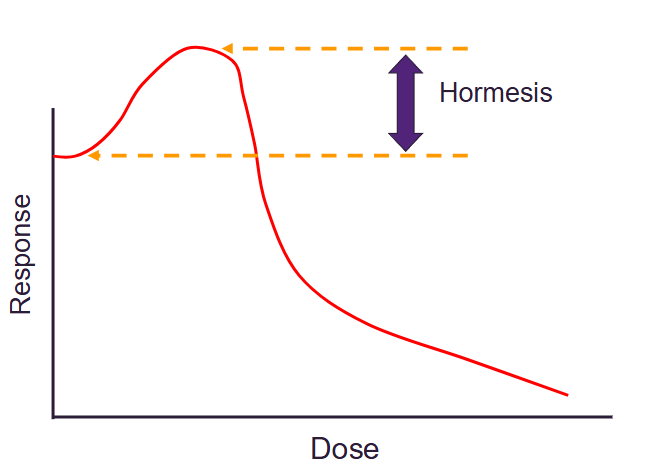
Hormesis dose-response
Hormesis is when a toxicant imparts a beneficial or stimulatory effect at low doses, but produces adverse effects at higher doses e.g. induction of enzymatic pathways that protect against oxidative stress
When do toxic effects occur?
A toxic effect can only occur when a chemical:
Reaches an appropriate site for a reaction/interaction to occur
The chemical is present at that site in a high enough dose
The reaction occurs for a long enough time
Factors contributing to a chemical’s toxicity
Physico-chemical properties
chemical structure, molecular weight, water/fat solubility (log P), viscosity, pH, ionisation potential (pKa), environmental persistence/degradation
Exposure
effect do not necessarily occur immediately
it may take time for sufficient effect to build up
Metabolism
the organism may metabolise or detoxify before effect takes place
Overall suceptibility of the individual/population
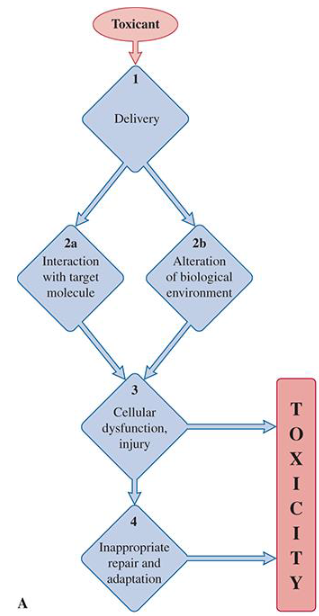
Mechanism of toxicity
After the chemical is exposed to an organism:
Delivery of the chemical to its target site
e.g. chemical is ingested and absorbed into the
blood stream where it is delivered to its target site
The chemical-biological interaction takes
placee.g. the chemical binds to its target receptor
Toxic effects take place
e.g. enzyme inhibition, impaired growth, impaired
reproduction
Inability to repair, or the organism adapts
e.g. irreparable organ damage and cellular death
or detoxification/sequestration mechanisms occur and damage is repaired
Two forms of cell death
Necrosis: unprogrammed cell death (dangerous)
Passive cell death, induced by accidental damage
of tissue (and baseline toxicity)Does not involve activation of any specific cellular pathway
early loss of plasma membrane integrity and
swelling of the cell body followed by bursting of
cellburst cell expels substances that can be
damaging to surrounding cells
Apoptosis: programmed cell death (not as
dangerous)Active form of cell death enabling individual cells to
shut down.dying cells shrink
small membrane-bound apoptotic bodies are
released, which are phagocytosed by immune
cells (e.g. macrophages)
Intracellular constituents are not released where they might have deleterious effects on neighboring cells
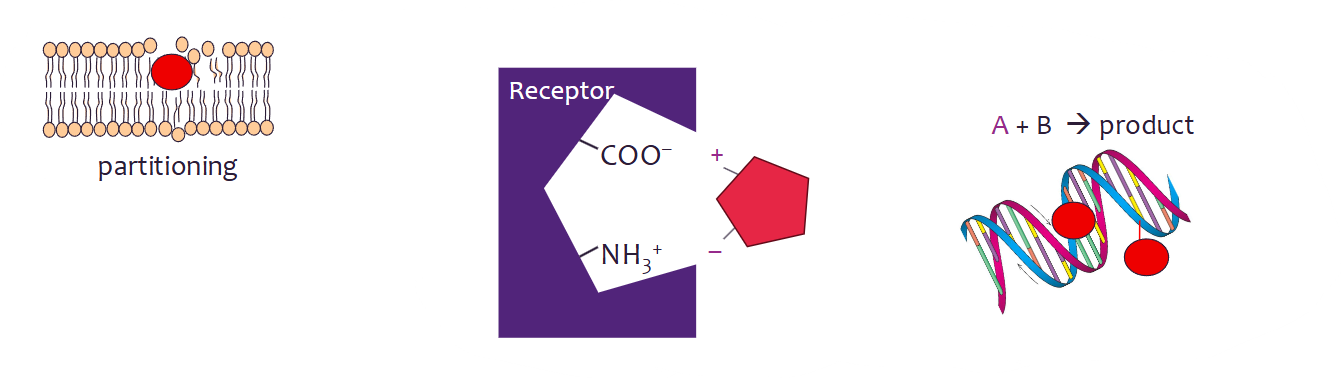
Three modes of toxic action
The modes of toxic action are based on the 3 types of primary interactions between environmental pollutants and biomolecules:
Non-specific
(sometimes called baseline toxicity or narcosis)
chemicals partition through cell membranes
is there is a high conc on the outside v low conc on the inside, diffusion is rapid
Specific
receptors looking for a particular shape to trigger a response
Chemical reactions
forming covalent bonds
Non-specific (baseline toxicity or narcosis)
Hydrophobic pollutants accumulate in biological membranes where they disturb membrane integrity:
Membrane function acts as a barrier and governs energy transduction (ion gradients that drive endergonic processes) and the formation of matrix for proteins
When impaired, membrane function decreases, potentials decay (things can cross into membrane too easily) and enzyme activity decreases
Specific toxicity
Compounds that generally interfere (complex, react etc.) with biological ligand (receptors for signalling). Chemical structure is really important:
Structural similarities to endogenous chemicals (e.g.,
proteins, hormones, enzymes)Endocrine disruptors
Enzyme inhibitors
Irreversible binding to receptors
No longer produce signals
Leave signalling pathways open
Block signals all together
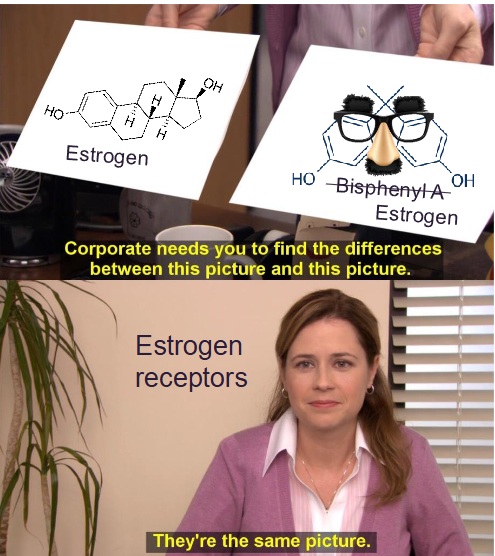
Endocrine disruption
Normal function
Hormones bind to hormone receptors
Endocrine disruption
Micropollutants enter as an agonist (binds to receptors and mimics hormones)
trigger hormone response
Micropollutants may also enter as antagonists (block hormones receptors
inhibit hormone response
Imidacloprid (example of specific toxicity)
Part of a group of insecticides called Neonicotinoids.
Imidacloprid mode of action in the body is:
An agonist of the nicotine acetylcholine receptor (nAChR)
this receptor is located within post-synaptic membrane of neurons, within the CNS
Agonist binds irreversibly to the nAChR
Leaves the Na+ (sodium ion) channel open
causes over-excitation of the central nervous system causing the organism to die
Mechanism of toxicity (exposure through dermal contact):
Delivery
transfuses through membranes into CNS due to its water solubility
Interaction with target
imidacloprid binds to nAChR, opening Na+ channel
Cellular disfunction or injury
neuron dies
Repair or permanent damage
damage is irreparable (once damage accumulates to a point, the insect dies)
Chemical reactions (reactive toxicity)
When covalent bonds are made between the chemical pollutant and natural biochemicals in the body:
Genotoxicity (DNA damage)
Mutagenicity (permanent genetic change)
Carcinogenicity (cancer causing)
Binding to biomolecules can cause altered protein functions and trigger altered immune responses (cells have range of defense mechanisms /adaptive stress response pathways):
Heat shock response
produces heat shock proteins to chaperone damaged proteins back to homeostasis
Hypoxia
conserved oxygen by cutting it off elsewhere
Metal stress
induces chelation and sequestration by metallothioneins
Osmotic stress
triggers rapid water efflux and cell shrinkage
Oxidative stress
production of antioxidants, often triggers hormesis effect
DNA damage (example of reactive toxicity)
Associated with:
Loss of stability
bulky adducts with guanine
strand breaks due to phosphodiester formation with bulky adducts
Lethal lesions
alkylation of adenenine stops DNA polymerase
Mutations (most common)
alkylation of bases changes hydrogen bond formation and causes base change
DNA repair mechanism include:
Adaptive response (reverse transfer of adducts)
Base excision by adduct specific glycosylases
SOS response (nucleotide excision)
How to use toxicity data?
Analyse chemical in drinking water
Review Human Health and Ecological Risk Assessment
Assess risk of PFAS and other chemicals in food
Australian Drinking Water Guidelines (ADWG)
Drinking water in Queensland is not allowed to exceed the ADWG health-based guidelines. Health-based guidelines are protective of human health, for a lifetime of exposure (chronic):
Toxic dose from toxicity studies, can be from animal studies
very strong preference for this to be a NOAEL
Body weight = assumed to be 70 kg for adults
Proportionality factor = proportion of that chemical likely to be consumed
from drinking water (more often than not is 10%)
Volume of water consumed = 2 L for an adult
Safety factor is an adjustment applied to account for things like:
variation between animals of the same species (including humans)
variation between species
use of a LOAEL instead of a NOAEL
