plant form & function study guide #1
 Call Kai
 Learn
Learn Practice Test
 Spaced Repetition
 Match
Match Flashcards
 Knowt Play
1/42

There's no tags or description
Looks like no tags are added yet.
Name | Mastery | Learn | Test | Matching | Spaced | Call with Kai | Chat |
|---|
No analytics yet
Send a link to your students to track their progress
43 Terms
when did the earliest life occur?
3.5 billion years ago
heterotrophic v. autotropic
heterotrophic: can’t live on their own; depend on outside sources (fungi, animals, organic matter)
autotrophic: self-feeders, can make their own organic molecules
what are the important events for adaptation of photosynthetic organisms moving from sea to seashore?
specialized structure (root-like) for anchoring, new forms developed, multiple-celled organisms, strong cell walls for support
what is the most critical environmental factor when plants moved from the sea to the land?
the access to water becomes limited, and water loss protection occurs
epidermal cells: covered with waxy cuticle (prevent water loss)
guard cells: controls opening/closing of stomata to control gas and water exchange
what are the functions for the aerial parts and the roots of a plant?
aerial parts: photosynthesis, support, transport of materials
roots parts: anchor, collect water and minerals
what kind of organic molecule is the most abundant organic molecule in nature?
carbohydrates
what is the basic unit for cellulose?
beta glucose
what are the chemical features of monosaccharides
single unit that functions as the building blocks of high order of saccharaides
sources of energy
hydrophilic
soluble in water
what is the transport form of sugar in a plant?
sucrose
what are the characteristics of fatty acids?
building blocks of lipids
insoluable in water

what is the basic structure of a amino acid?
amino group attached to a hydrogen, R group, and a carboxyl group
building blocks of proteins
how many amino acids were used to build up proteins?
20
what are the products if a peptide undergoes hydrolysis?
amino acids
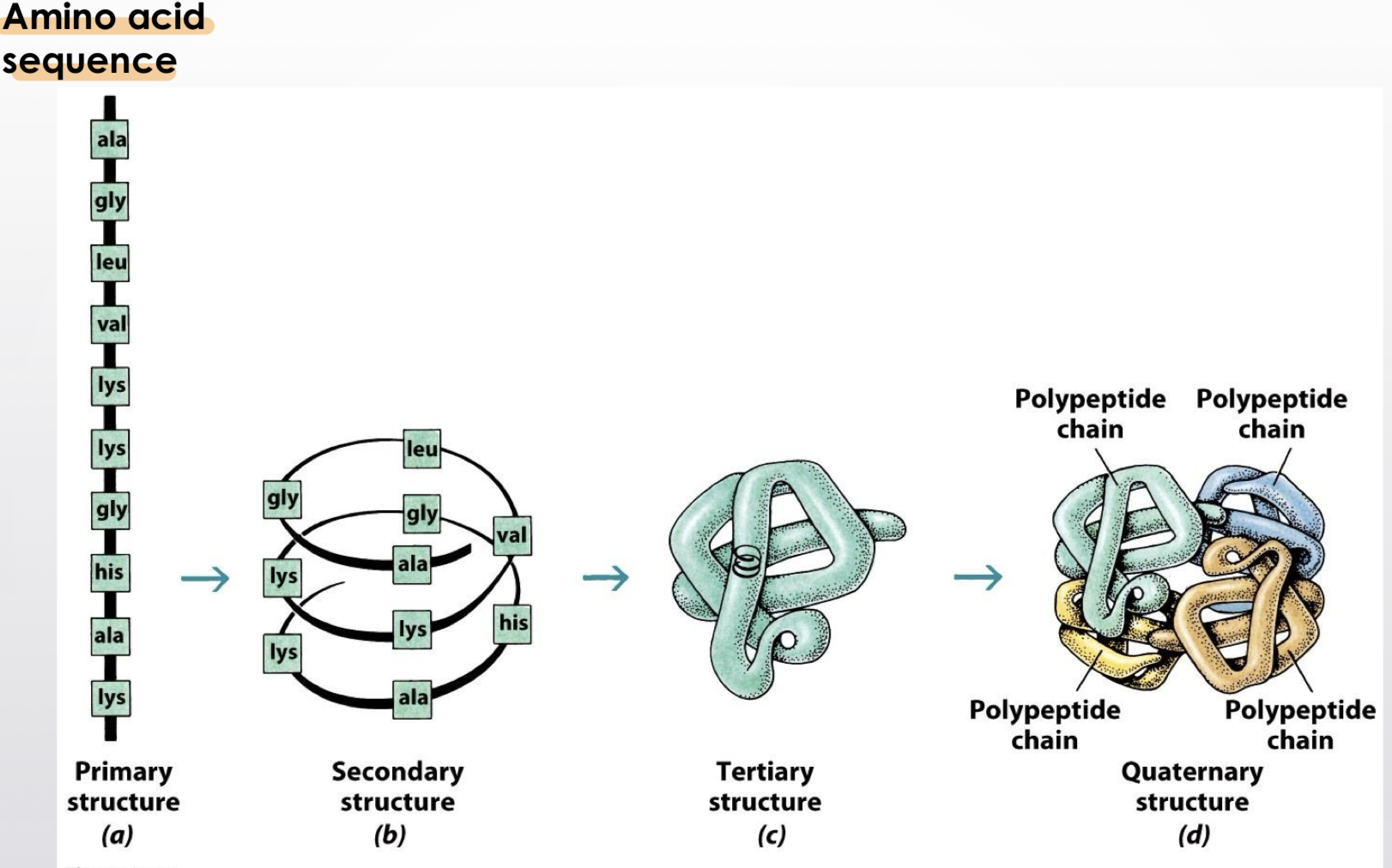
what are the features of the primary, secondary, tertiary and quaternary structures of a protein?
primary: amino acid sequence
secondary: alpha helix linked by hydrogen bonds and a beta sheet; adjacent portions line up
tertiary: polypeptide chains
quaternary: complex of protein molecule

what are the components of nucleotide?
phospharte group + sugar (ribose) + nitrogenous base (adenine)
which element is unique in proteins when comparing nucleic acids and proteins?
sulfur (absent from DNA RNA)
what is the major cell energy currency?
adenosine triphosphate (ATP)
is energy released or required when a sucrose is hydrolyzed?
it’s released
which base is only found in DNA not in RNA
thymine (T)
dna —> ATGC
rna —> AUGC
primary metabolites vs secondary metabolites
primary metabolites: sugars, lipids, proteins, nucleic acids, and carbohydrates
found in plants
necessary
secondary metabolites: other primary metabolies and minerals
induced or activated for defense
what kind of secondary metabolite is Nicotine?
insectiside alkaloid (poison for higher animals)
which secondary metabolites is responsible for adding compressive strength and stiffness to the plant cell wall?
lignin
which secondary metabolites in the cell sap are responsible for the red and blue colors of many fruits and vegetables?
anthocyanin
structure of cell walls (the three layers)
middle lamella —> joins adjacent cells
primary wall → deposited while cell size is increasing; determines size/shape of the cell
secondary wall —> deposited after primary wall stopped growing; supports and defends; thick, cellulose, lignin
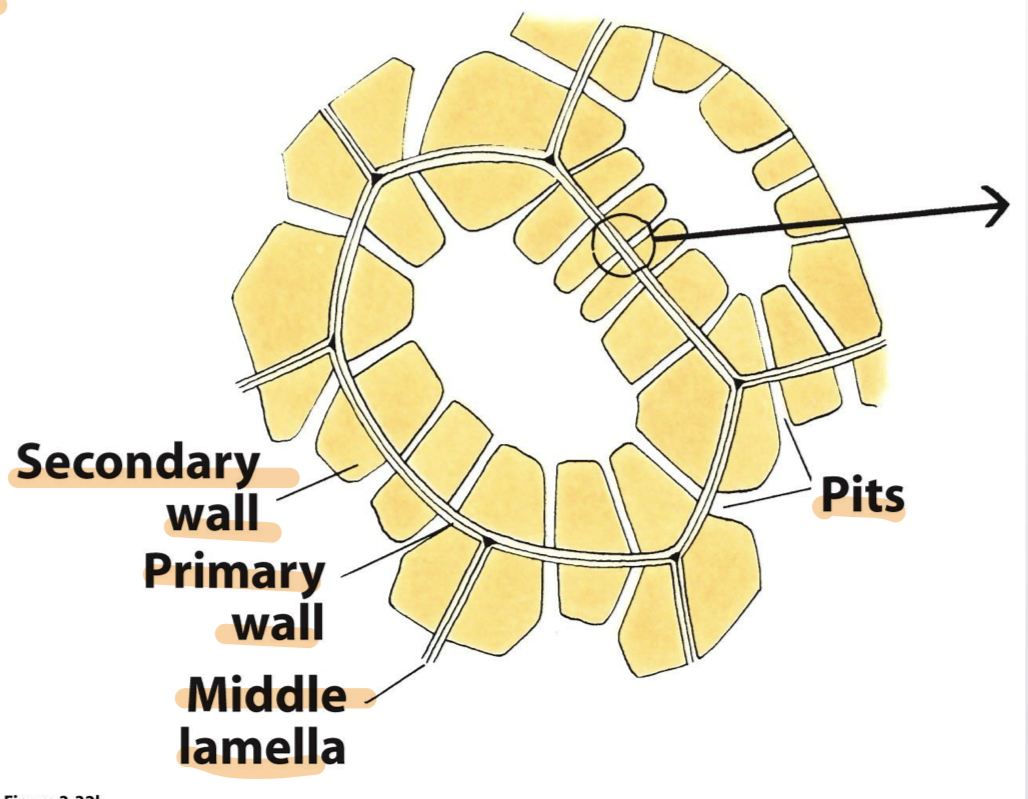
features of secondary cell walls
deposited from the inside after the primary cell wall stopped growing
supports and defends
many layers
what is chromoplast?
plastid that contain carotenoids (yellow oil bodies) but lack chlorophyll
what are the features of mitochondria?
membrane-bound cellular organelles
has an inner membrane —> cristae
programmed cell death
increase the surface area available to proteins
sites of respiration
includes: dna, rna, and ribosomes
what are the physiological functions of vacuole?
50% of the cell volume (usually in the middle)
warehouse of the cell —> lots of chemicals stored in vacuole
what are the units of microtubes and microfilaments?
microtubes —>tubulin heterodimers
microfilaments —> actin monomers
features of interphase, prophase, metaphase, anaphase, telophase, cytokinesis
interphase —> dna is replicated
prophase —> chromatin is condensed into chromosomes (longest phase)
spindle forms
nuclear envelope disappears
metaphase —> chromosomes line up at the equator line
spindle microtubules attach to sister chromatids
anaphase —> sister chromatids separate and move to the poles (shortest phase)
telophase —> nuclear envelope reforms, spindle disappear
cytokinesis —> the division of cytoplasm

how are two sister chromosomes connected?
by a centromere
phragmasome and phragmoplasts
phragmasome: sheet that separate vacuole and let nucleus move to the center for cell division
phragmoplasts: composed of microtubules separated by two nuclei
how do O2 and CO2 get into the cell?
diffusion (high to low concentration)
how do Na+, K+ get into the cell?
through active transport of the sodium potassium pump using atp
what is osmosis and how does it work?
movement of water molecules through a selectively permeable (allowing some molecules but not others) membrane
this is done via diffusion
what may regulate the activities of enzymes?
temperature
pH
effector, inhibitor
feedback inhibitor
what is feedback inhibition?
end product of a metabolic pathway that stops an enzyme in the earlier pathway to prevent overproduction
what is the cleavage step in glycolysis?
where glucose (6C) is partially oxidizes into two pyruvate (3C) molcules
what are the products of glycolysis?
two pyruvate molecules, two atp molecules, and two nadh molecules
when does fermentation take place and what are the products of fermentation?
in the absence of oxygen (anaerobic)
products —> 2 ATP
how many ATP molecules are generated from each NADH produced in glycolysis and
Creb’s cycle respectively?
2 ATP - glycolysis
3 ATP - kreb’s cycle
what happened during the preparatory phase of glycolysis?
adding 2 ATP molecules to activate glucose (converting one 6-carbon glucose into two 3-carbon sugar phosphates)
where in the cell does Citric Acid Cycle occur?
the matrix of the mitochondria