APES soil formation
 Call Kai
 Learn
Learn Practice Test
 Spaced Repetition
 Match
Match Flashcards
 Knowt Play
1/17

Earn XP
Description and Tags
reading check 229-250
Name | Mastery | Learn | Test | Matching | Spaced | Call with Kai | Chat |
|---|
No analytics yet
Send a link to your students to track their progress
18 Terms
soil
minerals from rocks + organic matter from decomposing organisms
soil erosion
soil is worn away and carried away from water/wind
3 types of rock
igneous
sedimentary
metamorphic
igenous rock
formed by magma/heat
2 types of rock
basaltic rock: dark colored, high in iron magnesium, calcium, dominant rock in the oceanic rock
granitic rock: light colored, contains feldspar, mica, and quartz. dominant rock in continental crust, it can form sand.
Sedimentary rock
formed by loose pieces of rock get buried and squeezed together until they become solid rock. (sediments)
fossil record
metamorphic rock
formed by existing rock that was changed because of heat and pressure
rock cycle
rocks changing from one type to another over a very long time.
cycle:
MAGMA
⬇ cools + hardens
🪨 IGNEOUS ROCK
⬇ weathering + erosion
🏖 SEDIMENT
⬇ pressure/compression
🪨 SEDIMENTARY ROCK
⬇ heat + pressure
🔥 METAMORPHIC ROCK
⬇ melting
🔥 MAGMA
⬆ And the cycle starts again!
does not follow the same cycle everytime.
weathering
the natural breakdown or dissolving of rocks and minerals on Earth's surface by water, air, ice, and living things
physical weathering
physically broken apart, but its chemical makeup stays the same.
chemical weathering
chemically changed or dissolved.
acid percipitation/rain
rain, snow, or other precipitation that contains unusually high amounts of acids.
erosion
The physical removal of rock fragments from a landscape or ecosystem.
5 properties that determine soil properties
parent material - the underlying rock the soil comes from
climate - temperature, humidity
topography - the slope and shape of the land
organisms - plants, animals, bacteria, fungi
time - how long soil has been developing
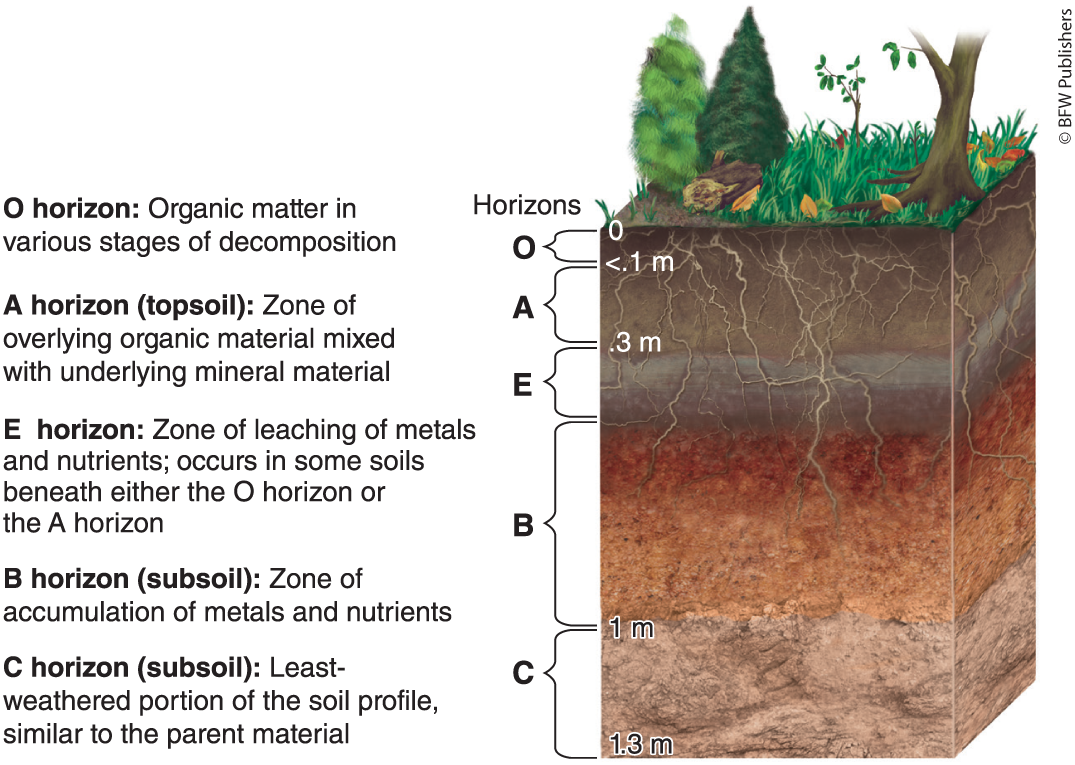
soil horizons
O - organic matter. dead leaves, twigs, animals, humus ( very decomposed organic matter)
A - topsoil, organic matter + minerals, lots of nutrients, important for plant growth
E - leaching layer, leaching removes minerals from this layer, not always present, found in some acidic soils
B - sub soil, metals
C - least weathered layer, very similar to parent material
soil minerals
3 clay, = smallest
2 slit = medium
1 sand = largest
the bigger the particle, higher the porosity
porosity = amt of air between soil particles.
sand
large, loose particles
high permeability ( water can move through )
lower water holding capacity, drains easily
roots can move around
clay
tiny, tight particles
low permeability
low water holding capacity
roots can move through easily as well
slit
in between clay n sand