Morphology Form and Function Tooth Parts to Remember
 Call Kai
 Learn
Learn Practice Test
 Spaced Repetition
 Match
Match Flashcards
 Knowt Play
1/109

Earn XP
Description and Tags
Includes certain cusps, lobes, angles, positions on tooth from different views
Name | Mastery | Learn | Test | Matching | Spaced | Call with Kai | Chat |
|---|
No analytics yet
Send a link to your students to track their progress
110 Terms
Cusp
An elevation or mound on the crown portion of a tooth making up a divisional part of the occlusal surface
Cusps form the bulk of _____ surfaces of ____ teeth
occlusal surfaces of posterior teeth
Premolars have _____ cusps.
Molars have ______ cusps.
Premolars have 2-3 cusps.
Molars have 4 or more cusps.
The incised portion of canine crowns exhibit ___ cusp.
one
_____ DO NOT possess cusps.
Incisors
A smaller elevation on some portion of the crown produced by an extra formation of enamel
tubercle
Common locations for tubercles include ______ and ______.
lingual surfaces of maxillary teeth and lingual surfaces of maxillary molars
Where is the cusp of carabelli located?
maxillary first molars
Lobes are defined as ______.
a primary division of the tooth
The ____ pattern plays a part in the form and function of each individual tooth.
lobe
All anterior teeth are composed of _____ lobes.
Four
What are the lobe names of anterior teeth?
3 labial lobes
mesiolabial
middle labial (labial)
distolabial
1 lingual lobe (cingulum)
The three labial lobes on permanent anterior teeth are sometimes found on newly erupted incisors, called ______.
mamelons
The permanent anterior teeth have two ______ found on the labial surface.
shallow developmental depressions
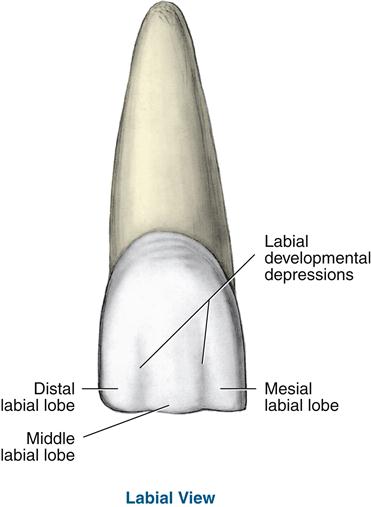
The shallow depressions found on labial surface of anterior teeth are ___ & ____
mesiolabial & distolabial developmental depressions
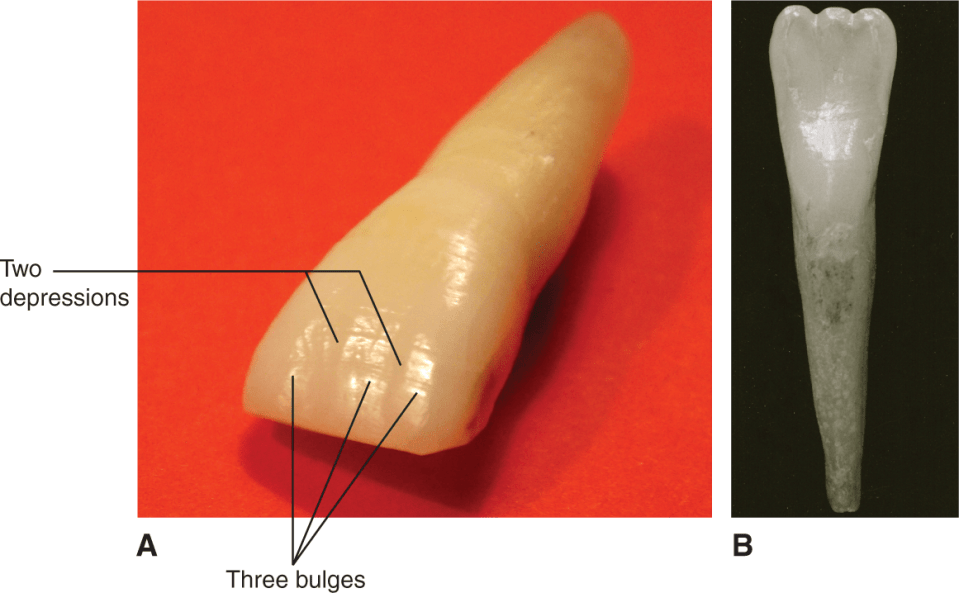
Most permanent premolar teeth exhibit _____ lobes.
four
What are the names of the premolar lobes?
3 Buccal
mesiobuccal
middle buccal
distobuccal
1 Lingual
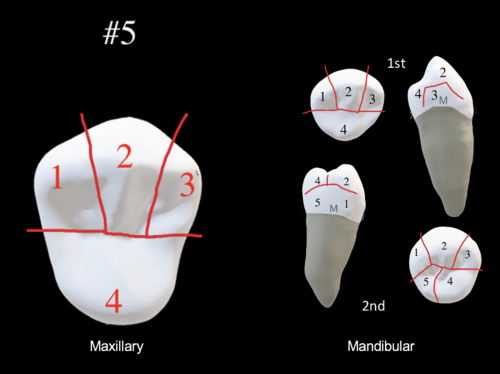
The premolar teeth that have 4 lobes
maxillary premolars & mandibular 1st premolar
Developmental depressions can be seen on the _____ surface between lobes.
buccal
What premolar tooth is an exception to the 4 lobe rule and has 5 lobes?
Mandibular 2nd premolar
Lobes on the mandibular 2nd premolar
3 Buccal
mesiolabial
middle buccal
distobuccal
2 Lingual
mesiolingual
distoliwngual
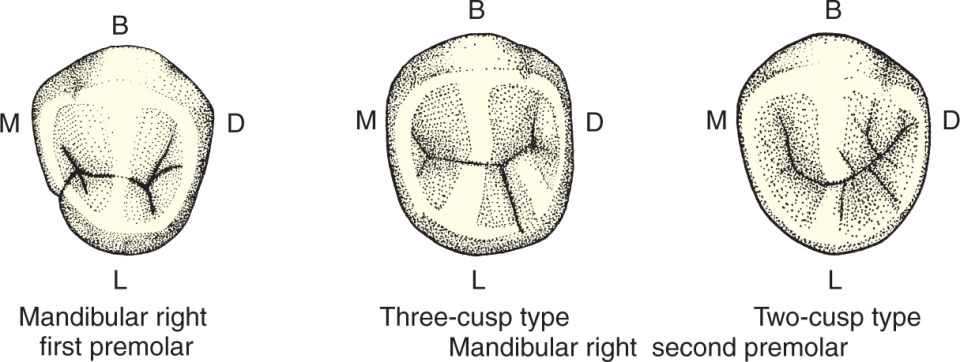
Evidence of lobe separation on premolar teeth
central groove
lingual groove
developmental depressions (between 3 buccal lobes)
The permanent maxillary molars are composed of _____ lobes.
four
The 4 lobes of maxillary molars are _____.
2 Buccal
mesiobuccal
distobuccal
2 Lingual
mesiolingual
distolingual
__________ DO NOT exhibit developmental depressions.
Molars
Evidence of lobe separation on maxillary molars include
central groove
distolingual groove
buccal groove (separates 2 buccal lobes)
The _____ are the only molars with 5 lobes.
Mandibular 1st molars
The 5 lobes of mandibular 1st molars are
3 Buccal
mesiobuccal
distobuccal
distal (small lobe)
2 Lingual
mesiolingual
distolingual
What lobe separates the distobuccal and distal lobes on mandibular 1st molars?
distobuccal groove
Evidence of lobe separation on mandibular 1st molars
central groove
buccal groove
distobuccal groove
lingual groove
The other mandibular teeth are composed of _____ lobes.
four
Lobes on permanent mandibular teeth (excluding 1st)
2 Buccal
mesiobuccal
distobuccal
2 Lingual
mesiolingual
distolingual
Evidence of lobe separation on permanent mandibular teeth
central groove
buccal groove
lingual groove
A two dimensional curve of the occlusal plane in the anterior-posterior direction
curve of spee
The Curve of Spee begins at ________ and follows the ________ of the premolars and molars posteriously.
beings at the tip of the canines and follows the buccal cusp tips of the premolars and molars posteriously.
Root inclinations needed to form curve of spee
maxillary teeth - inclined to mesial
mandibular teeth inclined to distal
Crowns are in the ____ direction of root inclinations in curve of spee.
Maxillary crowns - inclined to distal
Mandibular crowns - inclined to mesial
A two dimesional curve of the occlusal plane in a medio-lateral direction
curve of Wilson
Root inclinations needed to form curve of Wilson
maxillary - inclined to lingual
mandibular - inclined to buccal
Sphere of monson is also called
compensating occlusal curvature
a three dimensional curvature of the occlusal plane
sphere of monson
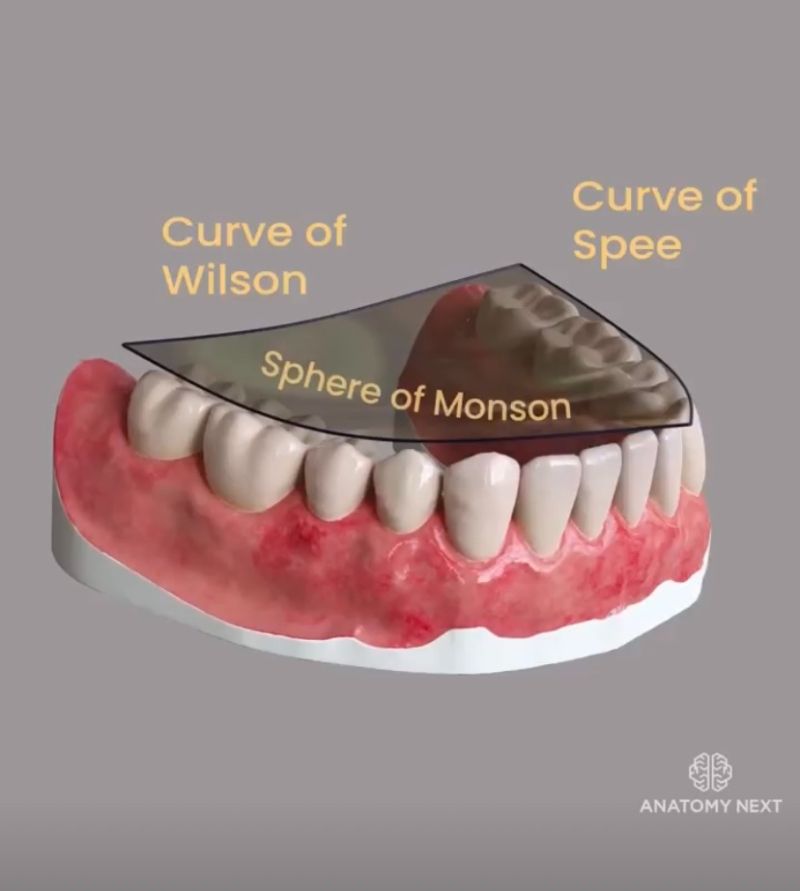
The sphere of monson curvature is _____ for the mandibular arch.
Concave
The sphere of monson curvature is _____ for the maxillaryarch.
Convex
The axial position is the angulation of the teeth with respect to the _________.
alveolar bone
For the axial position of maxillary anterior teeth, the root inclines toward the _____.
lingual (palate)
For the axial position of maxillary anterior teeth, the incisors’ root inclines _____ in the mesial/distal direction
nearly straight in mesial/distal direction
Maxillary canine roots of incline toward the _____
distal
For the axial position of maxillary premolar teeth, the root inclines toward the _____ & ______.
lingual (palate) & distal
For the axial position of maxillary molars the root inclines toward the _____ & ______ .
lingual (palate) and distal
For the axial position of mandibular anterior teeth, the root inclines toward the _____.
lingual
For the axial position of mandibular anterior teeth, the incisor root inclines toward the _____.
nearly straight in mesial/distal direction
For the axial position of mandibular anterior teeth, the canine root inclines toward the _____.
distal
For the axial position of mandibular premolar teeth, the root inclines toward the _____.
distal
For the axial position of mandibular premolar teeth, the 1st premolar root inclines slightly toward the _____.
lingual
For the axial position of mandibular premolar teeth, the 2nd premolar root inclines slightly toward the _____.
buccal
For the axial position of mandibular molar teeth, the roots incline toward the _____ & ______.
buccal and distal
Rule #1 of root shape: Roots are normally widest toward the _____ area and taper toward the _____.
widest toward the cervical area and taper toward the apex
Rule #2 of root shape: _____ teeth and _____ normally have single roots. (except maxillary 1st premolar)
Anterior teeth & premolars
Rule #3 of root shape: __________ normally possess three root branches (one lingual, two buccal)
Maxillary molars
Rule #4 of root shape: ______ molars normally have two root branches (one mesial, one distal).
Mandibular
Which premolar has 2 root branches?
maxillary first
Which teeth are a single root?
anterior teeth and premolars (except maxillary first premolar)
Which teeth have two roots?
maxillary first premolar
one palatal and one buccal
mandibular molars
one mesial and one distal
Which teeth have three roots?
maxillary molars
one mesiobuccal, one distobuccal, one palatal
________________ are aligned into one continuous valley in each quadrant.
The continuity of central grooves
Continuity of central grooves allows for a trough ____________ through the centers of the occlusal surfaces of the posterior teeth
antero-posteriorly
The continuity of central grooves allows for
more efficient food flow pattern during mastication
The height of ____________ ofadjacenteeth in the same arch should be at the same level.
marginal ridges
Adjacent marginal ridges are normally shaped so that they create a small _________ between posterior teeth or ________ between anterior teeth.
occlusal embrasure between posterior teeth
he between anterior teeth
The amount of ______________ seems to be related to the width and lengths of the crown, as well as the location of the contact areas.
cervical line curvature
Rule for cervical line curvature:
The cervical line is normally curved toward the _______ on facial and lingual surfaces.
apical
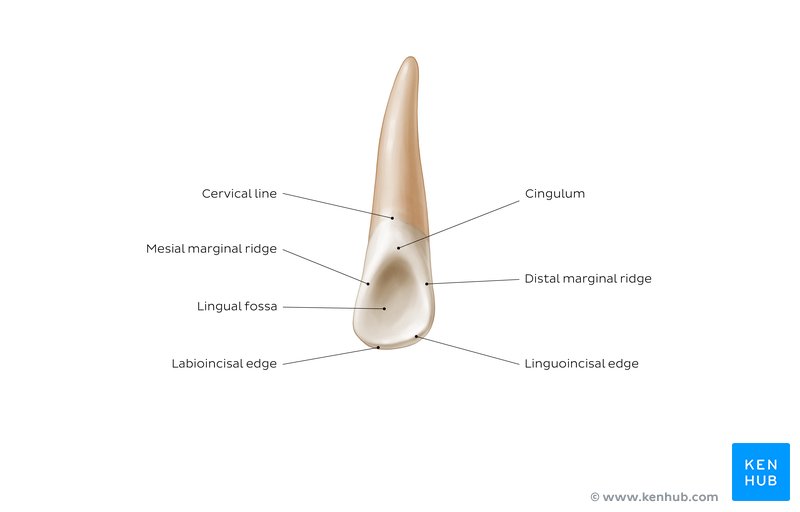
Rule for cervical line curvature:
The cervical line is normally curved toward the ________ on the mesial and distal surfaces
incisal (occlusal)
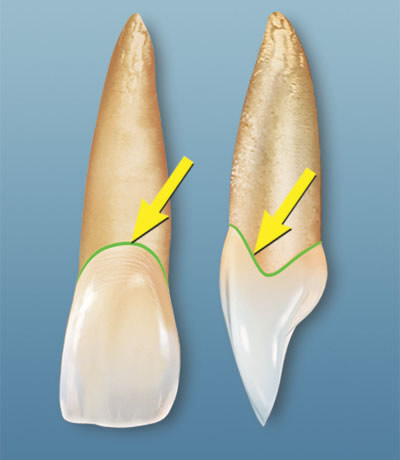
Rule for cervical line curvature:
The depth of the cervical line curvature on any individual tooth is normally greater on the ______, compared to the _____ surface.
greater on mesial; compared to the distal
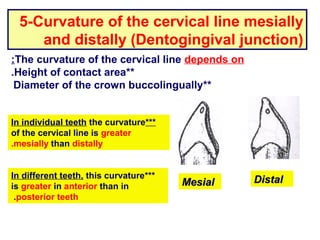
Rule for cervical line curvature:
Cervical lines on adjacent proximal surfaces of adjacent teeth have approximately the same _________.
depth of curvature
Rule for cervical line curvature:
The depth of the curvature on all surfaces is greater on _________ and decreases posteriorly.
central incisors
Mesial cervical line curvatures range from _____ to _____.
3.5 mm to 1 mm
Distal cervical line curvatures range from _____ to _____.
2.5 mm to 0 mm.
The height of contour on the facial surfaces of all anterior and posterior teeth is located in the _______ third.
cervical
On anterior lingual surfaces, the lingual height of contour is located in the ______ third.
cervical
On posterior lingual surfaces, the lingual HOC is located in the ____ third.
middle or occlusal
How great is the contour in maxillary dentition?
½ mm or less
How great is the contour in mandibular dentition?
½ mm or less, ¾ mm (facial surface of 2nd premolar), 1mm (facial surface of 1st molar and 2nd molar)
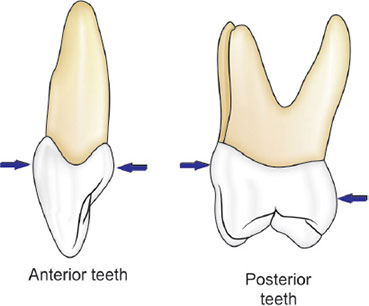
The ____ are the termination of the embrasure.
line angles
There should be symmetry in the location of line angles of ____ teeth.
adjacent
Line angles are more noticeable when viewed from the _____ aspect.
incisal (occlusal)
The open space between the proximal surfaces of two adjacent teeth in the same arch, where they diverge facially or lingually, and incisally or cervically from the contact area.
Embrasures
Embrasures provide _______
a passage through which food escapes from the occlusal surfaces during mastication; also service as integral part of self-cleaning process
Incisal (occlusal) embrasures increase in relative size from the ______ to ______.
anterior to posterior
Cervical (gingival) embrasures decrease in relative size from _____ to _____.
anterior to posterior
The labial and lingual embrasures are nearly ____ in size in anterior teeth
equal
The lingual embrasure is normally _____ than the buccal embrasure in posterior teeth.
larger
When one side of an embrasure has a certain contour, the other side of the embrasure will
normally have a similar contour
The triangular shaped area (inter proximal space) between adjacent teeth in same arch is formed by what?
the alveolar bone at its base
proximal surfaces of addict teeth on its sides
contact area of the adjacent teeth at its apex
Normally the contact areas ____ in size with age, due to abrasion between proximal surfaces
increase
Proper location of contact areas aids in ____ and prevents ____.
stabilization of dental arch and prevents food from slipping between teeth
contact areas become more _____ located from anterior to posterior
cervically
On an individual tooth, distal contact is _____ than mesial contact.
more cervical
Contact area - Size _____ from anterior to posterior
increases
Anterior teeth contact areas are normally centered _____
labiolingually