2A1 Chapter 6 Plant Maintenance
 Call Kai
 Learn
Learn Practice Test
 Spaced Repetition
 Match
Match Flashcards
 Knowt Play
1/140

Earn XP
Description and Tags
2nd Class Power Engineering
Name | Mastery | Learn | Test | Matching | Spaced | Call with Kai | Chat |
|---|
No analytics yet
Send a link to your students to track their progress
141 Terms
What is the definition of maintenance?
The combination of all technical and administrative actions intended to retain an item in, or restore it to, a state in which it can perform a required function.
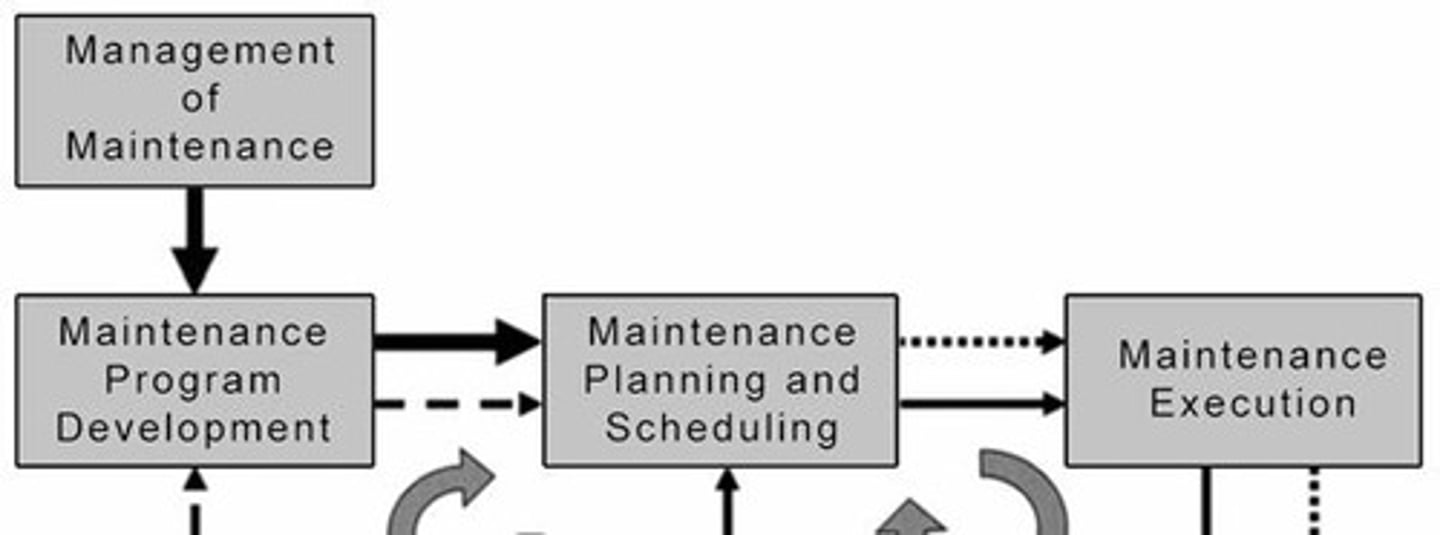
What are the major aspects of managing maintenance activities?
Management of maintenance, program development, planning and scheduling, execution, assessment, and improvement.
What does preventive maintenance aim to do?
To retain equipment in a functioning state by performing regular maintenance tasks.
What is the goal of corrective maintenance?
To restore equipment to a functioning state after a failure has occurred.
What tools are used for scheduling major maintenance activities?
Gantt charts, PERT charts, and the critical path method.
What is the role of maintenance planners in Maintenance program development?
To develop maintenance programs, identify preventive maintenance tasks, and plan resources needed for maintenance.
What is involved in Maintenance execution?
Obtaining resources, following safety procedures, repairing equipment, and documenting work done.
What is Maintenance assessment?
The process of evaluating the success of maintenance actions and measuring performance indicators.
What is the purpose of Maintenance improvement?
To incorporate changes and enhancements in equipment, procedures, and maintenance tasks.
How does reliability relate to maintenance?
Reliability is achieved when equipment is designed for operating conditions, operated within limits, and properly maintained.
What is Total Productive Maintenance (TPM)?
A formal approach to maintenance management that focuses on proactive and preventive maintenance.
What are the responsibilities of supervisors and managers in Management of maintenance?
Developing maintenance strategies, managing budgets, and providing resources for maintenance.
What is the continuous improvement loop in maintenance?
A process that incorporates changes and improvements in equipment and procedures based on maintenance assessments.
What factors are important for measuring the success of a maintenance program?
Reliability, availability, product quality, production capacity, and cost.
What does Maintenance planning and scheduling involve?
Planning resources and scheduling maintenance tasks within available limits.
What is the role of maintenance staff during Maintenance execution?
To carry out the maintenance tasks, including repairs and documentation.
What is the importance of documenting maintenance work?
To keep records of actions taken, resources used, and to assess the effectiveness of maintenance.
What are maintenance performance indicators?
Metrics used to measure the effectiveness and efficiency of maintenance actions.
What does maintenance enhancement include?
Improvements to maintenance tasks, procedures, and program development.
What is the role of computerized systems in maintenance management?
To manage maintenance activities efficiently, including work order systems.
What are the types of equipment monitoring methods?
Log sheets and trending.
What is the purpose of a plant budget in maintenance?
To control maintenance costs and allocate financial resources effectively.
What is the relationship between maintenance and operational reliability?
Effective maintenance is essential for ensuring that equipment operates reliably within its designed capabilities.
What is the first step in preparing for a pressure vessel inspection?
Planning and scheduling the inspection activities.
What is the significance of safety and environmental procedures in maintenance?
To ensure the safety of personnel and compliance with environmental regulations during maintenance activities.
What is the overall goal of maintenance management?
To ensure that equipment operates efficiently and effectively while minimizing downtime and costs.
What are the two major categories of maintenance?
Preventive Maintenance and Corrective Maintenance.
Maintenance carried out at predetermined intervals to reduce the probability of failure is called _____.
Preventive Maintenance
Maintenance carried out after fault recognition to restore an item to a functional state is called _____.
Corrective Maintenance
A type of maintenance aimed at predicting failures by monitoring equipment condition is called _____.
Condition Monitoring
Condition monitoring and inspection, functional testing, and interval-based repair or replacement are the 3 types of _____.
Preventive Maintenance
A method aimed at finding hidden failures that do not become evident until a function is activated is called _____.
Functional Testing or failure finding
Regular repair or replacement of components after a specified interval, regardless of equipment condition is called _____.
Interval-Based Maintenance
What is the purpose of Corrective Maintenance?
To address failures after they occur, prioritizing based on the impact on production.
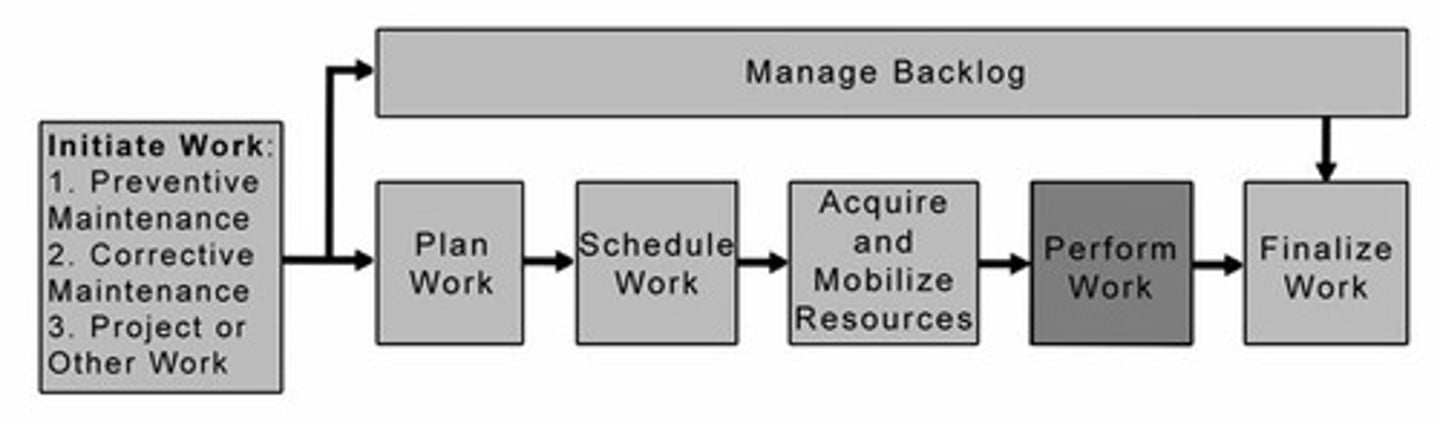
What is the first step in the planning and scheduling process for maintenance?
Initiating the work by raising a work request.
What triggers a work request for Preventive Maintenance?
It is often triggered automatically by a computer system.
What is the benefit of effective planning and scheduling in maintenance?
It reduces downtime, maintenance costs, and improves resource utilization.
What is the impact of corrective maintenance on production?
It can lead to delays and increased costs if not managed properly.
What is the role of condition monitoring in maintenance?
To determine the most efficient time to perform maintenance just before failure.
What is the significance of hidden failures?
They can lead to catastrophic results if not identified before the function is required.
Corrective maintenance that must be done immediately after a failure occurs is called _____.
Emergency maintenance
What are the benefits of preventive maintenance?
Reduces the probability of failure and enhances the reliability of equipment.
What is the difference between reactive and proactive maintenance?
Reactive maintenance occurs after failures, while proactive maintenance aims to prevent failures.
What is the goal of a good maintenance program?
To prevent most major failures and minimize costs associated with maintenance.
What factors can trigger interval-based maintenance?
Elapsed time, running hours, number of operating cycles, or other relevant factors.
What is the importance of regulatory compliance in maintenance?
It ensures that maintenance activities meet legal and safety standards.
What is the impact of maintenance on environmental compliance?
Effective maintenance can reduce environmental impact associated with operations.
What is the significance of measuring maintenance performance?
It helps in assessing the effectiveness of maintenance strategies and improving them.
What is the purpose of screening work requests?
To ensure that only necessary and approved tasks move to the planning stage.
What is the role of maintenance costs in planning?
To evaluate and optimize the budget allocated for maintenance activities.
How can maintenance activities impact production schedules?
Poorly managed maintenance can lead to delays and disruptions in production.
What does the scheduling step in maintenance involve?
Deciding the most appropriate time for the work to be carried out.
What is a work order?
A document that turns a work request into actionable tasks.
List some tasks involved in acquiring resources for maintenance.
Obtaining parts, reserving tools, identifying personnel, and transporting resources.
What does finalizing maintenance work include?
Documenting results and returning tools and unused materials to inventory.
In maintenance, what term refers to the total amount of work yet to be completed?
Backlog
What is the average duration of a maintenance backlog?
About three weeks of work.
What is involved in the planning stage of maintenance?
Identifying tasks, required resources, and safety procedures.
What is the purpose of scheduling in maintenance?
To accomplish tasks efficiently within existing constraints.
What factors influence the scheduling of maintenance tasks?
Task urgency, equipment shutdown timing, and availability of resources.
What is a major maintenance shutdown?
A significant event requiring intensive planning and scheduling for multiple tasks.
What is the first step in the scheduling process?
Identify all required tasks.
What does 'Early Start' refer to in scheduling?
The earliest time that a task can begin.
What is 'Slack' in the context of scheduling?
The amount of time a task can be delayed without affecting overall completion.
What is the significance of estimating task duration?
It helps in planning and scheduling tasks effectively.
What role do external contractors play in maintenance?
They provide specialized services and support for maintenance tasks.
What is involved in managing the maintenance backlog?
Adjusting priorities and resources in response to new tasks and changes.
Why is it important to document maintenance results?
To track progress and ensure accountability for completed tasks.
What is the purpose of applying resource constraints in scheduling?
To ensure that the scheduling process is realistic and achievable.
What is a major function of the planning process in maintenance?
To manage the backlog and ensure timely completion of tasks.
What happens if the maintenance backlog becomes too large?
It indicates insufficient resources and potential delays in required work.
What is the significance of safety procedures in maintenance?
To ensure the safety of personnel and compliance with regulations.
What is the role of financial account codes in maintenance?
To track costs associated with maintenance tasks.
What is the purpose of determining task dependencies in scheduling?
To understand the relationships between tasks and optimize the scheduling process.
What does 'parallel (no dependency)’ mean in task scheduling?
Two tasks are independent and can be completed simultaneously if resources are available.
What is 'finish to start' dependency?
Task C cannot start until Task B has been completed.
What does 'start to start with delay' mean?
Task B cannot start until after a delay following the start of Task A.
What does 'finish to finish with delay' mean?
Task B cannot be finished until after a delay following the finish of Task A
What is a PERT (Program Evaluation and Review Technique) chart?
It is used to organize tasks into a schedule.
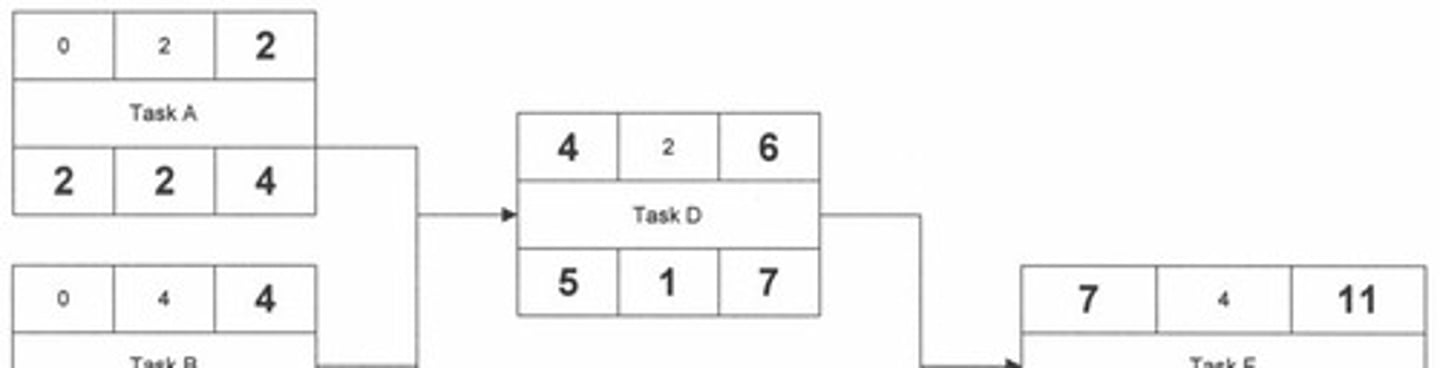
How is late finish time determined in a PERT chart?
By adding the longest duration of parallel tasks to the early start time.
A timeline-based chart that visually represents the schedule of tasks in a project is called a _____.
Gantt chart
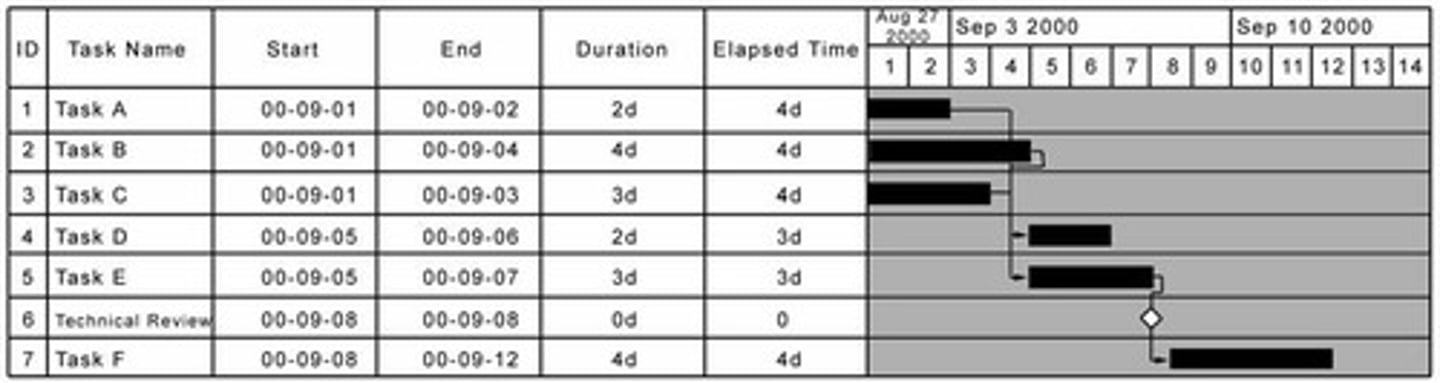
Who developed the Gantt chart concept?
Henry Gantt, in the early 1900s.
What is the critical path in scheduling?
It is the sequence of tasks that determines the minimum completion time for a project.
What happens if a task on the critical path takes longer than planned?
The overall project completion time will increase.
What types of tasks should be considered for a pressure vessel inspection?
Preparation, safety requirements, inspection, and completion tasks.
What is included in the preparation tasks for a pressure vessel inspection?
Obtaining special tools, picking up spare parts, and traveling to the inspection location.
What safety requirements must be met before a pressure vessel inspection?
Obtaining a work permit, isolating and depressurizing the vessel, and performing a safety check.
What does the actual inspection of a pressure vessel involve?
A visual inspection, ultrasonic inspection of wall thickness, and replacement of the relief valve.
What are the completion tasks after a pressure vessel inspection?
Returning the vessel to service, documenting results, and traveling back to the maintenance shop.
What skills are required for a pressure vessel inspection?
An operator, a technician for ultrasonic inspection, and a maintenance worker for valve replacement.
How can adding more workers affect the scheduling of tasks?
It allows for more tasks to be completed in parallel, reducing total elapsed time.
What is the significance of analyzing the critical path?
It helps identify scheduling options that may reduce total elapsed time and optimize resource use.
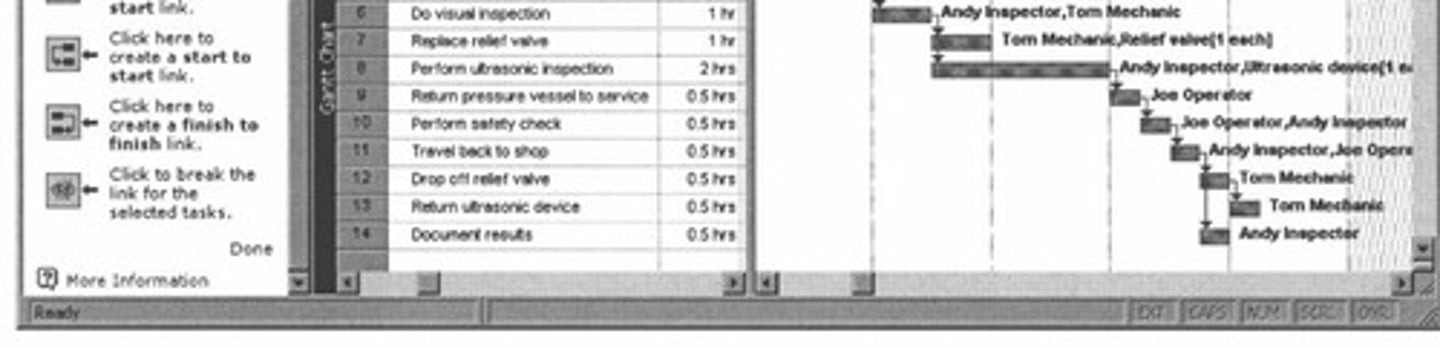
What is the role of Microsoft Project in task scheduling?
It allows for detailed scheduling and production of critical path flowcharts or Gantt charts.
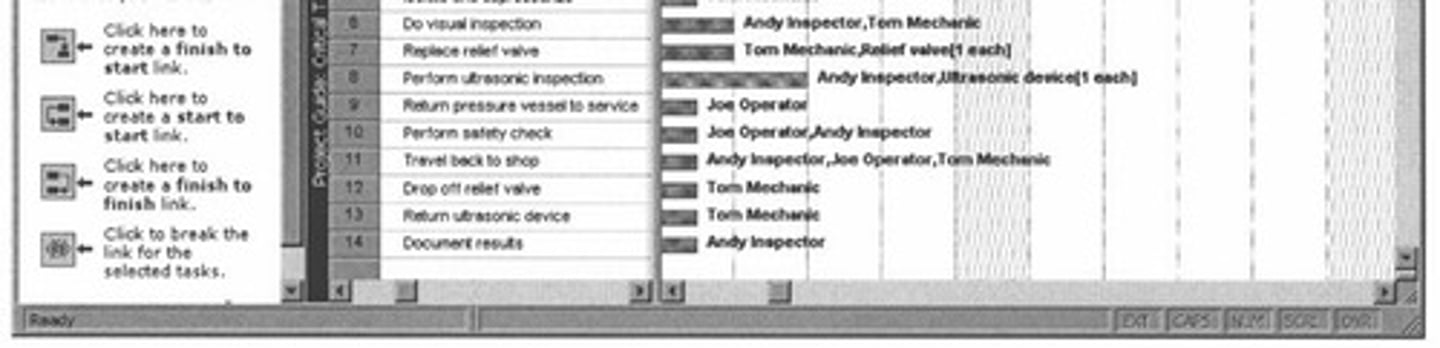
What is the outcome of performing both visual inspection and relief valve replacement simultaneously?
It reduces both total elapsed time and equipment downtime.
What does EAM stand for?
Enterprise Asset Management systems
What are the two types of systems available for CMMS?
Desktop applications for small uses and server-based systems for large corporations.
Name a major component of a CMMS.
Work management (work requests and work orders)
What is included in the planning and scheduling function of a CMMS?
Identifying resources, task duration, and planned start time.
What triggers work orders for preventive maintenance tasks?
Elapsed time, running hours, or when an indicator value is exceeded.
What is the significance of completed work orders?
They document the maintenance history of the equipment.