Instrumental Analysis Exam 1
 Call Kai
 Learn
Learn Practice Test
 Spaced Repetition
 Match
Match Flashcards
 Knowt Play
1/168

There's no tags or description
Looks like no tags are added yet.
Name | Mastery | Learn | Test | Matching | Spaced | Call with Kai | Chat |
|---|
No analytics yet
Send a link to your students to track their progress
169 Terms
What is Analytical Chemistry?
improving/extending analytical methods and/or developing new analytical tools/methods
Analysts/enablers
build instruments, devise procedures for obtaining information
Determinators/exploiters
Concerned only with end result
Analyte
chemical species we are looking for
matrix
everything else present in the sample
Classical Methods
Physically separate components of interest
Instrumental Methods
Using physical properties of analyte as distinguishing characteristic
Instrument
Produces measurements
Machine
Produces products
Transduction
Change in form of information
Systematic/determinate error
comes from flaw in equipment or experiment design, error is consistant/reproducibl.
Detection of systematic error
analyze known sample, use different method to measure same quantity, round robin, analyze blank
correction of systematic error
Calibrate glassware and instrumentsm use standard addition/internal standard to correct matrix effects
Random/indeterminate error
Comes from. uncontrolled variables in measurement, equal chance of being above or below true value
Ways to correct random error
can’t be totally eliminated
Precision
Describes reproducibility of result
Accuracy
how close the measurement is to the true value
uncertainty
degree of variability within a dataset
Experiment repeated multiple times and errors purely random, results will appear as
gaussian distribution
standard dev describes
level of random error
smaller standard deviation=
better precison
calibration/working curve
response vs quantity
Selectivity
ability to distinguish analyze from other species in sample, to the degree of which the analyte is free from interference
Sensitivity
ability to respond measureable and reliably to change in analyte concentration (slope of calibration curve)
Blanks
sample not intended to contain analyte, accounts for interference by other species in sample
A method is specific if
responds to only one analyte without interferances
Detection limit (LOD)
Smallest quantity of analyte that is significantly different from the blank k=3
Quantitation limit (Lower Limit of Quantitation)
smallest quantity of analyte that can be quantified with reasonable accuracy (IUPAC k=10)
Linearity
measures how well a calibration curve follows straight line, response proportional to analyte quantity
Bias
degree of systematic error
LOD
IUPAC, k=3, smin=sblank+kstdevblank
linear Dynamic Range
rage of analyte concentrations where quantification is possible (LOQ to LOL)
Limit of linearity (LOL)
response deviates from best fit line by 75%
transducer
changes form of information
processor
separates, correlates, processes info
Why are electrical measurements common?
fast acquisition, rapid and complex processing possible, inexpensive
analog electrical measurements
continuous in amplitude and time, directly measure current, voltage, charge, power, more susceptible to electrical noise
Time electrical measurements
information stored in time domain, measures frequency, duration (pulse width), phase, less susceptible to electrical noise
Digital electric measurements
Information quantized in levels, measure by counting/discrite value, least susceptible to electronic noise
Analog Measurements
current, voltage, charge
time measurements
frequency, pulse width, phase
Digital measurements
count, serial, parallel, number
Signals that can be both analog and digital
Photomultiplier, Tachometer, Geiger counter
Ohm’s Law
V=iR
Power Law
P=iV

DC Power suppy

AC Power Supply

Resistors

Ground
Kirchoff’s Law
all in=all out

Voltage Divider (Resisters in series)

Current Divider (resistors in parallel
Voltage Divider Equation

For voltage measurments, to prevent loading error
internal resistor (RM ) large compared to load resistor (Rl)
Load Resistor
what voltage is measured across
For current measurements
want Rm (internal resistor) small to RL (Load resistor
AC voltage quanitifcation
peak to peak or RMS
Capacitance
ability to store charge with potential
Capacitor
Twi netak okates with non-conductor between

Capacitor

Potentiometer
Capacitance relation
Q=C*V
Voltage and current across capacitor
time dependent, takes time for capacitor to charge/recharge
RC time constant
t=R*C (in s)
in AC, increasing frequency results in
decreasing resistance
Low Pass Filter
Resistor and capacitor in series
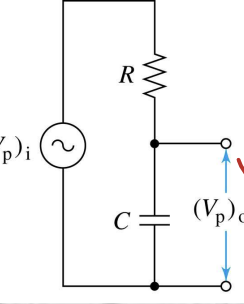
Low Pass Filter
Diode
conducts current in only one directions (semiconductor
Zener Diode
semiconductor that conducts in only reverse direction once threshold voltage is reached

Diode

zener diode
Converting AC to DC
Transformer, rectifier, filter/regulator

What does a transformer do
decreases voltage amplitude

Rectification
With diode, makes everything positive

Filtering/smoothing
With RC together, smooths out the distance between peaks

Regulate/stabilizer
With Zener diode with zero breakdown voltage
Amplification
increasing electronic signal
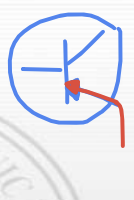
PNP Amplifier

NPN Amplifier
Gain
Signal out/signal in
Operational Amplifier (op amp)
complex arrangement of transistors
Issues with Basic amplifiers
Fragile, provide limited gain
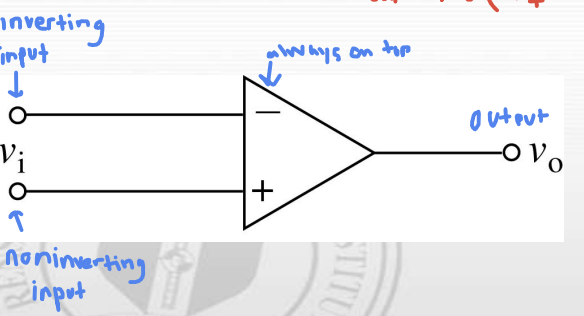
Op amp
Op amp properties
High gain (10^4-10^6), doesn’t draw much power from input, produces a ton of current, adjustable gain with feedback, can perform math operations

Positive feedback loop (less preferred)

Negative Feedback Loop

Comparator

Comparator Equation
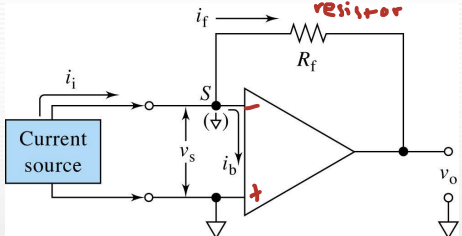
Current follower/current-to-voltage converter

Current follower/current-to-voltage converter equation

Voltage Follower

Voltage Follower Equation
What does a voltage follower do mathematically?
Multiplication/division

What does this do mathematically?
Addition or subtraction
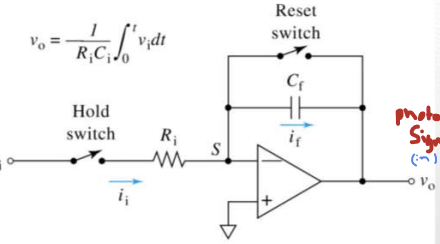
What does this do mathematically?
integration

What does this do mathematically?
Differentiation
Binary System
Two states: on/off
Components of digital system
Signal shaper, internal clock, gates
Signal Shaper
Comparator, differential amplifier with high gain