Physiology 4: Small intestine
 Call Kai
 Learn
Learn Practice Test
 Spaced Repetition
 Match
Match Flashcards
 Knowt Play
1/13

Earn XP
Description and Tags
Name | Mastery | Learn | Test | Matching | Spaced | Call with Kai | Chat |
|---|
No analytics yet
Send a link to your students to track their progress
14 Terms
What are the parts and the lengths of the small intestine?
Parts:
1) Duodenum
2) Jejunum
3) Ileum
Lengths:
During life is 3 meters
After death is 6 meters
What are the functions of the small intestine
Secretes intestinal juice, GIT hormones
Digestion as food stuff is completed in small intestine
Absorption of different food stuffs.
Motor function
What is the definition and routes of the absorption?
The passage of digested food form the lumen of GIT to the blood stream through GIT mucosa.
Routes:
Small intestine for: most sub.
Stomach for: Alcohol, drugs, water
Large intestine for electrolytes, drugs, and water
What are the factors affecting absorption?
1) Vitality of the mucosa
Depends on blood flow & O2 supply
2) Lymph flow:
Necessary for fat absorption
Obstruction of thoracic duct decreases fat absorption.
3) Digestion
Proper digestion → almost complete absorption
Maldigestion (in pancreatic insufficiency) → malabsorption
4) Area and time of contact with digested food with mucosa
Decreased area of contact with mucosa = decreased absorption
Decreased time of contact with mucosa e.g diarrhea = decreased absorption
5) Intestinal motility:
Increase absorption by increased blood and lymph flow and intraluminal pressure
6) Other factors:
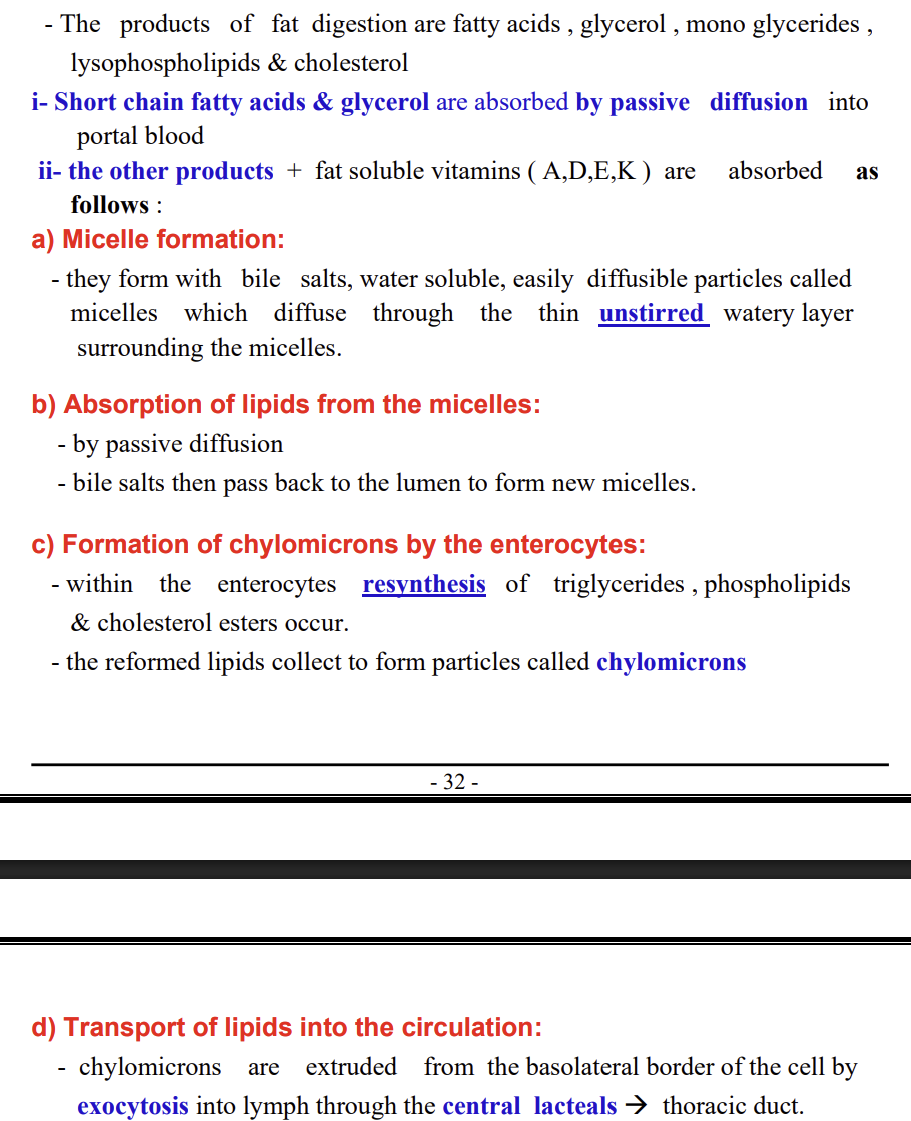
Bile salts aid in absorption of fat & fat soluble vitamins.
Intrinsic factors aid in absorption of B12.
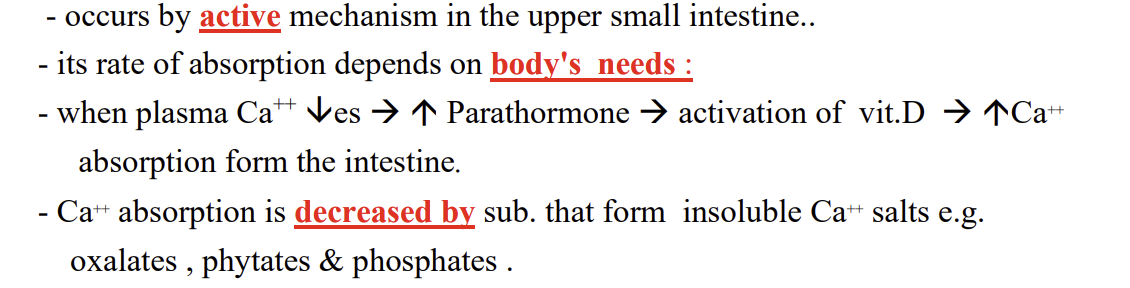
Parathormone & vit.D aid in absorption of Ca++.
Is the absorption of water an active or passive process?
Always passive as water follows during absorption of electrolytes & nutrients by osmosis.
Describe the process of the absorption of Na
Na+ is transported form the lumen into the enterocytes:
30% by Na-glucose transporter and Na-AA transporter.
30% by Na-Cl cotransporters
40% by special Na channels
Then Na is transported from the enterocytes to the intercellular spaces through the basolateral border by Na+, K+ pump
How does the absorption of K occur?
Occurs mainly passively according to concentration gradient from the lumen to the blood.
Describe the process of absorption of Ca
How does the process of iron occur?
Active mechanism, occur in the upper part of the small intestine
Describe the mechanism of iron absorption

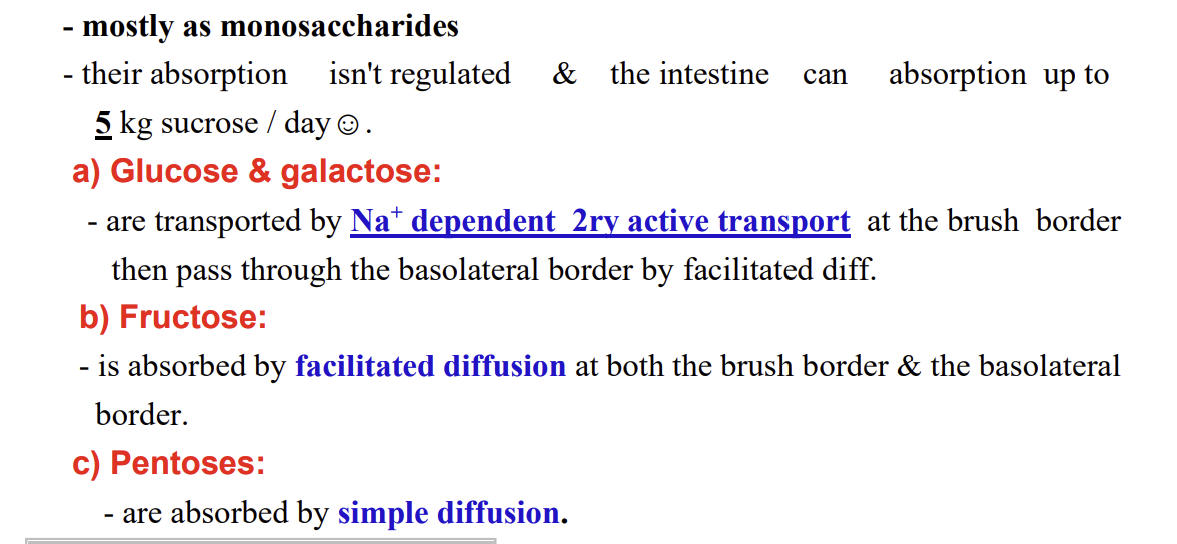
Describe the mechanism of carbohydrate absorption
Describe the mechanism of lipid absorption
Describe the mechanism of protein absorption

Describe the mechanism of vitamin absorption
