Chem Bonding
 Call Kai
 Learn
Learn Practice Test
 Spaced Repetition
 Match
Match Flashcards
 Knowt Play
1/120

There's no tags or description
Looks like no tags are added yet.
Name | Mastery | Learn | Test | Matching | Spaced | Call with Kai | Chat |
|---|
No analytics yet
Send a link to your students to track their progress
121 Terms
Radius size increases ______ and decreases ______.
down a group
along a period
Fluorine is the smallest and Francium is the biggest.
Metallic Bonds refer to …
Strong electrostatic forces of attraction between a lattice of metal cations and a sea of delocalised electrons.
How are metallic bonds formed?
In metals where metal atoms lose valence electrons to form metal cations. These valence electrons are delocalised.
Metals like copper are giant metallic structures which consist of a lattice of metal cations in a sea of delocalised electrons held together by strong metallic bonds.
What is a coordination number for a metallic compound?
The number of nearest neighbours of a central atom of interest.
Memorise: Factors affecting Metallic Bonds
The greater the number of valence electrons contributed to the sea of delocalised electrons, the stronger the metallic bonds.
Mg (Group 2) is stronger than Na (Group 1) because Mg contributes 2 electrons while Na only contributes 1 electron.
The larger the radius of the metal cation, the weaker the metallic bonds.
This is because the delocalised electrons are further away from the positive nuclei, causing the electrostatic forces of attraction between the electrons and positive nuclei to be weaker.
Memorise: Physical Properties of Metals
High melting and boiling points
The stronger the metallic bonds, the higher the melting / boiling points.
A large amount of energy is required to break the electrostatic forces of attraction between metal cations and the sea of delocalized electrons in the giant metallic lattice.
Good electrical conductors in both solid and molten states
Due to the presence of delocalised electrons to function as charge carriers to conduct electricity.
Good heat conductors
When heat is applied to one end of a piece of metal, kinetic energy of the electrons at that end increases. The energy is transferred by the delocalised electrons to other parts of the metal.
Malleable (can be hammered) and ductile (can be pulled into wires)
When a force is applied, the layers of metal atoms can easily slide over each other without breaking the metallic bonds, as they are easily reformed, and the metallic lattice is restored.
Definition: Alloy
Alloys are metals made by combining two or more metallic elements to make soft metals stronger and harder.
This is because atoms of other metals are different sizes, which disrupts the orderly arrangement of the main metal in the lattice, so that layers of atoms do not slide over each other easily.
Ionic bonds refer to…
Strong electrostatic forces of attraction between oppositely charged ions.
How are ionic bonds formed?
Between elements with a large electronegativity difference
Metal atoms lose electrons to form cations while non-metal atoms gain electrons to form anions to achieve a stable noble gas configuration.
Giant ionic lattice structures consist of oppositely charged ions held together by strong ionic bonds. The cations and anions are arranged alternatively to maximise attractive forces between oppositely charged ions and minimise repulsive forces between similarly charged ions.
What is coordination number for an ionic bond? What does it depend on?
The coordination number of an ion is determined by the total number of ions of opposite charge surrounding it. It depends on:
Relative charges of the ions (to reach electrical neutrality)
Relative sizes of the ions (smaller ions → lower coordination number)
Memorise: Why does CsCl have a different-looking lattice than NaCl?
The radius of the Cs+ ion is larger and cannot possibly fit into a simple cubic lattice structure. The larger radius of Cs+ allows more anions to surround it and thus, have a higher coordination number.
Memorise: Factors affecting Ionic Bonds
The strength of the ionic bond is indicated by the lattice energy, ΔHlatt, of an ionic compound.
The greater the magnitude of the lattice energy, the stronger the ionic bond.
The higher the charge, the larger the lattice energy.
The smaller the radius, the larger the lattice energy.
Memorise / Formula: Lattice Energy Formula (For Ionic Compounds)

Memorise: Physical Properties of Ionic Compounds
Very high melting and boiling points
A large amount of energy is required to break the electrostatic forces of attraction between oppositely charged ions in the giant ionic lattice.
Good electrical conductors only in aqueous or molten solutions
In aqueous and molten state, there are free mobile ions acting as charge carriers to conduct electricity.
In solid state, the ions can only vibrate about their fixed positions, and there are no free mobile ions to conduct electricity.
Hard
In an ionic solid, the oppositely charged ions are held together by strong electrostatic forces of attraction.
Brittle
When stress is applied on an ionic lattice, the layers of ions slide over each other, causing ions of similar charges to come together, and the repulsion shatters the ionic structure.
Soluble in polar solvents (e.g. water)
Insoluble in non-polar solvents
Memorise: Why are ionic compounds soluble in polar solvents (water)?
When an ionic compound interacts with water in a process known as hydration, polar water molecules are attracted to the ions, forming ion-dipole interactions (exothermic).
The ion-dipole interactions formed between ions and water molecules releases sufficient energy to overcome the ionic bonds between oppositely charged ions as well as the hydrogen bonds between water molecules. This causes the ionic lattice of the solid to break down and the ionic compound dissolves.
Hence, ionic compounds are soluble in water.
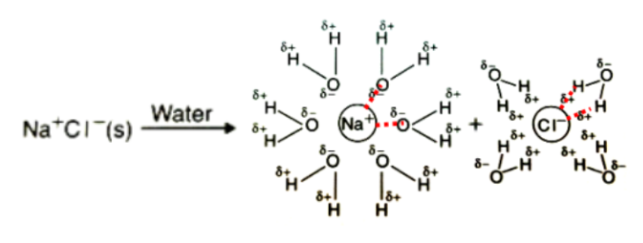
Memorise: Why are ionic compounds insoluble in non-polar solvents?
The interaction between the ions and solvent molecules is not as strong and releases insufficient energy to overcome the ionic bonds between the oppositely charged ions and the attractions between solvent molecules.
When does covalent character in ionic bonds arise?
Due to the distortion / polarisation of the anion electron cloud by the cation in an ionic compound

Memorise: Factors affecting covalent character in ionic bond / polarisation of electron cloud
The greater the extent of polarisation, the greater the covalent character in the ionic bond.
The extent of polarisation depends on the polarising power of the cation and the polarisability of the anion.
The extent of covalent character increases when the cation is small and highly charged, resulting in a high charge density, q/r causing a high polarising power and when the anion is larger, which causes a higher polarisibility.
Example: Determine whether SrCl2 or MgCl2 has a greater covalent character.
The ionic charge of both Mg2+ and Sr2+ is +2.
The ionic radius of Mg2+ < Sr2+.
Charge density q/r and polarising power: Mg2+
Extent of polarisation of the Cl- electron cloud: Mg2+ > Sr2+
Hence, covalent character in ionic bonds: MgCl2 > SrCl2
Memorise: Explain why AlBr3 exists as a simple molecular structure whereas AlF3 is a giant ionic in nature.
Al3+ has a small radius and a high charge.
Al3+ has a high charge density and high polarising power to polarise the electron cloud of the large Br- anion to a large extent that the Al-Br bonds become covalent.
Although the charge density of Al3+ is high, the small anion F- is not easily polarisable, making AlF3 ionic in nature.
Covalent Bonds refer to…
Electrostatic forces of attraction between a shared pair of electrons and the positively charged nuclei..
How is a covalent bond formed?
Sharing a pair of electrons, and are formed between elements of small electronegativity difference, such as between non-metals to achieve the stable noble gas configuration
Covalent bonding arises from the overlapping of valence orbitals, which can either occur ______ or _______
head-on
sideways
Memorise: σ bond
When the valence orbitals overlap head-on with one another, a σ bond is formed.
σ bonds can be formed from overlapping of the s orbitals, p orbitals or hybrid orbitals.
It can be between the same type of orbitals or different types of orbitals.
Example: σ bonds
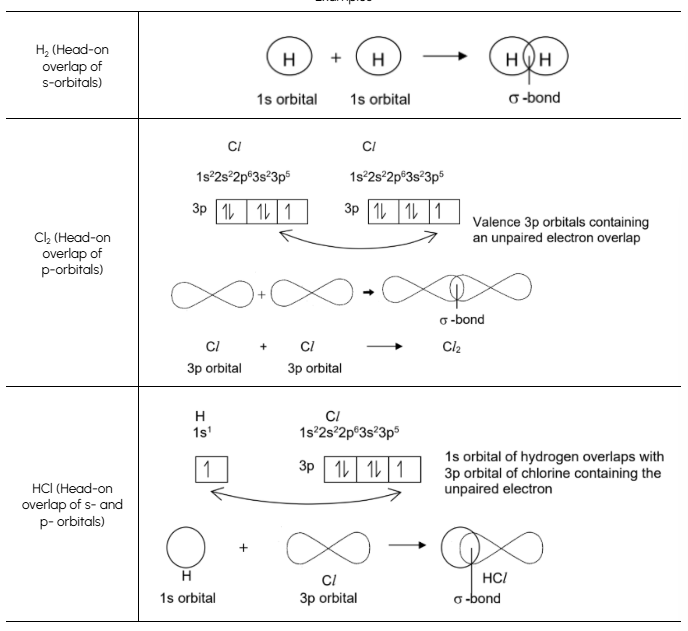
Memorise: π bond
A π bond is formed when parallel valence p orbitals overlap sideways with one another.
Although the π bond has two lobes of electron clouds above and below the inter-nuclear axis, it constitutes only one bond.
A double bond consists of one σ bond and one π bond.
π bonds are only formed after the σ bond has been formed to ensure that the two atoms are close enough for sideway overlap.
A triple bond consists of one σ bond and two π bonds.
Example: π bonds

Memorise: How many σ bonds and π bonds are there in a single, double and triple bond?

Definition: Bond order
Number of covalent bonds formed between 2 atoms
Definition: Dative Bond
A dative bond is a covalent bond in which the shared pair of electrons is provided by only one of the bonded atoms.
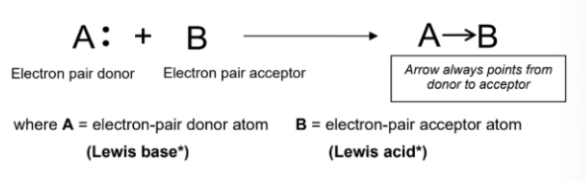
How are dative bonds different from covalent bonds?
A dative bond, once formed, is no different from the usual covalent bond.
Memorise: What are the requirements for dative bonds to occur?
1. The donor atom must have at least one lone pair of electrons in its valence shell.
2. The acceptor atom must have a vacant and energetically accessible orbital in order to accept the lone pair of electrons.
Memorise / Example: Dative Bonds
Example 1: Ammonium ion, NH4+

N in NH3 has a lone pair of electrons and acts as the donor atom while H+ accepts the lone pair of electrons.
Example 2: Ammonia-boron trifluoride, BF3.NH3 (adduct)

B in BF3 is electron deficient and accepts the lone pair of electrons from N in NH3 via a dative bond to attain a stable octet configuration.
Example 3: Al2Cl6

Al in AlC3 is electron deficient and accepts a lone pair of electrons from Cl in another AlCl3 molecule via a dative bond to attain a stable octet configuration. There are two dative bonds present in Al2Cl6.

At r.t.p., solid aluminium chloride has an ionic lattice with covalent character. In dilute aqueous state, aluminium chloride dissociates to form Al3+ (aq) and Cl- (aq). In non-polar organic solvents, aluminium chloride exists as the dimer, Al2Cl6.
Memorise: Factors affecting covalent bonds
The greater the extent of orbital overlap, the more effective the orbital lap and hence, the stronger the covalent bond.
A σ bond is stronger than a π bond as there is greater overlap of valence orbitals.
The shorter the bond length, the stronger the bond. (small radius)
The greater the bond energy, the stronger the bond. (check in Data Booklet)
The greater the bond order, the stronger the bond.
Triple bond > Double bond > Single bond
Definition: Bond Length
The distance (nm) between two nuclei in a covalent bond.
Definition: Bond Energy
Average energy required to break one mole of the covalent bond in the gas phase into constituent gaseous atoms under standard conditions.
Definition: Bond Polarity
A measure of how equally the electrons are shared between the two bonded atoms, which depends on the difference in electronegativity between the atoms.
Bond Polarity depends on the difference in ______ between atoms in a covalent bond.
electronegativity
In a covalent bond:
If the two atoms have the same electronegativity, the bonding electrons are ________ and a _____ is formed.
equally shared
non-polar covalent bond
In a covalent bond:
If the two atoms have different electronegativity, the bonding electrons are ___________ and a ________ is formed.
not equally shared
polar covalent bond
Memorise: How is a dipole formed? (covalent)
The atom with a greater electronativity pulls the electrons of the covalent bond towards itself, causing it to acquire a partial negative charge, δ-.
The other atom is depleted of electrons and acquires a partial positive charge, δ+.
The permanent partial separation of charges results in the formation of a dipole.
Definition: Dipole Moment
Measure of the separation of charges between the partial positive and negative ends in one covalent bond, and the extent of polarisation or distortion of electron clouds of a covalent bond.
Dipole moments are ___ quantities and are denoted by __ pointing from the _____ to the ____ atom along the bond. (covalent)
vector
⇸
δ+
δ-

Memorise: What does the magnitude of a dipole moment depend on? / How do we know how polar a covalent bond is?
Difference in electronegativity between the two atoms sharing the covalent bond.
The greater the electronegativity difference, the larger the dipole moment and hence, the more polar the covalent bond.
Example: Which is more polar, the C-Cl or C-I bond?
The C-Cl bond is more polar than the C-I bond because there is a larger electronegativity difference between C and Cl compared to C and I.
Electronegativity increases _____ and decreases _______
across a period
down a group
A giant molecular structure consists of…
numerous strong covalent bonds holding the atoms together in an infinite way
Name some giant molecular structures.
Diamond
Graphite
Silicon
Silicon dioxide
Silicon carbide
Boron nitride
Memorise: Structure of Diamond
Allotrope of carbon
Giant molecular structure where each carbon is joined by strong covalent bonds to four other atoms in a tetrahedral arrangement with a bond angle of 109.5
Memorise: Structure of SiO2
Occurs in quartz
Each Si atom is tetrahedrally bonded to four other O atoms while each O atom is bonded to two Si atoms
Memorise: Structure of Graphite
Allotrope of carbon
Giant molecular structure
Within each layer, each carbon atom forms strong covalent bonds with three other carbon atoms in a trigonal arrangement with a bond angle of 120, using three of its valence electrons
The fourth electron from the outer shell of the C atom is delocalised in a π-bond that extends over the whole layer
Memorise: Physical Properties of Diamond and SiO2
High Melting / Boiling Point → due to large amount of energy needed to break the numerous strong covalent bonds between the atoms in the giant molecular structure
Very hard → due to the very strong carbon-carbon / silicon-oxygen covalent bonds and the rigid tetrahedral structure
Does not conduct electricity → has no mobile delocalised electrons as all valence electrons are localised in the covalent bonds
Does not dissolve in water → energy released from the formation of instantaneous dipole-induced dipole interactions between water molecules and atoms is insufficient to overcome the strong covalent bonds between atoms
Memorise: Physical Properties of Graphite
High Melting / Boiling Point → due to large amount of energy needed to break the numerous strong covalent bonds between the atoms within each layer as well as the instantaneous dipole-induced dipole attractions between layers in the giant molecular structure
Slippery → layers of graphite can slide over each other by breaking the weak instantaneous dipole-induced dipole attractions between the layers
Good electrical conductor parallel to layers → presence of mobile delocalised electrons within each plane of carbon atoms
Does not conduct electricity perpendicular to layers → delocalised electrons cannot move across the layers
Does not dissolve in water → energy released from the formation of instantaneous dipole-induced dipole interactions between water molecules and atoms is insufficient to overcome the strong covalent bonds between atoms
What is diamond used for?
Drilling, cutting, grinding
What is graphite used for?
Lubricant
Lead in Pencils
Drawing: Diamond

Drawing: SiO2

Drawing: Graphite

Explain the bonds within the similar molecular structure. Example: I2
Within each molecule, the atoms are joined together by strong covalent bonds.
The separate molecules are attracted to each other by weak intermolecular forces of attraction.
Iodine solid has a simple molecular structure. The I2 molecules are held together by weak instantaneous dipole-induced dipole attractions.

Memorise / Drawing: Step-by-Step on drawing covalent dot-and-cross
Draw the central atom, which is usually the atom that needs the greatest number of electrons to be stable.
If it is a cation, for each positive charge, remove 1 electron from the less electronegative atom.
If it is an anion, for each negative charge, add 1 electron to the more electronegative atom.Complete the valence shell of each atom via covalent bond formation.
Elements with one to four valence electrons form the same number of covalent bonds as the number of valence electrons it has.
For period 2 atoms, if the number of valence electrons is greater than 4, it forms the number of covalent bonds to the number of electrons it requires to gain an octet. (e.g. N has 5e → requires 3 bonds, O has 6e → requires 2 bonds, F has 7e → requires 1 bond)
ALWAYS TRY SINGLE COVALENT BONDS FIRST, followed by double and triple bonds to attain the octet. Dative bond is assigned the last, in particular for elements which cannot expand octet configuration (Period 2).
Check that all valence electrons for each atom have been accounted for and remember to draw any lone pairs.
Definition: Bond Pair
In a covalent compound, an electron pair that is shared between the bonded atoms is called a bond pair.
Definition: Lone Pair
An electron pair that is part of an atom’s valence shell but not ‘shared’ with another atom is called a lone pair.
Memorise / Drawing: Exceptions to octet rule when drawing covalent dot-and-cross
Molecules with a central atom of < 8 valence electrons.
Groups 2 and 13 elements (Be, B, Al) may form molecules with central atoms of < 8 valence electrons.
BCl3
Molecules with a central atom of > 8 valence electrons
Elements in Period 3 onwards can expand their octet structure.
In PCl5, the central atom P is a Period 3 element and has energetically accessible vacant 3d orbitals, which it can use to accommodate the extra electrons.
In contrast, the elements in Period 2 like N cannot expand its octet structure due to the absence of energetically accessible vacant orbitals in its valence shell, and hence, can only hold a maximum of 8.
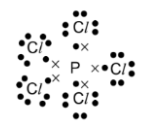
Molecules with a central atom having unpaired electrons
Such species are called radicals and are extremely reactive
NO
Drawing / Memorise / Practice: Attempt these dot-and-cross drawings.
Must know | |
SO32- | NO2 |
HSO3- | N2H4 |
SO42- | NO2+ |
HSO4- | NO3- |
H2SO4 | N2O4 |
N2H5+ | N2O5 |
CO32- | H2CO3 |
HCO3- | H2O2 |
Al2Cl6 | NH4+ |
CN- | CO |
NO | PCl5 |
SF6 | BF3 |
NH4+ | NH4Cl |
(NH4)2SO4 | CaCO3 |
What are the shapes of covalent molecules determined by?
Number and arrangement of electron pairs around the central atom.
Definition: Valence Shell Electron Pair Repulsion (VSEPR) Theory
Electron pairs in the outer / valence shell of the central atom arrange themselves as far as possible to minimise repulsion and maximise stability. (shape of molecule)
The strength of repulsion between electron pairs decreases in the order:
Lone pair-Lone pair repulsion > Lone pair-Bond pair repulsion > Bond pair-Bond pair repulsionA central atom, which is more electronegative, will give rise to a larger electronic repulsion between two bond pairs, hence larger bond angle between the bond pairs.
A multiple bond (double / triple) can be considered to be like a single bond.
Memorise: Step-by-Step on explaining shapes and bond angles using VSEPR
State number of electron pairs in the outer / valence shell of the central atom.
Apply VSEPR 1 to determine electron geometry → To minimise repulsion and maximise stability, the electron geometry for:
2 electron pairs → linear
3 electron pairs → trigonal planar
4 electron pairs → tetrahedral
5 electron pairs → trigonal bipyramidal
6 electron pairs → octahedral
State the number of bond and lone pairs and the shape.
Apply VSEPR 2 to determine bond angle.
If 1 lone pair, lone pair-bond pair repulsion > bond pair-bond pair repulsion
If 2 lone pairs, lone pair-lone pair repulsion > lone pair-bond pair repulsion > bond pair-bond pair repulsion
State bond angle.
#The more lone pairs around the central atom, the smaller the bond angle.
#The more electronegative the central atom, the larger the bond angle. (H2O > H2S)
#The more electronegative the NON-central atoms, the smaller the bond angle. (H2O > F2O)
Memorise: What is the electron geometry for the following:
2 electron pairs →
3 electron pairs →
4 electron pairs →
5 electron pairs →
6 electron pairs →
2 electron pairs → linear
3 electron pairs → trigonal planar
4 electron pairs → tetrahedral
5 electron pairs → trigonal bipyramidal
6 electron pairs → octahedral
Memorise / Drawing: 2 bond pairs, 0 lone pairs → State the shape, bond angle and an example.
Linear
180
Cl — Be — Cl, O = C = O

Memorise / Drawing: 3 bond pairs, 0 lone pairs → State the shape, bond angle and an example.
Trigonal Planar
120
BF3, AlCl3, CO32-

Memorise / Drawing: 2 bond pairs, 1 lone pairs → State the shape, bond angle and an example.
Bent
< 120
SnCl2, SO2

Memorise / Drawing: 4 bond pairs, 0 lone pairs → State the shape, bond angle and an example.
Tetrahedral
109.5
CH4, NH4+
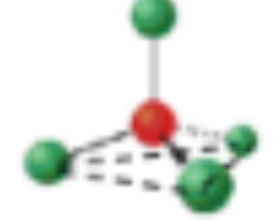
Memorise / Drawing: 3 bond pairs, 1 lone pairs → State the shape, bond angle and an example.
Trigonal Pyramidal
< 109.5
NH3 (107)
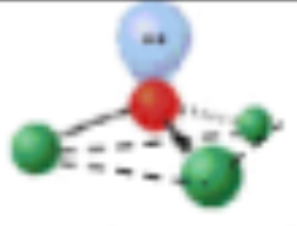
Memorise / Drawing: 2 bond pairs, 2 lone pairs → State the shape, bond angle and an example.
Bent
< 109.5
H2O (104.5)

Memorise / Drawing: 5 bond pairs, 0 lone pairs → State the shape, bond angle and an example.
Trigonal bipyramidal
120, 90
PCl5
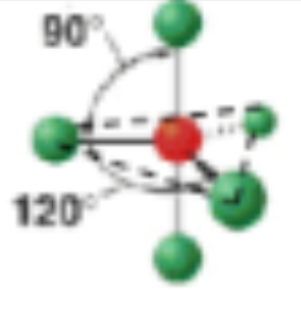
Memorise / Drawing: 4 bond pairs, 1 lone pairs → State the shape, bond angle and an example.
Seesaw
< 120, < 90
SF4

Memorise / Drawing: 3 bond pairs, 2 lone pairs → State the shape, bond angle and an example.
T-shaped
< 90
ClF3

Memorise / Drawing: 2 bond pairs, 3 lone pairs → State the shape, bond angle and an example.
Linear
180
ICl2, XeF2

Memorise / Drawing: 6 bond pairs, 0 lone pairs → State the shape, bond angle and an example.
Octahedral
90
SF6

Memorise / Drawing: 5 bond pairs, 1 lone pairs → State the shape, bond angle and an example.
Square pyramidal
< 90
BrF5
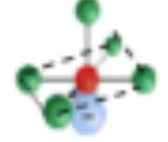
Memorise / Drawing: 4 bond pairs, 2 lone pairs → State the shape, bond angle and an example.
Square planar
90
XeF4, ICl4-

Example: Why does CH4 have a different bond angle than NH3?
Although they have the same number of electron pairs, NH3 has a smaller bond angle than CH4 because of the greater repulsion between lone pair and bond pair of electrons, which forces the bond pairs closer together, resulting in a smaller bond angle of 107 degrees.
Example: Predict the shape and bond angle of BF3.NF3 (adduct) with reasoning.
There are 4 electron pairs in the valence shell of both the B and the N atom.
To minimise repulsion and maximise stability, the electron geometry is tetrahedral.
Since there are 4 bond pairs and 0 lone pairs, the shape is tetrahedral with respect to both the B and N central atoms.
The bond angle is 109.5 degrees.

Example: Predict the shape and bond angle of H2O with reasoning.
There are 4 electron pairs in the valence shell of the central O atom.
To minimise repulsion and maximise stability, the electron geometry is tetrahedral.
Since there are 2 bond pairs and 2 lone pairs, the shape is bent.
The bond angle is 104.5 degrees because lone pair-lone pair repulsion > lone pair-bond pair repulsion > bond pair-bond pair repulsion. The bond pairs of electrons are forced closer together resulting in a smaller bond angle.
Example / Memorise: Compare the difference in bond angles of H2O and H2S.
Since O is more electronegative than S, the bond pairs of H2O are drawn closer to the central atom O than the central atom of H2S.
There is a higher electron density around O and bond pairs in H2O experience a greater repulsion.
Hence, the bond angle of H2O is larger than in H2S.
Example / Memorise: Why does F2O have a smaller bond angle than H2O?
Since F is more electronegative than H, the bond pairs of F2O are drawn closer to each other (F).
There is a lower electron density around O and the bond pairs in F2O experience a lesser repulsion.
Hence, the bond angle of F2O is smaller than in H2O.
The terms ‘polar’ and ‘non-polar’ do not apply to ______ like NH4+, CO32-, SO42-.
polyatomic ions
Memorise: Method to determine overall polarity of molecules

Memorise: How is the net dipole moment obtained?
The net dipole moment is obtained by resolving the individual dipole moments of each polar bond.
If the dipole moments do not cancel out, it has a net dipole moment → polar
If the dipole moments cancel out, the molecule has NO dipole moment → non-polar
Memorise: Which shapes net dipole moments cancel out and do not cancel out?
If the dipole moments do not cancel out, it has a net dipole moment → polar
If the dipole moments cancel out, the molecule has NO dipole moment → non-polar

Memorise: Which shapes are polar? / Which shapes dipole moments do NOT cancel out?
Bent
Trigonal Pyramidal
See-Saw
T-Shaped
Square Pyramidal
Example: Is NH3 polar?
Since N and H have different electronegativity, the N-H bond is polar.
The shape of the molecule is trigonal pyramidal.
Hence, the dipole moments in the molecule do not cancel out.
There is a net dipole moment.
NH3 is a polar molecule.

Permanent Dipole-Permanent Dipole attractions are only for ____ molecules.
polar
Instantaneous Dipole-Induced Dipole attractions are for ____ molecules.
all
Definition: Instantaneous Dipole-Induced Dipole
Electrostatic force of attraction between the instantaneous dipoles and induced dipoles present in molecules.
Though these are present in BOTH polar and non-polar, it is only significant for non-polar molecules like Br2 and CCl4.
Memorise: How do ID-ID arise?
ID-ID arise when the electrons in a molecule are in continual motion.
At any point in time, the electron distribution may be slightly displaced towards one side of an atom or molecule, making that side slightly negative and the opposite side slightly positive, creating an instantaneous dipole.
This dipole will induce dipoles in neighbouring molecules giving rise to id-id dipole attractions.
Memorise: Factors affecting ID-ID
Greater size of electron cloud / Mr → Stronger ID-ID
Greater the extent of distortion / polarisation of the electron cloud
Stronger and more extensive ID-ID attractions
Greater surface area of contact / Straight chain → Stronger ID-ID
Straight chains have greater surface area of contact between the molecules compared to branched molecules, which are more spherical
More extensive ID-ID attractions
Definition: Permanent Dipole-Permanent Dipole
Electrostatic forces of attraction between permanent dipoles of polar molecules
Memorise: Factors affecting PD-PD
Greater the dipole moment (greater polarity: electronegativity difference / presence of lone pairs) → Stronger PD-PD
Definition / Drawing: Hydrogen Bonding
Electrostatic forces of attraction between an H atom covalently bonded to a highly electronegative atom (N, O, F) and a lone pair of electrons on a second highly electronegative atom. (N, O, F)
