Aquatics K3: Organisms (minus macroinvertebrate ID)
 Call Kai
 Learn
Learn Practice Test
 Spaced Repetition
 Match
Match Flashcards
 Knowt Play
1/45

There's no tags or description
Looks like no tags are added yet.
Name | Mastery | Learn | Test | Matching | Spaced | Call with Kai | Chat |
|---|
No analytics yet
Send a link to your students to track their progress
46 Terms
nares
Similar to nostrils, but used for smelling only (no breathing)
Operculum
Bony flap that protects the gills from harm. Opens and closes to allow water to pass over the gills
Pectoral Fin
Allows for abrupt changes in side-to-side direction and speed. Brake to decrease speed while swimming.
Pelvic Fin
Stabilizes fish while swimming and allows for up-and-down movement in the water.
Vent
Removes waste and extra water. Outlet for eggs or milt (sperm) during spawning.
Anal Fin
Stabilizes fish while swimming
Caudal Fin
Moves, propels, or pushes the fish through the water.
Adipose Fin
not present on a lot of fish species. Unknown purpose. Trout, salmon, and catfish have an adipose fin. Small thick, fleshy fin located between dorsal and caudal fins
Dorsal Fin
Maintain balance while swimming
Barbels
“Whiskers” found on the head area of fish such as catfish or bullheads. Sensory organ to help track down prey or food. Sturgeon also have barbels.
Swim Bladder
Long, skinny organ that can inflate/deflate with air to allow fish to swim at different levels in the water column.
otoliths
Fish have pairs of inner ear bones called otoliths that allow them to sense sounds in the water. Fisheries biologists can also use otoliths to age fish and determine the health of fish populations.
Lateral line
Senses vibrations or movements in the water. Allows fish to locate predators and find prey.
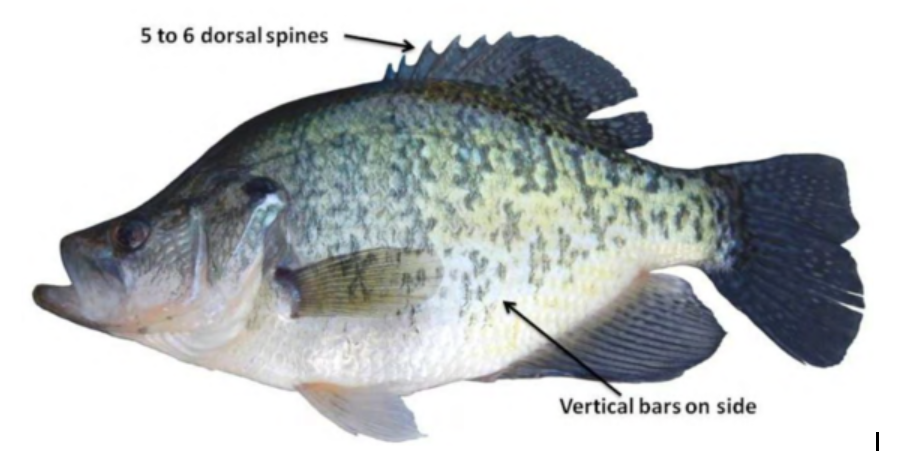
white crappie (Pomoxis annularis)
Other names: white perch, Sac-a-lait, Slab, and Papermouth
Description
Deep-bodied and silvery color
silvery -white to silvery/dark green from belly to back, may have possible blue reflections
Dark vertical bars on the sides
Males have dark coloration on through and head during spring spawning season → may mistake them for black crappie
Five or six spines on the dorsal fin
Black crappie has seven to eight spines
1-3 lbs
14 inches or more
Live up to 10 years
Habits and Habitats
Adults feed on small fish and insects
Crappies prefer deep water near drop offs/areas of cover
Found in many different types of habitats
Reservoirs, oxbow lakes, and rivers
Like other members of sunfish family, they are nest builders
Produce many eggs
Causes overpopulation, slow growth, and small sizes in small lakes and ponds
Spawn from March through May w/ water temperatures b/w 58-65 degrees Fahrenheit
Can tolerate muddier water than black crappie
State Record
Caught by Fred Bright from Memphis, Tennessee in 1957 from Enid Lake
5 lbs 3 oz
21 inches in length
Fishing Fact
Popular baits
Jigs, small crank baits, and minnows
Found around structures like
Logs, brush piles, and cypress trees
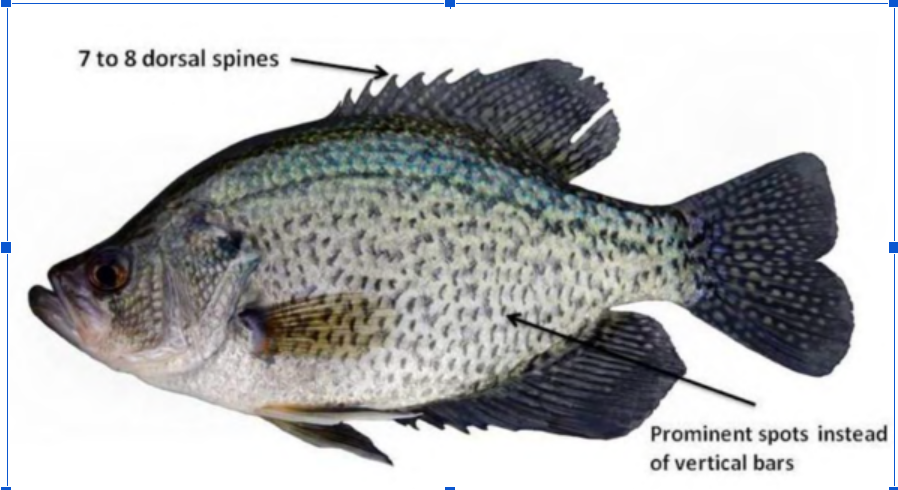
Black Crappie (Pomoxis nigromaculatus)
Other names: White perch, calico bass, speck, strawberry bass, papermouth, speckled perch and slab
Description
More deeper bodied than white crappie
White or silver underneath
Bluish green or gray on top
Irregular black spots on body
“Blackstripe” or “blacknose” crappies are a genetic color variation with a distinctive dark strip from top dorsal fin to under mouth
Seven or eight spines on dorsal fin
1-3 lbs
12 inches or more
Live up to 10 years
Habits and Habitat
Most active at night/early morning
Adults feed on insects, insect larvae, and fish (sunfish and minnows)
Prefer shallow water lakes and sloughs and are abundant where there is clear water and aquatic vegetation
Spawn in early spring with water temperatures b/w 58-65 degrees fahrenheit
State Record
Mississippi’s Rod and Reel record is 4 lbs 4oz
Caught in 1991 at Arkabutla Lake by Gerald Conlee
Fishing Fact
Same baits as white crappie
how to tell difference b/w white and black crappie
white: 5-6 spines on dorsal fin
black: 7-8 spines on dorsal fin; more deeper-bodied than white crappie
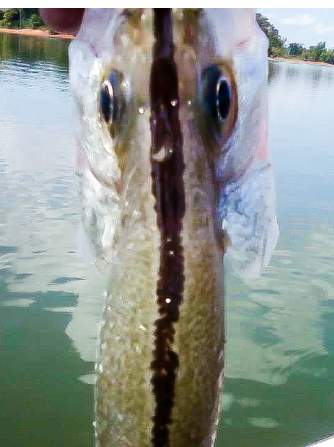
“Blackstripe” or “blacknose” crappies; genetic color variation of black crappie with a distinctive dark strip from top dorsal fin to under mouth
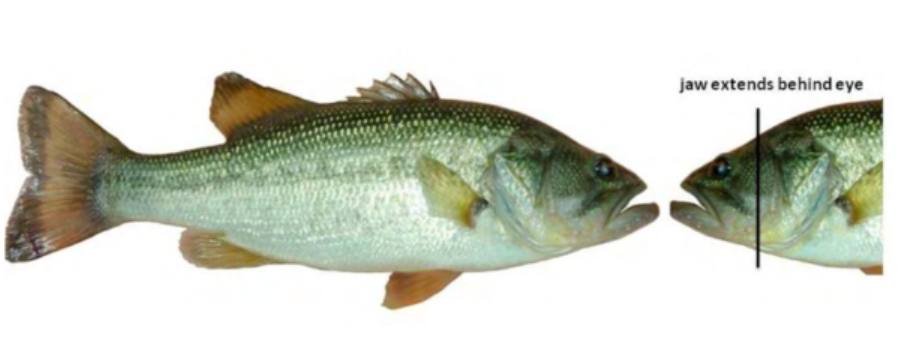
Largemouth Bass (Micropterus salmoides)
Other names: Green trout, bigmouth bass, bucketmouth bass and hog
Description
Two subspecies in Mississippi
Northern Largemouth bass (Micropterus salmoides salmoides) native to MS
Florida Largemouth bass (Micropterus salmoides floridanus) was introduced
Green w/ dark blotches that form a horizontal stripe along the middle of the fish
Underside light green to almost white
Upper jaw extends far beyond the rear margin of the eye
Weight greater than 10 to 15 lbs
Females grow faster and larger than males
26 inches
Females can live 10-12 years and males live 5-7 years
Habits and Habitat
Adults feed almost exclusively on other fish, insects, and large invertebrates such as crayfish
Protective cover
Logs, vegetation, rocks, man-made structures
Prefer slow moving water
Can still survive in wide variety of habitats: streams, rivers, lakes, and reservoirs
Spawning in spring with 60 to 75 degree fahrenheit water temp
Males build nests, care for nest, protect it from predators, and fan eggs until they hatch
Next to brush piles, underwater logs, under overhanging tree limbs
Guards young for a week or more after the hatch
State Record
MS Rod and Reel record is 18.15 lbs
1992 in Natchez State Park Lake by Anthony Denny
Fishing Fact
Spring through fall during evenings or mornings
Minnows, artificial baits, and even frogs
MISSISSIPPI's STATE FISH
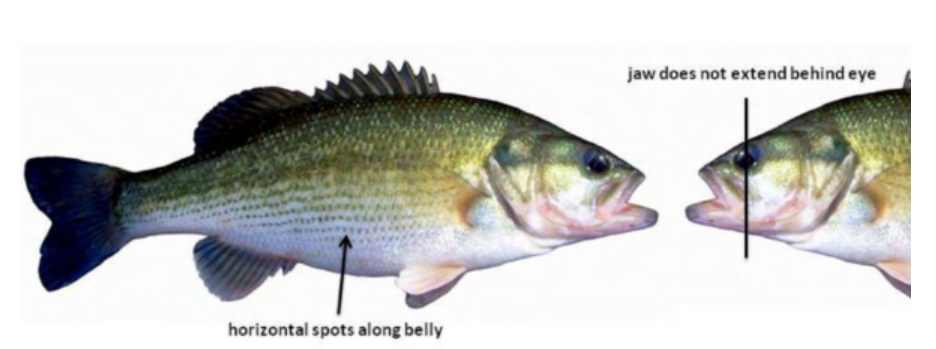
Spotted Bass (Micropterus punctulatus)
Spotted Bass (Micropterus punctulatus)
Other names: Kentucky bass, diamond bass, creek bass, red-eye bass, and spot
Description
Slender w/ rose of dark spots on lower belly → horizontal streaks
Diamond-shaped blotches
Dark mottling back against an olive green color
Top and sides is dark
Underside is white
24 inches; but usually smaller than largemouth or smallmouth bass
Live no longer than six years
Females live longer and grow faster than males
Habits and Habitat
Diet changes as fish grows
Plankton, small aquatic insects, and small crustaceans
To larger aquatic and terrestrial insects, crayfish, and small fish
Live in streams and rivers
Prefer faster waters than largemouth bass
Adapted well to reservoirs and often found around rocks or rip-rap
Spawn in mid-April through June
63 fahrenheit to 78
Female and male mature at age 2 years old
Like other bass they are nest spawners
Males build and guard nests till eggs hatch
State Record
MS Rod and Reel 8 lbs 2 oz
Farm pond in 1975 by S. R. Grantham
Fishing Fact
Spinner baits, jigs, crank baits, plastic worms, and live worms
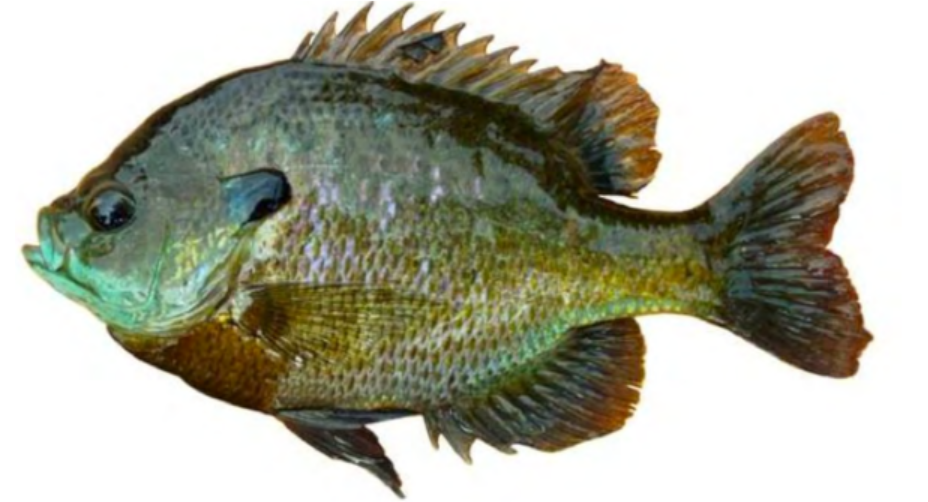
Bluegill (Lepomis macrochirus)
Other names: Bream (Brim), coppernose, copperhead, bull bream, blue sunfish, and blue joe
Description
Deep bodied
Dark olive green with distinctive black spot on the dorsal fin
Intense colors on breeding males
Sides are blue or silver w/ vertical stripes
Belly is yellow, silver, or white
Coppernose bluegill is Florida subspecies
Fins have whitish margins and head displays copper patch
Smaller impoundments S and central portions of MS
½ to 1 lbs
Live up to seven years
Habits and Habitat
Prefer vegetated waters of shallow lakes and ponds
Feed on insect larvae
65 degrees temp to spawn and spawn multiple times during the summer
Community spawners with nests located close together
No nests in heavily vegetated areas
Males compete, sweep away sand, and expose coarse gravel for nesting sites
State Record
3.45 lbs
Gerald E. Thurmond in a farm pond in 1995
Fishing Fact
Scrappy fight
Crickets, earthworms, and small artificials (spinners and flies)
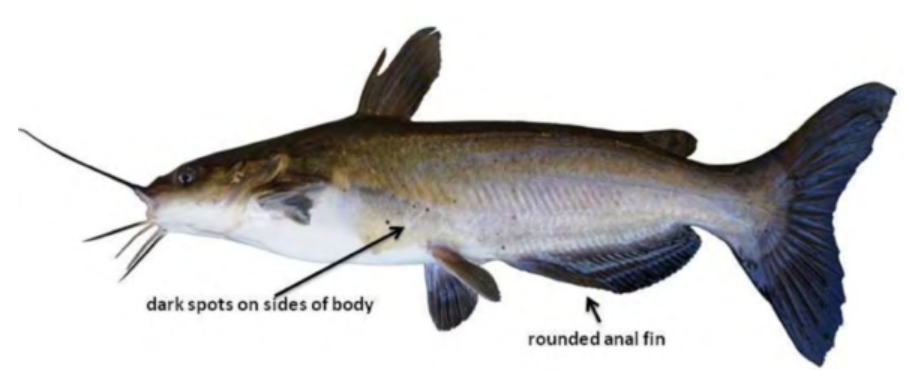
Channel Catfish (Ictalurus punctatus)
Fiddler, willow cat, speckled cat, spotted cat, government cat, and river cat
Description
Elongated bodies w/ white belly and olive/brown body
Deeply forked tail, barbels, and black spots on side and tail
Channel catfish have rounded anal fin and dark spots on the body
Compared to blue catfish which have straight anal fin
5-10 lbs
Up to 50 inches
Live around 6-10 years but can live longer
Habits and Habitat
Feed on insect larvae, crustaceans, crawfish, and small fish such as gizzard shad and minnows
Active at night in streams, rivers, oxbow lakes, and ponds
Spawn late spring to early summer 60 to 75 degree fahrenheit water
Raise commercially in Delta and other areas of the state
Raised in small lakes/ponds
If over-stocked in bass-bream ponds → poor growth for fish and muddy water
State Record
51 lbs 12 oz
Tom Edwards at Lake Tom Bailey in 1997
Fishing Fact
Hand grabbing, jugs, limblines, rod and reels, and trotlines
Liver, stink baits, cut fishes, and worms
Rarely ever caught on artificials
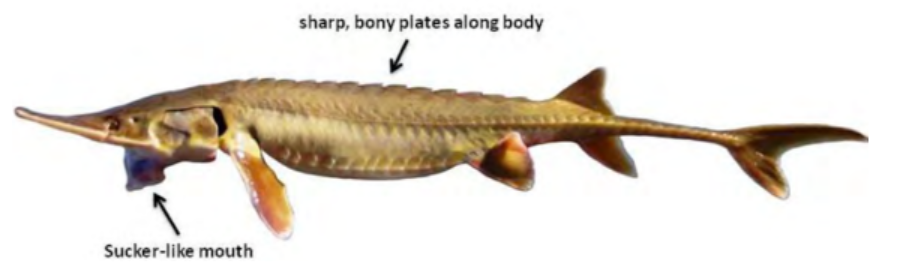
Shovelnose Sturgeon (Scaphirhynchus platorynchus)
Hackleback sturgeon
Description
Rows of sharp, bony plates along elongated body, strongly forked tail, spade-shaped snout, sucker-like mouth, and four barbels
brown/olive colored w/ cream belly
22-26 inches
Long lived and reach sexual maturity at age 5-10 years
Do not spawn every year
Habits and Habitat
Mississippi River
Deep water with moderately strong current
Feed on bottom and eat aquatic insects
Spring spawning with 63-70 degrees fahrenheit over gravel and sand substrate
State Record
No record because harvest of shovelnose sturgeon is illegal
Fishing Fact
Sometimes caught by anglers running trotlines for catfish
Abundant in MS river but historically have been harvested for their roe for caviar
Listed as threatened under U.S. Fish and Wildlife Service due to similar appearance with endangered pallid sturgeon
Harvest of all sturgeon species is prohibited
Diadromous fishes
describe species that spend part of their lives in freshwater and part in saltwater
Two categories of diadromous fishes: Catadromous and anadromous
Catadromous fishes
hatch/born in marine habitats, but migrate to freshwater areas to spend the majority of their lives maturing/growing → return to sea to spawn
Catadromous “downward-running”
Anadromous fishes
hatch/juvenile in freshwater → migrate to mature in ocean → migrate back up rivers to reproduce in freshwater habitats
Anadromous “upward-running”
Freshwater fish are hyperosmotic to the environment
Actively take ions across gills and skin using energy
Excrete nitrogenous waste products in great quantities (highly diluted urine) to rid excess water
Marine Fishes lose water to ocean and gain ions from it
increase their drinking rate & extrete smaller amounts of highly concentrated urine
Eliminate excess ions through specialized salt-excretion cells in gills and in lining of mouth
Factors that are decreasing the population of anadromous species
Estuarine habitats are under threat
Increased river pollution damages critical spawning habitats
Building of dams or man-made barriers makes upward migration difficult
Overfishing of commercially important species
biomonitoring
Biomonitoring is the use of organisms to assess the overall quality of their environment or habitat
why do we use macroinvertebrates for WQ and biomonitoring?
Macroinvertebrates are better reflections of long-term water quality compared to single chemical sample b/c they have limited mobility and cannot escape pollution
What affects macroinvertebrate communities?
Streamflow, geology, elevation, temperature, dissolved oxygen, seasonal life cycle patterns, substrate, and riparian habitat influence abundance and diversity of macroinvertebrates
how do humans affect macroinvertebrate communities?
Human changes: increased pollution, land use changes that modify channel structure or contribute to nonpoint source into waterbody
Macroinvertebrate multimetric index (MMI)
Macroinvertebrate multimetric index (MMI) is a numerical value calculated by combining individual measurements (metrics) of a sample into an overall index score
What are the challenges of using macroinvertebrates as a water quality parameter?
Ensuring consistency in collecting samples
Taking appropriate sample sizes
Conducting adequate research
Special considerations — multiple pollutants can affect macroinvertebrates
Hemimetabolous
(incomplete metamorphosis) Orders Ephyemeroptera, Plecoptera, and Odonata
Go from egg to larva (nymph) to adult with no pupal stage → nymphs look very similar to adults
Holometabolous
(complete metamorphosis w/ a pupal stage)
Orders Trichoptera, Coleoptera, Megaloptera, and Diptera
Egg → larva → pupa → adult
Larvae look very different from adults
5 aquatic insect habitats in stream systems
Riffles, pools, substrate, vascular plants, and woody debris
how do aquatic insects breathe
Tracheae tubes take oxygen through openings in the cuticle (protective covering) called spiracles and carry it directly to the body tissue
Lotic aquatic systems typically pull oxygen from the dissolved oxygen in the water around them
Typically have closed tracheal systems → no spiracles/openings present in cuticle, only some thinner areas of the cuticle
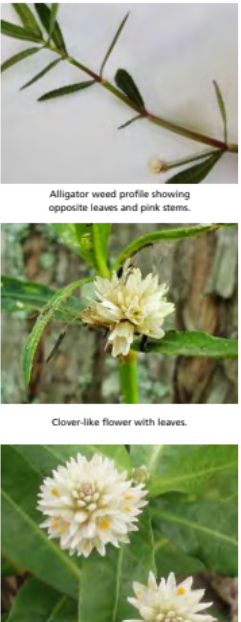
Alligator Weed (Alternanthera philoxeroides)
Non-native; originally from South America and first reported in Alabama in late 1800s
Form at the shoreline in thick mats
Elliptical to lanceolate (sword-shaped) opposite leaves
Stem is green to pink
Easily mistaken for water primrose; stems of alligator weed are hollow, while primrose stems are solid
Flowers are small, round, white, and similar in appearance to clover flowers
Petals are thin and the stem that a flower is on is 3-5 inches in length
Outcompetes most native species w/ similar growth form
reduce /eliminate shoreline access to anglers and wildlife
Forms floating islands that block sunlight
Spreads easily from plant fragments left during control efforts
Management Value
Highly invasive and not recommended for any application
Should be eradicated on first appearance
Class C noxious weed in Alabama
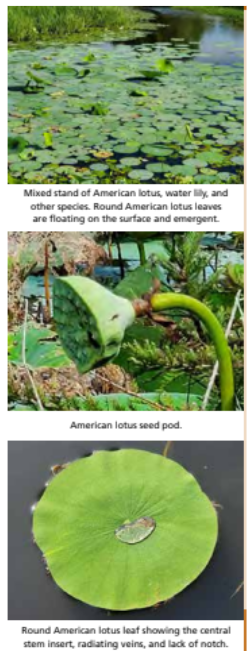
American Lotus (Nelumbo Lutea)
Found throughout Mississippi
Recognizable large, round leaves w/ central stem insertion
Large, yellow single flower, and unmistakable seed pod
Leaf stems extend to aquatic bottom where plant is rooted and has rhizomes that store nutrients
Leaves can reach diameters of 2.5 feet or more and may float on water surface
Umbrella pads are when some leaves emerge several feet above the water
Flowers can be as wide as 10 inches
Seed pod/receptacle is shaped like an inverted cone and contains acorn-like seeds in the center
Management Value
Native plant
Seeds are eaten by species of waterfowl and other wildlife
Rhizomes are eaten by beavers and muskrats
Leaves and stalks provide habitat for fish
Invades and takes over shallow ponds → not recommended for pond management
Native Americans were known to eat the starchy rhizomes, and young leaves can be cooked eaten like spinach, immature seeds can be eaten raw, seed pods are commonly used in floral arrangements
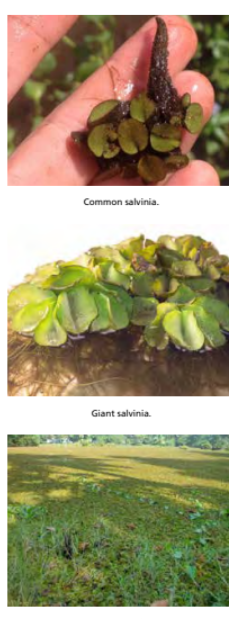
Salvinia (Salvinia spp)
Common salvinia (Salvinia minima) and giant salvinia (Salvinia molesta) are non-native invasive plant species
Salvinia are aquatic ferns that float on the water’s surface in calm areas
Common salvinia leaves are relatively small (¼ in to no more than 1 inch)
Giant salvinia leaves are twice as large
Leaves are hairy and may be flat, slightly bent, or heavily folded
“Roots” are modified leaves
Giant salvinia is one of the worst invasive plants worldwide
Can form mats up to 3 feet thick
Management Value
Eradicate on sight
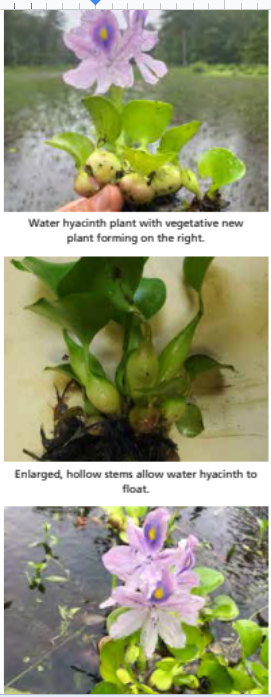
Water Hyacinth (Pontederia crassipes)
Non-native, highly invasive species from Brazil
Free-floating and rooted forms
Floating form is aggressive and can rapidly cover water in thick, heavy 3 feet tall mat
Recognizable by its leathery, spongy, spoon-like leaves that feature parallel striations (wrinkles or ridges)
Stems are spongy and buoyant (smaller plants = enlarged bulbous area)
Young colonies may be misidentified as frog’s-bit (however major veins are absent in water hyacinth leaves)
Roots are purple to black and feathery
During summer, showy, light-purple flowers w/ darker purple and yellow highlights
Can reproduce by seed but commonly uses vegetative reproduction
Stolons (runners) extend horizontally to form new plants → rapid reproduce
Management Value
Should never be introduced
Doesn’t provide wildlife or fishery benefits → eliminates nearly all light penetration → eradicate at first sight
Easily controlled in small ponds
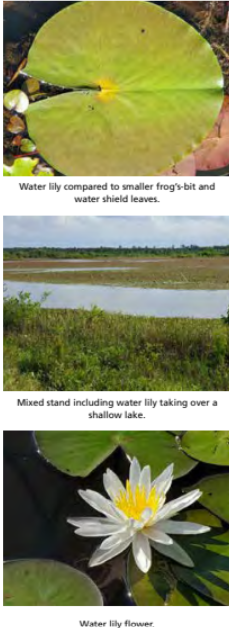
Water Lily (Nymphae spp)
Common calm-water plant added for aesthetics
Some species are native, while others are cultivars or introduced from elsewhere
Leaves are round to oval and have a deep notch where leaf stalk inserts
Leaves and stems are spongy, green on top and purple/red underneath
Plants grow from rhizomes on the lakebed
Flowers are very showy
Mainly white or yellow but can be other colors
Three common types:
Yellow flowers (N. mexicana)
Light purple and yellow flowers (N. elegans)
White and yellow flowers (N. odorata)
Management Value
Excellent habitat for fish and other aquatic animals in moderate densities
Flowers attract pollinators
Some mammals, turtles, and birds eat parts of the plant
Rhizomes can make medicine for gastrointestinal issues, sore throats, or dressings for burns
Flowers, seeds, and rhizomes are edible raw or cooked
Can take over shallow lakes → should be used for deeper ponds
Can first plant in large containers or on isolated shallow islands w/ spot treatment
name of sunfish family
Centrarchidae
name for catfish family
Ictaluridae
name of sturgeon
Acipenseridae