Chapter 5: Reference Point Placement, Multifocal Height, and Blank Size Determination
 Call Kai
 Learn
Learn Practice Test
 Spaced Repetition
 Match
Match Flashcards
 Knowt Play
1/124

There's no tags or description
Looks like no tags are added yet.
Name | Mastery | Learn | Test | Matching | Spaced | Call with Kai | Chat |
|---|
No analytics yet
Send a link to your students to track their progress
125 Terms
metal
With metal/plastic frames, it is best to adjust the nose pads to the correct angle and position before measuring is done.
plastic
With metal/plastic frames, you should evaluate the bridge size before measuring is done
small, large
If a plastic bridge is too high, it means that the frame is too small/large. If a plastic bridge is too low, it means that the frame is too small/large
optical center
Point in a lens that has no prescribed prism?
major reference point
point in a lens where the prism is equal to the prescription
OC, MRP
If there is not prism in the prescription, the ____ and _____ are at the same point in the lens
patient
Differentiating MRP, OC, and GC: MRP is a property of the _______.
lens
Differentiating MRP, OC, and GC: OC is a property of the _______.
frame
Differentiating MRP, OC, and GC: GC is a property of the _______.
Prentice's Rule
Equation to calculate the amount of prism experienced when the patient looks away from the OC of the lens
Prism Diopter = cF (c is in cm)
What is the formula for prentice's rule?
1.2 (0.6 x 2.00)
Example: If the lens power is +2.00D and the OC varies from the wearer's PD by 6 mm, what is the induced prism?
center, edge
When considering prentice's formula, the base direction of the prism for plus lenses is toward the edge/center of the lens and the base direction for minus lenses is toward the edge/center of the lens.
face form
Change to frame front that occurs to properly align the front and back surface to be perpendicular to the wearer's line of sight
no (should pass four point test)
If the wearer's PD equals the frame PD, is face form required?
positive face forming (frames bend to the temporal sides)
If the wearer's PD is less than the frame PD, how should the face forming be shaped?
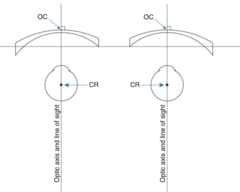
negative face forming (should NOT be done)
If the wearer's PD is more than the frame PD, how should the face forming be shaped?
no (will alter sphere and cyl value of the lens)
If the optical center is directly in the eye's line of sight, should pantoscopic tilt be included?
yes
If the optical center is below the eye's line of sight, should pantoscopic tilt be included?
1 mm for every 2 degrees of pantoscopic tilt
What is the general rule of thumb when adding pantoscopic tilt?
False
True or False: The OC should be dropped below the level of the horizontal midline of the frame.
bridge
Measuring MRP Height 1: Frames are adjusted to fit the wearer, giving attention to nose pads, frame height, pantoscopic tilt, and straightness of the frame on the face. Fitter positions himself or herself on the same level as the wearer and the wearer fixates on the _______ of the fitter's nose.
perpendicular
Measuring MRP Height 2: Frames are adjusted to fit the wearer, giving attention to nose pads, frame height, pantoscopic tilt, and straightness of the frame on the face. Fitter positions himself or herself on the same level as the wearer and the wearer fixations on the bridge of the fitter's nose. Fitter tilts wearer's chin back until frame front is __________ to the floor and marks location of pupil center.

pupil centers, inside bevel
Measuring MRP Height 3: Frames are adjusted to fit the wearer, giving attention to nose pads, frame height, pantoscopic tilt, and straightness of the frame on the face. Fitter positions himself or herself on the same level as the wearer and the wearer fixations on the bridge of the fitter's nose. Fitter tilts wearer's chin back until frame front is perpendicular to the floor and marks location of pupil center. The MRP is then measured from the ________ _________ and lowest portion of the ______ _______ of the lower eyewire to the line on the glazed lens

Higher
Higher/Lower index materials have a higher chance of having aberrations so it is especially important to measure monocular PDs and MRP properly.
true
True or False: The farther from the OC the eye looks, the more evident chromatic aberration may become
monocular, MRP
An aspheric lens typically has a central zone of contanst lens surface, but the power changes gradually. This is why __________ PD and _______ height measurements are important to obtain.
thinner, thicker
Raising the OC of a minus lens makes the top ________ and the bottom _________
thicker, increases
Raising the OC of a plus lens makes the top ________ and sometimes ___________ center thickness
False (higher index lenses like polycarbonate can run into bigger issues
Measuring MRP height is most important for lower index lenses like crown class and CR-39.
false (not acceptable unless the lenses are intended exclusively for near work
True or False: It is advisable to move an MRP height below the horizontal midline (datum line) of the classes
consider a frame that places the eye higher in the lens, reduce the pantoscopic tilt, do not lower the MRP by the full 2 for 1 amount
When pantoscopic tilt is especially large, what are the three advisable conditions?
vertex distance
the distance from the back surface of the spectacle lens to the apex of the cornea
13.5 mm
What is the average vertex refracting distance?
0.6
Each increase of 1 D of base curve increases the depth of the vertex distance by ______ mm
higher
Vertex distance becomes more of a concern in lower/higher powered lenses because a change in vertex distance induces a change in both spherical and cylindrical powers of the lenses
fitting cross
What is the reference point for a progressive addition lens called?
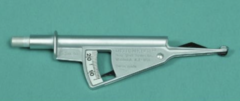
distometer
What is the following instrument?
fitting cross height
What is the reference point for a progressive addition lens?
monocular PDs, fitting cross height
What two measurements are needed for determining multifocal heights?
vertical
Progressive lens fitting cross height is measured like MRP height for SV lenses, but there is not ________ compensation made for pantoscopic tilt
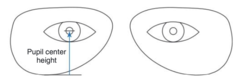
lower limbus, lower lid margin, subjective determination, fresnel press-on segments
What are the four methods of measuring bifocal height?
false (duh)
True or False: When measuring segment height, it does not need to be done at the height where the frame will actually be worn.
lower limbus
method of measuring bifocal height where the subject fixates on the bridge of the dispenser and the PD ruler is lined up to the lower limbus and measured to the lowest part of the eyewire
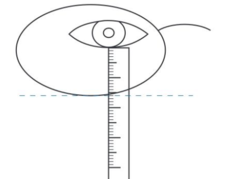
lower lid margin
method of measuring bifocal height where the subject fixates on the bridge of the dispenser and the PD ruler is lined up to the lower eyelid and measured to the lowest part of the eyewire. Not as accurate!
lower limbus (low eyelid gives a lot more variability)
When measuring bifocal height, which method is more accurate: lower limbus or lower eyelid?
subjective determination
method of measuring bifocal height where the measurer uses either a marking pen or transparent tape at the level of the suggested bifocal segment and the subject checks the proposed height using near material. The line is then measured to the lowest part of the eyewire. This is the most accurate method!

fresnel press-on segments
method of measuring bifocal height where press on BIF segments are added to a SV lens and the subject will judge the location of the BIF using near material
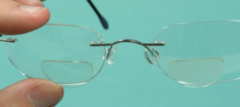
provide high amounts of prism in vision therapy, apply prism to a certain part of the lens, as temporary flat-top bifocal segments (should NOT be used long term!)
What are the uses of fresnel press-on segments?
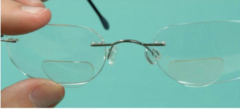
subjective determination
What is the most accurate method of measuring bifocal height?
intermediate
The techniques for measuring trifocals are identical to those for measuring bifocals, except the reference is the top of the near/intermediate section.

lower edge of pupil, subjective determination
What are the two methods of measuring the height of trifocals?
lower edge of pupil method
Method of measuring trifocals where the ruler is lined up with the lower edge of the pupil and the lowest portion of the eyewire. 1 mm is then subtracted for pupil clearance.

1 mm
If using the lower edge of pupil method to measure trifocal height, how much needs to be subtracted from the measurement to account for pupil clearance?
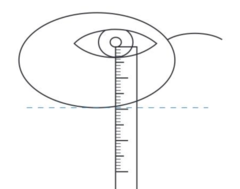
subjective determination
Method of measuring trifocals where a line is drawn represented the trifocal and the subject has to determine if the placement is adequate. (need to consider if frame is large enough to accommodate trifocal)
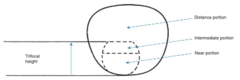
lower limbus, lower pupil
Bifocals measure from the ________ ________, whereas trifocals measure from the ___________ ___________
bifocals are always in the way (too high), neck is stiff (too low
What are two common complaints with bifocals in the improper position?
true
True or False: Bridge height, lens size, and lens shape influence the position of the seg height.
lower eyewire, lower lid
When measuring to match the segment height of a new bifocal lens, the subject should wear their old glasses. Note the seg line in relation to the lower lid and measure from seg line to the lower lid. The measure the distance from the ________ _________ to the ________ _____ and add/subtract to get the old seg line.

13, 14
When a double seg lens is ordered, the lower edge of the top segment is _____ to _____ mm above the lower seg line position.
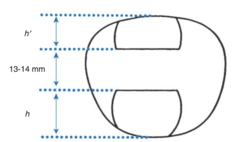
9 mm
What is a reasonable minimum area for an upper seg (in a double seg lens)?
true
True or False: When a vertical prism is prescribed, one eye is allowed to turn up slightly more than the other, meaning one eye will cross the seg line before the other.
0.3
When considering vertical prism and seg height, there is a ______ mm difference for every diopter of vertical prism prescribed.
lowered, 1 (image goes to apex so eye is going to look down, meaning you should decrease the seg height)
If a prescription included 3 BU PD in the right eye, the right seg height should be lowered/raised approximately ___ mm from its measured position.
always in the way, lower bifocal line
Posture plays a large role on segment height. An individual who walks tall may have what complaints about a bifocal line? How should you adjust?
can never get into the near portion, higher than usual
Posture plays a large role on segment height. An individual who walks hunched over may have what complaints about a bifocal line? How should the bifocal be placed
lower
Tall individuals need segments set slightly higher/lower than usually because their eyes must turn downward to a greater degree to see at the floor
false
True or False: Shorter individuals should be given a higher than normal seg height.
higher
Bifocals with round segments need to be positioned about 1 mm lower/higher than flat-top bifocals because the upper area is not wide enough to be useful
difficult to raise it significantly more without interfering with distance vision
Why do we only raise bifocals with round segments 1 mm higher? Why not raise them more?
blended bifocals
demarcation line is blended on the add power, but the blended area can cause distortion
1 mm (like visible round)
How much higher should you raise blended bifocals in comparison to standard?
should have straight top bifocal and the bifocal should be placed closer to the OC
What are the two requirements a bifocal lens should meet with someone who has a high Rx?
wide, flat top style
What type of bifocal seg is commonly used for children?
center of pupil
If a child is unable to understand the purpose of a bifocal, where should the flat-top bifocal line be placed?
at the standard place (like at lower limbus)
If a child is able to understand the purpose of a bifocal, where should the flat-top bifocal line be placed?
4, higher
If a progressive addition lens is used for children 7 years of age or younger, the fitting cross is placed ____ mm lower/higher than normal
decrease
If a wearer complains that the new bifocals are too high and always in the way, the lenses are likely sitting farther from the face, meaning you should increase/decrease vertex distance
pad arms
One solution to a bifocal always in the way is to decrease the vertex distance by adjusting what structure on the frame?
increase
One solution to a bifocal always in the way is to decrease/increase the pantoscopic angle of the frame.
center
When a person has anisometropia, unequal prism is induced when looking through any area of the lenses except the ___________.
turning head downward and keeping the lines of sight of both eyes close to the OCs of the spectacles (only induces a small amount of prism)
For individuals without anisometropia, they can look downward and inward without prismatic effect. How can an individual with anisometropia who doesn't wear eyeglasses prevent unwanted prismatic effects?
unwanted prismatic effects
For individuals without anisometropia, they can look downward and inward without prismatic effect. An individual with anisometropia tries to read at near, what can happen?
slab-off prism to counteract unequal prismatic effects
What can you do for an anisometropic patient who drops their head to read, meaning they are looking through the OCs to read?
nothing, would likely not need any prismatic compensation in the seg
What can you do for an anisometropic patient who drops their eyes to read, meaning they are looking through the bottom of the lenses?
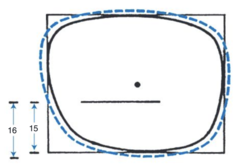
1, increases, 1
When the eye size is increased by 2 mm across the A dimension, there is effectively ___ mm of lens material being added to the outside edge in every direction, meaning the desired seg top position to the lower eyewire also decreases/increases by ___ mm.
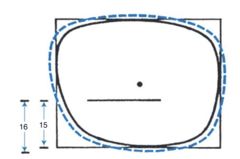
one-half
For an improper eye size, the seg height is corrected by ______-______ the difference between sample frame eye size and desired frame eye size (A size 2 mm too big, seg height raised 1 mm).
frame with incorrect eye size and correct bridge size
If you had to choose between a frame with a incorrect eye size and correct bridge size or a correct eye size and incorrect bridge size, what frame would you choose?
dropping, center, erect, lower
For a new bifocal wearer, they should be instructed that the floor is seen by dropping/raising the chin and the head, looking through the _______ of the lens. A book must be ready by holding the head ________ and dropping the eyes into the upper/lower portion of the lenses.
lens blank
a lens before it has been edged to fit into the frame may be finished or semifinished
finished lens blank
lens blank that has the correct powers called for in the prescription with both front and back surfaces finished and ready to sue
semifinished lens blank
lens blank that only has one side of the lens finished, usually the front side; the back side needs to be ground and polished to the correct power
equal
If the OC of the lens falls at the geometric or boxing center of the frame's lens shape, then a lens blank with a diameter ________ to the frame shape's ED is large enough to till the frame's lens opening
2, 1
If the lens is decentered with a lens blank, it is a rule of thumb that ___ mm must be added to the ED of the lens blank for every ____ mm that the lens is decentered.
total decentration = (A+DBL) - binocular PD
What is the formula for total decentration?
MBS = ED + total decentration + 2 mm
What is the formula for minimum blank size?
decentration per lens = (A+DBL)/2 - monocular PD
What is the formula for decentration per lens?
MBS = ED + 2 (decentration per lens) + 2
What is the formula for minimum blank size when considering decentration per lens?
larger
The larger the ED of the frame, the smaller/larger the lens blank required.
edge
As blank size increases for minus-powered lenses, so will ____ thickness