exercise 5- the cell: transport mechanisms and cell permeability
 Call Kai
 Learn
Learn Practice Test
 Spaced Repetition
 Match
Match Flashcards
 Knowt Play
1/20

There's no tags or description
Looks like no tags are added yet.
Name | Mastery | Learn | Test | Matching | Spaced | Call with Kai | Chat |
|---|
No analytics yet
Send a link to your students to track their progress
21 Terms
selective, or differential, permeability
valuable cell proteins and other substances are kept within the cell, and excreta or wastes pass to the exterior
passive processes
concentration or pressure differences drive the movement
active processes
the cell provides energy (ATP) to power the transport process
kinetic energy
Molecules possess kinetic energy and are in constant motion.
concentration gradient
is present when molecules are unevenly distributed, resulting in an area of higher concentration and an area of lower concentration.
Diffusion
is the movement of molecules from a region of their higher concentration to a region of their lower concentration.
simple diffusion
The unassisted diffusion of solutes (dissolved substances) through a selectively permeable membrane
facilitated diffusion
The substances move by a passive transport
process
osmosis
The flow of water across a selectively permeable membrane
isotonic solution
Cells retain their normal size and
shape in isotonic solutions (same
solute/water concentration as inside
cells; no net osmosis).
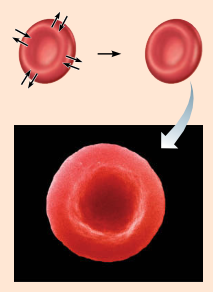
hypertonic
Cells lose water by osmosis and
shrink in a hypertonic solution
(contains a higher concentration
of nonpenetrating solutes than
are present inside the cells).
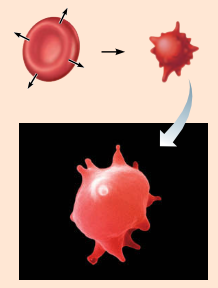
hypotonic solution
Cells take on water by osmosis
until they become bloated and burst
(lyse) in a hypotonic solution
(contains a lower concentration
of nonpenetrating solutes
than are present in cells).
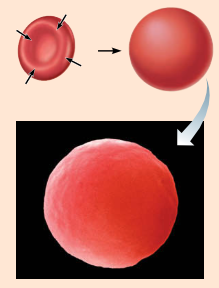
active transport
requires carrier proteins that combine specifically with the transported substance. Active transport may be primary, driven directly by hydrolysis of ATP, or secondary, driven indirectly by energy stored in ionic gradients.
vesicular transport
fluids containing large particles and macromolecules are transported across cellular membranes inside membranous sacs called vesicles.
endocytosis
vesicular transport moves substances into the cell
exocytosis
vesicular transport moves substances out the cell
three types of endocytosis
phagocytosis, pinocytosis, and receptor-mediated endocytosis
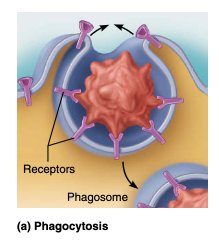
phagocytosis
(“cell eating”), the cell engulfs some relatively large or solid material such as a clump of bacteria, cell debris, or inanimate particles
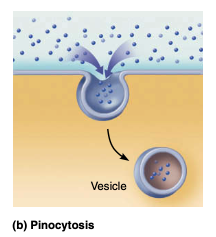
pinocytosis
(“cell drinking”), also called fluid-phase endocytosis, the cell “gulps” a drop of extracellular fluid containing dissolved molecules
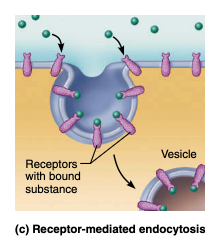
receptor-mediated endocytosis
The main mechanism for specific endocytosis of most macromolecules is receptor-mediated endocytosis.
The receptors for this process are plasma membrane proteins that bind only certain substances.
This exquisitely selective mechanism allows cells to concentrate material that is present only in small amounts in the extracellular fluid.
secretory vesicle
The substance to be removed from the cell is first enclosed in a protein-coated vesicle